Then he sat across from her and slid the newspaper across the table, opened the notebook beside it, and said in his quiet careful way: Miss Ruthie, I think something bad is happening to a rich lady and I don’t know who to tell. Miss Ruthie looked at the newspaper. Then she looked at the drawing. She did not say he was imagining things.
She picked up the drawing and held it close to her face, then far away, then close again. She traced the comma-shaped scar with the tip of her finger. She looked at the newspaper photograph for a long time. Then she said very softly: Baby, where did you see this woman?
Daniel told her. The bench, the handkerchief, the whispered word, the date written at the bottom of the drawing. September 23rd. Miss Ruthie set the drawing down.
She folded her hands on the table. Then she said something Daniel would remember for the rest of his life. She said: Daniel, Katherine Whitfield went into a private clinic in Switzerland on September 15th. She wasn’t supposed to come home until November 1st.
She didn’t fly back through Charleston. She flew into New York. Miss Ruthie was a soup kitchen cook with arthritic knees, but Charleston is the kind of city where every story eventually finds its way to the kitchens. Her niece worked as a housekeeper at the Whitfield estate.
Her niece had packed Katherine’s suitcases for Switzerland. And her niece had mentioned over cornbread that something at the big house was off. The staff had been told the Mrs. was returning early.
Flowers in the master bedroom had been changed to white lilies, which Catherine had always hated. A new personal assistant named Vivien did all the correspondence, answered the phone, turned visitors away with a polite firmness Catherine had never possessed. Miss Ruthie told Daniel all of this in the quiet voice she used when the kitchen was empty and the lights were low. She told him because she had decided this was no longer a child’s strange story.
This was something else. She said: We find out who that woman in your drawing is. Because if Katherine Whitfield is not in that big house on Trad Street, then she is somewhere else. And somewhere else is a place we need to find.
Daniel slept that night on the floor of the church basement under a folded blanket, the notebook tucked under his head like a pillow. He dreamed of the woman on the bench, crying inside a small white room with no windows and a door that did not have a handle on the inside. She looked up at him and mouthed the same word: Please. In the morning, Miss Ruthie made phone calls.
She called her niece, who said the Mrs. did not come downstairs anymore, took all meals in her room, had developed a sensitivity to noise and light. She called a woman who worked nights at a private clinic on James Island, asked whether anyone matching Katherine Whitfield’s description had been admitted in the last six weeks. The woman said she could not say.
Her tone said everything. Miss Ruthie hung up the phone. She turned to Daniel. Baby, she said, I think Katherine Whitfield is alive and I think somebody has put her somewhere she cannot leave.
And I think your Mr. Whitfield doesn’t know it. Marcus Whitfield was 46 years old, worth north of two billion dollars. He had married Catherine Ashford, a quiet woman whose family had been in Charleston since the city had a name.
The marriage had surprised everyone. But he loved her. And then in late August, Catherine started to seem tired, then more than tired. Headaches, trouble sleeping, weight loss.
A specialist suggested rest, a quiet European clinic. Marcus wanted to go with her. Catherine insisted he stay and run the company. She wanted to be alone, to not be Mrs.
Whitfield for a little while. He let her go. He put her on the plane himself on the morning of September 15th. He kissed her forehead and watched the jet climb into a clear blue sky.
He worked 16-hour days for six weeks. Then on October 28th, four days early, the plane came back. Catherine walked off it onto the tarmac at Charleston Executive Airport. Marcus was waiting beside the car with a bouquet of white lilies because the florist’s new girl had misheard him.
Catherine smiled and said they were lovely. He did not notice she hated lilies. He did not notice because he was holding her and her perfume was the same and her voice was the same and her laugh was almost the same. Almost.
There had been a beat too long before she laughed. But he reached for the explanation any man in love would reach for: she was tired, the flight was long. She was not herself in the morning. She was not herself in the week that followed.
The not-herself was so small, so subtle: she did not want to go riding, did not want to play the piano, did not laugh at the old private jokes. She laughed at new things instead. He told himself she was changing. He told himself the retreat had done what retreats were supposed to do.
He told himself he was being a fool to want her to be exactly the woman she had been. He was telling himself all of this on the morning of November 2nd, sitting at the breakfast table, watching the woman who was not his wife pour herself a cup of coffee with her left hand. Catherine was right-handed. He noticed.
And then very deliberately he stopped noticing. Marcus Whitfield practiced denial the same way he practiced everything else: with discipline. He had been practicing for nine days. The annual Whitfield Foundation gala was scheduled for the evening of November 6th at the Magnolia Grand Hotel.
300 guests, a live orchestra, press from three states. Catherine had chaired the gala for two years running. The real Catherine had visited the Low Country Children’s Shelter once a month for the last 18 months and knew the children there by name. The woman pouring coffee with her left hand did not know any of the children.
She did not know the menu, did not know the orchestra had been booked because the first violinist had played at Catherine’s grandmother’s funeral. But she had a binder, a thick black binder her assistant Vivien carried everywhere, containing everything she needed to be Catherine Whitfield in public for one evening. Daniel and Miss Ruthie did not know about the binder. What they knew was that the gala was four days away and that the woman in the newspaper was going to stand on a stage in front of 300 people and pretend to be a woman Daniel had drawn weeping on a park bench.
Miss Ruthie made a decision. She told Daniel he would stay at the church, eat three meals a day, sleep on the cot, and not go anywhere alone. Then she went upstairs and called a man named Wendell Pierce. He was 81 years old, an attorney who had once tried a case against the Whitfield family and lost.
He spent the afternoon pulling up public filings. He found a power of attorney, limited but durable, granting authority over Catherine Whitfield’s personal finances and medical decisions to one Vivien Marchetti, executive assistant, in the event Mrs. Whitfield was incapacitated. The document was dated September 12th, three days before Catherine boarded the plane.
The signature was close to Catherine’s real signature, but the loop of the C was wrong. Wendell Pierce had spent 40 years looking at forged signatures. He called a private investigator named Delphine Budro. Within hours, she had established that no aircraft registered under Catherine’s name had landed at Charleston Executive on October 28th.
The plane that landed that day had originated in Miami, not Zurich, and had no record of any international leg. Catherine had entered Europe and had not left it. The Swiss clinic where she was supposed to have been treated had no patient by that name. The reservation had been cancelled on September 14th by a phone call from a prepaid mobile purchased in Charleston.
By the evening of November 3rd, Delphine had more: Catherine had never reached Switzerland. The plane took her to a private airstrip outside Lyon, France, where a car met her. The car was registered to a shell company whose directors included Vivien Marchetti. And Vivien Marchetti was not her real name.
Her real name was Vivien Whitfield. She was Marcus Whitfield’s half-sister, written out of the inheritance 41 years ago when she was seven. She had spent her adult life waiting for the right moment to take it back. Wendell Pierce did not sleep that night.
He understood: at the gala, in front of 300 witnesses and cameras, the false Catherine would announce a restructuring that would move a significant portion of Catherine’s personal estate into a vehicle controlled by Vivien. The legal challenge would take years. By the time anyone unwound it, the real Catherine would be gone. He could go to the police.
They would require evidence. He had a child’s drawing and a private investigator’s report built on sources that would not survive a deposition. The Whitfield name was not one the police moved against on the strength of a drawing. He could go to Marcus directly.
Marcus had not spoken to him in 30 years. Wendell did not know whether the man would listen. He decided there was only one move that would work. And it depended on a child.
He called Miss Ruthie. He told her what he needed. She said: He is 11 years old. You want to put him in a ballroom and ask him to tell the truth out loud to the richest man in this city.
Wendell said he wanted to give the boy the choice. He drove to the church. Daniel was awake, eating eggs, the notebook open beside his plate. Wendell sat down.
He explained in language a child could understand what he believed was happening. He explained what he believed was going to happen on Friday night. Then he asked: Son, do you want to help her? Daniel set down his fork.
Yes, sir. There were two days. The plan was simple. The Low Country Children’s Shelter had a tradition: at the climax of the gala, six children from the shelter would be brought onstage to receive framed photographs from Catherine.
The children were the one category of person whose presence would not be questioned. Daniel would arrive with the other children at 6:00 in a clean shirt and dress shoes Miss Ruthie bought at a thrift store for $11. He would sit at the children’s table. When the children went up, he would go with them.
And when the false Catherine leaned down to hand him his photograph, he would say the words out loud. Wendell knew the words alone would not land unless Marcus was ready to hear them. So on Thursday afternoon, he drove to the Whitfield offices. He gave his name.
He waited. To his astonishment, Marcus Whitfield himself stepped out of the elevator and said: My father is dead. Whatever you came here to say to him, you can say to me. Wendell laid Daniel’s drawing on the table.
He laid the newspaper photograph next to it. He laid the power of attorney, the flight records, the cancelled clinic reservation, and a single sheet with Vivien’s real name. Marcus read slowly. He read each document twice.
When he reached the last sheet, he set it down very carefully. He placed both hands flat on the table. He closed his eyes. When he opened them, he said: Where is my wife?
We don’t know yet. We believe she is alive. We believe she is being held somewhere in southern France. The woman in your house is a hired actress.
The purpose of the gala is to let her announce a restructuring that will move Catherine’s estate into your half-sister’s control. Marcus was quiet for a long time. He looked at the drawing with the comma-shaped scar, the thin ring on the right hand, the mole at the base of the throat. He had kissed that mole.
He had not kissed it in nine days. He said: The coffee cup. She pours coffee with her left hand. Catherine is right-handed.
He looked up. He said: Tomorrow night I will be on that stage with her. I will give no indication that anything is wrong. I will smile.
I will let her make her announcement. And when the boy walks up, I will listen. 26 hours remained. The Magnolia Grand Hotel on the evening of November 6th was lit from within like a lantern.
At 6:00, a small white van from the shelter pulled up to the service entrance. Six children climbed out. The sixth was a quiet boy in a clean white shirt and black dress shoes with a notebook tucked into the inside pocket of a borrowed blazer. Miss Ruthie knelt down in the service corridor.
She straightened his collar. She said: Baby, you remember who you are. He nodded. She kissed the top of his head.
Then Anita Coleman, the shelter director, took his hand and walked him into the ballroom. Marcus Whitfield stood on the stage at 9:12 with the woman who was not his wife on his arm. He smiled. He thanked the donors.
He did not look at Wendell Pierce near the back wall. The false Catherine spoke for four minutes. She was good. She announced the restructuring, named Vivien Marchetti as the new executive director.
The room applauded. And then the children came up. They came up in a line. The false Catherine smiled, bent down to the first child, handed her a framed photograph, said a sentence.
She did the same for the second, third, fourth, fifth. Then the sixth child stepped forward. She reached for his photograph. He did not take it.
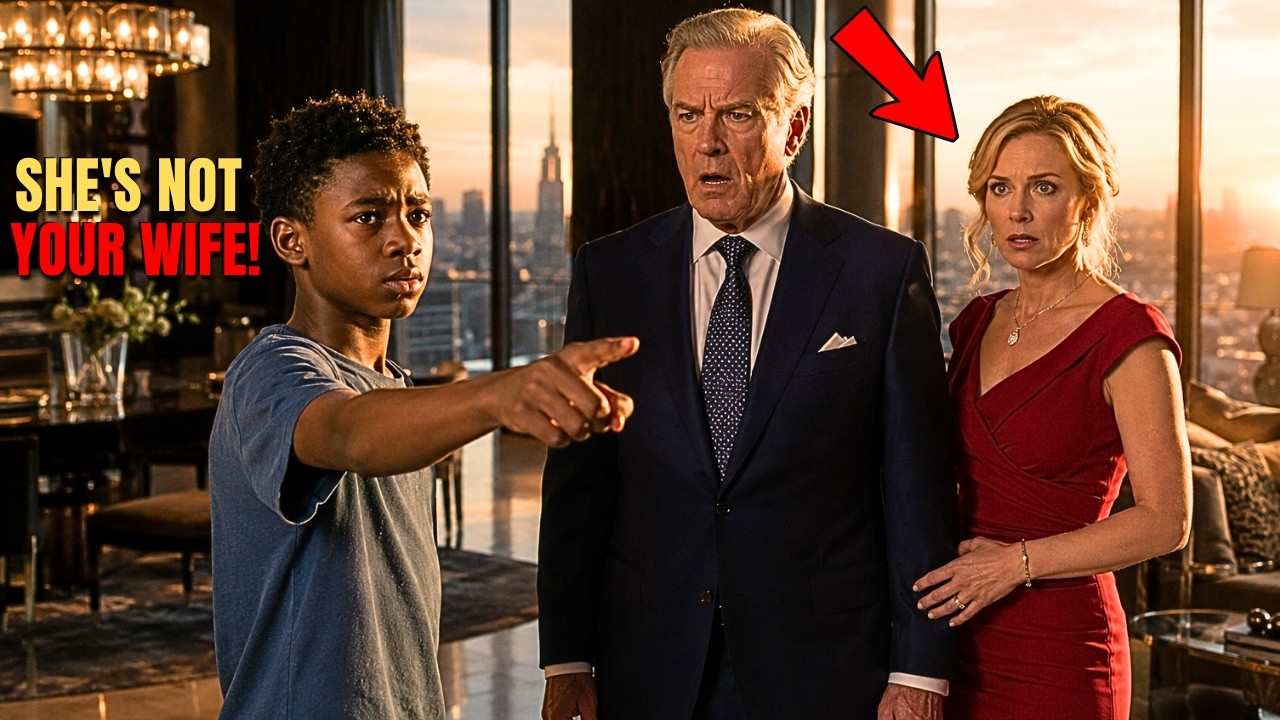
He reached past her and tugged very gently on the sleeve of the man standing beside her. The ballroom did not understand yet. The boy looked up at Marcus Whitfield and said it: She’s not your wife, sir. I don’t know who she is, but she’s not.
The silence that followed was the silence we began with. 300 people did not yet understand what they had just heard, but they understood with the animal certainty of a crowd that something had just happened that could not be unsaid. Marcus Whitfield looked down at the boy. He looked at the woman beside him.
He took the small piece of paper Daniel held up to him, the page from the notebook with the drawing of a woman weeping on a bench in White Point Garden on the afternoon of September 23rd. He looked at the comma-shaped scar. He turned to the woman beside him and in the quietest voice the ballroom had ever heard, he said: Where is my wife? She did not answer.
But at table one, Vivien Marchetti stood up. Catherine Whitfield was found 11 days later in a private residence outside Aix-en-Provence. She was thin, tired, alive. She came home on the 18th of November, and Marcus met the plane on the tarmac with no flowers at all because he had finally remembered that she had never wanted flowers, only him.
Daniel did not go back to the street. Miss Ruthie did not allow it. As it turned out, neither did Catherine.
But that part of the story is for another night.