You gave up your bed for us for 18 years. Let us give you a home. Family don’t disappear for two decades and then show up with a key and a court order. Take your key and go.
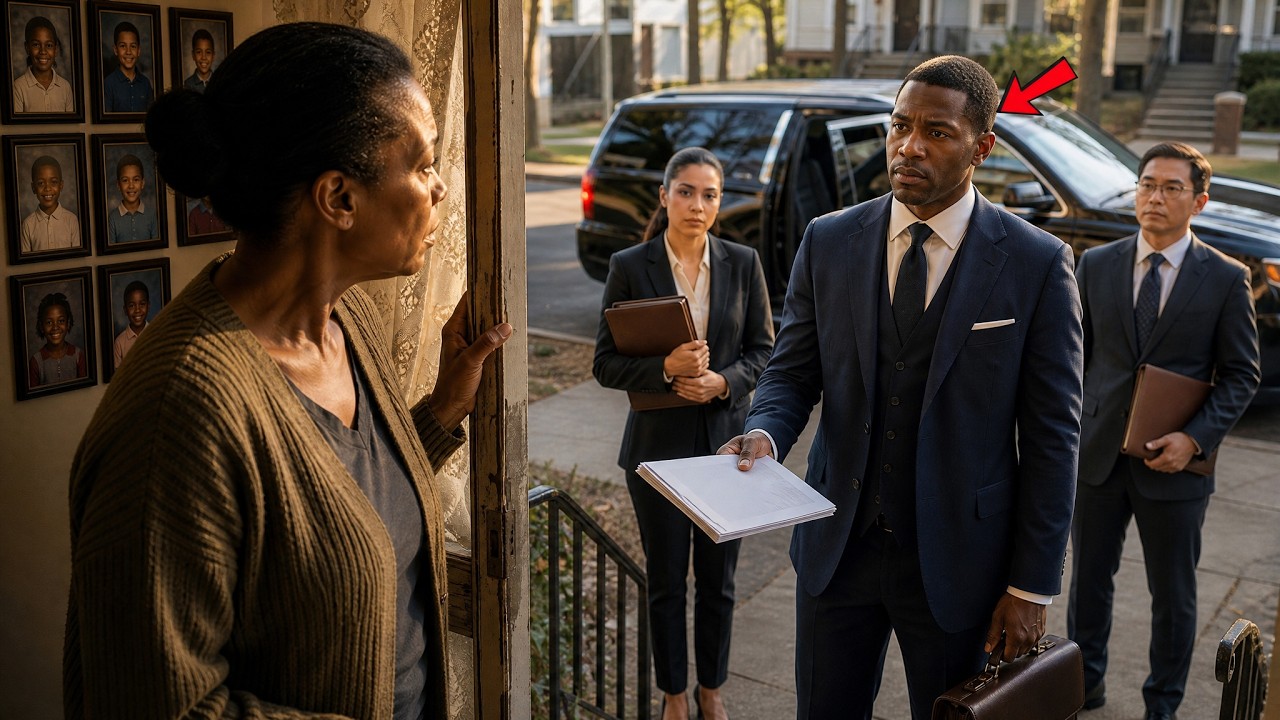
I don’t need your pity or your money. Steven didn’t move. The brass key remained on the table. The only thing shining in the dim room.
Shirley turned her back to him. Her hands shook at her sides. Outside, a minivan pulled up behind the SUV. A car door slammed.
Miss Johnson, it’s Maya. I drove all night when Steven told me you had the order. Two more doors opened. Isaiah and Precious stepped into the daylight, both holding flowers.
Shirley barely opened the screen door before Maya wrapped her in an embrace. The hallway filled with the sound of weeping. We couldn’t let Steven do this alone. You raised us together.
We needed to be here together. You gave me my first real coat. I never forgot that morning. I had to come say thank you.
You shouldn’t have come all this way. I told Steven I need time. The old living room was suddenly full of voices, of flowers, of adults she once tucked into bed. But her arms stayed crossed.
Maya sat down on the old couch beside Shirley and took her hand the way she used to when she was 12. You sold your television to buy my prom dress. I never told you I figured it out years later. She knew.
All that time she knew. Isaiah stepped forward holding a bundle of crayon drawings, the paper yellowed and soft at the edges. You sat up with me every night I had nightmares. I still remember the sound of your voice.
You filled out my first job application with me. You never made me feel like I was a burden. They’re giving me the title I was too scared to take. None of us made it out of Newark by accident.
Miss Johnson, you put us on the path. Shirley pressed her fingers to her mouth, tears slipping past her glasses. But she still shook her head. The key still lay on the table, untouched.
Steven wiped his eyes and drew a slow breath. We filed the adoption because we were scared. Your health, it’s not good, Miss Johnson. We found out.
If something happened, legally none of us could visit you. Couldn’t make a single decision. You would be alone. They’ve been tracking my health all this time.
You never let us be alone. How could we let you face old age that way? Shirley’s hand covered her mouth. The court order, the house, it all snapped into focus.
They were trying to make sure they could legally hold on to her. We needed to be your next of kin so the system couldn’t shut us out when you needed us most. They needed this not for her sake. For theirs.
The brass key still lay on the table, but its meaning had changed. Shirley set down the photograph and looked at the eight frames on the wall. For the first time, she understood. I was terrified.
Every time one of you walked out that door, I thought I’d never see you again. So I never let myself be your mother. Not on paper. The room held its breath.
The secret she’d guarded for 30 years finally broke the surface. I thought if I didn’t adopt, I could survive when you left. I was wrong about all of it. You were already our mother.
We just needed the paper to catch up. He called me mother. Not foster mother. We never stopped being your kids.
Not once. Not even when we were miles away and too proud to call. Shirley lowered her hands and looked at them. Adults she raised, standing in her living room, waiting for her to finally let them in.
I am sorry I pushed you away. I didn’t know how to let you be my family. Then let us in now. That’s all we’ve ever wanted.
Shirley looked at the brass key on the table. Then back at their faces. The wall she’d built for 30 years had cracked open. The next morning, before the sun was up, Shirley pulled on her old coat and picked up the brass key.
She didn’t wake anyone. She walked down the sidewalk of the block she’d known for 40 years. Two houses stood side by side. One weathered, one fresh.
At the new front door she paused, key in hand. Then she turned the lock. The living room was empty and quiet. Morning light falling on a deep burgundy couch.
Her old couch reupholstered and restored. She walked toward it, fingers outstretched, touching the fabric where she’d slept for 18 years. It was soft now. Rich.
Made new. A note rested on the cushion, written in Steven’s hand: Mom, we slept in beds for 18 years because you gave up yours. It’s your turn now. They gave me my couch back.
She sank onto the cushions, the note still in her hand, and let the tears come. Not from sadness. From the release of a weight she’d carried for 30 years. I’m home.
By the time they arrived, Shirley had already wrapped the eight framed school photos in newspaper, one by one. Tell us where to start. The kitchen cupboards. All those old pots and pans.
For the first time, she let them lift the heavy boxes while she only pointed and remembered. Steven and Isaiah carried the old floral couch to the curb. The same couch where she’d slept for 18 years. By late afternoon the house was hollow.
Only the faint outlines of eight frames on the hallway wall remained. Shirley pulled the screen door shut for the last time. She did not look back. In the new living room, boxes sat untouched, but the reupholstered couch already bore the weight of her children’s laughter.
The siblings left with hugs and promises to return Sunday. The new locks clicked shut. Shirley stood in the quiet. She opened the refrigerator.
It was full. Milk, greens, a covered dish with a note: Eat, Mama. She lifted the eight wrapped school photos and carried them to the hallway. One by one she hung them in their old order.
Then she took the last frame—the adoption certificate—and centered it. She pressed the thumbtack into place. There. Nine frames.
I am someone’s mother now. On paper and in here. She walked to the reupholstered couch and sat, spreading her fingers over the fabric. No blanket needed tonight.
From where she sat, she could see the eight faces and the one court seal. It looked like a family tree. I never thought I’d have this. Her eyes closed.
A faint smile settled. The next morning Shirley sat on the reupholstered couch and picked up the phone. She called Maya first. Maya, I’ve never said this to you before.
I am proud of you, sweetheart. My daughter. She called Isaiah. She called Precious.
Each time the words she’d locked away for decades finally found air. By afternoon Steven knocked. When she opened the door, he saw the nine frames on the wall behind her and nodded. We’ve worked out a rotation.
Every Sunday, at least four of us will be at your table. That’s the minimum. Four of you every week? That’s too much trouble.
It’s not trouble. It’s family. You fed us for years. Now let us feed you.
Shirley looked at him. Then at the wall of faces. A smile broke through. For the first time, she didn’t protest.
Sunday arrived with the scent of collard greens and fried chicken. Shirley cooked, but the kitchen held too many hands. I told you all to let me feed you, not take over my stove. We brought the dishes.
You just sit at the head of the table where you belong. They crowded around. Steven, Maya, Isaiah, Precious, and three more whose laughter filled the decades-old silence. Plates passed.
Stories bounced. Isaiah still folded his napkin the way she taught him 30 years ago. I’ve been folding napkins like this since I was 10. You’d be proud.
I always was. Shirley glanced past the table to the hallway. Nine frames in order. Eight faces and one court seal.
My children. All eight of them. Someone raised a glass. Laughter spilled into the afternoon sun.
Shirley set down her glass and motioned toward the living room. Come here. I need to show you something. She walked to the burgundy couch.
She sat down on the cushion, and they slowly settled around her. Some on the couch, some on the floor at her feet. I slept on this couch for 18 years. Every single night.
So each of you could have a bed. I never knew that. I mean, I saw you here every morning, but I didn’t realize. That was the point.
I never wanted you to know what I gave up. I just wanted you to have what you needed. She pointed toward the hallway where the nine frames caught the light. That piece of paper tells the court I am your mother.
But this couch—it told me I was a mother long before any judge signed. No one spoke. Maya leaned her head on Shirley’s shoulder. The silence held everything they’d ever needed to say.
Later the kitchen came alive with clattering dishes. Shirley tried to grab a plate, but Maya took it from her hands. I am not too old to dry a dish. Maya, next Sunday Precious is bringing her peach pie.
And Isaiah wants to teach you chess. Chess? The boy who couldn’t sit still for 5 minutes. I’ve had 30 years to practice, Ma.
One by one they packed leftovers and hugged goodbye. The house grew quieter with each departing car. Only Steven lingered at the door. Shirley caught his eye and motioned him back inside.
You gave me eight lawyers when I just needed one son to come home. You gave us a mother when we needed one. I just brought the paperwork. She pulled him into a tight embrace.
Outside, street lamps flickered on over the block where everything had changed. The lock clicked. The house fell silent. Shirley walked to the hallway where the nine frames waited.
She touched the first photo—a boy with a shy smile. Steven came to me crying. Wouldn’t speak for a week. She moved to the next face—a girl with braids, so silent she’d forgotten her own voice.
Maya only watched me cook. Months passed before she made a sound. Then a boy with glasses—Isaiah, who had torn through the house like a summer storm. Couldn’t keep him in a chair.
Now he wants to teach me chess. She took a step back. Eight faces and one court order arranged like a family tree. Looks like you all came back after all.
A soft smile crossed her face. She crossed to the burgundy couch and lifted the knitted blanket from the armrest. She lay down and pulled the blanket over her. The cushions soft beneath her.
Not because there are no beds anymore. Because this couch is mine now. In the hallway, the nine frames caught the low light. Her breathing slowed.
The lines on her face—drawn from decades of worry—finally relaxed. They’re coming back Sunday. All of them. The hallway wall kept its vigil.
The adoption certificate an answer at last. For the first time since 1996, Shirley Johnson slept. Not out of sacrifice.
Out of peace.