I’ve never run anything bigger than a mop bucket. ”
The will, sixteen pages of tight legal script, contained her name fourteen times. Any challenge would fail. The relatives gathered their coats and left, heels clicking on marble.
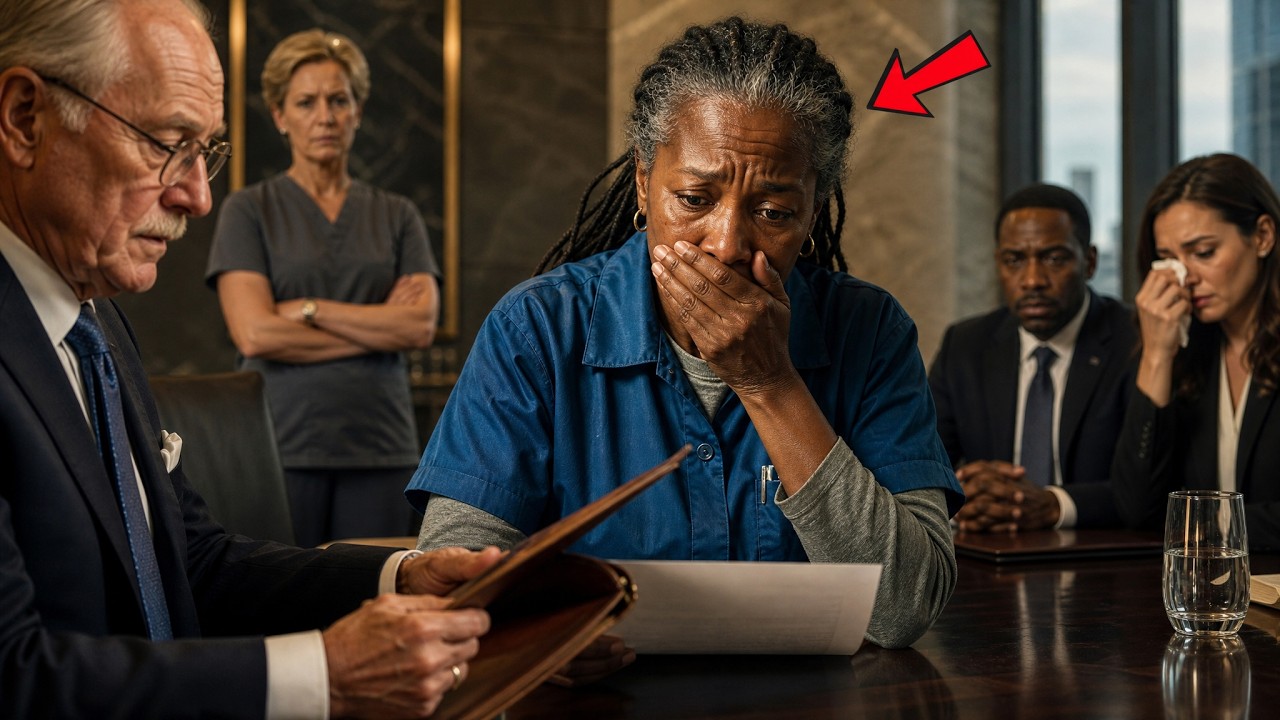
“They’re gone and I am still here. ”
“This doesn’t have to be decided today. But the foundation’s doors open the moment you are ready. ”
“Ready for what?
To spend someone else’s millions on strangers because I held a hand? ”
Dorothy stepped out of the law firm into the cold Boston dusk. The papers in her hand felt heavier than any mop. By ten that night, she was back in her blue smock, pushing the cart down the ICU hallway.
“Macklin, you left a room unsanitized last shift. What’s wrong with you tonight? ”
“Nothing. I’ll fix it.
”
“You’ve been distracted for weeks. If you can’t handle the workload, tell me now. ”
Tell her that a dead billionaire handed me $40 million? She’d think I lost my mind.
“You are right. I can’t handle it. Not anymore. ”
She unpinned the name tag that had hung on her chest for fourteen years and placed it in Randall’s palm.
“You can’t be serious. You have nothing else. ”
“I have something. And it started in room 412.
”
The next morning, Dorothy walked into Mr. Crane’s office for the first foundation meeting. Her blazer was new, but her hands still smelled of bleach. A banker slid a document across the table.
“Someone with financial expertise should advise you. ” He didn’t meet her eyes. By the end of the first week, three law firms, two banks, and one investment manager had questioned her education. The hospital board was worse.
Six people in suits looked at her as if she still wore a smock. “Miss Macklin, we appreciate the gesture, but this hospital has protocols. We can’t just hand a room over to someone with your background. ”
“My background.
He means the color of my collar. ”
“Then the door is that way. I know how to mop. But I also know what room 412 meant to a dying man.
Do any of you? ”
She walked out of the board room, her heels loud on the polished floor. Her hand shook, but her back was straight. “He didn’t leave me that money to ask permission.
He left it so I’d act. ”
That night, Dorothy drove to a cemetery on the edge of the city. She found his name under a sycamore tree. “I am nothing, William.
A woman who scrubbed floors can’t run your foundation. ”
But you kept coming back every winter, didn’t you? No board gave you permission to grieve. “You didn’t pay them to ask.
He just sat there. I can do that. One room, one sitter, one patient. ”
She stood up, her knees stained with dirt.
“I don’t need a board room. I need a chair, a lamp, and someone to hold a hand. ”
By morning, she had leased a small office and begun hiring the first companion sitter. Three days later, Dorothy hired a young woman with quiet hands and no fear of stillness.
“Your job isn’t to cure. It’s to companion. Read aloud, hold a hand, be a witness. ”
Within a week, that sitter sat beside a dying woman in a hospice room, fingers entwined.
No television. No phone. Just breath. A handwritten card arrived: “My sister died that night.
You held her hand. I will never forget what you gave us. ”
A local reporter caught wind. The headline read: “Ex-janitor’s foundation fills final loneliness.
”
The hospital board room grew quiet. “They said I couldn’t do it. Now they’re reading about me over their morning coffee. ”
The hospital’s PR officer called, asking for a meeting.
Dorothy’s hand tightened on the phone. “I am not coming to another board meeting. If the hospital wants to talk about a companion room, they can come here. ”
Three months later, Dorothy walked into the same hospital board room.
She didn’t pause at the door this time. Her heels echoed with purpose. The board chair spoke first, his tone warmer than before. “We’ve seen the press, Ms.
Macklin. We’d like to partner. ”
“Partner? I’m not looking for a partner.
I want room 412 designated exclusively for companion sitters under the foundation’s full control. ”
A board member objected that the hospital had other needs. Dorothy didn’t blink. “This is non-negotiable.
The money is mine to direct, and the directive is clear. Companion sitters. Room 412 is where it starts. ”
The board chair exchanged a glance with the others.
A long silence stretched. Then he nodded. “Room 412 will be renovated and rededicated to your program. You’ll have full operational independence.
”
They shook hands. For the first time, Dorothy left the board room not as a janitor, but as a director. “He wanted a room for his son. I am going to make sure it’s never empty again.
”
Three years later, room 412 bore no trace of its old silence. Soft lamp glow, shelves of books, a plaque on the door. The plaque read: “The companion sitter room in memory of William Jameson and his son Thomas. ”
Dorothy stood in the doorway, a pair of scissors in hand.
The ribbon across the threshold was as stark as a fresh start. “This room held a father’s grief for fifty years. Now it holds the promise that no one dies alone. ”
The ribbon split.
The door swung inward. Inside, a young companion sitter already sat beside the bed, cradling the hand of an elderly man with no visitors. The sitter was reading aloud from a worn paperback. “The tide always comes back in.
”
“He heard those words once. Now someone else will hear them at the end. ”
The crowd had gone. The ribbon fragments had been swept away.
Dorothy remained alone in room 412. The silence no longer hollow. From her bag, she pulled out the same worn paperback she had read aloud on his final nights. The cover was curled, the spine cracked.
“You listened. ”
She placed the book on the sitter’s chair. It rested on the cushion like a promise that would outlast her. A single tear traced her cheek and fell onto the page, blurring a line about the sea.
She turned to the window. The Boston skyline was settling into dusk, a soft orange glow stretching over the buildings. “Good night, William. Thomas.
”
She walked out, leaving the book on the chair for the next sitter, the next hand to hold, the next silence to break.