He stopped in front of her, chest heaving, face flushed from the cold and the exertion. His eyes were brown and very bright. “Please don’t sell our house,” he said between breaths. “My dad promised my mom we’d stay here.
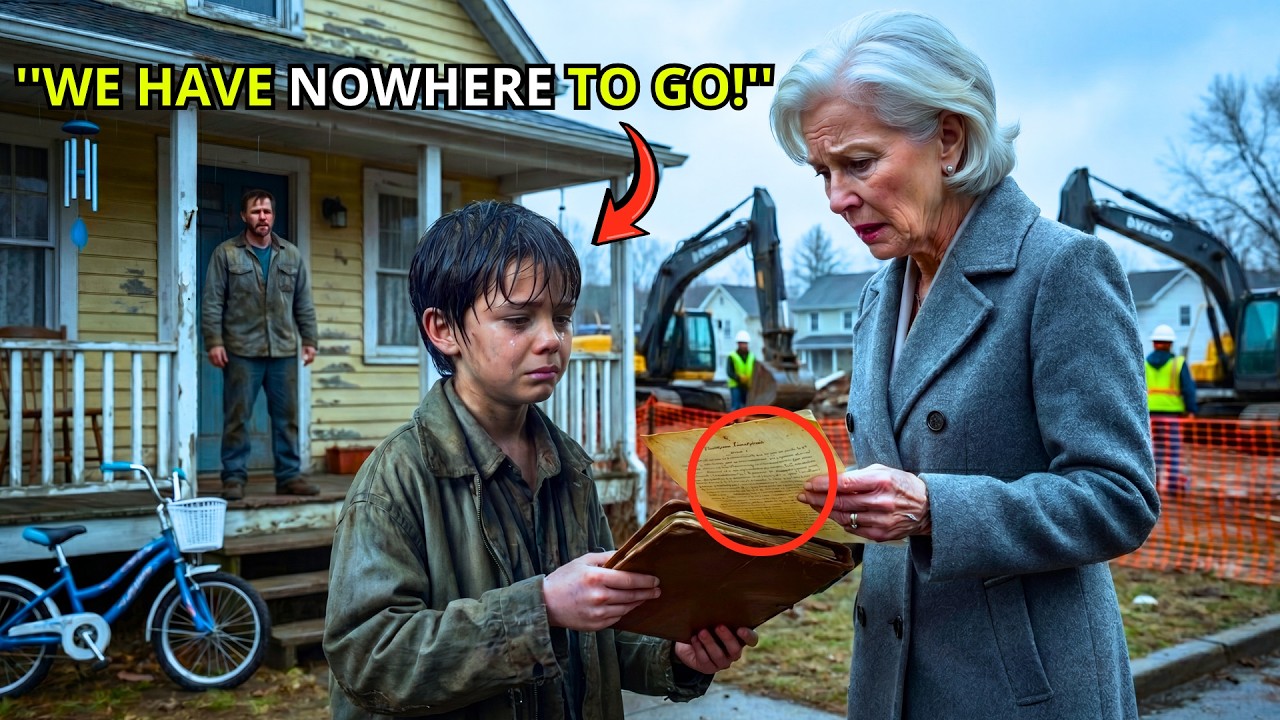
”
She looked at him. At the folder pressed against his chest. “What’s your name? ”
“Ethan.
Ethan Carter. ”
“What are you holding, Ethan? ”
He held it out to her with both hands. “I found it in the attic this morning before school.
There’s a name in it. I think you should probably read it before anything happens. ”
Eleanor took the folder. The leather was dry and cracked.
She undid the brass clasp. Inside were papers, photographs, a letter folded into thirds. And at the back, separated by a piece of stiff card, a document on heavy paper with a notary’s embossed seal. She read the first paragraph.
Then the second. Then she stopped and read the first paragraph again. Her grandfather’s signature was at the bottom. She would have recognized it anywhere.
The confident down stroke of the capital H, the flourish at the end of Whitmore. The signature at the other end of the document belonged to a man named Robert Carter. She looked up. Across the cleared ground, Daniel Carter stood on his porch, watching with an expression between bewilderment and hope.
She read the document from the beginning, carefully. It took her five minutes. It was dated fifty-three years ago, in the August of the year Eleanor turned eleven. The year her grandfather had taken her to break ground on his first building in South Baltimore.
She had not known that three months before that groundbreaking, he had nearly not been there at all. He had been driving on a mountain road in Western Maryland when his car lost traction on a rain-wet curve and went through a guardrail. A man driving a truck in the opposite direction had seen what happened, stopped, climbed down the embankment in the rain, and pulled him from the car before the engine fire spread. The man’s name was Robert Carter.
And the document in her hands was the formal record of what her grandfather had done afterward. A guarantee, permanent and unconditional, that Robert Carter and his family would always have the right to occupy the property on which they lived. For as long as they wish to occupy it. Because some things could not be put into any other kind of ledger.
The document had never been filed with the county recorder’s office. Eleanor understood how this had happened. Her grandfather had been a man of large intentions and occasional blind spots about administrative follow-through. He would have believed that signing the document was enough.
And then life had continued, and the document remained in whatever box her grandfather had placed it in, waiting until a nine-year-old boy climbed up looking for a picture of his mother. She looked at Ethan. He was watching her with the patience of a child who has done everything available and is now waiting to find out what it means. “You found this this morning?
”
“Yes, ma’am. I wanted to find a picture of my mom. I found the picture, and then I found the folder. I read the name on the outside.
I told my teacher I had to leave. She wasn’t happy. ”
“I imagine not,” Eleanor said. “I thought this was more important than staying.
”
She looked at him for a moment. “You made the right decision. ”
She turned to Marcus. “Call Katherine Morrow.
I need her here in person. Contact Park and Holloway. And Marcus—stop the crew. ”
Marcus held her gaze for a beat.
“Stopping the crew,” he said, and stepped away with his phone already at his ear. She looked at Ethan. “Your great-grandfather saved my grandfather’s life. ” The boy blinked.
“Two men on a mountain road in the rain fifty-three years ago. My grandfather signed this document because he didn’t know how else to say thank you for something that large. And then it never got where it needed to go. Until this morning.
”
Ethan was quiet. Then he looked at his house. “Does that mean we can stay? ”
“It means I have a number of very difficult conversations ahead of me.
But yes, that is what it means. ”
He looked at her. Then at the wind chime on the porch. “Thank you,” he said very quietly.
Catherine Morrow arrived forty-five minutes later, read the document twice, and said, “This is going to be complicated. ”
“I’m not asking whether it’s legally enforceable,” Eleanor said. “I’m telling you I intend to honor it. I need you to tell me how to do that properly.
”
The board meeting happened that evening. Eleanor stood at the head of the table and presented the situation. Gerald Ashton, the board’s longest-serving member, looked at her with an expression she had not seen before. “Eleanor, this is a private document with no recorded legal standing.
”
“I understand your concerns,” she said. “The Whitmore Heights project represents a $4 billion development. If we halt or alter the project, we are exposing the company to significant liability. ” She paused.
“My grandfather gave this family the right to their home. He put it in writing. And then it did not get filed correctly. Fifty-three years passed.
Eight months ago, my legal team began removing their ability to stay there. Yesterday a court gave us permission to finish that removal. This morning, a nine-year-old boy ran three blocks to put that document in my hands before I made an irrevocable decision. I am not going to be the person who looks at that and continues with the demolition.
”
The silence had a specific texture. Not agreement, but the silence of people encountering an argument they were not prepared for. “The project footprint can be adjusted,” she continued. “Not easily, and not without cost.
But I will not demolish a house because my grandfather’s lawyer didn’t file a piece of paper correctly when the intention was entirely clear. ”
The vote was taken. Not unanimous, but sufficient. Eleanor called Daniel Carter at 9:40 that evening.
She told him the board had approved a path forward that would allow his family to remain in their home. She apologized for the eight months. A long silence. Then: “My son left school without permission this morning.
I’ve had him grounded, but I’m having a difficult time explaining why what he did was wrong when it clearly resulted in this. ”
“The right lesson,” Eleanor said, “is that he read a situation correctly and acted on it decisively. That’s not a lesson I would want him to unlearn. ”
What followed unfolded over weeks and months.
The architects adjusted the site plan, incorporating the Carter house as a deliberate presence at the development’s southern boundary. The legal process took six weeks. The agreement was signed on a Tuesday morning in May, with Ethan present. As the attorneys collected their papers, Ethan looked across the table at Eleanor.
“Were you going to tear it down? ”
“Yes. I had full legal clearance. ”
“What made you stop?
Was it the paper or something else? ”
She thought about the question. “The paper gave me something to act on. But I stopped because you ran three blocks carrying something you believed was important, and you stood in front of everything I had brought to that site and you said what you came to say without flinching.
You showed up for your family completely. It reminded me of who my grandfather was and what I’m supposed to be. ”
His eyes were steady. “My mom used to say that the brave thing and the right thing are usually the same thing.
The hard part is recognizing which thing is which. ”
“Your mother was a very wise person. ”
“I know,” he said. “I figured that out when I was pretty small.
”
The Whitmore Heights development broke ground four months later on a Tuesday morning in early April. Eleanor stood at the edge of the site, looking at the Carter house at the southern boundary. The wind chime was moving. The blue bicycle with the white basket was against the side wall.
Ethan had replaced the orange traffic cone with a small potted plant, green and determined. Daniel Carter stood on the porch with coffee in hand. He raised a hand when he saw her. She raised one back.
She thought about her grandfather’s signature. The bold down stroke of the H. The flourish at the end. The word behind it.
Some signatures are transactions. But some are the record of a moment when a person looked at what they owed in the deeper accounting that runs beneath all the others. Her grandfather had signed his name at the bottom of a document that said, “I owe you something that cannot be measured in ordinary terms. ”
The paper had failed administratively.
But the word behind it had not failed. It had traveled through fifty years and two generations and one rainy attic and arrived finally in the hands of the person who needed it. Eleanor understood now that the most durable thing she had ever been part of building was not a building at all. It was a word kept, fifty-three years late, by the most unlikely possible route, but kept.
And in the keeping of it, something her grandfather had tried to say in a mountain county in Western Maryland—in the rain with a notary and two pens and all the intention in the world—had finally, completely arrived.