You’ve done more than medicine already. Just sit with me tonight. ”
She did. After a long silence, he turned her hand over like he was reading the lines of her palm.
“If you ever find out who I was, promise me you’ll use it for them. The next ones. Not for yourself. ”
“The next ones?
What does that mean, John? I don’t understand. ”
“You’ll know. When I’m gone, you’ll know.
Just promise me, Margaret. ”
“I promise. I promise. ”
He nodded.
The tension in his shoulders dissolved. He looked lighter than he had in years. —
A Friday in late autumn, the bench stood empty. A threadbare wool blanket draped across the slats like a shed skin.
“John? ” He never leaves. She found him behind the bench, collapsed face down. One hand still curled around the edge of his flask.
She rolled him over, pressed her fingers to his neck, and started CPR, counting compressions in a voice that broke. The ambulance came, but the paramedics moved slowly. No siren on the way back. In the cold morgue, they handed her a clear plastic bag.
A worn Bible, a silver flask, and a single military dog tag. The tag was tarnished, but the stamp was clear. Wainwright, J. Below it, a string of numbers.
Wainwright. He had a name. All these years, and I never knew. —
Three days after the morgue, a form letter from the city arrived.
Pauper’s burial in a potter’s field, no service, no name. Margaret sat at her kitchen table, still in scrubs. She called a modest funeral home three blocks from the hospital. She paid for a viewing.
No obituary. No invitations. She expected an empty room. Just her and a casket.
But when she turned the corner, black SUVs lined the curb. Men in dark suits scanned the street with coiled earpieces. This is the wrong address. It has to be.
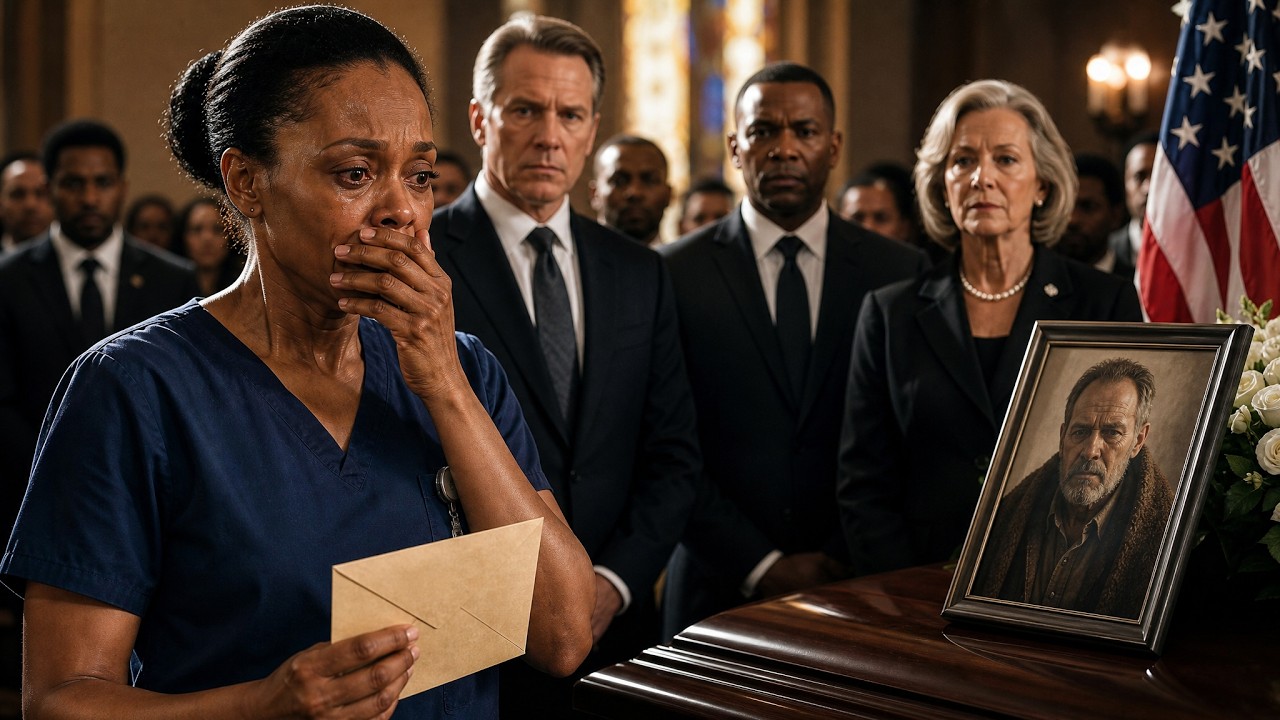
She pushed through the door. The guest book sat open on a wooden stand. The first entry made her freeze. Senator David Royce.
Marcus Brecken. Claire Hurst. Their names in heavy black ink. In the back pew, three figures sat who did not belong in any funeral for a homeless man.
They were here for John. —
The service began with the quiet rustle of expensive suits. Senator Royce stepped to the podium, face set in granite. “He was the bravest man I ever knew.
A patriot who gave more than his country ever asked. ”
Margaret barely heard. She held the envelope the pilot had given her. A small brass key tumbled into her palm.
Behind it, thick cream paper covered in John’s neat cursive. Dear Margaret, if you are reading this, I have finally gone home. My real name is Jonathan Wainwright. I hid on that bench because you were the first person in 30 years who saw a man, not a threat.
You treated my hand, not my file. The key opens a safety deposit box at Rothschild Bank in Zurich. Inside is $47 million. Use it on the next seven people.
The next ones. That’s what he meant that night. —
She folded the letter with trembling hands. The senator’s eulogy became a distant murmur.
After the service, Marcus Brecken extended his hand, eyes raw. “He told me about you. Encrypted calls. You kept him human when the world made him a ghost.
”
Claire Hurst pulled her into a tight hug. “He saved my career in ’86. I owe him everything. You gave him peace.
”
Senator Royce clasped her hand. They came for a homeless man. And I am the nurse who gave him sandwiches. She finally rose, the key in her palm, and walked past the empty pews.
At the door, she looked back. The casket was alone. —
At her kitchen table that night, she opened her laptop and typed Jonathan Wainwright. Old headlines filled the screen.
Defector presumed dead in fiery crash. Below, a photograph of a young man in a tuxedo at a state dinner. The same sharp eyes she’d bandaged for seven years. One article quoted a Swiss banker: Wainwright moved billions through untraceable channels.
She dialed Rothschild Bank. A crisp voice confirmed the balance. $47 million. And a sealed instruction waiting for her authorization.
She could pay off her student loans. Move into a real apartment. Never work another double shift. No one would know.
The bank said it was hers to spend. But she remembered a cold night six years ago. His voice hoarse. “You see people the way I used to see numbers.
That’s rarer than $47 million. ”
He didn’t give me this for a new car. He gave it for the next seven. —
She spent weeks bent over her laptop, studying how other cities ran street medicine programs.
Seven hospitals. Seven Friday night teams. That’s how you scatter 47 million. She drafted a one-page proposal with John’s handwritten instructions scanned at the top.
Her first call was to the foundation director at Georgetown University Hospital. “I am an ER nurse. And I am holding a promise from a dead man who was worth more than this hospital. Yes, I am serious.
”
Within a month, seven hospitals committed to staffing the vans. She named it the John’s Promise Fund. The logo: a simple wooden bench. She authorized the first wire transfer.
$5 million to Georgetown. The bank portal refreshed. $42 million remained. —
The first Friday night, the van rolled out.
A cold drizzle fell on a DC neighborhood that hadn’t seen a doctor in years. Margaret stepped out in a blue volunteer vest, her scrubs underneath, the same gold cross at her throat. “Ma’am, I’m a nurse. Do you need someone to look at that?
”
The woman had an infected foot and flinched like a wounded animal. Margaret cleaned it with the same steady hands she’d used on John. The woman whispered, “Thank you, miss. ” And Margaret’s eyes stung.
A local news van pulled up. A reporter asked who funded a mobile clinic in this forgotten corner. “It’s called John’s Promise. He asked me to use it for the next seven.
This is the first. ”
—
Within weeks, the hospital board reviewed the news footage. Unanimous vote: they would install a permanent memorial at the bench site. Margaret ordered the plaque herself.
A simple brass rectangle. No dates. Just the words John had spoken. A year after his death, the unveiling was scheduled for a Friday, just before sunset.
The hour she’d always brought him sandwiches. Nurses, patients, and the powerful figures who had first appeared at John’s funeral all returned. Margaret held the edge of the black cloth. With one pull, she drew it away.
The brass caught the last light. For John, he was already home. “He told me once this bench was the safest place on earth. Now it’s a home for anyone who needs one.
The next ones, John. The ones you never met. ”
—
When her shift ended at midnight, she walked out the same ER doors and sat on the new bench. “I sat here every Friday for seven years and I never knew your name.
Now your name is on a bench. You see people the way I used to see numbers. That’s rarer than 47 million. I see them now, John.
The next ones. They’re out here every night. And I’ll keep showing up. ”
She felt no ghost.
Only the weight of a promise kept. When she finally rose, the moon had shifted. She paused at the door, looked back, and nodded once. Home at last, John.
For both of us. —
Another Friday night settled over the hospital. Inside the ER, Margaret stood by the window in her blue volunteer vest. Below, a woman in a thin coat shuffled out of the dark.
She touched the bench like a question, then lay down with her head beside the brass plaque. Margaret let the curtain fall. She hung her vest by the door and pulled on her gloves. The same steady hands.
Outside, the homeless woman slept peacefully. The bench had become exactly what John had promised. A home for the next ones. Margaret worked through the night.
And when dawn broke, the bench was empty again, waiting. On the bench where a homeless man had once shivered, the brass words caught the light. John had no home, but he gave a home to everyone who sat there. And Margaret, finishing her shift, walked past the window and saw the empty bench.
She smiled. She didn’t stop. She had work to do.
But outside, the bench held the morning sun like a keeper of promises, waiting for night.