In the corridor the maids passed the bench without noticing Emani at first. They murmured in low voices. “She really meant it this time. ”
“Did you see his shirt?
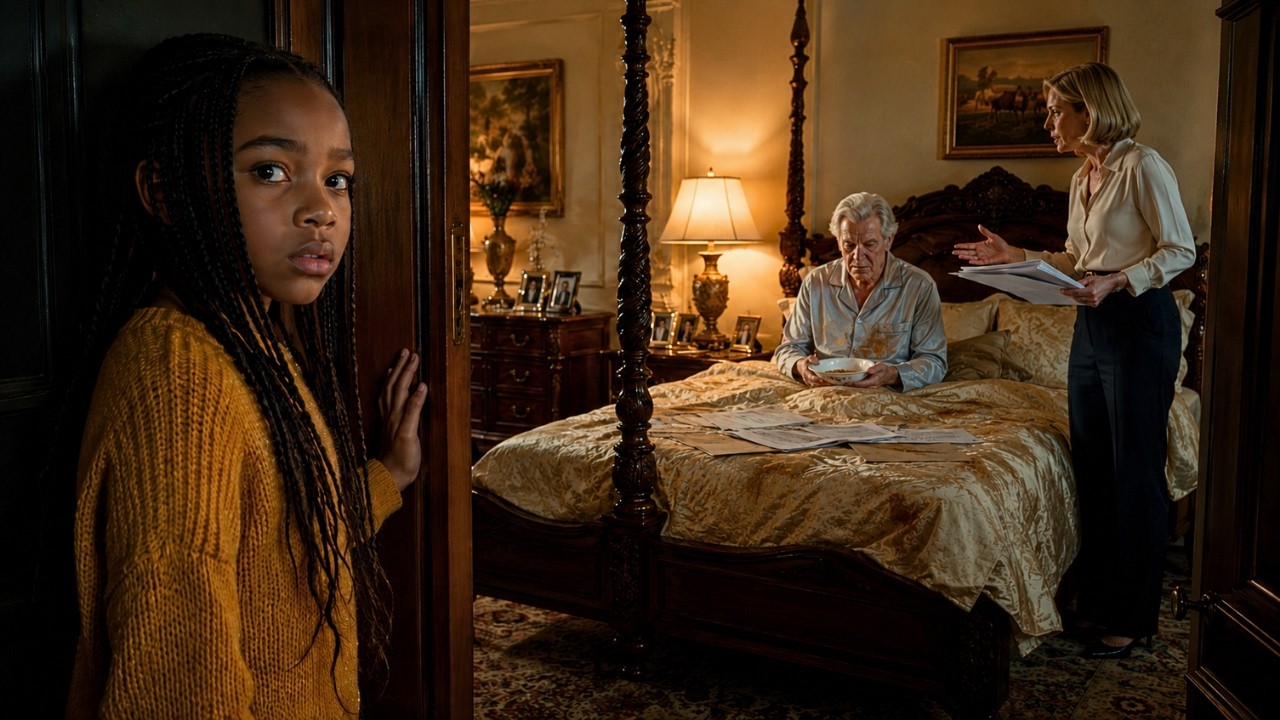
He barely got a swallow in. It’s getting worse. ”
“Dr. Layman said his tremors are doubled from six months ago.
And Mrs. Hollister is just done. ”
The older maid stopped. She had finally noticed the small figure on the bench.
Her face shifted through embarrassment, kindness, the blank look of a woman who knew a child overhearing the wrong thing could become a problem. She offered Emani a tight smile. “You waiting for your mama, honey? ”
Emani nodded.
“She’ll be down soon. ”
The maids continued past. Their footsteps faded. The tray went with them.
The evidence of the evening removed rather than addressed. But the words had already landed in a child. Emani sat very still for almost a full minute. Then she slid down from the bench, set her small hand against the polished banister, and walked very softly toward the bedroom door left half open at the end of the hall.
The hallway carpet swallowed the sound of her sneakers. She moved the way children move in churches and hospitals, as though noise itself might be a kind of trespass. At the door she paused. She could see him from here—a sliver of pale blue pajama shirt, one trembling hand on the embroidered blanket.
He had not moved since the maids left. Like a man arranged on a shelf and forgotten. She stepped through the doorway. Marcus turned his head.
His eyes, tired and red-rimmed, took a moment to focus. Surprise, confusion, a flicker of alarm. Then a softening he seemed unable to control. “What are you doing in here?
”
“I heard them,” she said. “The ladies on the stairs. They were talking about your dinner. ”
He looked away toward the dark window.
“You shouldn’t listen to people gossip. ”
“They weren’t whispering very good. ”
Something almost moved at the corner of his mouth. Not quite a smile.
It vanished before it could fully form. She watched him for a few more seconds. Then she walked closer, crossed the thick rug in five quiet steps, and stopped beside the bed. “Are you sad?
” she asked. The question landed somewhere in him he had thought was already closed. He drew a slow breath. He looked at her properly for the first time.
Large brown eyes that seemed to take in too much for a face that small. She was waiting for an answer the way only children wait—without impatience, without performance. “Yes,” he said quietly. “I am.
”
“Because of your hands? ”
He glanced down at the right one, still trembling. “Because of a lot of things. ”
She nodded as though this were a sensible answer.
She looked around the room, her gaze settling on a covered silver dish left on the side table by the window. “There’s still food,” she said. “You don’t have to do that. ”
She was already walking.
She lifted the silver cover with both hands, revealing a small dish of apple compote, a few soft pieces of buttered toast, a folded napkin. She picked up the dish carefully and brought it back to the bed. She considered the height of the bed, then climbed onto the upholstered bench beside it. Her shoulders came almost level with his.
She set the dish on the blanket near his knee. She unfolded the napkin across her lap. She picked up the spoon. “It’s just applesauce,” she said.
“Applesauce is easy. ”
She scooped a small portion and held it up toward him. Marcus looked at it. He could feel the heat of embarrassment rising.
He was a grown man. He had built three companies. He had testified before Senate committees. And he was about to be fed applesauce by an eight-year-old who weighed less than his suit jackets.
But the spoon held steady in her small fingers. Her face showed neither pity nor discomfort. She was simply offering. He opened his mouth.
The applesauce was cool. It was sweet. It was the first thing he had swallowed since lunch. It hit him with an ache he had not been prepared for.
She offered another. He took it. She offered a third. Between bites she watched his trembling hand with open concern.
When a small bit of applesauce slipped from the corner of his mouth, she immediately reached for the napkin and dabbed it away with the same gentle motion her mother used on her at dinnertime. “Sorry,” Marcus muttered automatically. Emani shook her head. “You don’t have to say sorry for that.
”
He looked at her, startled. Adults had been saying sorry to him for months for small mistakes. He himself had been saying sorry for needing too much, for being too difficult to watch, for existing in the room in the particular way illness had made him exist. And here was this child treating spilled applesauce like spilled rain—something that needed wiping up, something that carried no shame.
She offered another spoonful. This time his hand jerked without warning. A soft lump dropped onto the blanket near his knee. “Oh,” she said, small and matter-of-fact.
She set the dish down, picked up the napkin, and cleaned the blanket with patient dabs. “It’s okay. My mama says eating messy is still eating. ”
The sentence pulled something strange out of him—a half breath, half broken sound that startled them both.
It took him a full second to recognize it as a laugh. He had not laughed in his own room in so long the sound felt foreign. Emani brightened. “That sounds better than being sad.
”
He looked at her for a long moment. “You really shouldn’t be this kind to strangers. ”
She tilted her head. “Why?
”
“Because most strangers don’t deserve it. ”
She thought about that with the same serious expression. Then she shrugged one small shoulder and dipped the spoon again. “You’re not a stranger.
You’re hungry. ”
The simplicity of it nearly undid him. He opened his mouth and took the bite. For the first time in many months, he allowed himself to be fed without the heavy weight of shame following the food down.
Then the sound of high heels began moving down the corridor. Emani heard them before Marcus did. She turned slightly on the bench, the spoon still raised. Her body went still.
The bedroom door swung open. Vivien stood on the threshold. Her gaze took in the room in three quick movements. Marcus propped against the pillows with a faint orange smudge at the corner of his mouth.
The dish on the blanket. The napkin draped across a child’s lap. The spoon raised mid-bite. “What,” Vivien said in the soft, careful voice she used when she was at her most dangerous, “exactly is this?
”
Emani lowered the spoon slowly. “He was hungry,” she said. “And who told you that you were allowed in here? ”
“Nobody.
”
“No,” Vivien said quietly. “I imagine not. ”
Marcus felt the air change. The shame returned with full force, sharp and immediate.
But it was no longer only shame for himself. It was shame that this small girl who had walked toward him when everyone else stepped away should now have to stand inside his wife’s contempt. “She was helping me,” he said. Vivien laughed, thin and brittle.
“So this is where we are now. A child from the cleaning staff is feeding you in our bedroom. ”
The hurried sound of softer footsteps came from the corridor. Denise Ross appeared in the doorway, breathless.
Her eyes found Emani first, then the bed, then Vivien. The color drained from her face. “Oh Lord,” Denise whispered. “Emani.
”
Her daughter turned. “Mama. He was hungry. ”
Denise crossed the room fast enough to stumble on the rug.
“I told you to stay downstairs. I told you not to wander. ”
“I know, but—”
“It doesn’t matter what they said. ”
Vivien folded her arms.
“Apparently your daughter has made herself very comfortable in private rooms. ”
Denise straightened. Her hands were trembling. “Mrs.
Hollister, I am so sorry. I don’t know how she got up here. I only turned my back for a minute. ”
“She walked,” Vivien said.
“That much I can see. ”
Denise reached for Emani’s shoulder and drew her gently off the bench. “It won’t happen again, Mrs. Hollister.
I promise you. ”
Vivien’s eyes narrowed. “No, it will not happen again. ”
Marcus heard what lay inside those four words.
So did Denise. In a house like this, dismissal never needed to be spoken directly. “Vivien,” Marcus said quietly. She did not look at him.
“I think we have been more than generous with boundaries in this house. ”
“Vivien. ” He said her name with more weight. She turned, irritation open on her face.
He drew a careful breath. “Do not take this out on them. ”
She stared at him in disbelief. “You are defending this?
”
“Yes. ”
“She disobeyed every house rule we have. Her mother lost track of her. And I walk into our bedroom to find a staff member’s child playing nursemaid to my husband as though this were a charity ward.
”
“No,” Marcus said. His voice was firmer than it had been all evening. “You walked in and found the only person in this house tonight who made sure I didn’t go to bed hungry. ”
The sentence stopped the room.
Denise looked up despite herself. Vivien’s expression sharpened in the way it sharpened when she had been wounded somewhere her composure was not ready to acknowledge. “That,” she said, “is not a child’s responsibility. ”
“It shouldn’t have been,” Marcus replied.
“But it became one. ”
Denise cleared her throat. “Mr. Hollister, I truly am sorry.
Emani didn’t mean any harm. ”
“I know she didn’t. ”
Vivien’s head turned. “Take your daughter downstairs.
Please. Right now. ”
“Yes, ma’am. ”
Emani turned and looked up at Marcus.
The applesauce dish was still on the blanket. The napkin had fallen half folded onto the mattress. She leaned forward and tucked it gently within his reach. “I can come back later,” she said softly.
Denise’s eyes widened. Vivien let out a humorless breath. “No, you cannot. ”
“Why?
”
“Because this is not your place. ”
Before Denise could pull her toward the door, Marcus spoke again. “She was kind to me. ”
Vivien did not bother hiding her impatience.
“Kindness does not erase impropriety, Marcus. ”
“Neither does wealth erase cruelty. ”
The words were out before he had decided to say them. For one stunned second, even Denise forgot to breathe.
Vivien’s face lost all expression. She did not respond. She simply turned and walked toward the door, rigid control in every step. “Take the child out.
Now. ”
Denise guided Emani toward the hallway, one protective hand between her shoulder blades. At the threshold, Emani twisted around just enough to look back. “Good night, Mr.
Hollister. ”
The room held itself still. “Good night, Emani. ”
Denise led her out.
Their footsteps softened down the corridor. Vivien remained in the doorway another moment. Then she left, too. The door closed with a soft, controlled click.
The silence that followed was not the same as the silence Marcus had known before Emani entered. The old silence had felt defeated. This one felt altered. On the blanket beside him, the small dish of applesauce still sat with the spoon resting at an angle.
He looked at the last pale streaks clinging to the edges. He felt embarrassment, gratitude, grief, and something dangerously close to relief. Someone had seen him tonight. Someone had not turned away.
That night Marcus called his lawyer. He began the process of removing Vivien from his medical authority, his financial structure, his trust access. Harold Whitmore arrived the next morning through the side drive. Vivien noticed nothing.
She came and went from the house with her phone in her hand. Twice in three days the security log registered a vehicle arriving at the back of the property mid-morning. Marcus already knew the name: Daniel Reeves, real estate consultant. A man who had once shaken his hand at a fundraiser, already calculating which parts of another man’s life were available to inherit.
On the fourth afternoon, Emani came back upstairs. She appeared in the doorway of the private sitting room, a folded piece of construction paper held carefully in her hand. She had been told to stay in the laundry room. She had stayed mostly.
But she had finally decided her mother’s rules had run out of reasons. Marcus looked up. “Does your mother know where you are? ”
“No.
”
He exhaled. It was not quite a laugh. She held out the folded paper. He took it with his steadier hand and unfolded it.
A crayon drawing of his bedroom—the bed, the window, a small dish with a spoon, a bright round sun smiling from the upper corner. On the bed a stick figure with dark hair and one shaky hand. Beside it a smaller figure with braids and pink sneakers. “It’s your room,” Emani said.
“But I made the morning nicer. You didn’t have enough yellow in there. ”
He set the drawing on the desk beside Harold’s leather folio, beside the folded napkin he had not yet been able to put away. “Did you eat lunch a little?
”
He almost smiled. “Does your mother know you interrogate people? ”
“I’m not interrogating. I’m checking.
”
She stayed for an hour. She climbed onto the ottoman and asked him about the model sailboat in the glass case, about the framed photograph on the bookshelf, about whether the sky outside looked different from up here than from the laundry room. He answered one by one. His voice grew steadier.
What she was offering was not pity. It was company. Pity asked nothing of the person it was extended toward. Company assumed they were still a person worth being with.
That evening Vivien came to dinner alone. At twelve minutes past eight the side drive chimed. Warm cologne drifted up the back staircase later. Marcus woke the house tablet from years of disuse and pulled up the corridor feed with audio.
He heard Vivien’s voice, soft and conspiratorial. He heard a man’s quiet laugh. He heard her say she was waiting for the path of least damage. He listened to all of it.
He did not flinch. When the recording ended he called Harold. “It’s tonight. ”
The papers were ready by morning.
When Vivien came upstairs in her green silk blouse, Marcus was sitting at the desk. The folio open. The drawing to his right. The house tablet faced down to his left.
“Sit down,” he said. She sat. “I know about Daniel. ”
The sentence landed cleanly between them.
She opened her mouth, then closed it. “I don’t know what you mean. ”
“Yes, you do. ”
She went still.
“You had someone watching me. ”
“I had truth watching you. It did most of the work on its own. ”
She looked at the tablet, the folio, the small crayon drawing.
“What exactly do you intend to do, Marcus? ”
“In the morning, Harold will begin formal proceedings. ”
She did not move. She said, “You’re not strong enough for this.
”
He looked at her for the first time in their marriage. His face carried no apology. “I am exactly strong enough for this. ”
She left without finishing the sentence she had begun.
The next morning Marcus called Denise and Emani upstairs together. Denise came with the careful, braced expression of a woman who had spent the night being told her daughter could no longer come to the estate. Emani came holding her mother’s hand, yellow sweater traded for a soft cardigan, braids redone with new ribbons. Harold was already seated at the desk, papers prepared.
Denise said, “Mr. Hollister, if this is about Emani—”
“It isn’t. ”
Harold slid a single page across the desk. Denise looked down at it, then up at Marcus, then down again.
Emani leaned closer, too young to read all the words but old enough to recognize her own name printed in clear black letters. “Why is my name there? ” she asked. Marcus looked at her across the desk.
His right hand trembled against the polished wood. His voice did not. “Because in the worst days of my life, you did not turn away. And I have decided what kind of heart my life is going to honor.
”
Denise pressed one hand against her mouth. She read the page twice. She looked at Harold for confirmation. He gave her the small, professional nod of a man who had spent his career making sure documents like this could not be challenged.
“Mr. Hollister,” Denise whispered. “That is too much. ”
“No,” Marcus said.
“It is the first thing in this house that has felt measured correctly in a very long time. ”
Emani crossed the room. She walked with the same quiet seriousness she had brought into this room with applesauce four nights before. She stood beside his chair.
She reached for the folded napkin still on the desk beside the drawing. She set it gently within his reach. “I’m glad you’re not alone today,” she said. Marcus looked at the child, at her mother weeping quietly behind her, at the signed papers in Harold’s hand, at the small crayon sun smiling from the drawing on his desk.
He understood that justice did not always arrive with spectacle. Sometimes it arrived through a lawyer’s pen, a mother’s raised child, and a little girl who had once seen a hungry man in a fine room and decided that was reason enough to walk toward him. The Hollister marriage ended in the months that followed, quietly, expensively, without scandal. Vivien moved out before Christmas.
Daniel Reeves was never spoken of again in the house. Denise Ross was promoted with a salary that no longer required two jobs. Emani was enrolled in the kind of school with libraries longer than her hallway at home. She came to visit Marcus every Saturday afternoon.
She read to him when his hands were too tired to hold the book. She drew him new drawings. The crayon sun in the corner of the page grew steadier.
And so did he, on his better days.