She waited outside the staff exit at 6:37 a. m. Imani walked out, head down, jacket pulled tight. “Imani.
”
Imani stopped. She recognized the face from the poster. “You are Senator Whitfield. ”
“May I have ten minutes of your time?
”
“What is this about? ”
“It’s about my daughter. ”
Imani’s expression didn’t change. “I clean the floors.
I don’t know your daughter. ”
“You do. You don’t know that you do, but you do. ”
Margaret told her everything.
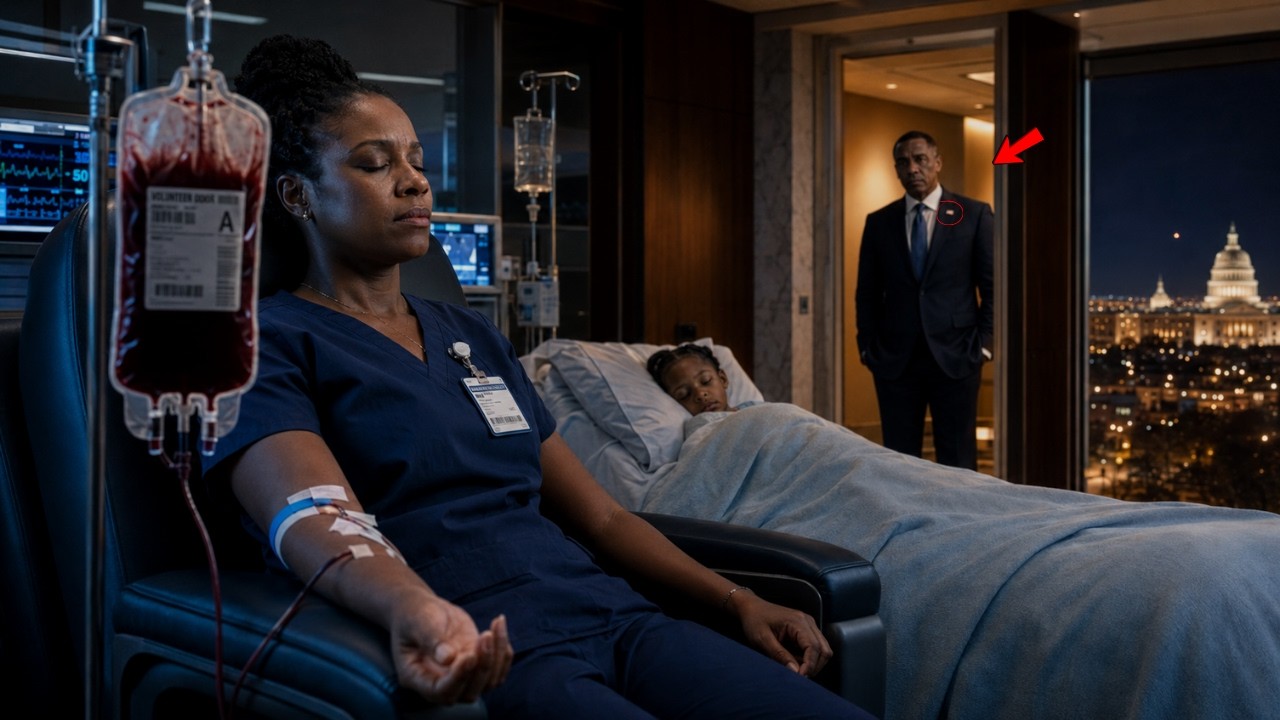
Lillian. The monthly transfusions. The crisis three nights ago. The donor who saved her.
Imani went very still. “The little girl with the braid. The one who drew the blood angel. ”
Margaret nodded.
“I sat with her three weeks ago. I didn’t know. I never tried to know. ”
“I know.
I’m not here to offer you anything. I’m here to thank you. ”
Imani stepped back. “Please don’t offer me money.
I didn’t give my blood for that. ”
“Then let me ask you a different question. Not as a senator. As one woman to another.
Is there anything I can do for the people you love? ”
Imani’s mouth opened. Closed. She didn’t say no.
That afternoon Margaret brought her up to the fourth floor. Lillian was sitting up in bed eating strawberries. Her face transformed when she saw Imani. “Miss Imani!
You came in the day. ”
“Hi, Lily. How are you feeling? ”
“Better.
Mommy says the blood angel came again. ” She looked at her mother, then back at Imani, then at the drawing on the nightstand—a crayon figure with a halo and a heart. “Are you the blood angel? ”
Imani couldn’t speak.
She nodded. Lillian set her bowl aside and opened her arms. Imani gathered her up and held her the way she had held her grandmother through the worst nights. Tightly, like giving permission to rest.
Margaret stood at the door, tears running down her face. That night she drafted a bill. She called it the Rare Blood Access and Donor Protection Act. It created a national rare blood type registry.
It tied federal hospital funding to a baseline wage of twenty-two dollars an hour for frontline workers. And it established the Vera Carter Nursing Education Grant—full tuition for any non-clinical hospital worker who wanted to return to school for a nursing degree. She introduced the bill on the Senate floor and told the story without naming Imani. She called her “the woman who saved my daughter.
”
“She earns sixteen dollars an hour. She raises her grandmother on that salary. She gave up her nursing degree to do it. She has never asked me for a single thing.
The richest nation in human history is held together by women like her, and we treat them like they are invisible. That ends today. ”
The bill passed. The president signed it.
Imani watched the signing ceremony from Vera’s living room. Vera, frail and forgetful, pointed at the screen. “Baby, that man is writing your grandmother’s name on the television. ”
“Yes, Mama.
He is. ”
“What for? ”
“For you and for me and for everybody like us. ”
Vera nodded slowly.
“About time. ”
Six months later Imani walked into the admissions office at Johns Hopkins School of Nursing. She was thirty-seven. She carried a folder with old transcripts, a letter from Dr.
Sundaram, and an acceptance letter she had read so many times the paper had softened. The Vera Carter Grant covered everything. Tuition. Books.
Housing. A monthly stipend larger than her old paycheck. She didn’t have to choose anymore. She sat in her first lecture hall surrounded by students ten years younger and opened a fresh notebook.
The professor wrote on the board: Nursing begins where seeing begins. Imani underlined it twice. Three years later she graduated. When the dean called her name, the auditorium stood.
In the fifth row, Lillian held yellow daisies. Margaret sat in a simple black blazer. And beside them, in a wheelchair with a pink quilt, Vera Carter sat up straight and clapped. “That’s my baby.
That’s my baby right there. ”
Imani heard her. She looked into the fifth row. She pressed her hand to her chest.
She didn’t speak. She didn’t need to. Those hands—that had mopped floors, scrubbed blood off linoleum, opened their veins twenty-four times for a stranger’s child—were going to hold a stethoscope now. They were going to hold the hands of frightened children in the dark.
And they would never forget where they had been.