If I take that money, then it wasn’t a real gift. Mama said a gift you get paid for is just trading. Marcus lowered the bills. How about this—I’m not paying you for the coat.
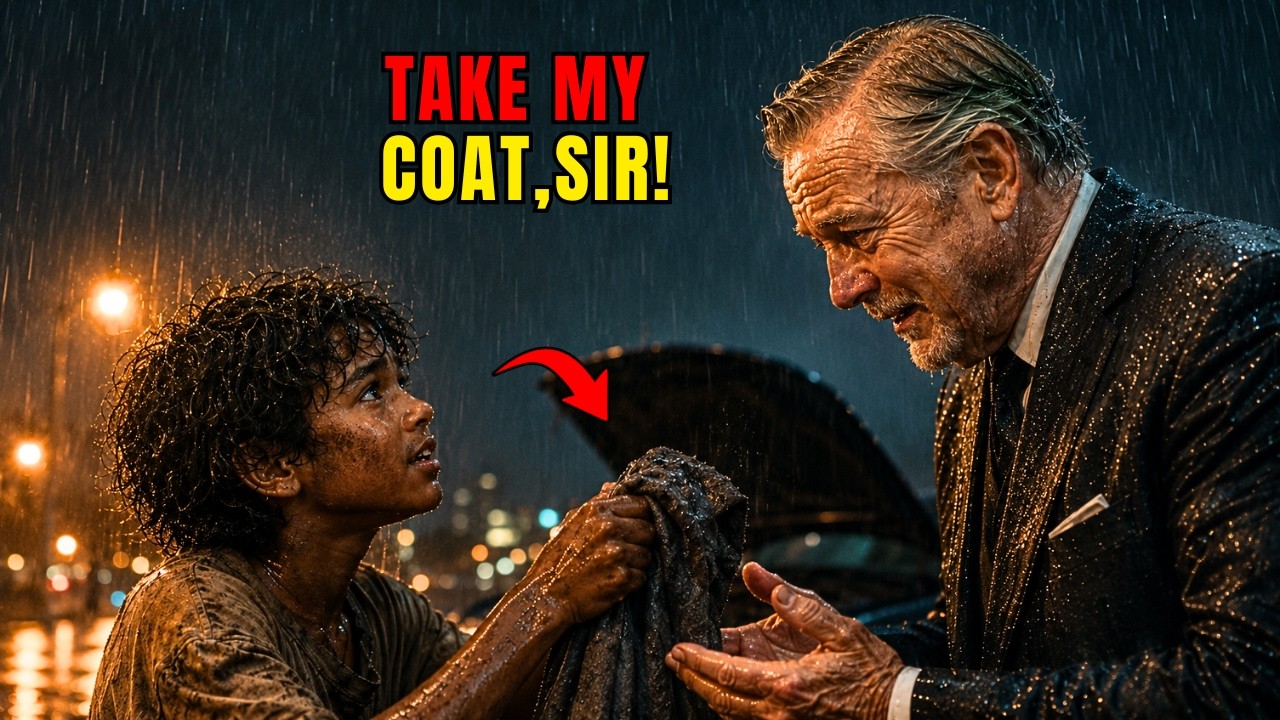
I’m asking you if you’d let me help you tonight. Not because of the coat. Because of you. Eli considered it.
What kind of help, sir? A hotel room. A hot meal. Dry clothes.
One night where you don’t have to sleep with your mama’s backpack under your head. The boy looked at his chapped hands. Sir, if I go with you, what happens tomorrow? I got to come back here.
One warm night just makes the cold ones hurt worse. I don’t know if I can handle remembering being warm. Marcus understood. Eli was protecting himself from hope.
Hope was the most dangerous thing a homeless child could carry. What if I told you tomorrow doesn’t have to look like yesterday? Marcus said. What if I came back tomorrow, and the day after?
What if I made sure the warmth doesn’t have to be a memory? Eli stared. Sir, why would you do that? You don’t even know me.
I know that you saw a stranger shaking in the rain and gave him the only coat you owned. Do you know how many people walked past me tonight? You were the only one who saw me. Eli’s eyes glistened.
Mama always said you got to see people. Otherwise, what’s the point of having eyes? Marcus could not speak for a moment. He thought about all the eyes he had paid for—security, investigators, PR consultants—and not one had taught him how to actually see anyone else.
Will you trust me? Just for tonight. I give you my word that nothing happens to your mother’s things. We come back tomorrow if you want.
But just for tonight, let me get you warm. The boy looked across the alley at his cardboard home, then back at Marcus. Sir, if you break your word, I won’t be mad. I’ll just know.
And I’ll know about all the other people you say things to. So please, if you can’t keep your promise, tell me now, and we can just sit here till the rain stops. Marcus felt his eyes burn. I have not kept a single promise in twenty years that mattered to anyone but a banker.
I’m going to keep this one. Eli studied him, then nodded. He stood and walked to the shelter, pulled out a small navy blue backpack patched with duct tape, and held it close to his chest. When he came back, his small body trembled.
They walked together down Eleventh Street. Marcus pulled the boy close against his side. Eli did not pull away. At the Lakeshore Hotel, the doorman opened the door, took in the sight of a man in a ruined suit and a dripping child, and said softly, When somebody walks through these doors with a wet child, you don’t ask questions.
You just open the door wider. Marcus asked for two adjoining rooms. The clerk’s eyes widened, but she did not question it. Eli stood clutching his backpack, staring at the marble floor.
In the room, Eli walked to the bed and touched the comforter. It’s warm, he whispered. Take a hot shower, Marcus said. I’ll sit right here.
The backpack stays exactly where you put it. Eli disappeared into the bathroom. Marcus heard the lock click, the water run, and then the small gasping breaths of a boy who had been holding something in for far too long. He stood at the window and did not move for fifteen minutes.
When Eli came out in a robe three sizes too big, his eyes red but calm, Marcus laid out new clothes from the drugstore. Soft pajamas with rocket ships. A blue puffer coat. And a small brown stuffed bear with a red ribbon.
Eli stared. Sir, I’m too old for a bear. Are you? Mama gave me one when I was little.
His name was Patch. He got lost when we moved out after she got sick. Then maybe this one’s name is Patch, too. Maybe he found his way back.
Eli picked up the bear and held it to his chest. They ate grilled cheese and tomato soup and two ice cream sundaes. Eli folded his hands and said grace. Thank you for the man who let me give him my coat, even though I think you sent him to me more than I gave anything to him.
After the meal, Marcus tucked Eli into bed. The boy insisted on sleeping with the backpack against his pillow and the bear cradled in his arm. Sir, will you be here when I wake up? I’ll be right through that door.
I’ll leave it open. What is your name? You never told me. Marcus felt a jolt of shame.
Marcus. Marcus Sinclair. Good night, Mr. Marcus.
Good night, Eli. The boy was asleep in five minutes. Marcus walked to his room and sat in the armchair. His phone had thirty-seven missed calls.
He returned none. Instead, he opened his laptop and typed for two hours—an email canceling Monday meetings, a note to his lawyer about emergency guardianship procedures for a minor child, a request for reports on long-term care facilities for orphans. At three in the morning, he looked through the open door at the small shape under the white comforter. He thought about his own mother, who died in a facility he had chosen based on a spreadsheet.
He had visited twice. He understood now that he had stayed away because visiting her made him remember he did not know how to love anyone. The not knowing had felt like drowning, so he stayed away from the water. He thought about Eli, who had stood in the rain and watched a stranger walk past four times before deciding the stranger’s freezing body mattered more than his own jacket.
I’m going to keep my promise, son, he whispered. Eli slept until ten in the morning. Over pancakes, Marcus said, I called my lawyer. I asked him what it would take for me to become your legal guardian.
Eli’s fork stopped halfway to his mouth. My what, sir? Guardian. You would have a place to live, food, school.
You would not have to live in cardboard. Sir, why would you do that? Because last night you reminded me I have spent my whole life being seen by everyone and known by no one. Because I have more rooms in my house than I’ve ever walked through, more money than I could spend in twenty lifetimes, and not a single person who would notice if I disappeared tomorrow except the people I pay.
Because you saw me when no one else did. Eli looked down. A tear landed in the maple syrup. Mr.
Marcus, I don’t want to be a project. If you’re going to do this, you got to really do it. You got to want me when I’m in trouble. You got to want me when I cry about Mama.
That’s going to be a lot, sir. Then we’ll cry about her together. We’ll talk about her until I know her almost as well as you do. Eli looked up.
Sir, do you got kids of your own? No. I was married once. She left because I worked too much.
Then you don’t know how to be a dad. No. I don’t. Eli considered it.
That’s okay. I don’t really remember how to be a son, neither. Maybe we can figure it out together. The guardianship was granted.
Marcus rented a house in Cleveland with a fenced yard and a school three blocks away. He did not move Eli to Connecticut. The boy needed continuity. He needed to stay near his mother’s grave.
They went together that first week. Sarah Lynette Whitfield. Beloved Mother. Eli knelt and traced her name with his fingertip.
Marcus stood behind him with a hand on his shoulder. Neither spoke for a long time. Two years passed. Eli grew four inches.
His voice began to deepen. Marcus stepped down as CEO, kept his board seat, moved his daily life to Cleveland. His old assistant launched a foundation funding mobile medical care for homeless children. Eli helped design the logo: a small house with a yellow light in the window and a coat hanging on the door.
The thin gray jacket hung in a glass shadow box in the foyer. Beneath it in brass letters: He saw a stranger and warmed him first. On the second anniversary of the rain, they sat on the front porch drinking hot chocolate in the December cold. Mr.
Marcus? Eli was twelve now. Yes, son. Do you remember what you said on the steps that night?
About how I was the only one who stopped? I remember. I’ve been thinking there’s probably somebody out there tonight walking past somebody else, and nobody’s stopping for either of them. Marcus looked at the boy.
Probably so. So maybe we should do another program. Just for jackets. We give coats to anyone who needs one.
No questions. Just, here, take this. You are seen. Marcus felt the ache behind his eyes.
Eli Whitfield, I think that is the best idea I have heard in two years. We can name it whatever you want, Dad. No, son. You name it.
Eli looked out at the dark street, at the Christmas lights blinking across the way. I think we should call it Take My Coat. Marcus closed his eyes and nodded.
Take My Coat it is.