She had doctors who charged by the second. He stood up, grabbing his spray bottle. His boot crunched on something. He looked down—shards of broken ceramic under the desk.
He sighed, unhooked his dustpan, and swept them up. As he reached for a damp rag, his hand brushed against the heavy unglazed red pitcher on her desk. He paused. He noticed a chalky pale residue around the rim of the pitcher, right where the water line would sit.
He ran a calloused thumb over it and brought it to his nose. That same sharp, metallic, garlicky bite. He stared at the pitcher. Unfired clay from certain regions was packed with heavy metals—lead, cadmium, arsenic.
If you put acidic liquid in it—like lemon water—it leached those metals out at a terrifying rate. Basic chemical reaction. They taught you that on day one of hazmat training. He looked at the trash can full of hair and bloody tissues.
Not my problem, he told himself. Do your job. Empty the trash. Go home to Chloe.
He tied off the bag, threw it in his cart, and wheeled out. The double doors clicked shut behind him, sealing the heat and the smell inside. Two weeks later, the rain hammered against the reinforced glass of Aldridge Tower. It was 11:45 p.
m. Dallas was running late—a floor buffer had broken down, spitting dirty water across the fifty-eighth floor. His back screamed with a dull ache that shot down his left leg. He pushed his cart up to Caprice’s office, swiped his card, and pushed the door open.
“I said no disturbance. Is that Thomas? ” a voice snapped from the dark. Dallas froze.
The only light came from the cityscape outside and a single desk lamp. Caprice Aldridge was sitting on the floor behind her desk, slumped against the wall, knees pulled to her chest. Her silk blouse was soaked in sweat, clinging to her emaciated frame. Her breathing came in ragged gasps.
“I’m sorry, Miss Aldridge,” Dallas stammered. “I’m just the night crew. I’ll come back. ”
“Don’t,” she gasped.
“Don’t leave it. ”
He stepped inside. She choked—a wet, horrific sound—and leaned sideways, her hands scrambling against the smooth floor. Dallas dropped to his knees beside her.
“Hey,” he said, keeping his voice low, the way he did when Chloe woke up from a night terror. “Look at me. I’m going to get you some water. ”
“Can’t,” she whispered.
“Legs numb. ”
He reached up to the desk. The red clay pitcher sat there, half full. A glass with a squeezed lemon wedge beside it.
“No,” Caprice hissed, slapping weakly at his arm. “Don’t touch that. It’s customized. Sterile.
”
“You need water,” Dallas said bluntly. He poured the liquid into the glass and brought it to her. Her hands shook so violently she couldn’t grip the crystal. He reached out to steady her—his rough fingers wrapping over hers.
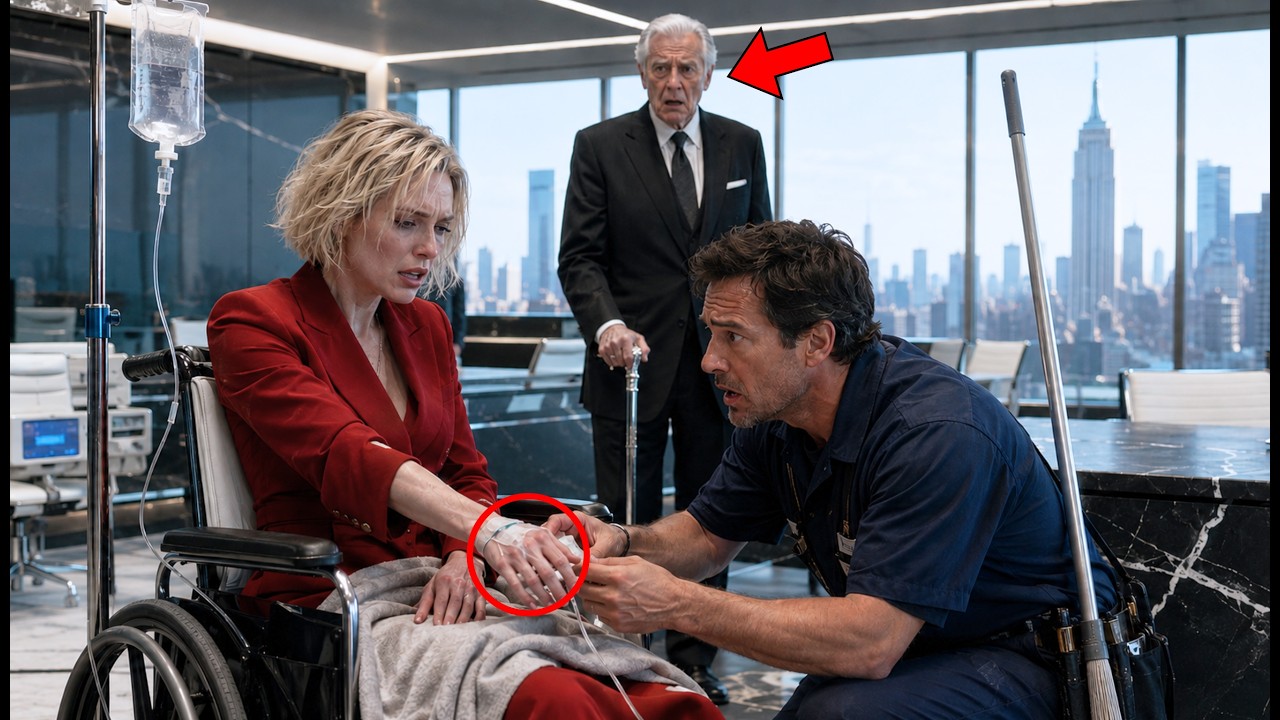
Her skin was freezing, slick with sweat. But it wasn’t the temperature that made him stop. It was her fingernails. Across every single nail, running horizontally from edge to edge, were distinct, stark white bands.
Thick, unmistakable lines interrupting the natural pink. Mees lines. Dallas stared. He had seen those exact lines on a foreman named Sal twelve years ago, right before Sal went into multiple organ failure from chronic arsenic exposure.
Caprice tried to pull the glass to her mouth. The smell hit him squarely—the sweet, pungent rot of garlic and metal. “Give me the glass,” Dallas said. His voice had changed—hard, flat.
Caprice glared at him. “Do you know who you are talking to? Get out. ”
“Give me the glass.
” He took the tumbler from her trembling hands and set it on the floor out of reach. “What is wrong with you? ” she demanded, trying to push herself up and failing. “I will have security drag you out.
”
“How much are you paying those doctors? ”
She blinked. “What? ”
“The doctors who can’t figure out why your nerves are dying.
How much? ”
“Millions,” she spat. “They are the best in the world. ”
“They’re missing it.
” He reached out and gently grabbed her wrist, turning her hand over to the light. “You see these white lines? Mees lines. Textbook response to heavy metal toxicity.
”
Caprice stared at him, chest heaving. “I’ve been tested for environmental toxins. My house is purified. ”
“Yeah.
” He let go, stood up, and grabbed the red clay pitcher. “Where did you get this? ”
“It’s imported. Volcanic clay.
Dr. Blackwell sourced it. It alkalizes the water. ”
“It’s unglazed earth.
You know what volcanic soil is packed with? Arsenic. And you know what draws arsenic out of unglazed porous clay faster than anything else? ” He pointed at the bowl of lemons.
“Citric acid. ”
The silence stretched. The rain lashed against the glass. “You drink this every day?
” Dallas asked. “Two liters a day,” she whispered. “For the last eight months. ”
“Your doctors are looking for genetic ghosts, lady.
You’ve been actively poisoning yourself with a five-hundred-dollar mud jug every single day. ”
Caprice looked up at him—the man in the blue uniform. The man who emptied her trash. “Arsenic?
” she whispered. “Arsenic. ” He walked over to his cart and held the pitcher over the steel bin. “Wait.
” She stared at the thing that had promised healing, the thing that had stolen her strength and millions of dollars. The absurdity crashed into her. A choked, broken laugh escaped her throat. “Throw it away,” she rasped.
“Throw the damn thing away. ”
Dallas dropped it. The pitcher hit the bottom of the empty steel bin with a heavy, satisfying crash, shattering into a hundred toxic pieces. Caprice didn’t scream.
She stared at the floor. Her mind, usually a terrifyingly sharp instrument, felt sluggish. She felt profoundly stupid. “Thomas,” she called.
The heavy doors clicked open. Her driver stepped in, taking in the shattered ceramic, the terrified janitor, his boss collapsed against the wall. “Get my chair. Call the sub-basement clinic.
Wake up the on-call technician. Heavy metals toxicology screen—blood, urine, hair. Fast. ”
Thomas didn’t blink.
He moved. Caprice turned to Dallas. “You’re coming with me. ”
“I have three more floors to scrub,” he said.
“My shift supervisor deducts an hour if I’m ten minutes late. I told you what I smelled. The rest is above my pay grade. ”
“I will buy your shift supervisor.
I will buy the company that contracted you. You are coming downstairs. If you’re wrong, I’ll have you arrested. If you’re right—” she swallowed the garlicky bile— “I’m paying you for your time.
”
The medical suite on the second subterranean level was blindingly white. A terrified lab technician tied a tourniquet around Caprice’s brittle arm. The needle slid in, drawing dark blood into a plastic vial. Forty minutes passed.
Then the heavy glass doors hissed open. Dr. Andrew Blackwell rushed in, hair disheveled, trench coat thrown over silk pajamas. “Caprice, what is the meaning of this?
Random toxicology screens at two in the morning? We have strict protocol. ”
“Shut up, Andrew. ”
The lab technician cleared his throat, holding a freshly printed stack of papers.
“Miss Aldridge. Your inorganic arsenic levels. Normal baseline is under ten micrograms per liter. Yours is eight hundred and forty.
The machine flagged it as critical, potentially fatal toxicity. ”
Blackwell froze. “That’s impossible. We screened for environmental toxins in the first month.
”
“In the first month,” Caprice echoed, her voice dropping to a serrated whisper. “Before you prescribed me a heavy, unglazed imported volcanic clay pitcher to alkalize my cellular structure. Before I started squeezing acidic lemons into it every day. Citric acid and unbaked mud, Andrew.
A high school chemistry student could figure it out. ”
Blackwell stared at the floor. “The wellness boutique swore it was sealed. ”
“You billed my holding company twenty-four million dollars.
You put me on experimental immunosuppressants. You told me my nervous system was spontaneously collapsing, and all I needed was to stop drinking out of a dirt cup. ”
She pushed herself off the examination table. Her legs wobbled, sharp electric shocks shooting up her calves, but she forced herself to stand.
“You’re fired. If I see you in this building again, Thomas will break your jaw. If you attempt to bill my family office for another cent, my legal team will bury you until your grandchildren are bankrupt. Get out.
”
Blackwell turned and fled. Caprice let out a long, ragged exhale. She looked at Dallas, still standing by the door, his face unreadable. “You were right.
”
“Yeah,” he said. He pulled out a cracked smartphone and checked the time. “It’s 3:15 a. m.
I missed the last bus. I have to walk two miles to the transit hub. My kid wakes up at six. ”
She stared at him.
She expected a demand—a plea for money, for a reward. Everyone extracted value from every interaction. This man just wanted to go home to his daughter. “Thomas,” Caprice called.
“Take Mr. Vanthorpe wherever he needs to go. And pull his employment file from human resources in the morning. ”
Dallas stiffened.
“You said you wouldn’t fire me if I was right. ”
“I’m not firing you. Just go home. ”
Six weeks later, the diner smelled of burnt filter coffee, industrial degreaser, and old fryer grease.
Caprice sat in a cracked vinyl booth, staring at a sticky laminated menu. She picked up a heavy chipped ceramic mug of black coffee. Her fingers still trembled, but she didn’t drop it. The numbness was retreating.
Chelation therapy was brutal—the intravenous drugs ripped heavy metals out through her kidneys. Her hair was still thin, chopped into a severe short bob. She looked ten years older. But she was alive.
The bell above the door jingled. Dallas Vanthorpe walked in, wearing a faded canvas jacket, carrying a white plastic pharmacy bag. He spotted her and stopped, hesitated, then slid into the booth opposite her. “They make a terrible cup of coffee here,” Caprice said.
“It’s seventy-five cents. You get what you pay for. ”
“I’ve found that is rarely true. I paid millions for a death sentence.
You worked for fourteen dollars an hour and gave me my life back. ”
Dallas looked away. “I didn’t do it to save you. I just hated the smell.
”
“I know. ” She reached into her blazer, pulled out a thick manila folder, and slid it across the table. “I read your file. Twelve years as a pipefitter.
Hazmat certified. Fired when the refinery downsized. Lost your pension just as your daughter’s medical bills started piling up. ”
His jaw tightened.
“Did you track me down to audit my miserable life? ”
“Open the folder. ”
He glared at her, but he flipped it open. Inside was a single, densely typed legal contract.
“I fired my entire environmental compliance team last week. They are credentialed, expensive idiots who look at spreadsheets instead of reality. This is a job offer—Director of Logistics, Safety, and Environmental Oversight. You’ll travel to my facilities.
You’ll look at the pipes. You’ll smell the air. You’ll look at the hands and fingernails of the people working the floor. ”
Dallas stopped reading.
“I’m a night shift janitor. I don’t have a college degree. ”
“I don’t care. Degrees gave me Andrew Blackwell.
I need someone who knows what a chemical burn smells like. Someone who isn’t afraid to tell a billionaire she’s actively drinking poison. ”
She tapped the second page. “Salary is three hundred thousand a year.
Full benefits. And there’s a rider on page four—covers all pre-existing medical conditions for dependents. Top-tier pulmonary specialists. ”
Dallas looked down at the pharmacy bag.
Chloe’s steroid inhalers. He had spent his last fifty dollars on the copay. “Why? ” he asked, his voice rough.
“You could just write me a check. That’s what people like you do. ”
“Because I am deeply selfish. I almost died because I surrounded myself with yes-men too busy cashing my checks to notice I was rotting from the inside out.
I need you on my payroll—someone who will look at the dirt. A check is a payoff. This is an investment in my own survival. ”
Dallas stared at the contract.
He didn’t trust her. She was cold, calculating, fundamentally ruthless. But she was offering him a lifeline built on mutual cynical necessity. He reached into his jacket and pulled out a cheap plastic pen.
He clicked it once. “I get to choose my own schedule. And if I find a hazard, you fix it. No red tape.
No cost-benefit analysis. You fix the problem. ”
“Agreed. ”
He signed his name, rough and jagged, and pushed the folder back across the table.
Caprice closed it. She didn’t smile. She didn’t offer to shake his hand. They both knew exactly what this was.
She picked up her mug, her fingers gripping the ceramic tightly, feeling the heat, feeling the painful, wonderful pulse of her own blood. She took a sip of the terrible coffee. For the first time in a year, it tasted exactly like what it was.