This isn’t anaphylaxis, it’s a panic attack coupled with seasonal allergies. ”
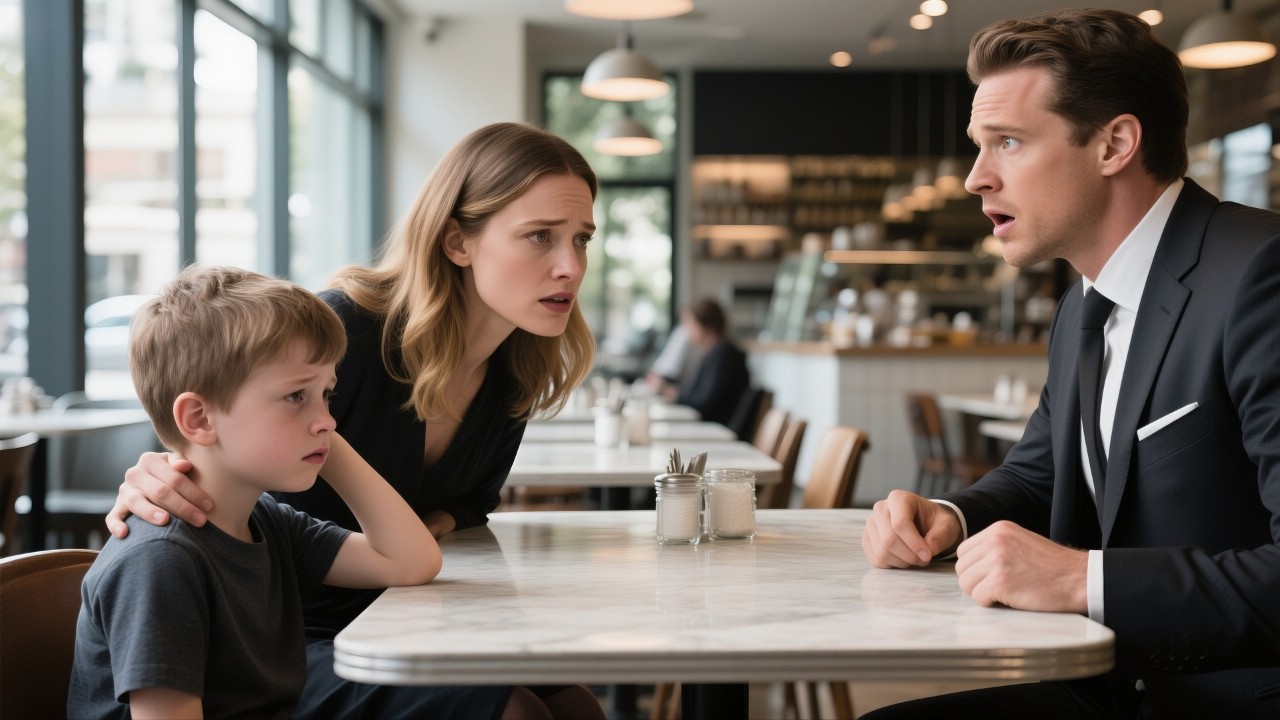
Audrey stood her ground. “With all due respect, doctor, he has urticaria spreading up his neck, stridor, and his lips are turning blue. The hazelnut crust on the scallops—is he allergic to tree nuts?
”
The flicker of uncertainty that crossed Dr. Morrison’s face told her everything. Westbrook turned to the doctor. “You said hazelnuts were in the probably safe category.
”
“They were, theoretically. The skin tests showed minimal reaction. ” Dr. Morrison stammered.
Tyler’s fingers clawed at the tablecloth, his chest heaving with futile attempts to breathe. “We don’t have time for debates,” Audrey said, her voice steady despite her racing heart. “I’m a nursing student, and this is anaphylaxis. If we don’t treat it now, he could die in the next few minutes.
”
The restaurant had gone silent. Dozens of Chicago’s elite watching the drama unfold. Richard Westbrook, a man accustomed to commanding rooms and making split-second billion-dollar decisions, looked from his gasping son to the determined waitress with the injector. “Do it,” he finally said.
With practiced movements, Audrey knelt beside Tyler. “This will hurt for a second, but then you’ll feel better,” she told him, pulling his pant leg aside to expose his outer thigh. She pressed the auto-injector firmly against his leg and heard the click that delivered the life-saving medication. Ten seconds.
Twenty. The entire restaurant seemed to hold its breath along with Audrey as she counted silently. Then, almost imperceptibly, Tyler’s breathing eased. The desperate clawing of his fingers relaxed.
Color began returning to his face. “Call an ambulance,” Audrey instructed, maintaining pressure on the injection site. “The epinephrine will help temporarily, but he needs emergency care. Anaphylaxis can have a biphasic response.
It could come back worse within hours. ”
As if awakened from a trance, Marcus rushed to the phone. Dr. Morrison knelt beside Audrey, his earlier certainty replaced with humility as he helped monitor Tyler’s vital signs.
Richard Westbrook had not moved. His expression unreadable as he watched his son’s life hang in the balance, saved not by his wealth or connections, but by a waitress working her way through nursing school. Outside, sirens wailed in the distance, drawing closer to Luminescence’s gleaming facade. Audrey remained beside Tyler, her hand steady on his wrist, counting his strengthening pulse.
For the first time since she’d approached table seven, she allowed herself to breathe deeply. What she didn’t know, couldn’t know, was how this moment would alter the trajectory of her life, entangling her fate with the Westbrooks in ways she could never have imagined. Two weeks later, Audrey stood outside the imposing glass headquarters of Westbrook Pharmaceuticals. The autumn wind whipped through Chicago streets, scattering golden leaves across the plaza.
She had been summoned by a brief, formal email from Richard Westbrook’s assistant: “Mr. Westbrook requests your presence to discuss a potential opportunity. ”
No explanation. No context.
She had convinced herself she would be fired. Protocol violations of that magnitude weren’t overlooked in establishments like Luminescence. Instead, she had arrived at work to find a massive bouquet of lilies and a handwritten note: “You saved my son’s life. I won’t forget that.
Richard Westbrook. ” Accompanying it was a check with enough zeros to cover her remaining tuition and then some. She hadn’t cashed it yet. Now, three elevator rides later, she was ushered into a corner office with floor-to-ceiling windows overlooking Lake Michigan.
Richard Westbrook stood with his back to her, phone pressed to his ear. “I don’t care what the focus groups say,” he was saying. “The side effect profile is too risky. We’re not putting it forward for approval.
End of discussion. ”
He hung up and turned to face her. Up close, without the dim lighting of the restaurant, he looked both more imposing and more human. Shadows beneath his eyes hinted at sleepless nights.
“Ms. Bennett, thank you for coming. ” He gestured toward a seating area by the window. “Please.
”
Audrey sat, smoothing her skirt. “How is Tyler? ”
A smile softened his features. “Fully recovered, thanks to you.
And much more careful about reading ingredient lists. ” He sat across from her, studying her face. “You haven’t cashed my check. ”
“I wasn’t sure if I should.
”
“Because you think it comes with strings attached. ”
“Doesn’t it? Money like that usually does. ”
Westbrook leaned back, something like respect flickering in his eyes.
“Fair assumption. But in this case, the only string was getting you to come here today so I could offer you a job. ”
A job. “Mr.
Westbrook, I’m still in nursing school. ”
“I’m aware. I’ve spoken with Dean Harriman at your school. ” He raised a hand at her surprised expression.
“Yes, I made some calls. I was curious about the woman who saw what a board-certified allergist missed. ”
“That’s a bit invasive. ”
“It’s thorough.
And what I learned was impressive. Top of your class despite working full-time. Clinical instructors who rave about your observational skills. And a personal history that explains your interest in anaphylaxis.
”
Audrey stiffened. He’d discovered her past. The childhood tragedy she rarely discussed. “My brother’s death was private family business.
”
“And yet it shaped you, drove you to notice what others missed with my son. ” His voice softened. “I apologize if my research feels intrusive, but I needed to understand who you are before making this offer. ”
“Which is what, exactly?
”
Westbrook walked to his desk and returned with a folder. “Westbrook Pharmaceuticals is launching a new division focused on emergency response medications. Epinephrine delivery systems, emergency antidotes, rapid response treatments. The kind of medications that save lives in critical moments.
”
Audrey opened the folder. Clinical Consultant. Patient Advocacy Program. “We need someone who understands both the clinical and human sides of emergency medicine,” Westbrook continued.
“Someone who can help ensure our products meet real-world needs. The position includes flexible hours to accommodate your studies, full benefits, and tuition coverage for the remainder of your program. ”
The salary listed made her eyes widen. Four times what she made at Luminescence.
“This is generous. ”
“It’s strategic. What happened with Tyler exposed a blind spot in our approach. Too many doctors are isolated from the realities of how their patients actually experience symptoms.
”
Audrey closed the folder. “Mr. Westbrook, I appreciate the offer, but I can’t help feeling this is more about your gratitude than my qualifications. I’m still a student.
”
“You’re selling yourself short. This isn’t charity or gratitude. It’s recognition of talent. You have something that can’t be taught—the ability to see what others miss, especially under pressure.
That’s rare and valuable. ”
Before she could respond, the office door opened and Tyler Westbrook entered. His complexion was healthy, his eyes bright with curiosity as they landed on her. “Dad, is this her?
The waitress who saved me? ”
Richard’s expression softened. “Yes, this is Ms. Bennett.
And what did we discuss about knocking before entering my office during meetings? ”
Tyler grinned, unapologetic. “Sorry, but Mom said I could come meet her if I finished my homework. ” He extended his hand to Audrey with surprising formality.
“Thank you for saving my life, Ms. Bennett. ”
The sincerity in his voice caught her off guard. She shook his hand, noticing the medical alert bracelet now encircling his wrist.
“You’re welcome, Tyler. How are you feeling? ”
“Better. Dad fired Dr.
Morrison. ” He stated this matter-of-factly. “And now I have a new doctor who actually listens when I say something feels wrong. ” He turned back to Audrey.
“Dad says you might come work with us. You should. The office next to his has the best view of the lake. ”
Audrey glanced at Westbrook, who looked slightly embarrassed.
“Tyler, Ms. Bennett would not be working directly with me. She would be joining Dr. Patel’s team.
”
Tyler shrugged. “Still, you should take the job. Dad never offers jobs to people himself unless he really wants them on his team. ”
After Tyler departed, an awkward silence filled the office.
“You fired Dr. Morrison,” Audrey said. Westbrook’s expression hardened. “He nearly killed my son through arrogance and negligence.
When the symptoms began, he was too proud to recognize his mistake. ”
“But that’s not why you asked me here today. ”
“Isn’t it though? Your son nearly died because a medical professional missed obvious symptoms.
Now you want to hire someone who won’t miss those details. ”
A smile tugged at his mouth. “You’re perceptive in more ways than one, Ms. Bennett.
And blunt. ”
“I should warn you about that. ”
“I consider that an asset, not a liability. ” He gestured to the folder.
“Take the weekend to consider the offer. But know this isn’t just about what happened with Tyler. It’s about what I believe you can bring to this company and to patients who need advocates like you. ”
Audrey left the building an hour later, her mind swirled with possibilities.
The job would solve her financial struggles instantly. Allow her to complete her education without working overnight shifts. Potentially give her a platform to influence medical products used nationwide. Yet something nagged at her.
A sense that there was more to Westbrook’s interest than he was revealing. Three months into her role, Audrey had settled into a rhythm. The clinical advocacy team had welcomed her expertise. Dr.
Patel had become both mentor and friend. Even Richard Westbrook had proven to be a more accessible boss than she’d anticipated. On this particular Tuesday morning in January, Audrey arrived early to prepare for a presentation. She set her coffee on her desk and noticed the manila envelope placed conspicuously atop her keyboard.
No markings. No labels. She opened it to find a stack of photocopied documents—internal memos, clinical trial reports, newspaper clippings—all dating back 15 years. A name jumped out from a faded article: “Bennett family files suit against pharmaceutical giant.
”
Audrey’s coffee grew cold as she read through the documents, her hands trembling. Westbrook’s previous company, Northstar Pharmaceuticals, had developed an asthma medication that had been fast-tracked. Her brother, Michael, had been one of 17 children who had suffered fatal reactions to the drug. The subsequent lawsuit had been settled quietly with records sealed by court order.
Six months after the settlement, Northstar had been acquired. Richard Westbrook had started his own company with his portion of the buyout. The final document was a confidential memo from Westbrook himself, dated weeks before Michael’s death. “Preliminary data suggests possible severe reactions in patients with certain genetic markers.
Recommend delaying market release until further testing. ”
That recommendation had been overruled by Northstar’s board. The medication had been released. Michael had died.
Audrey felt the room spin. She looked up to find Richard Westbrook standing in her doorway, concern etched on his face. When his eyes fell to the documents spread across her desk, his expression shifted to something unreadable. “Where did you get those?
” he asked quietly, closing her office door behind him. Audrey stood, anger rising. “They were on my desk this morning. Did you know when you hired me?
Did you know who I was? ”
Westbrook’s silence was answer enough. “My brother died because your company rushed a drug to market—a drug you knew wasn’t safe. ” Her voice shook.
“Was this job some sort of guilt offering? Penance? ”
“It’s more complicated than that,” Westbrook said. “Yes, I knew who you were when you saved Tyler.
I recognized your name immediately. ”
“And didn’t think to mention it? ”
“I wanted to tell you many times, but I feared you wouldn’t take the position if you knew. ”
“You’re right about that.
” Audrey gathered the documents into the envelope. “Consider this my resignation. ”
“Please wait. ” Westbrook moved to block her exit.
“There’s more you don’t know about what happened after Michael—and the others. ”
“What could possibly matter now? ”
“The memo you’re holding—my recommendation to delay—was the reason I was forced out of Northstar. I fought the board on releasing that medication.
I lost. And 17 families paid the ultimate price. ” His composed facade cracked. “When I started this company, I made a vow that patient safety would never be compromised for profit.
Never again. ”
“Noble. But it doesn’t bring my brother back. ”
“No.
Nothing can. ” He hesitated. “But what if you could help prevent other families from experiencing the same loss? The emergency response division you’ve been working with—it was created specifically to address the failures that led to those 17 deaths.
”
“Including Michael’s. ”
“Yes. ”
A knock interrupted them. Dr.
Patel entered looking concerned. “Audrey, I was hoping to review the slides—” She stopped, sensing the tension. “Is everything all right? ”
Westbrook straightened.
“Just discussing some historical documentation Ms. Bennett uncovered. We’ll continue this later. ” He nodded curtly and left.
Patel watched him go. “What was that about? ”
Audrey handed her the envelope. “Apparently, my new boss has a connection to my family I wasn’t aware of.
”
As Patel skimmed the documents, her expression grew troubled. “Oh, Audrey. I had no idea. ” She looked up.
“What will you do? ”
“Leave. I can’t work for the company connected to Michael’s death. ”
“But Westbrook wasn’t responsible.
From these documents, it seems he tried to prevent it. ”
“It doesn’t matter. Every time I see him, I’ll think of Michael. ”
Patel sighed.
“Before you decide, there’s something you should know. The emergency auto-injector you’ve been helping design—Westbrook fast-tracked it personally against the board’s objections about profit margins. He insisted it needed to be affordable for every school, every restaurant, every public space. ” She paused.
“Now I understand why. ”
The revelation hung between them as Audrey struggled to reconcile her anger with this new information. Before she could respond, her phone buzzed with a text from Paula, Tyler’s nanny: “Tyler having bad reaction in lobby. Need help now.
”
Audrey bolted for the elevator, Dr. Patel close behind. In the lobby, they found Tyler slumped in a chair, Paula frantically rummaging through a backpack. His face was flushed, hives spreading visibly up his neck.
“He insisted on a muffin from the cafe across the street,” Paula explained, panic in her voice. “I checked with the server. They said no nuts, but his injector—I can’t find it. ”
Audrey knelt before Tyler, who was struggling to breathe.
“Tyler, look at me. Where’s your backup injector? ”
“Left home. Switched jackets.
”
Dr. Patel was already on her phone. “I’m calling an ambulance. ”
“No time,” Audrey said.
“The R&D lab—we have the prototypes. ”
“Those haven’t been approved. ”
“Neither was watching my brother die. ” Audrey lifted Tyler.
“Get Richard now. ”
Together they carried Tyler to the elevator, his breathing growing more labored with each floor. In the lab, Audrey went straight to the secure cabinet where the prototype injectors were stored. Her access card wouldn’t work.
Dr. Patel swiped her higher-level badge. The cabinet unlocked. Inside, rows of the new auto-injectors gleamed under the fluorescent lights.
Audrey grabbed one, checking the dosage markings. “These are calibrated for adults,” Dr. Patel warned. “Tyler needs a pediatric dose.
”
Audrey’s mind raced, calculating. Too much epinephrine could cause cardiac problems. Too little would be ineffective against the closing airway. She understood exactly what Richard Westbrook had faced 15 years ago.
A critical decision with life-hanging consequences. “I’ll adjust the injection time. ” She manipulated the prototype’s innovative timing mechanism. “Instead of a full three-second deployment, I’ll manually stop at one and a half seconds.
”
Tyler’s lips were turning blue as Audrey pressed the injector against his thigh. “This will hurt, buddy, but it’ll help you breathe. ”
The click of the injector releasing its medication seemed impossibly loud. Audrey counted, her hand steady despite the adrenaline coursing through her veins.
At precisely one and a half seconds, she pulled the device away. For five agonizing seconds, nothing happened. Then Tyler gasped—a deep, shuddering breath that seemed to fill the entire room with relief. Color slowly returned to his face as the medication took effect.
The lab doors burst open, and Richard Westbrook rushed in. He fell to his knees beside his son, gathering him into his arms with a vulnerability Audrey had never witnessed from him. “The prototype worked,” Dr. Patel told him.
“Audrey modified the dosing on the fly. ”
Richard looked up at Audrey, gratitude and something deeper in his eyes. “Thank you. Again.
”
In that moment, with Tyler breathing steadily between them, Audrey felt the weight of her anger shift—not disappear, never that—but transform into something more complex. The documents in her office revealed a history she couldn’t change. But here, now, was a future she could help shape. One that might prevent other families from experiencing what hers had.
Spring arrived in Chicago, painting the lakefront with new life. Four months had passed since the revelations. Audrey had taken a leave of absence to sort through her complicated feelings—visited her parents’ and brother’s graves, spoken with her mother’s old colleagues, read through journals that painted a picture of the brilliant researcher and loving mother she barely remembered. The grief remained, but it had transformed from the sharp edges of betrayal to the softer contours of understanding.
Now she stood in Richard Westbrook’s office once again, the prototype epinephrine injector that had saved Tyler’s life now sleek and refined in her hands. The FDA had fast-tracked approval after clinical trials showed its innovative design reduced administration errors by 78%. “Production begins next month,” she told Richard, who was reviewing final marketing materials. “We’re prioritizing distribution to schools and restaurants first, just as you wanted.
”
He looked up. “And you’re sure about the pricing structure? The board wasn’t thrilled about the sliding scale. ”
“The board will adapt.
As you said once, patient safety over profit margins. ” She placed the injector on his desk. “Besides, early orders have exceeded projections by 30%. Turns out doing the right thing can also be good business.
”
Richard smiled. “Your mother used to say something similar. ”
Where once that comparison would have stung, now Audrey felt a quiet pride. She had accepted the new position: director of the newly created Margaret Bennett Memorial Patient Advocacy Division.
“Tyler’s school presentation went well? ” she asked. “Incredibly well. His science teacher wants him to enter it in the state competition.
” Richard’s face softened. “He’s talking about becoming a doctor now. Says he wants to help people the way you helped him. ”
“Smart kid.
Gets that from his father. ”
The easy comment surprised them both, a sign of how far they’d come—from adversaries to something approaching family, not by blood, but by choice and shared purpose. As Audrey turned to leave, Richard called after her. “We’re having a small dinner tonight.
Tyler’s birthday. He specifically asked if you would come. ”
She hesitated only briefly before nodding. “I’d like that.
”
Walking back to her new office, the one with her mother’s name on the door, Audrey reflected on the strange path that had led her here. From a waitress noticing symptoms in a sick child to the architect of a program that would save countless lives. The past couldn’t be changed. Her brother was still gone.
Her parents’ lives cut short by corporate greed. But the future remained unwritten. She reached her office and glanced at the framed photograph now sitting on her desk. Richard and her mother in happier times, their young faces alight with hope.
Beside it sat a newer image: Audrey, Richard, and Tyler at the FDA approval celebration. Three people connected by chance, tragedy, and ultimately redemption. Outside her window, Lake Michigan stretched toward the horizon. For the first time in years, Audrey found herself looking forward with hope, rather than backward with grief.
She had saved a boy’s life by noticing what others missed. Now she would build a legacy of saving many more.