During the Great Depression, when unemployment reached twenty-five percent and families lost nearly everything, the women holding households together had to become chemists, doctors, and cleaning engineers all at once. Their secret weapon was a cheap, accessible mineral powder that modern science is only now beginning to fully appreciate: borax. From the family flour barrel to the lace curtains hanging in the front window, these women built an entire system of survival chemistry around a single white substance. Lace curtains in the 1930s were not decorative extras.
They were status symbols, a public declaration that a family still had dignity even when it had nothing else. When those curtains yellowed, a grandmother would dissolve two tablespoons of borax in a basin of warm water and soak them for forty-five minutes before washing. For decades, fabric care experts insisted this was destructive to delicate fibers, too alkaline and harsh. But recent textile preservation studies have shown that borax actually buffers pH levels in a way that is gentler on aged cotton lace than modern enzymatic detergents.
The scientists came around. Grandma was right all along. Food security in the Depression era was not a concept but a daily obsession. To protect the family’s flour and grain from weevils, a small cloth sachet of borax powder was tucked into the corners of storage bins.
Health authorities later classified this as a contamination risk and discouraged the practice for years. Entomological research, however, has since confirmed that borax disrupts the exoskeleton of grain weevils and other stored food pests without penetrating the grain itself when used correctly in enclosed sachets. The warning labels never gave the practice enough credit. The cast iron skillet was the workhorse of every Depression kitchen, often passed down through generations.
When rust appeared, the remedy was a thick paste of borax and lemon juice, scrubbed into the affected area, left for twenty minutes, then rinsed and re-seasoned immediately. Cookware manufacturers spent decades insisting this would damage the iron surface. Culinary scientists studying traditional cookware restoration have since demonstrated that the mild abrasive action combined with borax’s chemical properties removes oxidation without the micro-pitting caused by harsh commercial rust removers. Grandma’s skillet outlasted everything the manufacturers ever sold.
Mattresses were expensive luxuries expected to last decades. When body odors became a problem, a light dusting of dry borax powder was left on the surface for two hours, brushed away, and the mattress aired in direct sunlight. Sleep hygiene experts later condemned this as a respiratory hazard and ineffective. Microbiological studies on textile hygiene have demonstrated that borax disrupts the cellular membranes of odor-producing bacteria with remarkable effectiveness, and the sunlight and airflow component turned out to be scientifically critical to the process.
Yellowed armpit stains were a serious problem in an era when a single good shirt might represent a week’s wages. The solution was a paste of borax, white vinegar, and water pressed into the fabric and left for three hours before washing. The dry cleaning industry later banned this practice and flagged it as potentially bleaching colored garments irreversibly. Scientists now understand that the combination of borax with acetic acid creates a mild oxidizing reaction that targets the exact protein compounds responsible for yellow staining without affecting the dye structure of most cotton fabrics.
The technique works. It was the industrial economy protecting its own interests that suppressed it. The household applications multiplied. Streak-free windows came from half a teaspoon of borax dissolved in two cups of warm water, applied with a cloth and buffed dry.
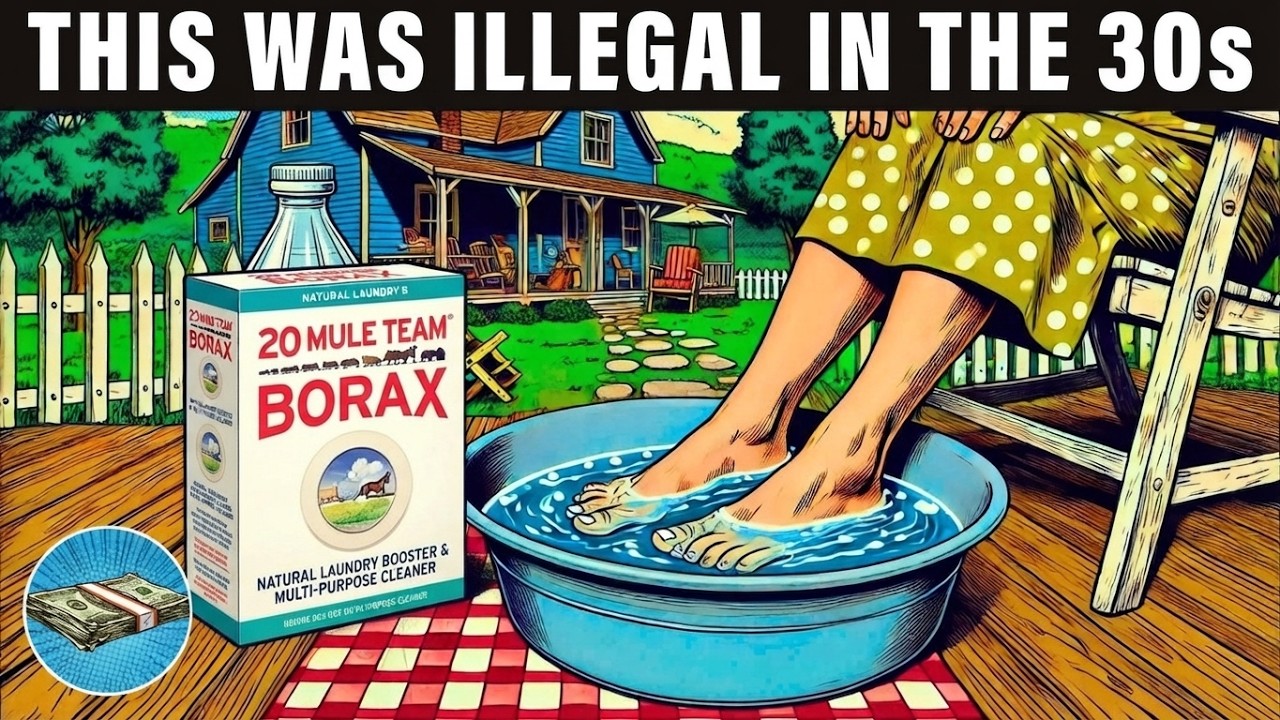
The glass cleaning industry promoted ammonia-based products as the only sound approach, dismissing borax as leaving mineral residue. Surface chemistry research has since shown that borax creates a temporary hydrophobic layer on glass that repels dust for up to a week longer than ammonia solutions, with superior results on old wavy Depression-era glass. When shoes wore out and podiatrists were unaffordable luxuries, a foot soak of two tablespoons of borax in warm water treated tired, cracked feet twice a week. The American podiatric establishment specifically targeted this practice in the mid-twentieth century, publishing guidelines that borax soaks were ineffective and should be replaced with commercial antifungal products.
Dermatological research has since confirmed that borax foot soaks possess genuine antifungal and antibacterial properties that address the actual causes of foot odor, athlete’s foot, and minor skin cracking. The alkaline environment inhibits fungal growth through a different mechanism than modern medications, making it effective against strains that have developed resistance. Grandma was treating resistant fungal infections before scientists understood what resistance meant. Ant infestations were handled by tracing the visible trail back to entry points and laying thin lines of borax powder mixed with powdered sugar along the kitchen perimeter.
Pest control industry regulations in several states later classified this as unlicensed pesticide application, and industry publications dismissed it as ineffective. Independent entomological studies have validated that borax bait mixtures are among the most effective long-term ant control methods available because ants carry the borax back to the colony, disrupting the entire population rather than just the surface foragers. In the nursery, cloth diapers were the only option, and sanitation was a survival concern. A tablespoon of borax in the diaper soaking pail neutralized ammonia and inhibited bacterial growth between washes.
Pediatric authorities later discouraged this citing skin sensitivity concerns, but textile hygiene researchers have demonstrated that when properly diluted and thoroughly rinsed, borax-treated diapers show significantly lower bacterial counts than water-only soaking methods. Ammonia buildup in cloth diapers is directly linked to diaper rash, a problem Grandma’s generation experienced at remarkably lower rates despite inferior access to health care. The toilet bowl was handled by pouring a full cup of borax in before bed, letting it work overnight, then scrubbing and flushing in the morning. Commercial manufacturers insisted specialized acidic cleaners were the only effective approach.
Microbiological testing has since shown that an overnight borax soak dissolves the calcium and magnesium deposits responsible for most staining while disrupting bacterial biofilm structures in ways that brief application of acidic cleaners cannot achieve. Grandma had patience. That was her chemistry. In the garden, which was survival infrastructure rather than a hobby, a diluted borax solution painted along the base of raised beds and fence lines deterred slugs, beetles, and crawling insects.
Agricultural Extension Services later classified borax as harmful to soil microbiomes and prohibited its use near food gardens. Recent soil science research has established that when applied to the perimeter structures rather than the soil itself, borax creates a contact barrier with minimal soil penetration that degrades naturally within a few weeks. Grandma never poured it on her plants. She painted it on her borders.
The prohibition ignored that crucial distinction. The applications continued through every corner of the Depression home: preserving cut flowers in a borax and cornmeal mixture that protected natural color compounds more effectively than the silica gel that florists later promoted; polishing silver with a borax paste whose particles were softer than the tarnish they removed; sealing mildewed books in paper bags with dry borax to halt active deterioration without the structural shock of temperature-based methods; treating early wood rot with a saturated borax solution that penetrated deep into wood fiber and stopped active rot fungus more reliably than many expensive commercial alternatives. One of the most whispered about practices targeted cockroaches. Grandma mixed borax with equal parts white flour and powdered sugar, placing small amounts behind appliances, inside cabinet toe kicks, and along wall junctions.
Health inspectors and licensing boards later prohibited such unlicensed applications, and the chemicals industry pushed hard to classify borax as unsafe for home use. The reality is that this mixture remains one of the most scientifically validated methods for long-term cockroach population elimination because it targets the entire population through the same foraging and feeding-sharing behaviors that make cockroaches so difficult to eliminate with fast-acting contact poisons. And then there was the final, most quietly confident practice of all. It was not a single trick but a philosophy.
Grandma placed open shallow dishes of dry borax powder throughout the house: under beds, in closet corners, in basement corners, and on window sills. Passed-down household knowledge held that borax naturally absorbs excess moisture from the air, and maintaining lower indoor humidity prevented the mold, mildew, dust mite proliferation, and respiratory illness that accompanied damp Depression-era housing. Authorities later classified this as pseudoscience with no measurable impact on indoor air quality. Indoor environmental quality researchers have since confirmed that borax functions as a genuine hygroscopic agent with real moisture-absorbing capacity, and reduced indoor humidity directly correlates with lower mold spore counts, lower dust mite populations, and measurably improved respiratory outcomes for occupants.
Across the entire household, from the flour barrel to the sleeping infant, from the lace curtains to the wooden porch boards, a single mineral powder did the work of an entire industry. The commercial economy that replaced it spent decades dismissing, prohibiting, and suppressing what Grandma already knew. The science eventually caught up, validating one Depression-era practice after another.
But by then, the generation that held the households together with a box of borax was long gone, and the quiet confidence of their knowledge had passed into memory.