I should have known something was off when no one answered my text that morning. I’m Brad, 27. For years, I’d been the unofficial workhorse of our blended family—always expected to show up early, carry the heavy stuff, and smile through the tension like I didn’t notice how carefully I was being kept at arm’s length. It’s not like I didn’t try.
I spent years trying to earn a real place in that family. But no matter what I did, I always felt like a guest in my own bloodline. It started after Dad remarried. He met Lisa, my stepmom, when I was 16.
She was polished, the kind of woman who could smile while cutting you down mid-sentence. Her two kids, Trevor and Meline, were around my age but acted like I was the weird kid invited out of pity. At first, I figured it would just take time. Families blend awkwardly at first, right?
But as months turned into years, it was clear Lisa was determined to make us one happy family without me in it. Dad tried to stay neutral. I think he meant well, but his version of peacekeeping usually meant asking me to be the bigger person. “Just let it go, Brad.
Lisa’s just stressed. ” Or, “Meline probably didn’t mean it like that. ” I heard that one after she accidentally left me out of her graduation dinner reservations and then posted a group photo with the caption “just family. ” When I mentioned it, I was told I was being too sensitive.
“It’s not a big deal,” Lisa had said. “She probably thought you were busy. ”
Still, I stayed civil. I came to birthdays, helped Dad move furniture, drove Trevor to job interviews when he didn’t have a car, and even spotted Lisa $400 once when she claimed her card had fraud issues.
She never paid me back. When I brought it up gently a few months later, she acted like I was nickel-and-diming her. “Wow, Brad, I didn’t know you kept score. ”
After that, I stopped trying to be included.
But I still showed up for Dad. So when he told me about the lake house trip this year, I thought maybe, just maybe, it was a turning point. A full week away at a beautiful rental property in Vermont that I helped him find online. He seemed excited when I sent him the Airbnb link.
“This looks amazing, son. Let’s do it. ” He even asked me to help organize the logistics—dates, who rides with who, grocery runs. I didn’t mind.
I like planning trips, and honestly, a week away from work sounded like something I desperately needed. The plan was for everyone to drive up in three SUVs, staggered by who was leaving when. Dad said they’d leave early Friday morning, and I told him I’d meet them there. I had a dentist appointment that morning.
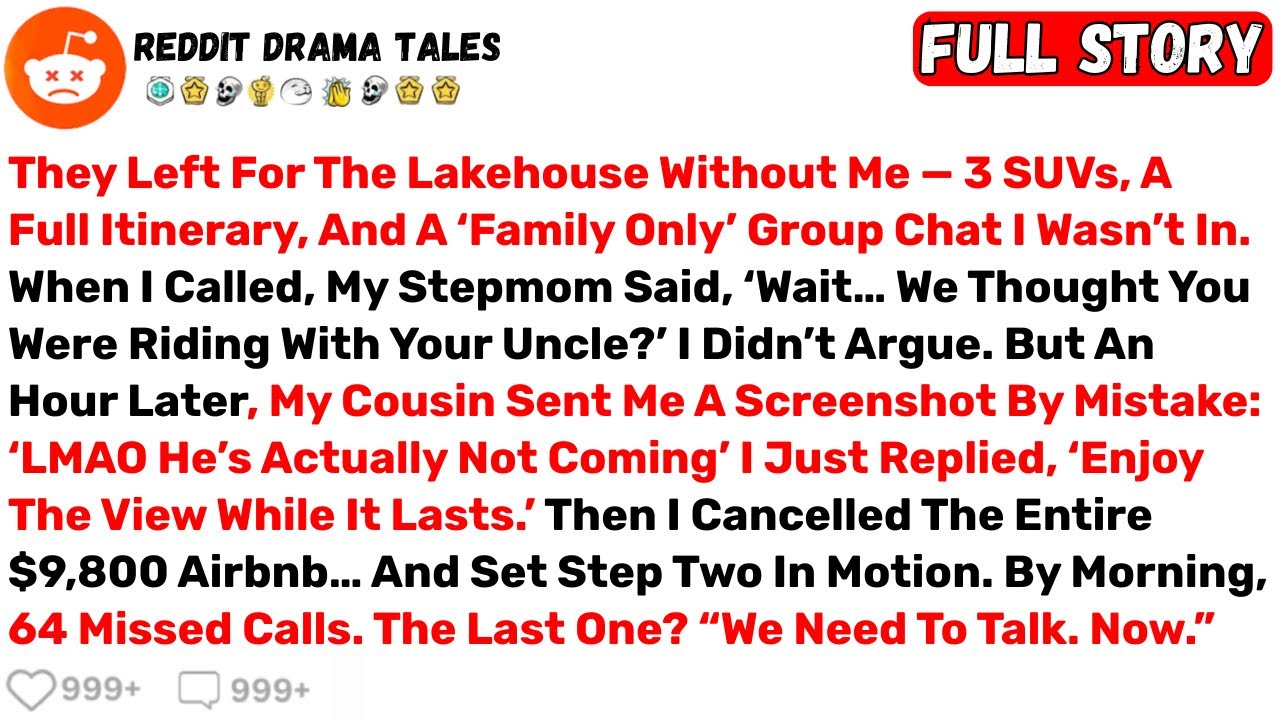
I couldn’t reschedule, but the drive was only three hours, and I was packed and ready the night before. “Text me when you hit the road,” I told him. “Will do,” he said. But Friday morning was silence.
I texted Dad around 8:00 a. m. No reply. I waited another hour, then tried Lisa.
Nothing. I called Meline—straight to voicemail. I didn’t panic. Maybe they were in a dead zone.
Maybe they were rushing to beat traffic. But something was off. Then, just after 10, I called Lisa again. She answered this time, sounding rushed.
I could hear wind in the background and someone laughing. “Hey, Brad,” she said, like she had just remembered I existed. “Hey, just checking. Did you guys already leave?
I didn’t hear back from anyone. ”
“Oh. Uh… wait, we thought you were riding with your uncle? ”
My stomach dropped.
Uncle Gary wasn’t even sure he was coming. “Huh, that’s weird. I thought we said you were going with him. Hold on, Trevor—did Brad say he needed a ride?
”
I heard mumbling in the background. “Huh? Okay, well, maybe check in with Gary. We’re already about an hour out.
”
I paused. My mouth felt dry. “No worries. ”
She hung up without asking if I needed directions or if I was still coming.
I sat there staring at my screen. I wasn’t on the packing list. I wasn’t on the call list. I wasn’t on anyone’s radar.
I didn’t call Uncle Gary. He was probably already up there. And I wasn’t about to grovel for a seat in the last car like a forgotten suitcase. I was halfway through packing my cooler when the message came in.
A screenshot from my cousin Ava, who had meant to send it to someone else. It was from a group chat I’d never been part of, titled “FamilyOnly Lakehouse. ” In the chat, someone had written, “Brad’s not coming, right? ” And Meline had replied, “Lol, he’s actually not coming,” followed by a bunch of laughing emojis.
I stared at it for a long moment. Then I just typed back: “Enjoy the view while it lasts. ”
Then I opened my laptop, pulled up the Airbnb dashboard, and hovered over the cancel reservation button. The total was $9,847.
32. I had booked it under my name using my account and even prepaid the security deposit. Dad had promised everyone would pay me back by the trip. No one had.
I clicked cancel. Then I started setting step two in motion. I didn’t hear anything for an hour. Then came the first missed call.
Then another. And another. By midnight, I had 64 missed calls. The last voicemail was from Lisa.
Her voice was tense, breathless. “Brad, we need to talk now. ”
You know that feeling when a thousand emotions hit you at once, but instead of saying anything, you just sit still? That was me, staring at my phone at 12:07 a.
m. , the screen glowing like it was mocking me. 64 missed calls, 19 texts, three voicemails. All of them came in a rush after the Airbnb cancellation went through.
I guess they didn’t realize I was the one who booked it. Or maybe they just assumed I was too much of a pushover to actually pull the plug. And maybe I was before tonight. Lisa’s voicemail was still playing in my head.
“Brad, we need to talk now. ” There was panic in her voice, like someone had kicked over her perfectly curated little world and she didn’t know where to find the pieces. But I didn’t call back. Not yet.
Instead, I sat on the edge of my bed and let the silence stretch out. The house was quiet—too quiet for how fast my thoughts were spinning. And that was the moment something inside me cracked. Not in an angry, explosive way.
It was quieter than that, more final. Like the sound a rope makes when it finally snaps after holding too much weight for too long. I wasn’t going to be the doormat anymore. Not for Dad, not for Lisa, not for anyone.
That night, I didn’t sleep. I lay in bed and replayed every little slight I’d brushed off over the years. Every forgotten invitation. Every time they’d accidentally made other plans without me.
The way they’d exclude me in the most subtle, deniable ways. How Lisa had once said right in front of me, “Well, the kids are so close because they grew up together, you know,” as if I hadn’t been there since I was 16. How Trevor had joked last Christmas that I was like the family’s in-turn. Everyone laughed.
I laughed, too. But later that night, when I asked Dad about it, he just said, “Come on, it’s just a joke. ”
I didn’t respond to any of their messages that night. The next morning, around 7:00 a.
m. , my phone buzzed again. Dad this time. I stared at his name.
Then I answered, calm as ever. “Hey, Brad,” he said, voice tight. “What happened? The Airbnb’s canceled.
Everyone’s freaking out. ”
“Yeah, I canceled it. ”
A long pause. “Why would you do that?
”
“You mean why would I cancel the $9,800 trip I organized, booked, and paid for after being purposely excluded and laughed at by my own family? ”
“Brad, no one purposely excluded you. This is a misunderstanding. ”
I almost laughed.
“A misunderstanding, Dad? Lisa told me I was supposed to ride with Uncle Gary, who wasn’t even sure he was going. Then Meline sent a group chat screenshot making fun of me. The chat I wasn’t even in.
Don’t play dumb. ”
“I didn’t know about that. ” He said it quickly. “Look, I’m sorry if Lisa—if we messed up, but you overreacted.
We had 15 people coming up here, and not one of those people thought to text me. ”
Another pause. Then, in a softer voice: “We’re already here. The whole family.
We’ve got food plans. This place was non-refundable, Brad. That was nearly $10,000. ”
“No, it wasn’t.
It was refundable. You would have known that if any of you had even glanced at the confirmation email I sent six times. But no one did, because I don’t matter unless you need something. ”
“That’s not true.
Isn’t it? ”
There was a long silence. “Look,” he said finally. “Let’s just talk in person.
Drive up here. We’ll figure it out. ”
“I’m not coming,” I said. “You made that clear when you left me behind.
”
“Brad, I have work to do. ”
“Hope the weather holds. ”
I hung up. That afternoon was quiet again.
Too quiet. But I wasn’t alone in it, because my cousin Ava—yeah, the one who sent me the screenshot by mistake—texted again, this time intentionally. “I didn’t know they left you out like that. I swear I thought you were riding with Trevor.
”
I didn’t answer at first. She followed up with, “You okay? ”
That broke the wall a little. “Honestly, not really.
But thanks. ”
She texted a few hours later: “Things are tense here. Lisa’s losing her mind. Trevor’s saying it’s your fault for being dramatic.
”
Of course he was. “Meline was crying earlier. Something about the deposit being gone. Also, did you really send an email to Airbnb saying there were structural issues with the house?
”
I didn’t respond to that one. Let’s just say the place wasn’t exactly up to code, and I may have included a few concerns about water damage and pest activity in my cancellation request. Airbnb took it seriously. I didn’t lie.
I just highlighted things the host had mentioned in the fine print. They should have read it. But the real breaking point wasn’t the voicemail. It wasn’t the missed calls or the canceled trip or even being left behind.
It came that night, when Dad sent me a single text:
“Can we talk? Lisa’s really upset. She said you’ve been causing problems for a while now. I think you should apologize so we can move on.
”
That one hit different. Apologize. After all the years of bending over backward to be part of their family. After swallowing every insult and brushing off every cold shoulder, I was the one who needed to apologize.
That was when I realized something. My dad wasn’t neutral. He never had been. He just didn’t want to deal with the fallout of choosing sides.
So he chose silence. And silence always favors the aggressor. I thought about all the times I’d stood up for him. How I defended him when he and my mom divorced.
How I stayed with him when everyone else said I should go with my mom. I thought about the weekends I spent helping him remodel the basement. The birthdays I spent in awkward family gatherings because he asked me to be there. Every time I showed up for him, even when his new family made it crystal clear they didn’t want me around.
And now he wanted me to apologize. I felt something in my chest twist. That was the moment I stopped seeing this as a misunderstanding. It wasn’t a miscommunication or bad timing.
It was a pattern I had allowed for too long. I opened my laptop and started making a list. Not a revenge list—not yet—but a list of everything I had helped this family with over the last five years. Expenses I’d covered, events I’d organized, emails I’d sent, reservations I’d booked, bills I’d paid.
It was longer than I expected. $400 to Lisa for her card issue. $270 for Meline’s birthday dinner when her card randomly got declined. $800 I spent hosting Thanksgiving two years ago because no one else had space.
$2,000 on a jet ski rental last summer that Dad promised we’d all split later and never did. And the lake house—$9,800 in total. Not $1 paid back. I wasn’t mad at the money.
I was mad at what it represented. Every dollar was another inch I’d stretched myself trying to prove I belonged. And I was done stretching. Ava texted again the next morning: “So Trevor said you sent him a Venmo request for $2,600.
”
I replied: “That’s his share for the Airbnb, jet ski, and last year’s groceries. ”
She added a crying-laughing emoji. “Then you’re a menace. ”
“Just thorough,” I texted back.
Trevor didn’t respond to the Venmo request, but I didn’t expect him to. I sent Meline one, too. And Lisa. I itemized everything.
And then I made a plan. I wouldn’t show my hand all at once. That would be too easy, too satisfying, too quickly. No, I wanted them to feel what I had felt.
The quiet exclusion, the sudden silences, the slow unraveling of certainty. I wanted them to wonder what came next. Because step one was canceling the lake house. Step two was already in motion.
And step three—well, let’s just say it would change everything they thought they knew about me. I was done asking for a seat at the table. I was building my own table. And it had locks.
The week after the lake house disaster, everyone else was scrambling to pick up their scattered plans while I sat alone in my one-bedroom apartment, scrolling through texts I didn’t want to answer and trying to pretend I didn’t care. But I did care—way more than I wanted to admit. For three days, I didn’t go to work. I didn’t answer calls.
I didn’t even open the blinds. I kept the lights off, let dishes pile up in the sink, and watched old movies I didn’t even like. My phone kept buzzing with messages from Dad. Some apologetic, some frustrated, some just tired.
“We should have communicated better. ” “Lisa’s upset. ” “She didn’t mean it that way. ” “This family is falling apart.
”
The irony wasn’t lost on me. Falling apart? It was never whole. Not for me.
The worst message came from Lisa herself. Surprisingly calm, almost rehearsed: “Brad, we never wanted you to feel excluded. But you have to understand, sometimes you pull away first. It’s hard to include someone who’s always at arm’s length.
”
That one stayed with me for hours. I stared at it, feeling something bitter rise up in my chest. I had bent over backward to be included. I was at every dinner, every birthday, every family game night I was invited to.
I drove hours to pick up Trevor when he locked his keys in his car, even when it made me late for a work meeting. I brought wine to Lisa’s “Just Girls” book club when she forgot to grab a bottle. I was always there. Just invisible.
But according to her, I was the problem. That was rock bottom. Not the exclusion, not the betrayal, not the money. The gaslighting.
The rewriting of history in real time. Watching people I called family recast themselves as the victims in a story where I was nothing more than an inconvenience. I wish I could say I snapped out of it overnight. I didn’t.
It took time. The first step was quiet. No big revenge plan. No dramatic speech.
Just small decisions. I cleaned the apartment, took out the trash, opened the blinds. I cooked an actual meal instead of microwaving leftover takeout. I didn’t realize how long I’d been holding my breath until I exhaled.
Then I opened my laptop—not to check emails, not to update the family group chat. They had finally added me after the lake house fiasco. Like that made a difference. No.
I opened my laptop to check something I hadn’t touched in months: my freelance business website. A year earlier, I’d started doing small graphic design jobs on the side. Logos, brand kits, packaging mock-ups. Nothing glamorous, but I was good at it.
I had a degree in visual communications and had even won a small award during college. Still, full-time work at a marketing agency left me drained, and I never had the energy to take it seriously. Until now. Something shifted that day.
Maybe I was tired of waiting for validation. Maybe I just needed something that was mine. I spent the next two weeks redesigning my portfolio, updating my rates, reaching out to past clients for testimonials. I built a newsletter, started posting design tips on LinkedIn.
Slowly, quietly, I was building something that didn’t depend on anyone else’s approval. And it worked. By the end of the month, I’d booked five clients. The next month, eight.
In three months, I made more on the side than I did in my full-time job. And I wasn’t done. One of my clients, an old college friend named Nina, connected me with a boutique fitness brand looking for a full-time creative consultant. We got on a Zoom call, and halfway through the meeting, the founder said, “I’ve seen your work.
You’ve got a sharp eye, and honestly, we need someone who doesn’t sugarcoat things. ”
She offered me a contract on the spot. Twice my agency salary. Remote.
Full creative control. I accepted. Quit my job two weeks later. I didn’t tell my dad.
Not yet. The funny thing is, once I stopped trying to impress them—once I stopped showing up to every family dinner and texting back within five minutes—things got eerily quiet. Lisa stopped messaging. Trevor ghosted completely.
Meline posted cryptic quotes on her Instagram stories like “sometimes the black sheep was just the one who saw through the BS. ”
Sure. But Dad kept trying. He called once a week, sometimes twice.
Left voicemails. I didn’t ignore him—just didn’t chase him either. We talked, but not about the trip, not about Lisa. We kept it surface level.
Work, weather, whether I’d seen the new Marvel movie. Then came Thanksgiving. I knew they were hosting, of course. Lisa posted pictures of her handmade place cards and dry-run table settings on Facebook.
Trevor posted a group pic of the crew holding drinks in matching flannel. No one invited me. I wasn’t surprised, but I felt it. So I did something different.
I invited my mom and her new husband over. Cooked an actual dinner. Turkey, stuffing, cranberry sauce from scratch. I even baked a pie, which I’d never done in my life.
We laughed, played cards, stayed up until 2:00 a. m. telling stories I hadn’t heard in years. It wasn’t fancy, but it felt like something I hadn’t felt in a long time.
Home. That night, I looked around my small, cozy apartment and realized I didn’t miss the lake house. I didn’t miss the forced smiles or the one-sided conversations. I missed the idea of family—the one I kept chasing like a mirage.
And maybe I didn’t have that with my dad anymore. Maybe I never really did. But I had it here. And I could build the rest.
In December, something interesting happened. I got a LinkedIn message from a recruiter who’d seen my posts. She asked if I’d be interested in giving a talk at a virtual conference about freelance design and building a personal brand. At first, I almost said no.
Me, talk at a conference? I wasn’t that guy. But then I thought about how far I’d come. Quietly, without applause, without backup.
I said yes. The talk went well—better than I expected—and two weeks later, I was offered a monthly segment on a design podcast with a growing audience. That was when I realized this wasn’t just recovery. It was reinvention.
Ava texted me around Christmas. She said Lisa had been in rare form lately, that Meline was still salty about the Airbnb, and Trevor was complaining to anyone who’d listen about the Venmo requests I sent him. She also said something that stuck with me: “You’re like a ghost to them now. It’s driving them nuts.
”
I smiled at that. Not out of spite, but because for once, I was no longer on the outside looking in. They were. On New Year’s Day, I got a call from Dad.
I almost didn’t answer, but I was in a good mood, and part of me was curious. “Happy New Year,” I said. He sounded tired. “Happy New Year, Brad.
”
We talked for a bit. Weather, resolutions, the usual. Then he sighed. “Lisa’s been upset,” he said carefully.
“She thinks you’ve frozen everyone out. ”
I didn’t say anything. He continued: “I’ve been thinking a lot about what happened, and I want you to know—I should have stood up for you more. ”
That caught me off guard.
“She was wrong to assume you weren’t coming,” he added. “They were all wrong to make fun of you. I didn’t know about the group chat until afterward. I stayed quiet, but I saw how hurt you were.
And I know you probably don’t trust me anymore. I don’t blame you. I just—I wanted you to know I see it now. ”
I exhaled slowly.
“It’s not about trust,” I said. “It’s about respect. I’ve spent years trying to earn a spot in that family. But the truth is, I was never really invited.
I just kept showing up anyway. ”
“I know. ”
And maybe he did. We didn’t talk much longer.
But when I hung up, I felt lighter. I wasn’t naive enough to think everything was fixed. Apologies don’t erase years of being overlooked. But maybe, just maybe, they were finally starting to see me.
And maybe that wasn’t even the point anymore. Because I saw myself now clearly. And that was enough. But this isn’t where the story ends.
Not even close. Because while I was rebuilding quietly, something else had been brewing behind the scenes. Something that would change the entire dynamic once and for all. Something I hadn’t told them.
Not yet. But it was coming. And when it hit, it would hit hard. Most people think revenge is about anger—that heat in your chest when someone wrongs you, that urge to scorch the earth beneath their feet.
But real revenge, the kind that matters, is cold, patient, surgical. It waits in silence while the people who hurt you forget the damage they caused. It sharpens itself while they laugh, move on, pretend it never happened. It doesn’t yell.
It doesn’t beg. It just watches. And builds. That’s what I’d been doing.
By the time January ended, my freelance design business had turned into a full-fledged agency. I brought on two part-time designers, both friends from college—one in branding, one in UX. I rebranded my website, raised my rates again, and began consulting for mid-sized e-commerce brands tired of boring design. I’d built something that finally gave me leverage, even if they didn’t know it yet.
And then the opportunity landed in my inbox like fate had a wicked sense of humor. It was a forwarded email from Ava. She was the only one from that side of the family I still kept in touch with. We weren’t especially close, but she had always been the type to observe more than she spoke.
She’d seen what had happened with the lake house, and while she hadn’t said much at the time, her silence had been different from the others. It felt understanding. Her message was short: “Figured you’d want to see this. ”
Attached was a forwarded email thread between Lisa and a woman named Dana.
Subject line: “Brand Design Help URGENT—Family Connection. ”
I scrolled down. Apparently, Lisa had started a little boutique lifestyle brand. Candles, home decor, motivational quote prints—the whole clean, white, minimalist aesthetic.
She was calling it “Haven by Lisa. ” Cringe, but whatever. The problem? Her designer had ghosted her three weeks before her online launch.
Her photos weren’t edited, her logo was pixelated, and her Shopify site was unprofessional. She needed a full brand identity refresh, packaging mock-ups, and help with her product labels ASAP. And the kicker: she had told Dana she had a family connection in design and wanted to see if I was available. I sat back in my chair, rereading the thread.
She didn’t text me. Didn’t call. Didn’t even bother reaching out directly. She tried to slide in through a mutual contact, like we were strangers.
That was when I knew this was it. The perfect opportunity. Step one had been the Airbnb. Step two had been going ghost and rebuilding in silence.
Step three was about to be a masterclass in poetic justice. But I wasn’t going to rush it. Oh no. The setup had to be clean.
I replied to Ava: “Thanks. Don’t forward anything else yet. Just sit tight. ”
Then I messaged Dana directly.
Professional tone and all: “Hi Dana, just got your message. I do offer brand identity and launch packages. What timeline are we looking at? ”
We set up a Zoom call the next day.
I didn’t tell her I already knew who the client was. I didn’t mention Lisa’s name. I let her explain the situation like it was any other project. She said: “It’s for a friend of mine, Lisa Reynolds.
You two might be related. She said your dad is her husband. ”
I smiled. “Small world.
”
“She’s really stressed about the launch. Wants to go live by the end of February. I know it’s tight, but if anyone can pull it off, it’s you. ”
I told her I’d take a look.
Then I ghosted her for two days. Not out of pettiness. Out of strategy. When I finally replied, I said: “Sorry for the delay.
I’ve been slammed with corporate contracts, but I could potentially fit this in if she’s serious. My rate for urgent brand launches is $7,500. I require full payment upfront. ”
Now, here’s the thing.
That was more than double what I normally charge for rush work. But I knew Lisa. She didn’t want someone good. She wanted someone connected, someone she could control, someone who would give her the “family discount” and bend over backward for her big moment.
Instead, I handed her a lockbox and threw away the key. She replied through Dana two hours later: “Hi Brad, thanks for getting back to us. Lisa said she’d be willing to do $3,000 max. She’s already invested a lot into this and is hoping for a family-friendly quote.
”
I waited a day. Then I replied: “I understand, but unfortunately, I can’t make exceptions. I treat family the same way I treat all my clients: with full effort and full value. $7,500 or nothing.
”
That was bait. And she took it. Because the next day, I got the first direct text from Lisa in over three months:
“Hey Brad, just wanted to touch base. Dana said you’re available.
I had no idea you were doing design full-time now. So proud of you. ”
I stared at that message like it had come from another planet. So proud of you.
After years of acting like my degree was a hobby and my work was “nice for something artsy. ”
I didn’t respond. She followed up again the next morning: “I’d really love to support your business. Can we talk price?
I’m in a tight place right now with inventory and production costs. ”
Ah, yes. The soft manipulation stage. I replied, polite but firm: “Hey Lisa, thanks for reaching out.
As I mentioned to Dana, my flat rate for urgent launches is $7,500. Let me know if you’d like to proceed. ”
She left me on read. I gave it three days.
Then I texted Dana directly: “Hey, circling back one last time. If Lisa is passing on the offer, I’ll be closing the calendar slot. ”
An hour later, Dana wrote: “She’s in. $7,500.
She’ll pay today. ”
And just like that, I had her. But this wasn’t about the money. It was about control, timing, the illusion of power.
Because once I had her contract signed, her files delivered, and her product list in my inbox, I began documenting every chaotic step of her unorganized operation. Misspelled product names. Wrong barcodes. Incomplete ingredient disclosures.
Inaccurate weight listings. And most importantly: she was using unlicensed images and fonts from Pinterest to mock up her packaging—which, if left unchecked, could lead to legal takedowns. Or worse. I didn’t sabotage anything.
That wasn’t the point. I just let her hand me the rope. And then I began building the scaffolding. Meanwhile, I started reaching out to contacts—podcast hosts, marketing writers, a few small e-com subreddits I contributed to anonymously.
I began planting little breadcrumbs. Not slander, not lies. Just questions. “What happens when someone launches a lifestyle brand with stolen design assets?
”
“What legal risks do small shops face using unlicensed imagery? ”
“Anyone seen Haven by Lisa yet? Notice some sketchy stuff. ”
Whispers.
That’s all it took. And while the whispers spread, I did exactly what she paid me to do. I made her brand beautiful. Elegant logo, custom font pairing, clean Shopify layout, social media templates, fully designed packaging.
It looked flawless on the outside. But I knew what lived underneath. And so did she, deep down. She sent me a thank-you email after I delivered the final package: “This is stunning, Brad.
You really are talented. I’m sorry we had tension before. Let’s let the past go. We’re family, after all.
”
I replied with one sentence: “Enjoy the view while it lasts. ”
That was mid-February. Two weeks before her launch. One week before I sent her an itemized list of licensing issues, misrepresentations, and potential copyright flags—gently framed as “things you may want to address before going live.
”
Her response was immediate: “Why didn’t you tell me this earlier? You said everything was fine. You’re trying to sabotage me. ”
I didn’t reply.
She began frantically asking me to fix things at no additional charge. Of course, I told her I could send referrals or take on the extra work for another $3,000. She exploded. Said I was exploiting her.
That she trusted me. That she was family. I didn’t respond. The final setup was complete.
She was cornered. Out of time. Over budget. Launching a brand she didn’t understand, on a platform she didn’t build, with assets she couldn’t legally use.
And the best part? She couldn’t badmouth me without admitting I’d done everything she asked—perfectly. But the real revenge—that was still to come. Because all this—the Airbnb, the silence, the cold rebuild, the flawless branding—it was all leading to one final reveal.
One that would flip the script permanently. Not just on Lisa, but on my father, on Trevor, on Meline, on the entire family who had written me off, laughed at me, used me, then forgot me. They thought I was gone. But I wasn’t.
I was just getting started. You only get one shot at a good ending. One that doesn’t just settle the score, but resets the balance. I wasn’t looking to ruin anyone’s life.
I wasn’t going to take down Lisa’s business or burn bridges in a way that left everyone worse off forever. That wasn’t the point. Revenge, for me, wasn’t about destruction. It was about clarity.
Truth. Making sure that people who had built entire narratives around my silence finally had to hear me. Not through yelling or pleading, but through results they couldn’t ignore and consequences they couldn’t escape. It all came down to timing.
Lisa’s launch was scheduled for a Saturday—a big one. She had teased it all over her personal Instagram: “Big reveal coming this weekend! Can’t wait to show you what I’ve been building! ”
There were styled teaser photos of her holding candles, standing beside quote prints about peace and grace and building something beautiful.
The hypocrisy of it made me nauseous. But I let it ride. I let her get to the peak. Because it’s only at the top that the fall really stings.
The day before launch, I sent her one final email. Professional tone. Attached as a formal memo. No drama, no emotion, just facts.
Subject: “Final Deliverables + Licensing Summary. ”
In it, I detailed every component she had failed to fix. The unlicensed Pinterest photo she insisted on using for her handcrafted soy wax labels—the one she didn’t realize belonged to a commercial photographer who actively tracked his images. The script font she loved that was actually a premium-license-only file she’d downloaded off a free font aggregator with no usage rights.
The candle descriptions she copied verbatim from another wellness brand’s Etsy page. The ingredient labels that didn’t match the actual scents. Each item in the memo was listed with the asset or content, the original rights holder, the specific licensing infraction, the associated risk: copyright claim, takedown notice, trademark conflict, or FTC violation. At the end, I wrote: “As your designer, I fulfilled the scope of work we agreed upon.
I advised you multiple times about licensing risks and offered to provide solutions at additional cost. You declined. Please consider this my final communication regarding your launch. I will not be liable for any third-party claims or misuse of assets beyond this point.
”
Sent at 9:02 a. m. At 10:17, she called me. I didn’t answer.
At 11:00, I got a long email. Half panic, half guilt trip: “Brad, this isn’t fair. You knew I was overwhelmed. I trusted you.
I put your name in the credits of the brand story video. Now you’re just washing your hands of it? ”
I didn’t reply. I didn’t have to.
Because the next part wasn’t about emails. It was about showing them exactly who they’d underestimated. See, what Lisa didn’t know—what none of them knew—was that I’d spent the past three months preparing for more than just her downfall. I’d quietly purchased the domain HavenbyLisa.
com six weeks earlier. She hadn’t even secured it. Her Shopify was built on a default subdomain. Her marketing campaign directed people to her Instagram, which linked to Haven by Lisa’s shop.
myshopify. com. So I bought the clean . com.
And I turned it into an exact replica of her brand—but with one major twist. Instead of selling products, it was a full documentation site. A digital paper trail. A case study in performative branding.
“The Rise and Fall of Haven by Lisa. ”
It had everything. Side-by-side comparisons of the plagiarized Etsy listings. Screenshots of the Pinterest photos with links to the original creators.
Archive links of the copied ingredient labels. A section titled “What Happens When You Build a Brand on Stolen Work,” with citations, warnings, and a very clear disclaimer at the bottom: “This site is a commentary and educational archive designed to highlight unethical design practices and intellectual property violations in the small business world. No products are for sale. All trademarks belong to their rightful owners.
”
It was airtight. Not cruel. Not defamatory. Just true.
And devastatingly public. By 2:00 p. m. on launch day, I posted the link on Reddit under my anonymous design-education handle—the same one I’d used for months to drop free branding tips and copyright guides.
The post title: “When a Wellness Brand Isn’t Well: A Deep Dive into Haven by Lisa. ”
It hit 1,000 upvotes in six hours. By the end of the weekend, three small creators featured in the case study had left comments thanking me for the exposure and confirming they’d filed takedown requests. Lisa’s Instagram went dark by Monday morning.
The Shopify site was pulled offline. She posted one story that night: “Due to unforeseen technical issues, our launch has been postponed. Thank you for your patience. ”
But she was spiraling.
And not just professionally. Because here’s where the fallout started to ripple outward into the family. Trevor messaged me the day after the Reddit post exploded: “Bro, what the hell did you do? ”
I replied: “Clarified the truth.
”
He tried to bluff, said I was being petty, said I’d cost Lisa thousands. I didn’t reply. Meline was subtler. She texted Ava: “Do you think Brad would take the site down if Lisa apologized?
”
Ava sent me the screenshot with a crying-laughing emoji. She still doesn’t get it. No. She didn’t.
But Dad did. Because three days later, he called me. No voicemail. Just a quiet, heavy call.
I answered. He didn’t say anything at first. Then: “You really did all this. ”
“Every word is true,” I said.
A long pause. “I didn’t know,” he muttered. “She said you were helping her. ”
“I did.
And I delivered. What she did with the help, that’s on her. ”
“She’s humiliated. ”
“She should be.
” Silence. “Then she blames me for not stopping you. ”
I almost laughed. “She should blame herself for how she treated me.
You all should. ”
He sighed. “Brad, I don’t even recognize this version of you. ”
That stopped me cold.
Because for the first time in my life, I realized he meant it. Not as an insult. As a fact. He didn’t recognize me.
Because the version of me they were used to—the doormat, the helper, the silent extra in the family photo—he was gone. I had burned him away. What remained was someone new. Someone who didn’t wait for permission.
Someone who didn’t beg to be included. Someone who built his own table and set the whole room ablaze when no one offered him a chair. “I know you don’t recognize me,” I said. “That’s the point.
”
He was quiet again. “I didn’t mean for things to get this bad,” he said. “You didn’t do anything,” I replied. “That’s how they got this bad.
”
He didn’t argue. Didn’t deny it. And in that silence, I felt something close for good. Not out of hate.
Not even out of anger. Just closure. We ended the call with a tired, “Take care. ” We haven’t spoken since.
Lisa never posted another story. Haven by Lisa never launched. The domain HavenbyLisa. com now redirects to a nonprofit supporting small artists and designers.
Ava and I still talk. She said Meline and Trevor are laying low now, rebranding themselves as the real victims. Let them. That part of my life is over.
My agency just signed its biggest client yet. I moved into a new apartment—top floor, natural light, no ghosts. Last week, I gave a talk at a design conference. I told the story of Haven by Lisa as a cautionary tale.
Names omitted. Facts intact. The audience laughed, took notes, asked me to write a book. Maybe I will.
Maybe I already am. Because the best stories—the ones worth telling—don’t start with revenge. They start with forgetting who you were long enough to become who you were meant to be. And when they try to pull you back, when they pretend not to understand why you changed, you look them dead in the eye and say:
“You left me behind, so I built the road ahead without you.
”