My older brother Darren was the golden child dipped in glitter. Loud, charming, shallow, and always ready with a new story about how amazing his life was going. According to him, he was a self-made businessman with multiple properties and a BMW he earned through pure hustle. Our parents nodded along like proud actors in a commercial.
I was the quiet one. The kid who colored inside the lines, fixed everyone’s computers, and said thank you when I got hand-me-downs instead of birthday gifts. That was my role. Background noise to his spotlight.
Then Halloween came, and I decided I was done playing it. The party was at my parents’ place, a big colonial house in the suburbs. Costume theme, overpriced outfits, fake laughter everywhere. I showed up as “the forgotten son”—a frayed jacket, a name tag reading “Hello, I’m nobody,” and a beat-up thrift store briefcase.
Subtle, tongue-in-cheek. I figured nobody would get it. Darren showed up dressed like a Wall Street CEO, fake cigar, slicked-back hair, that signature smug grin. He flashed his Rolex—the one he always showed off like an heirloom—and held out his car keys like they were made of gold.
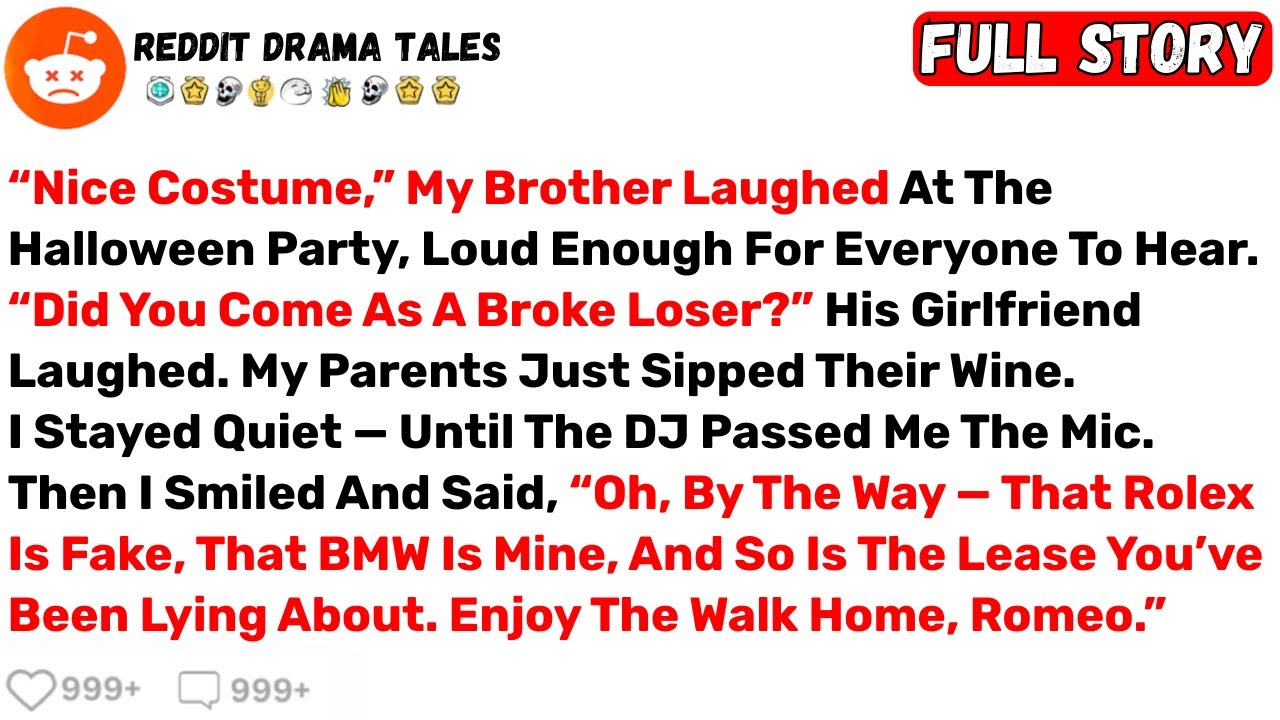
He spotted me within minutes. “James,” he said, blinking like he’d found a stray dog. “Nice costume, bro. Did you come as a broke loser?
”
Laughter rippled through the room. Kayla, his girlfriend, laughed like she’d rehearsed it. “Oh my god, he totally did. ”
My parents glanced over.
My mom looked away. My dad kept sipping his wine. No one said a word. Darren leaned in, whispering loud enough for half the room to hear.
“Didn’t think you’d show up. Brave move, considering you probably Ubered here. The BMW’s parked up front, right in the driveway. Just had it waxed.
”
I said nothing. He clapped me on the shoulder. “Don’t worry, man. Not everyone’s cut out for success.
Some of us lead, others write code. ”
Then he walked off, laughing. I stood there with my soda, heart pounding. Not with sadness.
Something colder. Sharper. The part of me that had been waiting for them to change finally locked the door. That’s when the DJ called Darren up for a toast.
Darren strutted to the center of the room and spent five minutes bragging about how hard he’d worked, how success didn’t come easy. He looked straight at me. “Some people just don’t get it. They think being quiet is noble, but the world doesn’t reward wallflowers.
”
The DJ, with terrible timing and a sense of mischief, passed me the mic. “Hey, maybe the mysterious brother wants to say something. ”
I took it. I smiled.
Just a little. And said, slowly, clearly: “Oh, by the way, that Rolex is fake. That BMW? It’s mine.
And so is the lease you’ve been lying about. Enjoy the walk home, Romeo. ”
The room went still. Music still played, but no one danced.
Darren stood frozen, mouth half open. Kayla blinked like she couldn’t process what she’d just heard. My parents’ wine glasses hung mid-air. I handed the mic back and walked to the kitchen.
Picked up a bottle of water. Leaned against the counter. The murmurs started. “Wait, that BMW?
” “Did he say fake Rolex? ” “Was Darren lying? ”
Darren found me three minutes later, stomping into the kitchen with rage barely contained. “You think that was funny?
” he hissed. “I just told the truth,” I said. “If that’s embarrassing, maybe that’s your problem. ”
“You’re lying.
That car is mine. ”
“You used my name for the lease, Darren. You know it. I have the paperwork.
”
His mouth opened, then closed. He tried to sneer. “So what? You’re jealous?
You think pulling a stunt like that makes you better than me? ”
“No,” I said. “But it does make me honest. ”
I left him there.
My mom texted. “We need to talk. Come back inside. ”
They were waiting in the hallway near the stairs.
My mom crossed her arms. “What you did was completely inappropriate. ”
I blinked. “What I did?
”
My dad tried to play mediator. “Son, we understand there are tensions, but humiliating him in front of all our guests—”
“He humiliated me,” I said. “He’s been doing it for years. You just never noticed, or didn’t care.
”
My mom rolled her eyes. “Oh, come on. You’re being dramatic. ”
“Am I?
He’s been using my name to lease that car because his credit is shot. He flashes a fake watch. He mocks me in front of you, and you laugh. Kayla treats me like a joke.
I say one sentence of truth, and I’m the problem. ”
My dad shifted. “This wasn’t the time or place. ”
“There never is a time or place, is there?
Because anytime I speak up, it’s inappropriate. But when Darren insults me, it’s just joking. When he takes credit for my work, you smile. When I achieve something, it’s ignored.
”
My mom’s face went cold. “We’re asking you to apologize. Just to smooth things over. ”
“No.
”
“Then maybe it’s best if you leave. ”
I nodded slowly. “Fine. ”
I walked out the front door.
No goodbyes. No drama. In my car—my car—I sat and stared at the windshield, heart racing. Not from anger.
From something deeper. A quiet, final understanding. They were never going to choose me. The next morning, I woke up to three missed calls from my dad and a long text from my mom.
“Your behavior was selfish and childish. Darren is your brother. Family comes first. I expect you to do the right thing and apologize.
He’s very hurt and you embarrassed all of us. ”
I stared at the message for a long time. Then put my phone down and went for a walk. I didn’t respond.
My cousin Erica called later that day. She’s one of the few family members who doesn’t pretend. “Dude,” she said. “That was legendary.
”
“Was it? ”
“Seriously, everyone’s talking about it. And not in a bad way. People are finally seeing through Darren’s act.
”
Then she told me Darren had argued with Kayla in the driveway after I left. Something about the car. She stormed off, and he had to call an Uber. I couldn’t help but smile.
The following week, I got an email from the dealership. Darren had missed two payments on the lease. Since the lease was in my name—thanks to some smooth talking he’d done back when I was naive enough to help—they were contacting me. The story wasn’t over.
It was just starting. I thought the Halloween party was the turning point. It wasn’t. That was just the first crack.
The real fracture came a few weeks later, and it didn’t come from Darren. It came from the people I still held out hope for. My parents. I was reading a proposal one quiet Saturday morning when the email hit.
Subject: “Urgent notice, lease account status. ”
As of November 17th, the BMW lease was 91 days past due. Ninety-one days. Three months of missed payments while Darren showed off that car, flashed those keys, made me the punchline of a party he drove to in my name.
I’d co-signed for the lease last spring when he called crying about lost hours and ruined credit. He said it would just be for a few months. I believed him. I never even told my parents because I knew what they’d say—that I was too soft, too naive.
I called him. No answer. Texted. Nothing.
I drove to my parents’ house. My mom answered in her silk robe. “James? What are you—?
”
“Where’s Darren? ”
“He’s not here. What’s going on? ”
I showed them the email.
“I want to know if either of you knew Darren hadn’t been paying the lease. ”
My mom set her mug down. “What lease? ”
“The BMW lease.
The one I co-signed for. The one he’s now three months behind on. ”
My dad’s jaw tightened, but he said nothing. My mom’s eyes darted.
“We didn’t know. Darren didn’t say anything about—“
“Don’t,” I snapped. “Don’t pretend like he hasn’t been coming here every week playing house. You really mean to tell me neither of you ever stopped to wonder where the money was coming from?
”
“He said he was working things out. ”
“And you believed him. ”
My dad spoke quietly, firmly. “James, that’s enough.
”
“No. It’s not. ”
I left. When I got home, I started making calls.
I contacted the leasing company and began the painful process of severing the lease—a process that would likely cost me thousands just to clean up Darren’s mess. Then I did something I hadn’t done since I was a teenager. I went into my old Gmail account, the one I hadn’t used in years, and searched for the backup folder I’d made back when Darren borrowed my laptop to apply for jobs and forgot to log out of his email. Dozens of screenshots.
Emails between Darren and his friends where he bragged about cheating on past girlfriends. Messages where he laughed about borrowing money from the little bro and never paying it back. One where he literally wrote, “Dude, my parents treat him like a ghost. He’ll do whatever I ask if I just pretend to be nice for five minutes.
”
I never told anyone about those emails. Back then, I still believed he could grow up. That he would. Now I knew better.
Three days later, my dad called. “James, we need to talk. Your mother and I are concerned. Darren told us you’re trying to sabotage him, that you threatened to ruin his credit and take his car.
He said you’re going through something, maybe stress related. We think you should come over and talk. ”
I almost dropped the phone. “He what?
”
“He said you threatened him. That you were unstable. ”
That was the final blow. Darren had weaponized my parents against me.
And they were believing him. I didn’t shout. I didn’t argue. I just said, “Don’t call me again.
” And hung up. I stopped answering their calls. Stopped responding to texts. Even when my mom sent a photo of our childhood dog with the caption “He misses you.
So do we. ”
I wanted to scream. But I didn’t say anything. I turned off notifications and went silent.
I didn’t tell anyone what was happening. There’s something incredibly isolating about family betrayal, the quiet kind that doesn’t leave bruises but still carves into your gut. So I let myself disappear for a bit. Work, home, repeat.
The lease company kept calling. Eventually, I worked out a deal to return the car voluntarily. It would reduce the damage to my credit but still tank my score. I’d have to live with that for a while, pay off the fees, rebuild.
I remember the day I handed over the keys. It was raining. The rep at the dealership said it happens more often than people think. That was supposed to be comforting.
It wasn’t. Watching them drive away in the car I’d never even used—the one Darren paraded around like a trophy while I took the bus to work most days—felt like a strange kind of funeral. Not for the car. For the version of me that still thought there was something worth salvaging.
That night, I sat alone in my apartment, lights off, rain tapping the windows, and broke. Not theatrically. Quietly. Letting the weight of everything I’d swallowed over the years settle on my chest like lead.
All the birthdays where Darren got what I asked for. All the times my parents told me to be the bigger person. Every joke at my expense laughed off. Every win I downplayed to avoid being accused of bragging.
Every apology I gave for things I didn’t do. Every time I believed that if I just kept being good and quiet, eventually I’d be seen. I wasn’t. And I wouldn’t be.
Not by them. At 4:12 a. m. , something clicked.
Not like a light bulb. Like a lock turning. I’m done. Not with my life.
Not with the world. With them. I wasn’t going to beg for understanding. I wasn’t going to prove my side of the story.
I wasn’t going to spend another minute explaining myself to people who had made up their minds years ago about who I was allowed to be. So I started cleaning house. Deleted old family photos from my drive. Unfollowed them on social media.
Archived the group chat. Then I got to work. I dug into the folder I’d labeled “Darren Truth. ” Lease documents.
Dealership emails. Screenshots of conversations. Emails from his old account. Voicemails where he thanked me for saving his ass.
Witnesses who’d seen him brag about the car. As I organized, I realized something. Darren didn’t just lie to me. He lied to everyone.
Business partners, girlfriends, friends, co-workers who only existed in his stories. He built a reputation on a hollow core, and he was still standing only because no one had ever pulled the curtain back. But I wasn’t ready for revenge. Not yet.
First, I needed to clean my own house. I scheduled a call with a financial adviser. We mapped out a three-year plan to repair my credit and clear the damage. I opened a new bank account, canceled the joint savings account my parents had insisted on years ago—Darren had access to that.
I pulled my credit report, filed disputes, set up monitoring. I also started therapy. A guy named Mark who wore Hawaiian shirts and let me unravel at my own pace. He didn’t try to fix me in the first five sessions.
Just listened. “I feel like they don’t see me unless I’m a mirror,” I told him once. He tilted his head. “And what happens when you stop reflecting what they want?
”
“I disappear. ”
He nodded. “Or you finally become you. ”
I started journaling.
Pages of grief, rage, regret, clarity. Things I wanted to say but never did. “I wasn’t quiet. You just weren’t listening.
” “Why did being a good son always mean being a silent one? ” “I don’t hate you. I just stopped needing you. ”
I missed them.
Not who they were—who I wished they could have been. But that version didn’t exist. And I wasn’t going to keep bleeding myself dry to pretend it did. Still, I watched quietly.
Because I knew Darren wasn’t done. He didn’t know how to walk away from a mark, a resource, someone who still had the receipts. But he had no idea what I was planning. Work was steady, but the real game-changer was the side project—a cloud-based workflow tool I’d built over nights and weekends.
It started small, just a way to automate tasks for a few freelance clients. Then word spread. One client recommended me to a friend connected to a VC firm. Within a month, I had an email asking if I’d ever considered scaling it.
By March, we had our first seed investor. Someone who didn’t care about Darren or my parents or what car I drove. They just saw potential. And for once, so did I.
I didn’t brag. I learned my lesson. Some things grow better in silence. But word still got out.
My dad sent a clipped email. “Hope you’re doing well. Saw your name mentioned on a site. Impressive work.
Maybe we could grab lunch sometime. ”
No apology. No mention of the lease, or Darren, or the way they questioned my sanity. I didn’t respond.
My mom called. I didn’t pick up. She left a voicemail about missing our talks and how life was too short for grudges. Darren came at it sideways, through Kayla.
She followed me on LinkedIn. I almost laughed. Then Darren texted me: “Hey man, heard you’re doing great stuff. Seriously proud of you.
Crazy what you’ve built. Let’s catch up soon. ”
Three months ago, this man told my parents I was mentally unstable. Now he wanted to catch up.
I didn’t block him. Not yet. Because Darren had no idea what I was building behind the scenes—and I wanted him to keep looking over his shoulder. The app, now branded Nestline, took off.
We got featured in a niche productivity newsletter. A YouTube channel called it a hidden gem. Signups doubled that week. Then a midsize consulting firm reached out about licensing the software.
Five figures, one deal. While my real life bloomed, his started cracking. Kayla dumped him after finding out about the lease fiasco. My cousin Erica texted me: “She threw his clothes onto the lawn.
Literal lawn, like in the movies. ”
A part of me smiled—the part that remembered Kayla calling me the family IT guy like I was an unpaid intern. Then, in early April, I got a call from Angela Fields, an editor at a tech blog. She wanted to feature Nestline.
“I think a lot of people would resonate with the story of someone who came from underdog beginnings. Overlooked, doubted, building in the background while everyone else is loud. ”
I agreed. The article went live two weeks later.
Tasteful, honest. It mentioned the bootstrap mindset, my early freelancing, the pivot into SaaS. It didn’t name my family. But it included a line that would come back around: “Sometimes being underestimated is your greatest asset.
They don’t see you coming. ”
A few days later, another text from Darren: “So you’re doing interviews now. Guess you forgot who helped you back when you had nothing. ”
I stared at the message, stunned by the audacity.
I didn’t respond. But I knew he was unraveling. Nestline secured a second round of funding. I was invited to speak at a panel.
I hired two developers full-time. My name, once a joke at parties, was now on articles strangers read. Then Darren went quiet. Which, ironically, was how I knew he was planning something.
Darren never lets someone else have the spotlight too long. And sure enough, I got an email from a legal office. Subject: “RE: asset and business dispute—inquiry into shared property rights. ”
Darren was trying to claim a stake in Nestline.
He’d lawyered up. I closed the email, sat back, and smiled. This was the mistake I’d been waiting for. I didn’t reply immediately.
I read it three times slowly, like a chess player studying the board after a flashy opponent made their move. The claim: Darren had contributed “foundational input and resources” in the early stages of product development and was entitled to equity or compensation. It was so vague I had to laugh. Darren didn’t even know what Nestline did.
I once overheard him describe it as “that app for spreadsheets or whatever. ” Now he was claiming he helped build it. This was exactly what I wanted. I didn’t need revenge that looked like revenge.
I had receipts. Emails, code commits, contracts, timestamped prototypes, bank statements, NDAs, and a legal paper trail going back two years. I scheduled a Zoom call with his lawyer. Before the meeting, I sent everything to my attorney, Melissa.
Lease documents. Emails where Darren admitted to missing payments. Screenshots from his old Gmail where he bragged about manipulating me. The voicemail where he called Nestline “James’s nerdy little project.
”
She reviewed it all and said, “If he wants to go to court, let him. I’ll bring popcorn. ”
The Zoom call was on a Monday morning. I wore a plain hoodie.
Looked calm. Darren didn’t show. His lawyer, a man named Trent, looked like he’d walked straight out of a catalog—expensive watch, too-white teeth, and the empty confidence of someone who hadn’t read past page two. “Mr.
Fields believes he’s entitled to compensation or a minority stake in Nestline,” Trent said smoothly, “based on the fact that the initial idea was discussed during collaborative exchanges between the two of you. ”
I cut him off. “I’d like to know the date of that conversation. ”
Trent blinked.
“Excuse me? ”
“You said the idea was discussed between us. When was that? ”
He flipped through notes.
“My client mentioned early 2023. ”
“I launched the first private beta in 2022. I have commit logs, timestamped prototypes, and user feedback dating back a year before your client ever knew the name Nestline. I also have a text from Darren calling it ‘James’s nerdy little app’ and asking if he could use the login to impress a girl.
”
Trent blinked again. I continued. “I also have email correspondence from him in March of last year asking for money because he said, quote, ‘You’re doing well now and I’m drowning. ’ Not exactly the words of a co-founder.
”
Silence. “I’ll send you the documents,” I said. “All of them. Along with a cease and desist.
If Darren makes any more claims, public or private, we’ll move to litigation. And I promise you, the discovery process will not be kind. ”
Trent cleared his throat. “I think we may have been misinformed.
”
“I think you absolutely were,” I said. “And if you want to save face, advise your client to drop this before it gets embarrassing. ”
The call ended five minutes later. I never heard from Trent again.
But I wasn’t done. Remember that tech blog interview? The one with the line about being underestimated? It got picked up by a few industry newsletters.
One of them, a snarky startup gossip Substack, reached out for a follow-up. They weren’t just interested in the product. They were interested in the story. “You’ve been through quite a journey,” the editor said.
“Ever think about telling the whole thing? Not in a petty way, just the truth. ”
I hesitated. Then I said, “Yes.
”
The article was titled, “How I Built a Startup While My Own Family Bet Against Me. ” It wasn’t a hit piece. I never mentioned Darren by name. But I told the story—how I loaned my brother my name to lease a car, how he defaulted, how my credit was trashed, how my parents believed him when he said I was unstable, how I rebuilt anyway.
I included a quote I knew would sting: “The hardest part wasn’t losing the money. It was realizing that some people only love the version of you that makes them look better. ”
The story went viral in startup circles. Two days later, I got a message from Kayla.
“Hey, just read your article. I didn’t know how bad things were. I’m really sorry for the way I treated you. You didn’t deserve it.
”
I didn’t reply. Closure doesn’t always need a conversation. A week later, Darren posted a cryptic Instagram story—a blurry photo of legal documents captioned “Everyone’s a victim these days. ” No one commented.
The likes were few. Then the account went dark. Turns out when your whole persona is built on lies and someone shines a light on the cracks, it doesn’t take much for the whole thing to crumble. People he owed money to came forward.
An old friend from high school messaged me: “I always wondered how he afforded that lifestyle. Should have known it was built on other people’s backs. ”
I didn’t celebrate. I didn’t gloat.
I just kept building. Nestline grew. We landed two more enterprise clients. I moved to a better apartment.
Started seeing someone—not serious yet, but healthy for the first time. I went to therapy, took walks, learned how to say no without explaining myself. Then, on a sunny Thursday in June, I got a text from an unknown number. “It’s mom.
Can we talk? Your dad’s not doing well. Darren’s in a bad place. I miss you.
Please. ”
I stared at the message. Then I closed my phone. Healing doesn’t mean reopening the wound.
Sometimes the best revenge isn’t destruction. It’s disconnection. Walking away, quietly, calmly, while they finally feel the silence they always forced you to sit in. I waited three days before writing back.
Not to be dramatic. Just to make sure that when I finally responded, it wasn’t from anger or guilt. I’d already spent too much of my life being reactive—the one who flinched first, who forgave before anyone even asked. When I replied, it was short.
Not cruel. Not cold. Just final. “I’m sorry to hear Dad’s unwell.
I hope he gets the care he needs. But I won’t be coming back. I’ve worked hard to rebuild my life, and I can’t risk reopening wounds that never healed in the first place. I wish you peace, but I found mine elsewhere.
”
I sent it. She never replied. And for the first time, that silence felt like freedom. Over the next year, Nestline went from promising to profitable.
We expanded internationally. I hired a small, brilliant team who respected me for who I was now, not who my family thought I should be. I gave a talk at a startup summit about resilience, about quiet success, about how the people who say “family comes first” are often the ones who expect you to come last. Strangers came up afterward, eyes misty, telling me they’d been through something similar.
That my story helped them set boundaries, say no, walk away. Then one day, on the anniversary of the Halloween party, almost exactly one year after Darren mocked me in front of a room full of people, I received a package at my office. No return address. Inside was a Rolex.
Fake, of course. Wrapped around a crumpled note: “You win. I hope you’re happy. ”
There was no signature.
I didn’t need one. I dropped the watch in the trash, tossed the box, and went back to my desk. Outside my window, the city pulsed with life, full of noise and movement and chaos. But in that moment, I felt still.
Anchored. Not because I’d won. Because I’d finally stopped trying to prove myself to people who were never rooting for me to begin with. That’s the thing about the best kind of revenge.
It isn’t loud. It isn’t petty. It’s a quiet life lived on your own terms. Unapologetic.
Unbothered. Unreachable.