On a summer morning in 1874, a man walked up to the doors of the Freedman’s Savings Bank in Washington, D. C. His hands trembled as he held his deposit book, its pages carefully preserved. Inside that book sat his entire future: seven years of wages saved, penny by penny, money earned as a free man working as a porter and a laborer, determined to buy land for his family.
He had deposited forty-three dollars. Not much to some. Everything to him. Freedom measured in coins.
The doors were locked. A sign hung in the window. Closed. No explanation.
Just that word, which would echo through generations. The man stared at his reflection in the glass. Behind him, others began to gather. A woman who had saved to send her daughter to school.
An elderly couple who had planned to buy a house. A church deacon whose congregation had pooled their resources. All holding deposit books. All locked out.
All about to learn that three million dollars had vanished. Sixty-one thousand depositors. Nine years of hope destroyed in a single calculated betrayal. The promise began with hope.
On March 3, 1865, the Civil War was ending. After 246 years of slavery, freedom was finally becoming real. The Thirteenth Amendment was about to abolish slavery forever. But the abolitionists who had fought for freedom knew that liberation without economic independence was freedom in name only.
President Abraham Lincoln sat in his office that day holding a pen that would sign into law something unprecedented: the Freedman’s Savings and Trust Company, a bank created specifically for the four million people who had just been freed from slavery. For men and women who had never owned anything, who had never seen their own wages, who had themselves been property. Now they would have a safe place to build wealth. Or so they were told.
The man behind the vision was John Alvord, a Congregational minister and abolitionist who had spent years watching newly freed people struggle with their first encounters with money. Weeks earlier, Alvord had gathered more than twenty philanthropists and businessmen in New York City. He painted a picture of what freedom truly required. Food and shelter were not enough.
Education alone was not enough. To truly escape the shadow of slavery, Black Americans needed financial independence. They needed to save, to invest, to own land, to pass wealth to their children. But where could they safely keep their money when so many banks refused to serve them, and swindlers lurked at every corner?
Alvord’s solution was elegant. A savings bank chartered by Congress itself that would accept deposits only from formerly enslaved people and their descendants. The money would be invested in safe government securities. No risky loans.
No speculation. Just steady, secure growth. It would teach thrift, encourage saving, and help build the economic foundation that freedom demanded. When Senator Charles Sumner of Massachusetts brought the bill before Congress on February 13, it passed quickly.
When Lincoln signed the charter into law on March 3, 1865, he had no way of knowing it would be one of his final acts as president. Five weeks later, on April 15, he was dead. The bank he had authorized would carry his legacy, or so people believed. In the years to come, the bank printed his image on deposit books and advertisements.
Lincoln’s face became a symbol of trust, a promise that this institution had the backing of the federal government itself. But that promise was a lie. The bank was private. The government guaranteed nothing.
And the men who would soon control it had very different plans than the ones Lincoln imagined. In its first year, the Freedman’s Bank opened its doors with genuine purpose. Two military banks that had served Black soldiers during the Civil War transferred their deposits to the new institution. By January 1866, the headquarters had moved from its original New York location, and branches began opening across the South.
Richmond. Charleston. Savannah. New Orleans.
Vicksburg. Houston. Everywhere Black communities gathered, the bank followed. Between 1865 and 1866 alone, nineteen branches opened in twelve states and the District of Columbia.
Alvord, now serving as bank secretary and later as president, worked tirelessly to build trust. He invited Black leaders to serve on local advisory boards, though they had no real power. He promoted the bank in churches and schools. Agents of the Freedmen’s Bureau actively endorsed the institution.
The message was consistent and powerful: this bank is safe. This bank is yours. This bank will help you rise. And Black Americans believed.
They came with coins wrapped in handkerchiefs, with bills folded carefully in pockets, with wages earned as soldiers, as laborers, as domestic workers. Most accounts held between five and fifty dollars. To wealthy men, these were trivial sums. But to people who had owned nothing, who had been owned themselves, these deposits represented something profound: hope, dignity, a future.
The bank grew with astonishing speed. By 1870, Black Americans had deposited more than twelve million dollars. Thirty branches stretched across the Mid-Atlantic and the South. At its peak in the early 1870s, the bank held assets worth $3.
7 million. Success seemed certain. The dream seemed real. But beneath the surface, something dark was growing.
In 1867, the headquarters moved from New York to Washington, D. C. , the center of political power. With that move came changes in leadership.
New trustees joined the board. Men with different priorities, different connections, different morals. The original fifty board members had all been white men, philanthropists and businessmen supposed to oversee the bank’s operations with integrity. But the charter Congress had approved contained fatal flaws.
It required no security from the trustees, no bond guaranteeing their faithful service, no personal liability if they failed in their duties. Some trustees barely participated. Some attended no meetings at all. Some even denied they had agreed to serve on the board in the first place.
The structure was broken from the beginning, built on the assumption that wealthy white men would act with honor simply because honor was expected. But honor without accountability is merely suggestion. And suggestions carry no weight when money is at stake. Then came the man who would orchestrate the systematic theft: Henry D.
Cooke. Born in Sandusky, Ohio, in 1825, Henry was the younger brother of Jay Cooke, the most powerful financier in post–Civil War America. Jay had founded the first investment bank in the United States, an institution that had helped finance the Union war effort by selling millions of dollars in government bonds to ordinary citizens. He was trusted by presidents, respected by senators, seen as a patriot.
Henry carried that reputation like a shield while wielding it like a weapon. In 1862, Jay opened a Washington branch of his investment bank, placing Henry in charge of operations in the nation’s capital. Through political connections and shrewd maneuvering, Henry quickly became president of the First National Bank of Washington. He also secured the presidency of the Washington and Georgetown Street Railroad Company.
His political connections ran deep. He financed elections. He cultivated relationships with powerful Republicans. He understood how Washington worked, how influence flowed, how money and power circulated in invisible but predictable patterns.
In February 1871, President Ulysses Grant appointed Henry Cooke as the first territorial governor of the District of Columbia. Henry was everywhere now. He controlled banking. He controlled transportation.
He controlled political appointments. When he joined the board of the Freedman’s Bank, he didn’t see a moral mission. He saw an opportunity. He saw deposits flowing in from people who had no political power, no legal sophistication, no ability to fight back.
He saw a charter with no enforcement mechanisms, no real oversight, no consequences for trustees who betrayed their duties. Henry Cooke quickly positioned himself as chairman of the bank’s finance committee, the single most important position for someone planning to loot an institution. From that role, he controlled where the deposits went, how they were invested, who received loans, and which companies the bank did business with. His first move was subtle but devastating.
He began depositing large amounts of the Freedman’s Bank’s cash into his own First National Bank. These weren’t small transfers. At its highest point, $500,000 of Black people’s savings sat in Henry Cooke’s personal banking operation, earning him 5% interest. Meanwhile, the Freedman’s Bank promised its depositors 6% returns.
The math was simple and brutal. Cooke was using other people’s money to enrich himself while promising returns that couldn’t be delivered. Every month the bank grew weaker. Every month Henry Cooke and his brother grew richer.
And every month the depositors moved closer to ruin without knowing it, because the bank looked solid, because it bore Congress’s charter, because Abraham Lincoln’s face appeared on their deposit books. But Henry Cooke wanted more than this quiet, steady theft. The Freedman’s Bank charter had been written with strict protections precisely because the founders understood the temptation that large deposits would create. Two-thirds of all deposits had to be invested in safe United States government securities.
The remaining third could be held in reserve or invested conservatively. And critically, no loans were allowed at all. The bank was designed to be a fortress. These rules stood directly in the way of Henry Cooke’s plans.
So he decided to change them. Cooke was a lobbyist, a political operator, a man who understood that in Washington, rules were negotiable for those with the right connections. He began meeting with members of Congress, explaining that the bank’s charter was too restrictive, that it prevented the bank from serving its depositors effectively, that it limited the bank’s ability to help Black Americans access credit for homes and businesses. He made it sound noble.
And Congress listened. On May 2, 1870, Congress amended the Freedman’s Bank charter. The change seemed technical, a matter of financial regulation rather than moral catastrophe. But it was the moment when the bank transformed from a protected institution into a feeding trough for corrupt trustees.
The bank could now make commercial loans. It could invest in real estate. It could speculate in corporate bonds and railroad securities. The bank that had been built as a conservative savings institution became authorized to operate as a commercial bank, taking on all the risks that commercial banking entailed, but without any of the oversight or expertise that commercial banks required.
Almost immediately, the money began flowing out in new directions. Cooke and his associates on the board made loans to themselves, to their friends, to their families, to their business partners. They invested heavily in Washington real estate during a temporary boom fueled by massive unsustainable government spending. They bought bonds in the Union Pacific and Central Pacific Railroads.
They loaned money to construction companies and quarries and real estate speculators, accepting collateral worth far less than the loans, or sometimes accepting no real collateral at all. The most egregious theft involved the bank’s new building, a monument to deception dressed in brownstone and marble. In the early 1870s, as deposits poured in from across the South and Mid-Atlantic, the trustees decided they needed headquarters that matched the scale of their supposed success. They chose a location impossible to improve upon for symbolic value: Lafayette Square, directly across Pennsylvania Avenue from the White House.
The site screamed legitimacy, authority, government backing. From that address, you could almost see into the president’s windows. Plans called for a six-story brownstone structure in the latest architectural style. High ceilings.
Marble floors. Brass fixtures gleaming under gas lamps. Everything about the design spoke of permanence, strength, and trustworthiness. Construction began in the early 1870s.
The final cost reached $260,000, equivalent to more than seven million dollars in today’s money. For an institution that served people depositing five to fifty dollars at a time, this was an almost incomprehensible expense. The entire point of the Freedman’s Bank was to serve the poorest, most vulnerable population in America. Yet here were the trustees spending the equivalent of tens of thousands of depositors’ entire life savings on a single building.
Construction contracts went to friends and associates of the board. Robert Fleming, a contractor with ties to Henry Cooke’s network, received loans totaling $224,000 from the bank to complete the work. The bank was essentially paying for its own building twice: once through legitimate construction contracts, and again through loans to the contractor that would never be repaid. A perfect closed loop of corruption.
By 1873, the building was complete. It stood proudly on Lafayette Square, its brownstone gleaming, its windows reflecting the White House across the street. The Freedman’s Bank had arrived. It looked like it belonged among the power centers of the republic.
And that appearance was exactly what the trustees needed. Frederick Douglass, the most famous Black man in America, visited the new headquarters shortly after it opened. Douglass had been asked to serve as a trustee years earlier and had reluctantly agreed, though his involvement had been minimal. He lived in Rochester, New York, and rarely attended board meetings.
When he finally saw the building in person, the impact was overwhelming. He later wrote that he felt like the Queen of Sheba when she saw the riches of Solomon, that half had not been told him. He saw elegantly dressed Black clerks behind the counters, men in fine suits conducting business with dignity. He saw depositors being treated with respect.
He saw proof that Black Americans could build and maintain institutions of economic power. What Douglass didn’t see, what he couldn’t see from the beautiful facade and the busy banking floor, was the books upstairs. He didn’t know about the $500,000 sitting in Henry Cooke’s bank. He didn’t know about the loans to the Seneca Sandstone Company.
He didn’t know about the railroad bonds that violated the charter. He didn’t know about Robert Fleming’s $224,000. He didn’t know the institution was already insolvent, kept afloat only by using new deposits to pay old obligations. The classic structure of a financial fraud.
Frederick Douglass looked at the building and saw a dream fulfilled. The trustees looked at it and saw a tool for maintaining confidence just a little longer, for extracting just a little more money before the inevitable collapse. The depositors looked at it and believed their savings were as solid as that brownstone facade. They were all wrong.
The building was beautiful. It was also a beautiful lie. Then came the catalyst that would expose everything. September 18, 1873.
On that day, Jay Cooke and Company, the most trusted financial institution in the United States, the firm that had financed the Union victory in the Civil War, declared bankruptcy. The announcement sent shockwaves through every financial market in America and Europe. Jay Cooke had built his empire on government bonds during the Civil War. After the war ended, he sought new ventures.
He founded the Northern Pacific Railroad, an ambitious project to build a transcontinental line from Lake Superior to Puget Sound. The railroad would open vast territories to settlement. It would be glorious. It would also be a disaster.
The Northern Pacific was plagued with problems from the start. The terrain was brutal. Tracks had to be laid through mountains and across rivers, through territories where winter temperatures dropped to thirty-six degrees below zero. Engines sank into mud during spring thaws.
Rails buckled in summer heat. Workers faced constant danger from accidents, weather, and conflicts with Native American tribes defending their ancestral lands. Costs spiraled far beyond projections. Jay Cooke had sold bonds to thousands of investors, promising safe returns backed by the railroad’s future profits.
But there were no profits. When he couldn’t raise enough capital to continue construction, when the bills came due and he couldn’t pay them, his empire collapsed in a single September day. Henry Cooke, holding his position at First National Bank in Washington, fled the city the day before the collapse became public, rushing to his brother in Philadelphia. But there was nothing either of them could do.
The firm that had seemed invincible was finished. And with it, a large portion of the Freedman’s Bank’s assets vanished. Remember, Henry Cooke had deposited $500,000 of the Freedman’s Bank’s money into his own bank. He had pushed the bank to invest in Northern Pacific Railroad bonds, securities that proved worthless.
The bank had loaned money directly to Jay Cooke and Company with inadequate collateral. When Jay Cooke fell, he pulled the Freedman’s Bank down with him. But Jay Cooke’s failure did more than destroy those direct connections. It triggered what became known as the Panic of 1873, a financial crisis that swept across the United States and eventually the world.
Within days, other banks began to fail. The New York Stock Exchange closed for ten days, the first time it had ever shut down in response to an economic crisis. Businesses couldn’t get credit. Factories closed.
Workers lost their jobs. The economy spiraled into a depression that would last for years. For the Freedman’s Bank, the panic was catastrophic. Depositors heard about bank failures and panicked themselves.
They rushed to branches demanding their money. In Washington, in Richmond, in Charleston, in New Orleans, frightened people lined up outside, clutching their deposit books, desperate to withdraw their savings before it was too late. And the bank couldn’t pay them. There simply wasn’t enough cash.
The money was gone, loaned to failed companies, invested in worthless railroad bonds, deposited in Jay Cooke’s collapsed bank, spent on a building that looked solid but protected nothing. By early 1874, the situation was desperate. The bank couldn’t meet withdrawal requests. Branches were running out of cash.
Trust was evaporating. The white trustees knew the end was near. So they made one final calculated move. They would install a Black president.
If the bank was going to fail, they wanted a Black face to take the blame. In March 1874, the board deposed John Alvord, the white minister who had founded the bank nine years earlier. Alvord had presided over the institution’s transformation from noble mission to corrupt vehicle, whether through incompetence or complicity. The trustees needed a new strategy.
They offered the presidency to Frederick Douglass. The decision was brilliant in its cynicism. Some historians believe the trustees wanted a scapegoat, someone they could point to after the collapse and say, see, this is what happens when you let Black people run financial institutions. Others take a slightly more charitable view, suggesting the trustees genuinely hoped Douglass’s reputation might restore confidence among Black depositors long enough for the bank to survive the crisis.
Either way, whether cynical or desperate, the trustees were using him. Douglass, respected and admired throughout Black America as the voice of abolition, had no experience in banking. He didn’t know how to read a balance sheet. He had never managed a financial institution.
He had no idea how deep the corruption ran or how completely the bank had been hollowed out. But the trustees knew he would bring something more valuable than expertise. He would bring trust. They approached Douglass with urgency.
They explained that the bank faced temporary difficulties due to the national financial crisis. They appealed to his sense of duty, his commitment to Black economic advancement, his desire to see the bank succeed in its original mission. They likely didn’t mention the $500,000 in Henry Cooke’s failed bank. They probably glossed over the worthless railroad bonds and the uncollectible loans to friends.
They certainly didn’t explain that they had spent years systematically looting the deposits. Douglass believed them. Or at least he believed the bank could be saved. In late March 1874, Frederick Douglass became the face of the Freedman’s Bank.
When Douglass finally gained access to the bank’s complete financial records, when he sat down with the ledgers and saw the full scope of what had been done, he was horrified. The bank wasn’t facing temporary difficulties. The bank was already dead. Years of fraud had hollowed it out so completely that there was nothing left to save.
Assets that appeared on paper as loans turned out to be uncollectible. Companies listed as borrowers had gone bankrupt or never existed. Real estate held as collateral was worth a fraction of the loans it supposedly secured. The numbers didn’t add up because they had never been meant to add up.
Douglass later described the experience with characteristic directness. Taking the presidency, he wrote, was like being married to a corpse. The institution looked like a bank. It had a building, branches, deposit books, official charters.
But it was already dead, killed by the men who had controlled it, and no amount of effort or good intentions could bring it back to life. Still, Douglass tried. He invested $10,000 of his own money into the bank, nearly half his annual income. He hoped the injection of capital might stabilize the situation.
He gave speeches reassuring depositors. He met with branch managers and tried to coordinate responses to the crisis. But it wasn’t nearly enough. The losses were too vast.
The theft had been too complete. The bank had promised depositors nearly three million dollars. It had only tens of thousands in actual cash. The gap was unbridgeable.
Douglass appealed to Congress for help. Congress held hearings. Controllers examined the books. Reports documented the fraud.
But no bailout came. White southern congressmen, many of them former Confederates, saw no reason to use federal money to reimburse Black depositors. If anything, they viewed the bank’s failure as proof that Reconstruction had been a mistake. Northern congressmen, even those sympathetic to Black rights, were reluctant to set a precedent of bailing out private banks that had been mismanaged.
On June 20, 1874, Congress passed legislation authorizing the closure of the Freedman’s Savings and Trust Company. Nine days later, the bank’s trustees met one final time. They finally admitted what Douglass had discovered months earlier. The bank was beyond saving.
They voted to shut it down immediately. After nine years of operation, after collecting deposits from more than 61,000 people, after promising security and hope and a path to economic independence, the Freedman’s Bank closed its doors forever. Branches across seventeen states shut down within days. Signs appeared in windows.
Closed. No more deposits. No more withdrawals. Just silence and locked doors and deposit books that had become worthless paper.
The final accounting was devastating. The bank owed $2,993,790. 68. It had $31,000 in cash.
Everything else was tied up in uncollectible loans and worthless investments. In Washington, D. C. , alone, more than 3,000 depositors lost their savings.
Across seventeen states, families who had saved for years to buy land, to start businesses, to educate their children found themselves right back where they had started. Worse, actually, because now they had lost not just money but trust. Congress appointed commissioners to liquidate the bank’s remaining assets and distribute whatever could be recovered. Between 1875 and 1883, commissioners issued dividend payments.
To claim their share, depositors had to submit their bank books and prove ownership. Many couldn’t. Bank books had been lost. People had moved or passed away.
Recordkeeping was incomplete. Time limits excluded many who learned about dividends too late. In the end, only half of all depositors received any money. Most recovered between fifty and sixty-two percent if they got anything.
Many got nothing. The impact rippled through generations. In October 1937, sixty years after the collapse, a woman from Clarksburg, West Virginia, wrote to President Franklin Roosevelt. She had a bank book showing deposits by her mother and grandmother between 1871 and 1873.
The last balance was $96. 28. She asked if there was any way to recover the money. The response came from a clerk in the office of the Comptroller of the Currency, brief and final.
No assets remained. Nothing could be done. Stories like hers played out across the country. Families discovered ancestors who had deposited money that should have been passed down, building wealth and opportunity.
Instead, it had been stolen by men whose names appeared on no deposit slips, who faced no criminal charges, who walked away wealthy while those they betrayed struggled to survive. For decades, account holders and their descendants campaigned for the federal government to assume responsibility. They argued correctly that the bank’s advertisements had implied government backing. Lincoln’s image on the deposit books.
Endorsements from Freedmen’s Bureau agents. The prominent location across from the White House. Everything had suggested the bank was safe, official, protected. But Congress had never guaranteed the deposits.
And when the bank failed, Congress refused to pay what was owed. Between 1882 and 1920, numerous bills were introduced proposing federal reimbursement. Several presidents expressed support, but white southern congressmen blocked every attempt. In 1927, the United States Treasury announced that the remaining assets from the bank’s liquidation were depleted.
No further funds would ever be available. The psychological damage was as deep as the financial loss. Historians argue that the failure of the Freedman’s Bank didn’t just destroy savings. It destroyed trust.
For generations, Black Americans viewed banks with suspicion. Why save money in an institution that could simply take it? Why believe in financial systems built and controlled by white people who had already proven they would steal? The bank’s collapse became a lesson passed down through families.
Be careful. Don’t trust them. They will betray you. W.
E. B. Du Bois, the great scholar and activist, wrote that the bank’s failure not only ruined thousands of colored men, but taught thousands more a lesson of distrust which it will take them years to unlearn. That distrust had real economic consequences.
Wealth is built over generations. Parents save and pass resources to children. Children use those resources for education, businesses, property. Each generation builds on what came before.
But the Freedman’s Bank stole that foundation. The 61,000 depositors were families, communities, churches, mutual aid societies. Their collective three million dollars should have become land ownership, business capital, college tuition, inheritance. Instead, it vanished into the pockets of Henry Cooke and men like him.
The racial wealth gap today, the vast disparity between white and Black household wealth, has many causes. But the Freedman’s Bank robbery is one of them. And what happened to the men who orchestrated the theft? Henry Cooke was never prosecuted.
Congressional investigations recommended indictments. The evidence was overwhelming. But no charges were filed. When Jay Cooke and Company failed, Henry Cooke resigned as territorial governor and moved in with his daughter’s family.
He died in 1881. He never paid back a cent. He never faced a courtroom. The other trustees followed similar paths.
Most simply moved on. The legal structure protected them. The charter required no personal liability. They could loot the institution and walk away because the law let them.
And the law was written by men like them. Frederick Douglass bore the emotional weight long after. He wrote that his connection to the bank brought upon his head an amount of abuse and detraction greater than any encountered in any other part of his life. People who didn’t understand the timeline blamed him for the failure.
It wasn’t true. Douglass had been deceived like the depositors. But he carried the stain anyway. The building on Lafayette Square, the magnificent brownstone that had convinced Frederick Douglass the bank was strong, stood as a monument to the betrayal for decades.
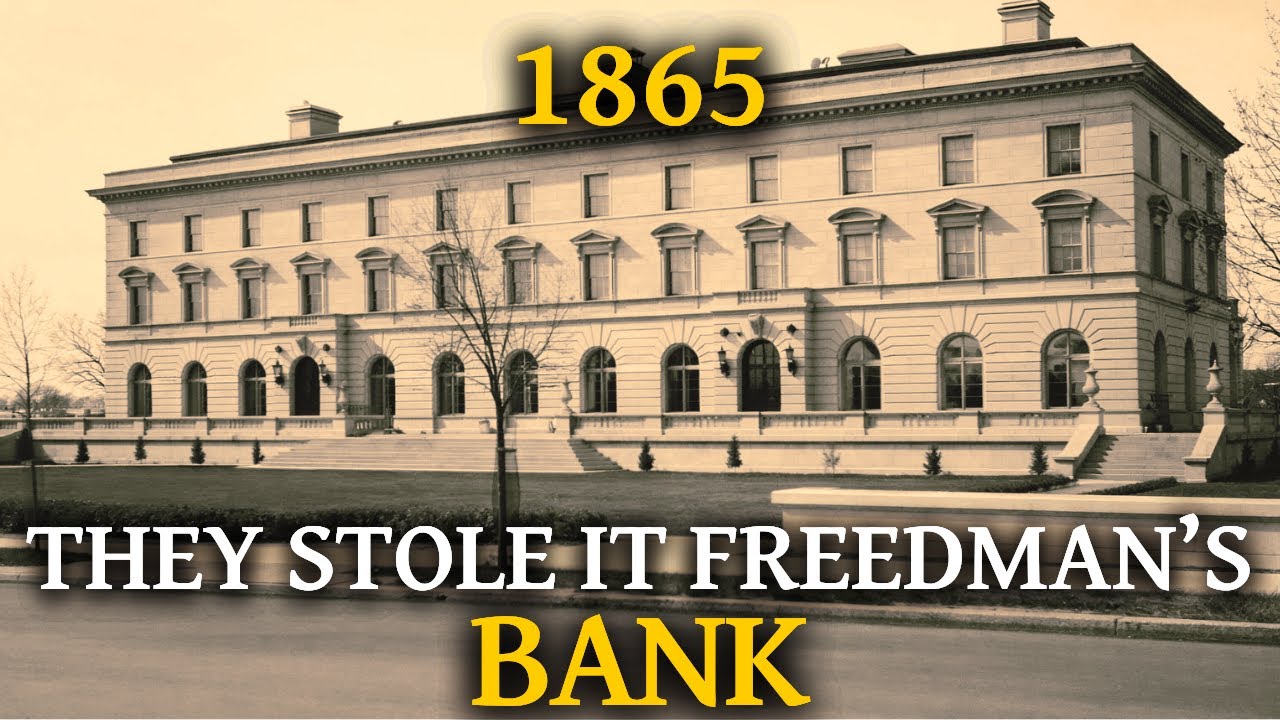
In 1882, eight years after the bank’s closure, the federal government purchased it. In 1899, it was demolished. The site sat empty until World War I, when the Treasury Department needed additional office space. A new building in the Beaux-Arts style was completed in 1919.
It was called the Treasury Annex. For nearly a century, no marker explained what had stood there before. The history was buried, forgotten, erased. Then, in 2015, advocates began pushing to acknowledge the truth.
Historians published new research. Descendants of depositors shared their family stories. On January 7, 2016, Treasury Secretary Jacob Lew announced that the Treasury Annex would be renamed the Freedman’s Bank Building. A ceremony was held.
Former Atlanta mayor and civil rights leader Andrew Young spoke about the bank’s legacy. The building finally acknowledged the institution it had replaced and the people who had been betrayed there. The records that survive tell remarkable stories. Twenty-nine branches of the Freedman’s Bank left behind registers of depositors now held at the National Archives.
These registers contain detailed personal information extraordinarily valuable for genealogical research: names and ages, birthplaces and residences, occupations, names of parents, spouses, children, brothers and sisters, sometimes the names of former enslavers, physical descriptions. In an era when records of Black families were rare, when enslaved people’s lives went largely undocumented, these signature books are treasures. They capture a moment when people were transitioning from slavery to freedom, when they were building new identities, new families, new futures. The depositors who signed those books believed they were securing their economic future.
They didn’t know they were creating an archive that would matter far more than the money they lost. Today, the story of the Freedman’s Bank is a story about trust, power, and betrayal. It’s about how systems can be designed to help but corrupted to harm. It’s about how good intentions mean nothing when accountability is absent.
It’s about how racism operates not just through violence or exclusion, but through theft disguised as benevolence. The white men who founded the bank may have had noble goals. John Alvord genuinely wanted to help formerly enslaved people build wealth. But when other white men, men with power and connections and no moral restraints, took control, the institution became a weapon.
The depositors had no power to stop them. They weren’t on the board. They couldn’t vote out corrupt trustees. They couldn’t access the books to see where their money was going.
They could only trust. And that trust was betrayed. The Freedman’s Bank failed in 1874, but its legacy lives in the wealth that was stolen, in the opportunities that disappeared, in the trust that died. When we talk about why racial wealth gaps exist, when we ask why Black families have less generational wealth than white families, this is part of the answer.
Three million dollars stolen from 61,000 people. Dreams destroyed. Futures erased. All because white men in positions of power chose greed over honor, theft over stewardship, lies over truth.
That is the real story of the Freedman’s Bank. Not America’s first Black bank. America’s most devastating betrayal of Black economic hope.