She sat on the floor with her back against the sofa, then got up, sat in front of the easel, picked up a brush. She didn’t choose a canvas size or think about composition. She just started. She didn’t stop until the sun came through the kitchen window.
The colors were wrong in a way that felt right. The composition broken open in the middle, like something had pushed through from the inside out. It looked like grief. It also looked, if you stood back, almost like relief.
She put it face in against the wall and didn’t look at it for a week. Suki Alladale had worked at the dry cleaner the same four years as Maren, and had decided in the first month that Maren was the most genuinely talented person she had ever been near — and was actively working to ensure nobody found out. “You know you’re doing something real, right? ” Suki said one morning during their break.
Maren changed the subject. Three months after Betty died, Suki came to the flat, brought food, asked to see the paintings properly. She moved through the flat slowly, stopped longest in front of the painting from the night Betty died. “This is serious,” she said.
“As in, this cannot live face down against a wall in Peckham forever. ” Maren said she’d think about it. She didn’t. So Suki found a London group exhibition accepting submissions from emerging artists.
She photographed the painting standing on a chair to get the angle right, submitted it under Maren’s name, paid the £11 fee from her own account. She told Maren seven days before the show opened. Maren spent three days furious, then two days frightened. On the Thursday evening she put on her good coat, got on the bus alone, found the gallery in Bermondsey.
She stood near the back, watched strangers stop in front of her painting, lean in, argue softly about what it meant. An older woman didn’t move for four full minutes. Maren left before the evening ended, sat on the top deck of the bus home and cried for most of the journey. Recognition.
Six months after that, the gallery called. A private collector. Serious interest. They said the number and waited while she processed it.
Maren sat down on the kitchen floor, the tiles cold through her jeans. The gallery’s account manager explained the payment would come as a banker’s draft. Same-day deposit would process fastest at the issuing branch in the city. She came straight from work — no time to change.
Paint on her right knuckles. Dark coat worn at the cuffs. Boots with a scuff. Canvas bag with the safety pin on the zip.
On the bus she looked at the draft, folded it, put it back. The glass towers of the city came into view. The bank stood on a wide street. Glass and brushed steel.
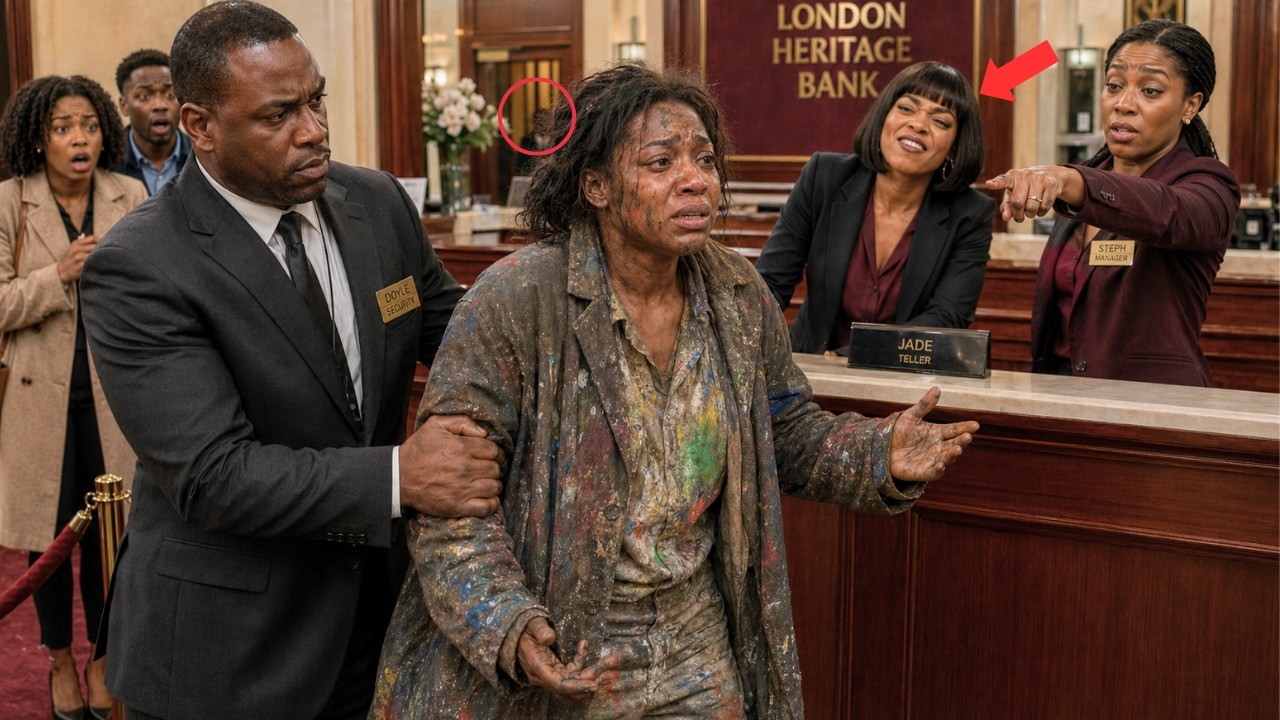
A security guard inside the door. Maren joined the queue. The guard clocked her the moment she walked in — his eyes moved over her coat, her bag, her boots and settled there. The woman directly ahead shifted two inches to her left without looking back.
The man behind her stepped two inches to his right. An island of space opened around her in the middle of the queue. Nobody made eye contact. Maren kept her eyes on the counter and waited.
When her turn came, she placed the envelope on the counter. “I’d like to deposit this please. ” The cashier — badge Jade — opened it, looked at the draft, then at Maren slowly. She picked up the draft, held it toward the counter light, set it back down.
Then she reached for a tissue from the box beside her keyboard and wiped her fingers slowly, deliberately. She leaned to her right so the cashier at the next window could see the amount. One look, a full conversation packed inside it. Jade slid the draft back.
“I’m sorry, this doesn’t look right to me. ” Maren said, “It’s a legitimate banker’s draft from a gallery in Mayfair. Can you call to verify it? That’s a two-minute phone call.
” Jade’s hands came off the counter. “I can see what it is. I’m telling you it doesn’t look right. ” Maren’s voice stayed level.
“Make one call before making any decision. ” Jade didn’t reach for the phone. She pressed something under the counter. Thirty seconds later Doyle arrived — broad, unhurried, lanyard swinging, in his 40s, carrying a small amount of authority he decided was large.
“This customer is presenting a document I flagged as suspicious,” Jade said. Doyle looked at Maren. His decision was already made. “You’ll need to step aside.
” Maren reached into her bag. “I’ll call the gallery directly right now. Two minutes and this is resolved. ” Doyle’s hand came down on her arm — not roughly, deliberately, with the full weight of his authority.
“Phone away. ” Maren looked at his hand, then at him. “Please take your hand off my arm. ” He didn’t move.
The queue had gone silent. She could feel it without turning around. Someone shifted weight. The soft unlocked sound of a phone screen.
One man near the back looked up, made eye contact for one brief second, and looked back down at his phone. Then Jade leaned forward and said it. No raised voice. No heat.
Even flat, the way you read a notice on a wall to someone who isn’t understanding it: “You don’t belong here. This isn’t the right kind of bank for you. ”
Six people heard it. Every member of staff on the floor heard it.
The woman near the back coughed over her exhale. Nobody moved. Four places back, the man nobody had looked at twice heard every single word. Ronan Ashby was 41, ran a property development firm, had been a client of this branch for 11 years.
He had come to hand in a signed document before a 3:00 meeting. He had been watching since the moment Jade opened the envelope. He saw the draft slid back, the phone not picked up, Maren asking once, twice, three times. The guard arriving.
The hand on her arm. The phone blocked. The man who looked and looked away. And then the words.
He stood in the queue for a moment after Jade said them. He almost didn’t move. He had a meeting at 3. A document to hand in.
He looked at the six people around him, at the phones, anywhere except the counter. Not one of them had moved through the whole thing. Not one had said a word. He looked at Maren — the coat, the bag, the paint on her knuckles, her face which was not panicking and was not crumpling, just steady.
The face of someone who has been told this many times by many rooms and made a decision long ago not to let them see it land. He put his phone in his jacket pocket. He stepped out of the queue. He walked to the counter.
“Excuse me. ” No performance in it. Doyle turned. Jade looked up.
“Before anyone goes any further,” Ronan said, “has anyone verified the document? ” Jade’s chin lifted. “Sir, this is a matter between—” “Has anyone verified it? ” Same tone, same volume.
Not a question this time. Silence. “She asked you to make one phone call. Did you make it?
” Silence. He gave his name clearly, without theater. 11 years at this branch. Then he asked Jade to call the branch manager.
Her composure took a visible knock. She picked up the phone. While they waited, Ronan turned to Maren, kept his voice low. “Are you alright?
” “Yes. Do you want to call the gallery now? They stopped me before I could. ” He nodded.
He looked at Doyle. Something in the way he looked was enough. Doyle removed his hand and stepped back without being asked. Two minutes passed.
Then Jade made the call she should have made when Maren first stood at that counter. She made it with everyone watching. She read back the draft details in a flat professional voice, listened, said yes, said yes again. Then she put the phone down carefully, the way you place something down when you are buying time to think and there is no more time left.
The gallery confirmed everything. Legitimate. Every penny of it real. The room absorbed this without speaking.
For the first time since Maren had walked through the door, everyone looked at the paper instead of her clothes. One phone call. Two minutes. The thing they had refused to do for 20 minutes.
Clive Wentworth had been watching the CCTV feed upstairs for 14 minutes. He had seen all of it from the beginning — the tissue, the look between Jade and Steph, the draft returned, the phone untouched, the hand on the customer’s arm, the words. He had replayed them while he sat upstairs and waited, hoping it would resolve itself quietly. When Ronan said his name at the counter, Clive stood up and came downstairs.
He walked to the counter, looked at each person in turn — Jade, Steph, Doyle. Then he looked at Maren. “Miss Tilby? I owe you an apology.
What happened here this afternoon is completely below the standard of this branch. I’m sorry. ” The queue stood absolutely still. For the first time since Maren had walked in, the room gave her its full silence and its full attention.
“The document has been verified. I want to process your deposit now in full with a senior member of my team. You will receive a formal written apology from this branch today. ” Then he turned to Jade and Steph.
“You’re both suspended with immediate effect, pending a formal disciplinary hearing. Access cards to the duty supervisor. Go upstairs. ” Jade’s mouth opened, then closed.
Doyle unclipped his lanyard. All three walked through the door at the back of the branch. The room exhaled. The senior advisor processed Maren’s deposit carefully, confirmed the funds, printed the receipt.
When it was done, Maren sat with the receipt in her hands. The painting she had made the night her mother died was now a number on a receipt in the same bank that had looked at her coat and boots and the paint on her knuckles and decided in 30 seconds, without making one phone call, that she didn’t belong there. She folded the receipt, put it in her bag, and came back out to the main floor. Ronan was still there.
He had sat down near the entrance and waited the whole time. He stood when she came through. “All done? ” “All done.
” “Good. ” She looked at him. No history, no debt, no reason to have done any of what he did. “You didn’t have to do that.
I know you had somewhere to be. ” He smiled slightly. “I called ahead. ” “Why did you step in?
” He thought about it, actually thinking, not performing the thought. “Because nobody else was going to. That was all. ” He reached into his inside pocket and took out a card.
“My firm works alongside galleries and private collectors. No pressure, but if you ever want someone to look at your work properly, reach out. ” Maren took the card. “I’ll think about it.
” “That’s all I’m suggesting. ” He buttoned his jacket, collected his document, and went to the counter to complete the business he had actually come in for. Maren walked out. The street was full of ordinary London afternoons.
Her phone rang. Suki. “Well? ” Maren walked through the city and told her everything — the island of space, the tissue, the look, the words, Ronan stepping out of the queue.
Suki listened without interrupting once. When Maren got to “you don’t belong here,” Suki went quiet. Then: “The manager watched the CCTV for 14 minutes before he came down? ” “Yes.
” “He was waiting to see if it resolved itself. ” A silence, something hardening in it. “Are you alright? ” “I think so.
I’m gonna get a coffee. ”
Maren went in, ordered a flat white, sat at the window table. She took the receipt out of her bag and put it on the table. Then Ronan’s card beside it.
The proof of what she had built over 20 years of evenings, and the door left open by a stranger who had stepped out of a queue because nobody else was going to. She thought about her mother. About a Tuesday. About a wooden box with a latch on it.
That evening she took the bus to Peckham Rye. She found him on the third bench — Reg Tilby, 61 years old, coat too thin, a bag beside him with everything he owned. He looked up when she stopped in front of him. “Maren.
” She sat down beside him, not across from him. They looked at the same water. A dog barked somewhere near the reeds. After a while she said, “I sold a painting today.
” He looked at the water. “Yeah? ” “Mom always said I would. ” His jaw moved.
His fingers pressed down on his knees and released. “What was it? ” he asked. “I painted it the night she died.
” He was quiet for a long time. “She would have liked knowing that. ” Maren nodded. “I wanted to tell you.
That’s all. I’m not here for a big conversation. ” She told him about a place called St. Mungo’s — housing, real support.
“I already called them. They said they can talk to you whenever you’re ready. No conditions. I’m not telling you what to do.
I just want you to know the door is open. ” “I don’t deserve that. ” “Maybe not. But I’m not doing it because you deserve it.
I’m doing it because you’re my dad. That’s all there is to it. ” They sat for a long time. Eventually she got up, put her hand on his shoulder.
He covered it with his. A few seconds. Then she walked back through the park. Three days later the HR manager called.
Jade and Steph were demoted, placed on probation, mandated to complete full customer conduct and unconscious bias retraining. Doyle received a formal written warning and was reassigned. A written apology had been posted. Maren thanked her and ended the call.
Two weeks after the bank she emailed Ronan. She sent three photographs — the painting from the night Betty died, two others made in the months since. He replied two days later. He had shown them to two collectors whose judgment he trusted.
Both had responded the same way. He wanted to introduce her to a gallery in Bermondsey. No obligation, just a meeting. She typed back yes.
Six months later Wynne came to the flat on a Sunday. He stood in the living area and looked around — more canvases now, two pieces on the wall with small white sold cards beside them. He read them for a long time. Then he turned.
“I was wrong. What I said in Mum’s kitchen about the pretty pictures, about wasting yourself. I was scared and I took it out on you. And I was wrong about all of it.
” Maren held her mug. “I know you were scared. I understood it even then. ” “That doesn’t make it right.
” “No. It doesn’t. ” He turned back to the cards on the wall. “She would have loved this.
” “I know. ” He said, “I’m sorry, Maren. ” She looked at her brother, his coat still buttoned, hands at his sides. “I know.
Come and sit down. ” He sat. “Do you remember when Mum used to sew at night? After we’d gone to bed.
You could hear the machine from the bedroom. ” He paused. “She was always making something. ” Maren looked at the piece on the easel — three nights in, a shape forming in the lower right that she hadn’t planned, a color she’d reached for without thinking that had turned out to be exactly right.
She didn’t know yet what it was. She never knew until she was inside it. That used to frighten her most. Now it was the part she trusted most.
She had been saying it ever since she was 12 years old, on a Tuesday in a kitchen in Peckham, a wooden box with a latch on it, a mother who put it on the table and looked at her daughter and said, “See what happens. ”