She drove from the shelter each morning after dropping Rue at school, worked until dark, and drove back. She carried debris out by the bag. Plaster dust, broken glass, an old calendar from 1987, a wood chair with the back gone. She propped the porch with timber posts from the barn, patched two windows with plastic sheeting, swept the ground floor clean enough to see what was under it.
By the end of that week she could see what the house was. High ceilings. A brick fireplace running floor to ceiling with a carved wood mantel. Wide windows with deep sills.
A stone hearth in the kitchen. A back staircase with thick timber treads that barely flexed even now. Someone had thought about every decision in this structure. Had built it to last and meant it.
But on the third day she found something else. On the floor of the kitchen near the back wall were boot prints. Recent ones. The dust in the rest of the house had settled into a uniform gray undisturbed for decades, but these prints were sharp-edged and clean.
Someone had been here within the last few months. Not a county inspector—the condemnation notice was dated three years ago. Not a trespasser—the padlock had been on the door when she arrived. Someone had been here before she had the key.
They had walked the kitchen, stood at the back door, looked out toward the barn. Then left without forcing any entry and without saying a word. Hester stood in the kitchen and looked at those prints for a long time. She did not have an answer.
She filed it away and kept working. She was checking the walls beside the fireplace for water damage, palms flat against the plaster. Her right hand found something. Not soft.
Something harder than the surrounding plaster. A shape beneath it with square edges. She stepped back and ran her phone light slowly along the wall. A rectangle roughly two feet wide and two and a half feet tall.
Plastered over and painted to match everything around it so carefully that you would never see it unless you pressed your hand in exactly the right place. Someone had hidden something behind that wall. She went to get the hammer. The first strike sent a burst of white dust into the cold air.
She swung again and pulled back. When she shone her light into the gap, she stopped breathing for a second. Metal. Not framing.
Not a pipe. Something placed there deliberately a long time ago. She put the hammer down and used her hands, pulling the plaster away section by section until the shape beneath it came clear. A safe.
Wall-mounted. Built directly into the framing cavity and plastered over so flush that without knowing where to press, you would search this room a thousand times and never find it. Steel body. Combination dial with an art deco border.
Handlebar below. Hester crouched in front of it and put her hand on the dial. She pressed the handle. Nothing happened.
She sat back on her heels and looked at what she had found. A hidden safe inside the wall of a condemned house on four acres of Creel County, Kentucky. Her father had paid $11 for this. Her brothers had laughed at her across a mahogany table.
She took a photograph. Then she went to pick up Rue from school. That evening, sitting at the shelter’s common table while Rue drew beside her, Hester searched her phone for locksmiths in Creel County. She found one name: Aubrey Solt, 38 years in the trade.
She called him in the morning. Aubrey drove out the next day in a pickup with a rusted toolbox. Lean man, early 70s, hands that moved over the safe like they already understood it. He put his ear to the door and turned the dial three times, not trying to open it, just listening.
“Pre-war,” he said. “Probably the 1930s. Good machine. ” He straightened.
“Mechanism seized. Combination’s gone. I can drill it or coax it. Drilling damages the door.
Coaxing takes longer. ”
“Coax it,” Hester said. He came back three days later. He worked for four hours without hurrying.
Then at 2:40 in the afternoon, with Rue doing homework on the living room floor, there was a sound from inside the wall. A deep mechanical release. A click that had been waiting longer than Hester had been alive. Aubrey turned the handle.
The safe door swung open. For a second Hester did not move. She just stared into the opening. Aubrey leaned forward slightly.
“What is it? ”
Hester did not answer. She reached in. The inside was dry.
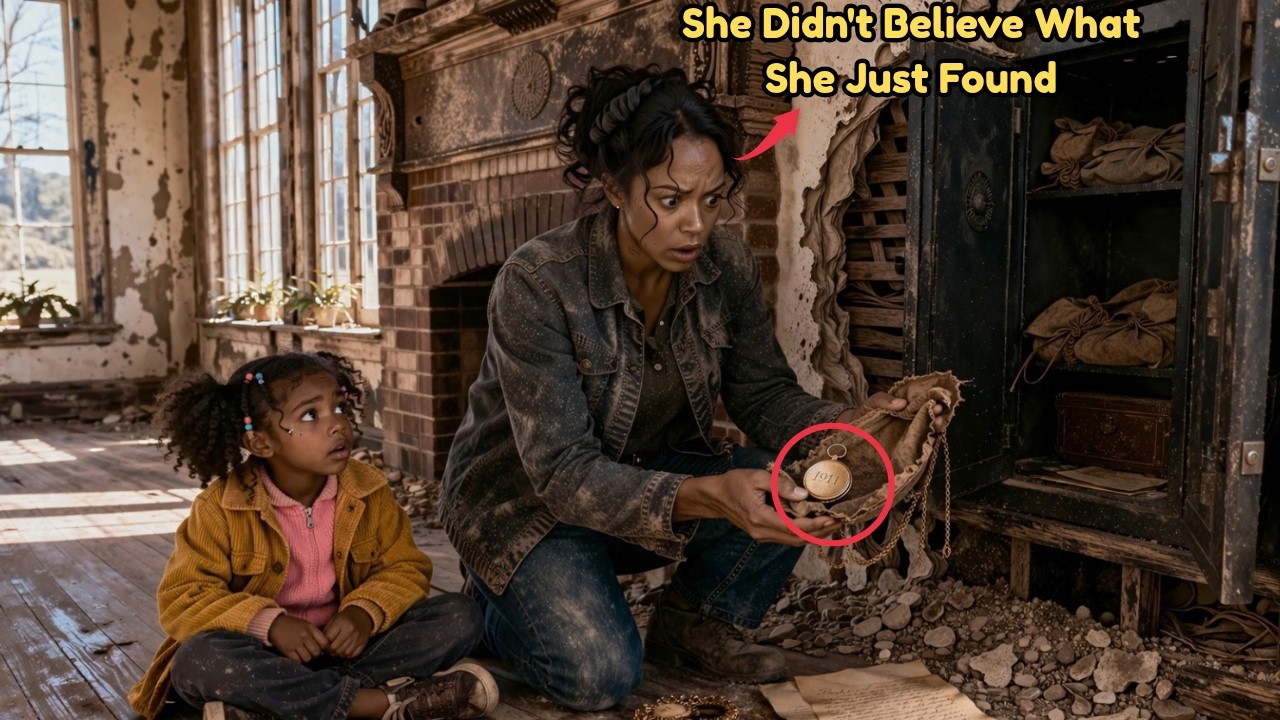
Old steel had kept out everything the years had done to the rest of the house. Bundles wrapped in cloth gone brown and stiff with age, tied with cord that crumbled when touched. She lifted the nearest one and unwrapped it slowly. A pocket watch, gold case, engraved on the back.
1911. She set it down and reached for another. A brooch, yellow gold, small stones that caught the light. A man’s ring with a dark red stone.
A folded document in careful old handwriting. Then two heavier bundles. Stacks of old currency, bills flat and dry, held in brittle rubber bands that snapped when she touched them. She held one note under her phone light.
Large format, detailed engraving, serial numbers clear. The condition was not something she had words for. Rue appeared at her shoulder and looked into the safe. She took a long, slow breath.
“Mom,” she said, “what is all that? ”
Hester kept her voice even. “I don’t know yet. ”
At the very back of the safe, upright against the rear wall, was a tin box.
Inside the tin, wrapped in cloth, was a letter. Three pages, black ink faded to brown, but completely legible. The letter was dated October 14th, 1943. The man’s name was Corvin Shade.
He had been born in this house in 1881. He had built most of it himself, lived his whole life inside it, worked the land, married, and lost his wife to pneumonia in 1939. In October of 1943, with his health failing and his only son somewhere in Europe, he had made a decision about everything he had spent a lifetime gathering. He wrote clearly.
He described each item in the safe. The watch had been his father’s. The jewelry had been his wife’s. The currency he had drawn from his bank accounts beginning in 1932, after watching a neighbor lose everything when his bank failed.
He listed the denominations. He listed the gold coins beneath the currency bundles, which Hester had not yet reached. He wrote that he had hidden these things because he did not trust what the world was becoming. He had seen one war.
He had survived the depression. He had watched people who did everything right lose everything anyway. He wrote, “If my son comes home, he will find this. If my son does not come home, I trust this house to hold it.
The right person will come eventually. I have faith in that. ”
He signed it, Corvin Shade, October 1943. Hester sat on the floor where Corvin Shade had been born and read the letter twice in the cold January light.
She thought about a man writing those words alone in this house, sealing up everything he had made and trusted and loved behind a wall of plaster, and believing, with no evidence, that the right person would eventually arrive. She thought about her father. Paying $11 for this building 20 years ago. Never fixing it.
Never selling it. Leaving it specifically to the daughter he had once abandoned, with one strange line from a lawyer: she would know what to do with it. She thought about the February hospitalization. 2:00 in the morning, the plastic chair, his eyes opening and finding hers.
“You always look at things right. ” She had thought it was the morphine talking, or guilt, or both. She reached back into the safe and lifted the currency bundles out. Beneath them, as the letter described, was a cloth pouch.
She untied it. 26 gold coins, double eagle denomination, American issue. Their surfaces still warm-looking, still bright, 80 years in the dark. She held one in her palm.
Then she looked up at Rue, who had not moved, who was watching her with wide and very serious eyes. “Are we going to be okay now? ” Rue asked. Hester closed her fingers around the coin.
“Yes,” she said. “We are. ”
That night, after Rue fell asleep on the couch under a quilt the neighbor had brought over, Hester sat alone at the kitchen table. The lantern light was low.
The fields outside were black. The gold coin lay in the center of the table. Eight weeks ago she had been counting her last $40 in a grocery store parking lot, deciding between gas and food. Six weeks ago she had been telling a woman at the shelter intake desk that yes, they would only stay a little while.
Three weeks ago Rue had asked her quietly whether sleeping in the car was normal. Hester had told her it was temporary. She picked up the coin. Her fingers closed around it slowly.
And then, quietly, with no one watching, the part of her that had been holding everything together for the past eight months finally slipped. Not loudly. Just a breath that broke in the middle. She leaned forward and pressed the heel of her hand against her eyes.
She thought about her father. About the years he had not shown up. The birthdays that passed. The silence that stopped feeling like absence and started feeling like weather.
She had forgiven him, or something close to it, because Rue needed a grandfather and Hester needed to stop carrying the weight. But she had never stopped wondering what it would have cost him to choose differently. Slowly her breathing came back. She wiped her eyes with the back of her sleeve.
Maybe he had known about the safe. Maybe he had bought an $11 house on pure instinct and left it to the one child he had wronged the most, and trusted her to find whatever there was to find. Maybe that was the only apology he knew how to make. Across the room, Rue shifted under the quilt and murmured something soft.
Hester looked at her daughter, at the small serious face gone slack in sleep. She smiled, tired, quiet, but real. “Yeah,” she whispered into the dark house. “We’re going to be okay.
”
She did not call her brothers that day, or the day after. She drove into Creel Junction and found a small antique shop. The owner, Joss Prater, looked at the pocket watch under a magnifier, turned the brooch in her hands, examined two of the currency notes under a loop. She put everything down.
“Where did these come from? ”
Hester told her. Joss was quiet. “The currency needs a specialist.
Large format notes in this condition are not common. The gold is significant. ” She folded her hands. “I know a man in Lexington.
Perry Alcott. He’s the person you call before you talk to anyone else. ”
Hester called Perry Allcott. He came out six days later with a light box and a leather case of reference materials.
He worked beside the fireplace for three hours, steady, unhurried, photographing each note, each coin. When he finished, he sat across from Hester at the kitchen table. “Miss Vane,” he said, “I want to give you a working number. The low end of my estimate is $290,000.
The high end is $420,000. ”
Hester read the number. She thanked him, shook his hand at the door, and watched his car disappear down the gravel lane. Inside, her phone buzzed.
A text from Clement: “Let us know if you need anything. ”
She set the phone face down and did not pick it up again that night. The formal letter from Clement and Forest’s law firm arrived nine days later. Undisclosed estate assets.
Cessation of sale pending resolution. Hester photographed it and sent it to Fitch. His reply came within the hour: “We’re prepared. Don’t engage.
”
She set the letter on the kitchen table and went back to work on the house. None of the money had arrived yet. She was still at the shelter with Rue, still working the motel job three days a week. But something had shifted in her.
She had been poor long enough to know that broken and worthless were not the same thing. She worked every day the light allowed. A semi-retired carpenter named Orville Deeps drove past one afternoon and saw her on a ladder. He pulled in and stood at the base.
“You know what you’re doing up there? ”
“Learning,” she said without stopping. He went to his truck, came back with a tool belt, and climbed the ladder. “Move over.
I’ll show you the right way. ” He came back the next three Saturdays, always with something—a coil of drip edge, a box of ring shank nails, once a full sheet of OSB. He never asked for payment. A retired teacher named Carla Overbeck stopped one evening with vegetable soup and stayed two hours on the porch talking to Rue.
She came back twice more with food, and the third time brought a bag of winter clothing from the church exchange. Rue had begun to love the house with the intensity of a child who had been without walls for too long. She drew it constantly in her notebook. The house as it was, the house as it might be, the house with smoke coming from the chimney and flowers along the front that were not there yet.
One afternoon she came to find Hester pulling old plaster in the upstairs hallway and said, “Mom, do you think the man who had everything in the safe knew he was going to die? ”
Hester kept working. “Probably. ”
“Was he scared?
”
“I think he was careful,” Hester said. “Scared and careful are different. ”
Rue considered this. “What’s the difference?
”
Hester stopped. She looked at her daughter. “Scared people hide. Careful people make sure the right things survive.
”
Perry Allcott returned six weeks later with Delia Marsh, a paper currency specialist from Louisville. They worked at the kitchen table for three hours while Rue did homework in the living room. When they finished, Delia opened her folder. She did not build it up.
She just said the number. The full collection appraised at $387,000. After fees and costs, Hester would receive $341,000. Hester read the number.
She looked up at Perry. He nodded once. She sat with it, a woman who had been counting $40 in a parking lot eight weeks ago, who had said “It’s temporary” in the back seat of a car while her daughter looked out the window at the shelter sign. Rue appeared in the doorway.
She looked at her mother’s face and read it the way children read faces before they learn to look away. “Good news? ”
Hester looked at her daughter. “Come here.
” Rue crossed the room, and Hester put both arms around her. “Does this mean we’re rich? ” Rue asked into her shoulder. Hester held her tighter.
“No. It means we can breathe. ”
The hearing at Creel County Courthouse was a Thursday in late March. Clement and Forest arrived with two attorneys.
Clement looked straight ahead. Forest looked at Hester once in the hallway. Something in his face had contracted. He knew she knew.
Fitch presented the affidavit, the title history, the appraisal documentation. He was not dramatic. He presented the way a man presents facts when the facts are sufficient. The opposing attorneys argued vague language, undue influence.
Hester sat beside Fitch and kept her face level. Fitch responded without raising his voice. He submitted affidavits from Birch Vane’s physician and nurses, each describing a man in full possession of himself. Then he submitted the county access records showing Forest’s inspection visit to the property three weeks before Birch died.
The opposing attorneys had not known he was going to do that. Forest heard it and said nothing, but his face said everything. Judge Carr reviewed everything. The courtroom was very quiet.
Then he spoke. The claim of undisclosed estate assets was not supported. The claim of undue influence was contradicted by the documentation. He noted, without elaboration, that the access records raised questions about the credibility of the surprise being claimed.
The motion was denied in full. Outside, the air was cold and bright. Clement walked past Hester without speaking. Forest stopped.
“I should have told you,” he said quietly. “When I went out there. I should have told you I’d been. ”
Hester looked at him.
He was not calculating anything. He was just a man standing in the cold with the thing he had done visible on his face. “Why didn’t you? ” she asked.
He shook his head. He did not have an answer that covered it. “That matters,” she said. “What you just said.
But it doesn’t change anything. ”
She walked with Fitch to his car. He drove her back to Cutters Gap Road. They sat in the gravel lane a moment before she got out.
“Your father was right about you,” Fitch said. She nodded and got out and stood in the yard. The windows were clear of boards. The porch was straight and solid.
A thin line of smoke from the kitchen chimney rose into the cold March sky. Inside she could hear Rue moving through the rooms, talking to herself in the comfortable, unhurried way she had started doing since they moved in. The house was hers. Fully, officially, finally.
She went inside. The artifact sale moved over the following four months. Hester did not rush. The currency collection went to a private collector in Nashville.
The gold certificates through a Louisville auction house. The gold coins to a numismatic dealer in Chicago. The letter went last, accepted by the Kentucky Historical Society in Frankfort. When Perry sent the final accounting, the total after all fees came to $341,000.
Hester sat at the kitchen table and looked at the number on her phone. The largest number that had ever been near her name without a minus sign in front of it. The condemnation order was formally lifted on a Wednesday in June. The county inspector signed the paperwork on the front porch while Orville stood beside him with his coffee.
Carla came that afternoon with a lemon cake and sat in the summer heat, looking at the house and the yard and the fields beyond it. “Corvin would recognize it,” she said quietly. “This is what it looked like. Exactly this.
”
That evening Hester stood on the back porch alone. Fields green and wide. The creek at the back of the property just audible. The barn rebuilt in new timber that Orville had matched as closely as he could to the original.
Square against the treeline. Inside the house, Rue was laughing at something. The kitchen lights spilled out across the porch boards and into the dark yard. Hester stood in the dark and breathed and listened to her daughter’s voice moving through the rooms of a house that had been empty for decades and was now full.
She thought about the first night here. The cold floor. The plastic sheeting on the windows. Rue asleep under their one good blanket while Hester sat in the kitchen and added up the same numbers over and over and came up short every time.
Her father had not left her wealth. He had not left her rescue. He had left her proof. Proof that he had seen who she was.
That he had understood, in the end, too late to make up for everything, but not too late to matter. He had made one good bet at the end of his life. He had bet on her.
She turned and went inside to her daughter.