She pulled out her phone and opened a number she hadn’t called in four months. She held it for a while. Then she pressed it to her ear. He answered on the second ring.
“Hey. You okay? ”
She said no. “Where are you right now?
”
She told him. “Stay there. I’m coming. ”
His name was Soren Osei.
He had taken Priya’s last name when they married. He ran the Osei Foundation—eight years building affordable housing, funding workforce programs, absorbing debt from families who had lost everything. Most of Lancaster knew him for that. Fewer knew he had sold two software companies before he was thirty.
The money didn’t live in his name. He drove a ten-year-old Subaru. Gray sweatshirt. Three jackets in rotation.
He coached his neighbor’s kids’ soccer team. Callum Morrow had never heard the name Soren Osei. That was about to change. Soren arrived twenty-two minutes later.
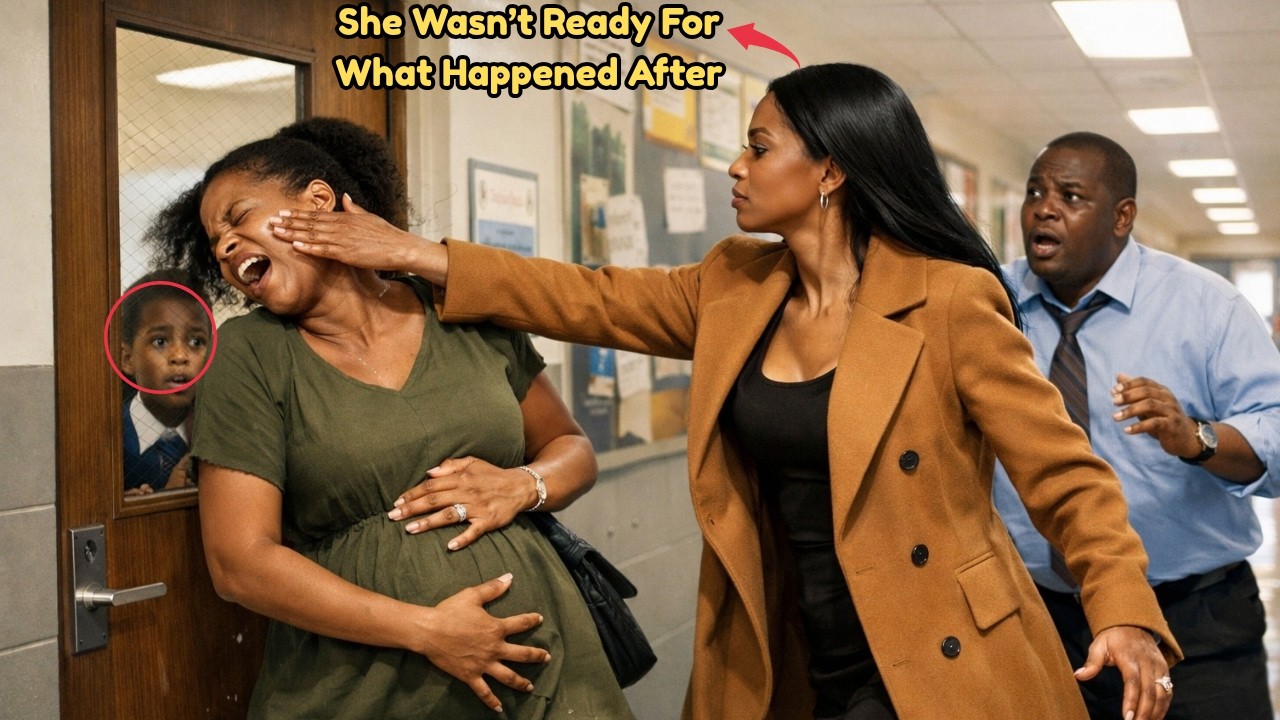
He walked into the school, said he was there for his wife. The front office receptionist’s face changed. She had been at her desk when Celine walked past that morning. She had heard the sound.
He waited in the hallway. Then Priya appeared. He sat on the edge of a student desk in her classroom, slightly too small for him, and looked at the mark on her face. He didn’t look away.
He held her hand and listened. All of it. The grade. The hallway.
The slap. The laugh. Winters and his careful suggestions. When she finished, he nodded once.
He asked how she felt, whether she’d had any cramping, whether the baby had moved. She told him yes. They were fine. He kissed her on the temple.
“Stay here for a few minutes. I need to go talk to someone. ”
He walked to Winters’ office and knocked on the open door. Winters looked up.
Saw the gray sweatshirt, the ordinary face. Nothing registered. “Can I help you? ”
Soren sat down without being invited.
“I’m Priya’s husband. I’d like to understand what steps you’re taking after what happened this afternoon. ”
Winters started talking. Circumstances.
The district’s relationship with the Morrow family. Perhaps a mediated conversation going forward. Soren let him finish. “A woman struck my pregnant wife in a school hallway, and your response is to suggest changing the grade.
”
Winters said it was more nuanced. “I’d like a copy of the security footage. A formal incident report. And I’d like to know whether you’ve contacted the police.
”
Winters blinked. He said he didn’t think police involvement was necessary. Soren looked at him. He looked at the framed photo behind Winters’ desk, the certificate on the wall.
Then back at Winters. “The woman who did this hit my wife in front of you. You were standing right there. And your concern right now is the donation.
”
Winters opened his mouth. Soren stood up. “Thank you for your time. ”
He made three calls from the parking lot.
The first to his attorney, Farida Ansa. She listened for ninety seconds without interrupting. “I’ll file by morning. ”
The second to a contact at the Lancaster County District Attorney’s office.
The third to Kwaku, the foundation’s head of communications. Kwaku asked one question: “How fast? ”
Soren said, “Let me see what they do in the next twenty-four hours. ”
He went back inside and walked Priya to the car.
She was quiet on the drive. He didn’t push. He made dinner. She sat at the kitchen table with her feet up and a mug of tea.
The baby turned once, slow and deliberate. The red mark had deepened. “I keep thinking about the laugh,” she said. “Not the slap.
The laugh. She hit me and then she laughed. Because she thought it didn’t matter. That I didn’t matter.
”
Soren didn’t rush to fill the space. Then he said, “She picked the wrong person to laugh at. ”
Principal Winters called at 7:45. His voice was thinner than it had been that afternoon.
The grade would stand. The incident would be formally documented. The school board had been notified. Priya thanked him and hung up.
“Good,” Soren said. “They’re going to come at us. ”
“They’re going to try. ”
She looked at him across the table.
“Are you sure about this? ”
“She slapped you in a school hallway in front of your principal. She laughed on her way out. Our daughter was two feet from that.
” He said it flat. Just fact. “I’m sure. ”
Callum Morrow found out at 9:15 that same evening.
By 9:15 his general counsel was calling. By 9:30 his publicist. By 10:00 he was sitting in his home office watching the security footage on his laptop. His wife, a pregnant teacher, a hallway, full force, a laugh on the way out.
He watched it twice. He called his attorney. His attorney said the word *lawsuit* before Callum finished his first sentence. Then he said, “I’ve been trying to identify the husband’s legal representation.
It’s Farida Ansa. ”
Callum knew that name. “Who is the teacher’s husband? ”
His attorney said he was still working on that.
He found out the next morning. Soren Osei. He typed the name. He read everything.
The foundation. The housing program. Eight years. No plaques.
No profiles. Families with nowhere else to go and an eighteen-month line to see him. He sat back in his chair. He didn’t pick up his phone.
He just sat there with the laptop open and the name on the screen. His wife had walked into a school and slapped a woman whose husband had spent nearly a decade building something for the most vulnerable people in this county. Not for press. Not for positioning.
Because the need was there. And his wife had laughed on her way out. Callum Morrow had more money than Soren Osei. He understood now that money was not the field they were playing on.
Celine came downstairs in her robe. Callum was at the kitchen table with his laptop and three phones. She poured coffee. He turned the laptop around and showed her the footage.
She watched it. She shrugged. “I was provoked. ”
He stared at her.
“I reacted. It was a moment. ”
“You hit a pregnant woman in a school. It’s on camera.
Two regional outlets picked it up overnight. ”
Her face shifted. Not into remorse. “We donate to this district.
We have leverage. ”
“Their attorney filed a civil suit at 8:00 this morning. Assault. Emotional distress.
There’s a criminal complaint with the county. ”
Silence. “Her husband is Soren Osei. ”
Something changed across Celine’s face.
She had heard of the Osei Foundation. She had attended a benefit the previous spring. She had written a check. She had shaken a hand.
She had never connected that name to a person she might one day need to think about carefully. “It was a slap,” she said. Callum closed the laptop. “You slapped a pregnant teacher in a school hallway in front of her principal.
And then you laughed. ” He looked at her. “There were six children visible through the classroom window when it happened. The school has a trauma counselor already scheduled.
”
She said nothing. “I cannot make this go away. This is a woman with a child, a camera, an attorney, and a husband who has spent eight years building goodwill with people in this county who never forget who helped them when they had nothing. ” He took a breath.
“He has more of that than we have money. ”
That was the sentence that landed. Not the lawsuit. Not the footage.
*He has more of that than we have money. *
Priya was back in her classroom Friday morning. The union representative had called. Two colleagues had left food on her doorstep.
She replied to every message. Then she came back. Her students noticed the bruise. Amaya sat in the front row and looked at her teacher’s face the moment Priya walked in.
She raised her hand. Then she raised it again. “Ms. Osei, does it hurt?
”
The room went silent. Twenty-two children looking at their teacher. Priya looked at Amaya. For just a second, something crossed her face.
Not tears. Not collapse. The smallest fracture in the composure she had been carrying since yesterday afternoon. “Not anymore,” Priya said.
She picked up the book. “Let’s start where we left off. ”
The week moved. The case was filed.
The regional story became a state story. The footage was clear. A school hallway, a pregnant teacher, a laugh at the end. People watched it and felt something specific and sharp.
Teachers shared it. Parents shared it. Nobody outside the school knew yet who the husband was. That was still coming.
The Morrow Foundation issued a statement. They deeply regretted what happened. A private matter. Being handled.
Kwaku texted Soren: *They hired a crisis firm. * Soren replied: *Let Farida handle the rest. *
He was at soccer practice. He finished the session before he checked his phone again.
Two weeks later, Celine Morrow sat across from Farida Ansa in a conference room downtown. Two attorneys beside her. She had dressed carefully. Farida opened a folder and placed a single photograph on the table.
A still from the security footage. Timestamped and clear. Celine’s hand mid-motion. Priya’s head turned by the force of it.
Both palms already moving toward her stomach. Farida said nothing for a moment. She let Celine look at it. Then Farida laid out the terms.
A substantial civil settlement. A formal public apology, written and signed, published in the county paper and through the district’s communications. A conflict resolution program for every parent in the district who wanted it, funded by Callum personally, running three years. A direct donation to Fairhaven Elementary’s resource fund, unrestricted, irrevocable.
And a letter to the district: Tate’s grade was not to be reconsidered, altered, or contested by anyone connected to the Morrow family, ever. Celine’s attorney whispered in her ear. She looked at the photograph on the table for a long time. Then she looked away.
She signed. The criminal matter was handled separately. A formal charge, a diversion program, community service hours at a women’s shelter in Harrisburg, where she was not permitted to say who she was or why she was there. She filed intake paperwork.
She stocked shelves. On Thursday mornings, she made sandwiches in the communal kitchen. One Thursday in the second month, a woman came through the serving line with a small girl on her hip. The girl had mismatched socks and a stuffed rabbit.
The mother asked if there was extra juice for her daughter. Celine looked at the girl. She poured the juice. She held it out.
The girl took it with both hands and said, “Thank you,” in the careful, deliberate way of a child who has been taught to say it and means it. The mother moved on. Celine stood there with the empty cup in her hand. She didn’t put it down.
She didn’t move to the next person. Her hand just stayed there, holding nothing for a moment longer than made sense. Then she set it down and reached for the next one. By the third month, she stopped wearing her rings on Thursday mornings.
Nobody asked her to. She did not laugh. Not once. Priya returned to teaching the Monday after the agreement was finalized.
The classroom arranged, windows cracked. Bev was in the hallway with a new water jug. She looked at Priya and said, “Good morning. ”
Her daughter was born on a Tuesday in November.
Seven pounds four ounces, a full head of hair and lungs that announced her arrival to the entire floor. Soren held her. He stood with the baby against his chest and looked at her face and did not speak for a long time. “She’s very loud for such a small person,” Priya said.
He laughed. “I wonder where she gets that. ”
Tate Morrow resubmitted his project. He submitted it on a Friday, the last day of the window, hand-delivered in a manila envelope with his name on the outside.
No parent note. Just the work. He wrote it himself. It was awkward in places.
There was a paragraph where he changed direction and then came back. He left it anyway. Priya gave him a 78 and wrote one sentence at the bottom: *This is your voice. Keep using it.
*
Amaya made a card when the baby was born. She drew the baby with a very large amount of hair, accurate, and wrote at the bottom in careful pencil: *We are glad your baby came and we are glad you are still our teacher. *
All twenty-two students signed it. Priya kept the card on her desk.
The drawings stayed on the walls. The bruise was gone. The daughter was home. The windows were cracked just enough.
And twenty-two children leaned forward as their teacher turned the page.