“You were the only one. Every Sunday for 6 years, you saw a man, not a transaction. ”
She stared at him. He’d been testing her all this time, and she never knew.
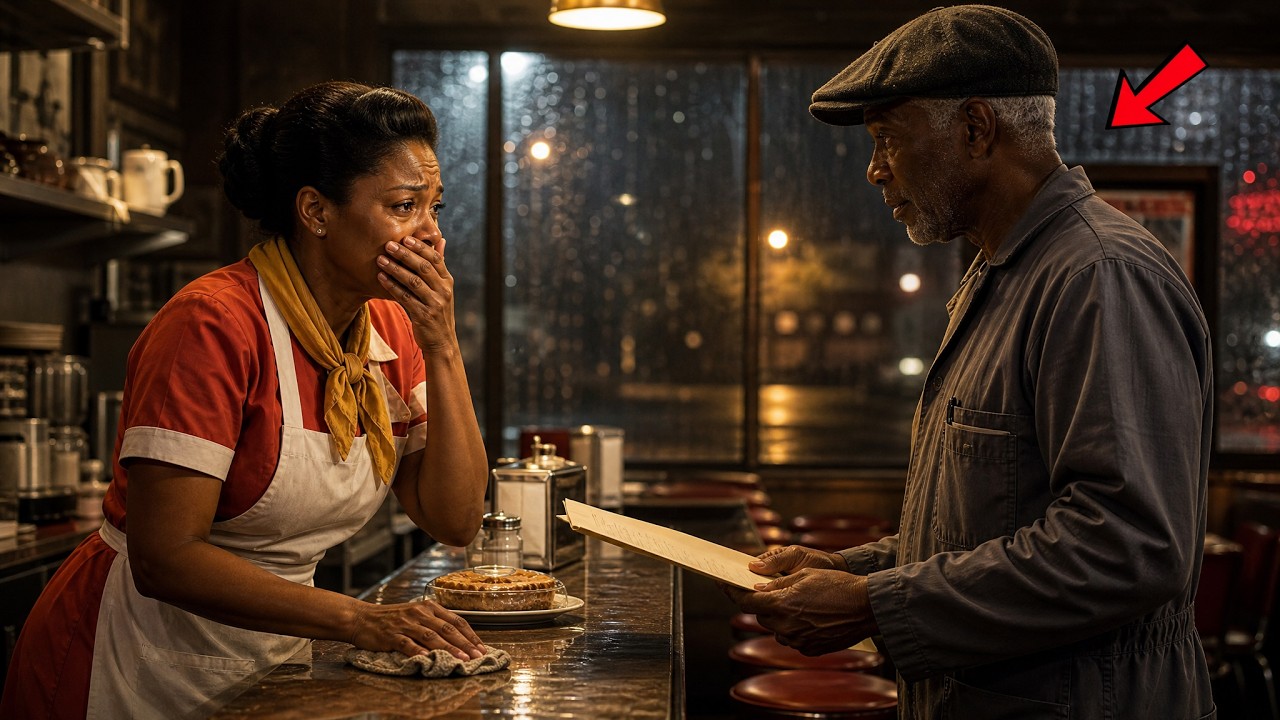
“I’ll come back at closing. There’s something I need to show you. ”
He stood, leaving the envelope on the table. It sat there like a locked door.
Barbara watched him walk out. Her mind racing with questions she couldn’t outrun. Who was this man, really? And what sat inside that folded paper?
The diner settled into silence after he left. She didn’t open the envelope. Couldn’t. Not yet.
It’s probably just a thank you note. He’s a janitor, not a miracle worker. Stop hoping. She busied herself with closing tasks.
Wipe the pie case. Lock the register. The hours felt like years. In the supply closet, reaching for the mop, her knees buckled.
A sob tore out of her, raw as a wound. “I can’t do this. I can’t start over at my age. Mom needs me, and I can’t even pay this month.
”
She stayed there until her throat burned and her eyes were dry. Then she scrubbed her face with a rag. At 6:00, a shadow filled the entrance. Harold stood there, coveralls pressed, the envelope clutched to his chest.
He didn’t knock again, just waited. She crossed the floor and turned the lock. “I said I’d come back. I always keep my word.
”
“I didn’t open it. ”
“Come in, Harold. Sit down. ”
They sat at the counter, the envelope once again a barrier between them.
His cap rested beside his elbow, worn as a promise kept. “I am not a janitor, Barbara. I own this building. I own the whole block.
”
He’d been the landlord all along. All this time, she gave free coffee to the man who owned the ground beneath her. He spoke with the calm of a man who had waited decades to say it. No arrogance, just gravity.
“In 1981, I bought this property. It was my first real success. I’ve held it ever since, wearing these coveralls. ”
Every Sunday, he could have raised the rent, fired her, laughed at her pity.
Instead, he just said thank you. She stared at the envelope, then at him. The questions were stacking up like unpaid bills. “Martha asked me to stay close to the ground.
The rest, it’s in there. But first, I need you to understand why. ”
He placed his hand flat on the envelope. It trembled, not from age, but from something older than words.
“40 years in the making. 37 diners, Barbara. I visited them all in these coveralls. Always water.
Always watching. Some waitresses wouldn’t even look at me. Others charged for the glass and the booth. ”
His eyes left hers and traveled to some place beyond the diner’s walls.
“But you. You brought coffee and pie before I could ask. Every Sunday, 6 years, you never once made me feel small. ”
He sat on millions, wearing boots with holes.
He reached for the envelope, but his fingers stopped on the string. “Martha wanted me to find someone like you. Someone who gives without expecting. You are the one.
”
She couldn’t speak. The test, the years, the silence locked her voice. “You passed, Barbara. Now, I need you to see what passing a test like this is worth.
”
He slid the envelope across the counter. The scrape of paper against Formica was louder than any confession. “Inside is the deed to this diner, free and clear. I’ve paid the back taxes.
There’s a renovation fund, enough to make it yours. ”
A deed. He was giving her the whole diner? “Harold, I can’t.
It’s too much. You barely know me. ”
“I know you better than anyone, Barbara. I’ve watched you for 6 years.
You’ve earned this every Sunday. ”
Her hands shook. Gratitude and shame colliding. She had spent mornings counting coins while he held millions.
If she didn’t accept, her mom wouldn’t make it another month. “It’s not charity. It’s repayment for something I lost long ago. Open it, please.
”
She couldn’t. Not like this. Not when every bone in her body said she didn’t deserve it. “There’s one condition, Barbara.
Every Sunday, coffee and pie for anyone in coveralls, free, forever. That’s all I ask. ”
Every Sunday. He was asking her to do what she’d done for him for 6 years, for every soul who walked in with worn boots.
With trembling fingers, she loosened the string. The flap lifted and paper rustled like a whispered promise. The paper was thick, official. The words deed of sale shimmered under the diner’s pale lights.
The deed read: Grantee, Barbara Wallace. Property, 1402 East Carson Street. Her name. This was her diner.
“It’s yours. Only one promise. Free coffee and pie every Sunday for anyone in coveralls. ”
She held the deed, hands shaking.
A promise unspoken still hung in the air. “Harold, I’ll sign the deed. But you have to promise me something in return. ”
“Anything, Barbara.
Anything in my power. ”
“You keep coming for coffee every Sunday. Not as the owner of the block. Not as a benefactor.
As a friend. As the man I’ve been serving for 6 years. Because this diner is yours, too, now. Promise me that.
”
Harold’s eyes widened, then softened. A smile broke across his face. The kind that starts in the eyes and takes its time. “I was afraid you’d tell me to stop coming.
I can do that. I will do that. ”
This wasn’t a test. It was a search for family, and he found it at a counter with a cup of coffee.
They shook hands across the counter, the deed pinned between their palms. A covenant not of money, but of belonging. “Every Sunday, Barbara. You have my word.
”
She held his hand a beat longer. Her tears finally shed not from grief or fear, but from something that felt frighteningly like hope. “Welcome home, Harold. Your spot will always be waiting.
”
From his coveralls, Harold spread blueprints, a checkbook, a list of contractors. Not more secrets. Plans. “I started drawing these the first Sunday you gave me coffee.
Every detail you need is in here. ”
6 years. He wasn’t testing her. He was preparing this gift the whole time.
“Renovations will take 12 weeks. I’ve already spoken to the crew. They begin Monday. ”
Spring.
The windows could stay open. The whole place would feel new. She crossed to the wall-mounted phone, lifting the receiver with hands that had wiped this same counter a thousand times. “Ma, the diner’s mine.
We’re going to be okay. I signed the papers. It’s real, Ma. It’s finally real.
”
“I knew you’d find your way, baby. You always do. ”
She hung up and took the pen. Her signature on the deed was small, deliberate.
The most honest thing she’d ever written with steady hands. Spring arrived with the scent of sawdust and fresh paint. The counter remained, but everything else was reborn. Harold visited every Thursday, not to check progress, but to share coffee and silence.
His old ritual intact. On the Friday before opening, she hung the sign herself. “Wallace’s — Since 1981. ” New beginning.
Same love. Late that night, she pulled out her mother’s recipe box. The handwritten card worn soft from decades of apple pies. She measured flour, folded butter, and every heartbeat was a memory of her mother’s hands guiding hers.
By 2:00 in the morning, the pie cooled on the counter. She wiped the cash register, now hers, and smiled at the silence. Tomorrow, the first cup of free coffee would pour. At 6:50, the line stretched down East Carson.
Men and women in gray, blue, khaki coveralls holding lunch boxes waiting. They actually came. For her. For him.
For a promise made over coffee. She turned the lock, the bell jingled, and Wallace’s Diner opened its arms. The first wave stepped in, boots on the tile. Within minutes, every stool filled.
The air thickened with the smell of fresh coffee and the sound of laughter. “This is the diner I always saw, Barbara. Full of the people who keep the world running. ”
“First cup’s yours, as always.
Welcome home, Harold. ”
A union badge glinted on a nearby sleeve. The promise was already spreading. A young woman in coveralls laughed with Barbara, sharing a story about a flooded basement and a grateful tenant.
She poured, served, laughed. Her reflection in the window showed a woman who wasn’t just an owner. She was the heart of a home. One Sunday, Harold’s stool stayed empty.
She checked the clock, wiped the counter, and waited. He never missed. Not once in all these years. A week later, a courier handed her a thick envelope.
The return address read Vance Estate. Dear Barbara, if you are reading this, I have kept my final promise. You gave me 6 years of Sundays. Keep the coffee hot, the pie fresh, and the door open.
Tell them it’s on the house. She pinned the letter to the wall, then set a small brass plaque beneath it. “In memory of Harold Vance, who believed that kindness is the rent we pay for being here. ”
She placed a yellow rose on his usual stool, the one she would never clear.
Years passed. The diner became a Sunday morning sanctuary for the city’s janitors. Barbara, now with silver threads in her hair, still tied her yellow scarf the same way. She trained a new waitress, showing her the rhythm of the place.
“If they’re in coveralls, that’s enough. You don’t check IDs. You just pour. That’s the promise.
”
Outside, the Sunday crowd waited. Inside, a new generation learned the rule that had rebuilt this place from silence. One summer Sunday, an elderly janitor woman settled into Harold’s old stool. She stared at the plaque for a long time.
Barbara placed a slice of apple pie in front of her. The woman looked up. “He was my landlord. Harold Vance did this in three other cities, always looking for kindness.
”
Barbara’s hand froze on the coffee pot. She had never known the test stretched beyond her own diner. The woman raised her coffee cup. “To Harold.
And to all the janitors who never asked for more than a fair chance. ”
The diner erupted in a murmur of agreement. A hundred coveralls clinking coffee mugs. Late that afternoon, the diner door swung wide.
A nurse pushed a wheelchair through the Sunday crowd. “Mama? You actually came. ”
Barbara parked the chair right beside Harold’s plaque.
The two most important people in her life meeting in the same corner. She set down a steaming cup and a slice of apple pie. “Your father would be so proud. ”
“I learned from you, Ma.
You taught me to give without keeping count. ”
Edith’s hand, thin and papery, closed around Barbara’s. The years of worry unwound like thread. When the last customer left, Barbara locked the door and stood in the silence of her own creation.
The same damp rag. The same counter. But the hands holding it no longer trembled. She stopped before the brass plaque.
Her fingers traced the words she could recite in her sleep. A single yellow rose, fresh as the day she first served him pie. The diner was hers, but it belonged to anyone in gray who needed a cup and a seat. She turned off the overheads.
The neon “Wallace’s” bled through the glass, casting her in a red glow from the street. The plaque was still visible. She disappeared into the kitchen, leaving the diner to the night and the neon.
And every Sunday, just as sure as sunrise, the coffee would be hot and the door would be open.