”
He stood there in the downpour, this man who had spent a decade believing that the only honest thing a person ever did was what they did when no one was watching. He understood all at once that he had been a coward dressed up as a philosopher. “How many flowers do you have left? ”
Maya counted.
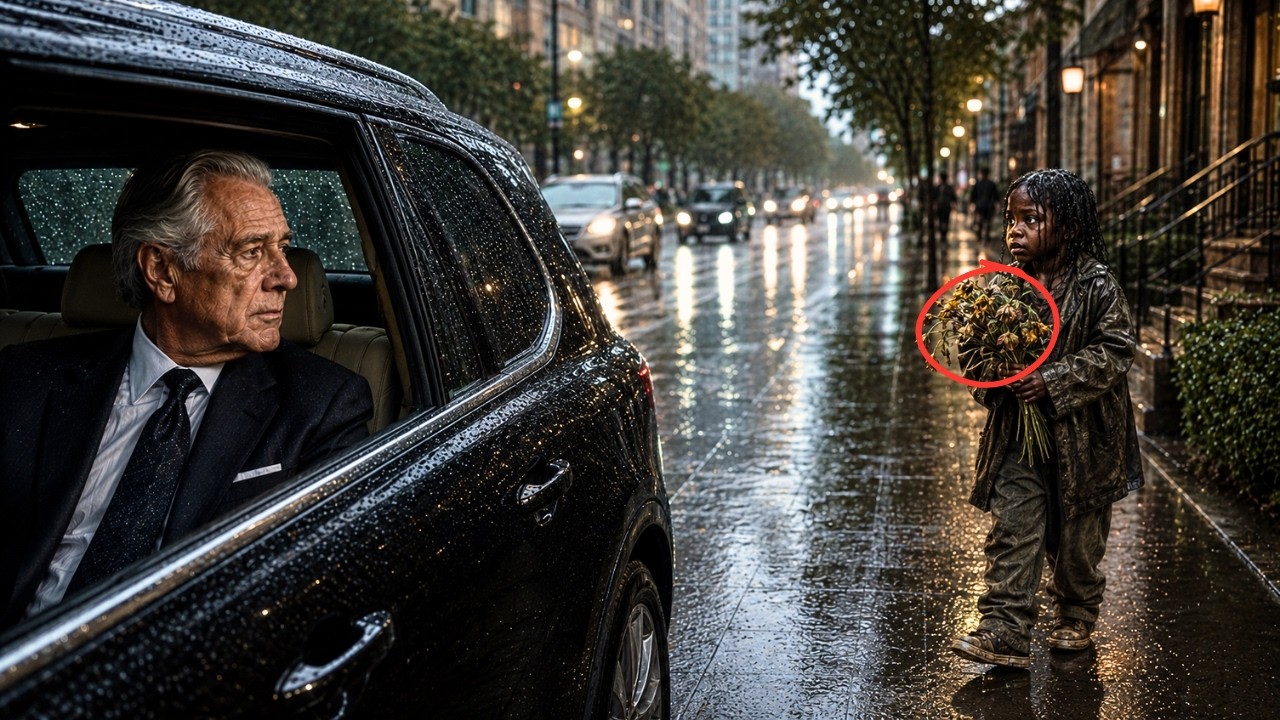
“Eleven bunches. ”
“I’ll take all eleven. And then if you let me, I’d like to meet the woman who taught you to keep the white ones dry. ”
Maya led him into the shop.
Augustus stepped out of the rain and into a room that smelled of eucalyptus and damp earth, and the smell undid him more thoroughly than the cold had. It was the smell of his entire childhood. It was the smell of his mother’s hands. The shop was small and worn and immaculately cared for.
Beside the counter hung a child’s drawing signed Maya in crayon with a heart over the eye. In a chair by the back room doorway sat an old woman wrapped in a knitted shawl. She rose when they came in, one hand going to the door frame to steady herself. She looked at her granddaughter soaked to the skin, then at the silver-haired man in the ruined expensive coat standing in her doorway.
“Maya. Baby, you’re soaked through. I told you when it comes down that hard, you come inside. ”
“I sold everything, Grandma.
All of it. This is Augustus. He bought all eleven bunches and he wanted to meet you because I told him you taught me about the white ones. ”
Edith Quinn looked at Augustus for a long moment.
“You bought out the whole pail. Then I owe you an honest accounting. Those are good flowers, the best I’ve grown, but they’re the last I’ll grow in this shop. We’ve got a notice.
The building’s bought and slated to come down. ”
She did not know that the company that sent letters and never answered a phone was his. That the demolition order with her shop’s address on it had crossed his own desk among a hundred others. A single line on a redevelopment schedule.
He had signed off on it without ever once seeing the green sign or the swept floor or the child’s drawing with the heart over the eye. “Mrs. Quinn,” he said, and his voice was not entirely steady. “What’s the name of the company on that letter?
”
She held out a heavy cream envelope. He took it. He knew the letterhead the way he knew his own signature. Vane Group Hospitality.
“You know it,” Edith said. It was not a question. “I know it. I’m the man who owns it.
”
The room went very quiet. Maya looked between the two adults, sensing the air change without understanding it, and reached up to take her grandmother’s hand. Edith Quinn did not flinch. She looked at the billionaire standing in her doorway in his soaked, ruined coat and said, with the terrible steadiness of someone who had nothing left to lose, “Then I suppose, Mr.
Vane, you’ve come to see what you’re knocking down. ”
“No. I came in out of the rain because of a little girl and a pail of flowers. I did not know whose shop I was walking into until thirty seconds ago.
I did not come here to gloat. I came because your granddaughter held up a bunch of white flowers in the rain and reminded me of someone I have spent thirty years trying not to remember. ”
“Who would that be? ”
“My mother.
She sold cut flowers from a tin bucket on a corner. She got sick the way you’re sick. There was a doctor she needed and we couldn’t pay for him, and she died before I had two coins to rub together. I built all of this, and I built it into a thing that signs papers to knock down flower shops without ever reading the address.
”
Maya looked up at him with enormous eyes. “You’re the one knocking down our shop? But you bought all my flowers. ”
“Yes.
I did both of those things, Maya. And one of them was wrong. So I’m going to fix it. The shop doesn’t come down.
Not this month, not next year. Your grandmother sees that special doctor this week. And if your grandmother’s willing, I’d like to buy flowers from this shop every single week for all forty-one of my hotels so that you never have to stand on a corner in the freezing rain to pay for a doctor again. ”
Edith lowered herself slowly back into her chair.
Her hand had not let go of Maya’s. For a long moment she said nothing. “Mr. Vane, I have lived eighty-one years and I have learned to be suspicious of rich men who arrive wet and remorseful and full of promises.
But you didn’t come in here promising. You came in here confessing, which is a rarer and more expensive thing. So I’ll believe you for now on a trial basis. And we don’t take charity in this shop.
Whatever you do for me and that baby, it’s an advance against flowers we’ll grow and deliver and earn. Every penny of that doctor gets paid back in white blooms and red ones. You understand me? ”
“Yes, ma’am.
”
“Then it’s settled. Now take that coat off before you catch your death, and Maya, put the kettle on. ”
The specialist saw Edith Quinn that Thursday. The cough had a name.
It was treatable. It should have been treated months ago, and a few more winters of standing in tin bucket cold would very likely have taken it past treating. The shop did not come down. Augustus froze the rents on the whole block at their original rates and offered ten-year terms for any tenant who wanted to stay.
The board was baffled. A senior vice president named Bertram Voss, whose eighteen-month project had been killed, assembled a folder of what he called a pattern of personal, not commercial, decisions. He laid it on the table in a leadership meeting. “It looks like the chief executive is running a charity out of shareholder funds.
And charity is the cheapest thing in the world. ”
Augustus let the folder sit there unopened. “You’re right about one thing. It is personal.
I want to tell you all something. Thirty years ago my mother sold flowers from a bucket on a corner and died of an illness we couldn’t afford to treat. I have spent every year since then making certain I would never be that powerless again. Somewhere in the making certain, I became a man who could sign a paper to demolish a flower shop and never even read the address.
A few weeks ago I read the address. It belonged to a sick old woman and her eight-year-old granddaughter, and the little girl was standing in freezing rain selling the last flowers in the place because they needed the money for a doctor. You called it charity and you meant it as an insult. What I’m doing is a correction, and a correction is the most expensive thing a man can pay because the only currency it takes is admitting you were wrong.
”
He called a vote. All in favor of the chief executive being permitted to read the addresses of the buildings he tears down. Hands went up around the table. Voss did not raise his hand, but it no longer mattered.
The treatment worked. Edith’s chest eased. By summer she could tend the greenhouse boxes again. The shop grew.
She hired three people from the neighborhood, two of them mothers raising children alone. The shop became a real and thriving business. Every penny of the doctor got paid back in white blooms and red ones, billed honestly. Edith lived to see six more springs.
She died in her own chair with Maya’s hand in hers and Augustus standing in the room he had once come to tear down. She went the way she had lived, with her chin up. At the funeral, Maya’s hand found Augustus’s and held on. He had not been able to help his mother.
He had been able to give Edith Quinn six good years and a granddaughter raised in a warm home and a shop that did not close. Maya grew up. She took over the shop at twenty-two. By then it supplied flowers to all forty-one Vane hotels and employed nine people.
The yellow raincoat she had worn on that first rainy morning she kept folded in a drawer in the back. Augustus died eight months after Edith. He had established something called the bucket fund inside Vane Group, offering frozen rents and hard introductions to small family businesses in neighborhoods his company had once simply bought and flattened. When the board asked what the name meant, he said it was a private matter.
Many years later, Maya Quinn was driving across the city on a gray Tuesday morning when the sky opened up. She saw a little girl on the corner, seven maybe eight, brown skin, hair in two careful braids gone heavy with rain, a coat the wrong weight for the weather. At her feet an overturned crate with a bucket on top. A little tent of clear plastic over the bucket.
The child was bent over it like a question mark. Maya’s foot found the brake. She pulled to the curb. She rolled down the window.
“Hey. Those real flowers? ”
The little girl looked up, wary. “Yes, ma’am.
My grandma grew them. They don’t smell like the fake kind. ”
“How much for the white ones? ”
“Two dollars a bunch.
You buy three, the fourth one’s free. It’s good business. Makes the customer feel like they won something. ”
Maya laughed, and it came out a little broken.
“I’ll take all of them. Every bunch in the bucket. And then I want you to get in this car out of the rain and tell me where your grandmother’s shop is, because I’d like to meet a woman who taught a kid to keep the white ones dry. ”
She reached across and pushed open the passenger door.
“Come on. I’ve been exactly where you’re standing. I promise you that. ”
The little girl hesitated.
Then she carefully lifted her bucket, climbed in, settled the flowers on her lap so they wouldn’t tip, and pulled the door shut against the storm. For a few blocks neither of them spoke. Then the little girl said quietly, “Nobody usually stops in the rain. ”
“No.
They don’t. But somebody stopped for me once, and somebody stopped for my grandmother before that, even if it took him a while to get out of the car. So now I stop. Every time.
That’s the whole thing. ”
She drove the child home through the storm, and the rain that had once tried to stop them both came down on the roof of the warm car and could not touch a single thing inside it.