She reached into the cabinet beside the stove, retrieved the pill bottle she kept there—the one she had asked her pharmacist to fit with a standard cap because she would not spend her illness being defeated by her own medication—and opened it cleanly with one hand. She said nothing. She started leaving rooms when his phone rang. The shift was small but consistent—he’d step into the garage or onto the back patio, closing a door behind him.
She noted it without comment. The desk in the home office had a shallow center drawer where he kept things he considered important. She noticed one morning that the folded copy of the development’s original term sheet was gone, and the business cards had been shifted to the left. She checked the house phone log on a Thursday afternoon.
Three outgoing calls to the same number across eleven days. Each between eight and twenty-two minutes. She ran the number through a reverse directory: Darren Cole, licensed real estate agent specializing in residential and estate property sales, Memphis and surrounding areas. She wrote that down too.
Then she submitted a records request through her firm’s case management login. The county assessor’s office had received a property value inquiry for the Callaway Ridge address seventeen days earlier. The inquiry had been submitted online. It had not been submitted by her.
Ronda sat with that information for a few minutes. Outside the window, the light was doing what Memphis light does in late afternoon—going amber and long, stretching across the lawn. She thought about her grandmother buying this property in 1971 with fourteen years of saved wages and a cast iron skillet. She opened her laptop and created a new folder.
She named it “Freeman property active file. ” She gave it a password Melvin would not guess: her grandmother’s middle name, Celestine. He had never asked enough questions about the Freeman women to have learned it. She began populating the folder that same evening.
Screenshots, photographs, a typed summary of her observation. She started a running log in her notes app: dates on the left, observations on the right, the same format she used for case notes. She was exhausted in the way chemotherapy makes a person exhausted—a heaviness distributed at the cellular level. But her mind was a courtroom, and courtrooms do not close for illness.
She found the financial attorney through a conflict-of-interest search: Gerald Pitts, estate and asset planning, whose office was eleven minutes from the house. She flagged the name and added it to the file. Then she called Denise. “Pull the original trust documents,” she said.
“All of them. I need them somewhere he can’t find. ”
Denise paused. “Already pulling.
”
Darren Cole arrived at 11:43 on a Tuesday morning in a silver sedan he parked with two wheels slightly on the lawn. Ronda noted that from the backyard through the gap in the fence slats. A man who parks carelessly on someone else’s property has already decided, at some level, the property isn’t quite someone else’s. She was in the backyard in her hospital gown and foam slippers, face tilted toward the sun per her oncologist’s instructions, when she heard the front door open and Melvin’s voice shift into the register he used for professional meetings—a half step more projected, a half step more assured than his actual affect.
The pocket recorder was already running. She had taken to keeping it in the gown’s single shallow pocket. A small digital device the size of a lip balm tube. She had pressed the button before she heard the car door close.
She listened through the screen door. Melvin’s voice moved through the house: “Our home. We’ve been here six years. We’re looking to leverage the equity and move into something more manageable given the circumstances.
” A pause, then lower: “She’s been sick. It’s been hard on both of us. Honestly, the timing might actually be good for a transition—less for her to manage. ”
She gave them four minutes inside.
Then she released the brake on the IV pole and wheeled around to the front of the house. She came around the corner as Melvin and Darren Cole stepped off the front porch. Darren Cole looked up first. When he saw her—the hospital gown, the chrome pole, the patient wristband, her bare head catching the light—something left his face.
The business card stayed in his hand. Melvin went still. Ronda smiled. It was a courtroom smile—pleasant, unhurried, communicating nothing beyond the surface.
“I didn’t realize we had a showing today,” she said. “My husband must have forgotten to mention it. ”
Darren Cole said something that functioned grammatically as a greeting but carried the weight of a man reassessing every decision that had led him to this driveway. He looked at Melvin.
Melvin looked at Ronda. Ronda looked at Darren Cole and waited. The showing did not continue. Darren Cole left within four minutes.
The silver sedan reversed off the lawn with considerably more care than it had arrived. Ronda went back inside and transferred the recording to the active file before Melvin had come in from the driveway. By morning, he had made his decision. She heard it before she saw it: the percussion of luggage wheels on hardwood, closet doors pulled open without care, the front door swinging wide.
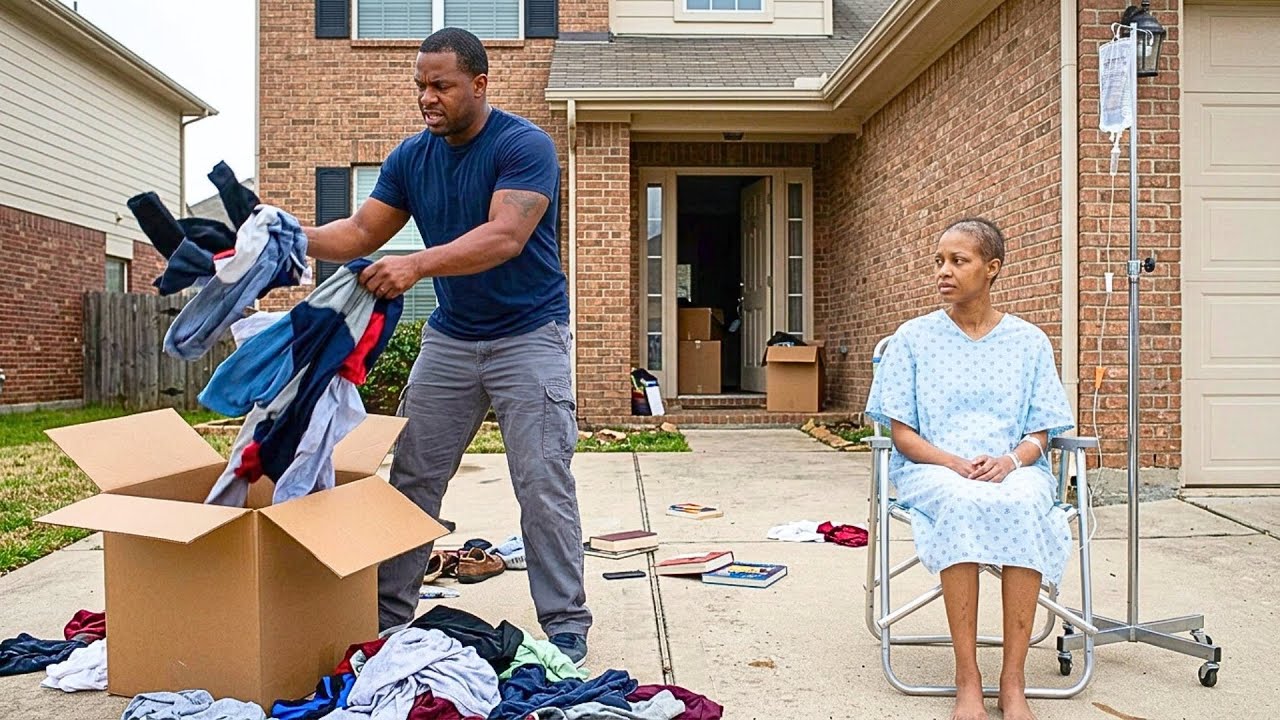
She took her time. She washed her face. She put on her gown and slippers. She carried the folding chair from the hall closet out to the driveway.
She sat down. She set the pocket recorder on her knee. And she watched Melvin Sturgis throw her belongings across the property that had never belonged to him. On the second-floor balcony across the way, a phone appeared above the railing.
Its camera faced the driveway. Ronda noted it the way she noted everything—without reaction, without acknowledgment. She let him finish. Memphis family court sat on Adams Avenue with the gravity of a building that had witnessed enough human failure to have stopped being surprised by it.
Ronda walked those hallways slower than she used to—the treatment had taken something from her stride—but with the same directness. Denise walked beside her, carrying a banker’s box with both hands. Melvin was already in the corridor in the charcoal suit he saved for occasions he considered important. His attorney, Bradford Hines, stood beside him reviewing something on a tablet with the focused energy of a man confident in his preparation.
Hines opened with fluency. Six years of shared occupancy. A home valued at nine hundred thousand in a rising market. A wife who, due to illness, had become unable to contribute to the household’s financial stability.
A husband seeking equitable access to a shared asset. It was a coherent argument. It would have been effective against a different opponent. Ronda did not argue.
She presented. She began with the Freeman Family Estate Trust—the original document notarized, filed with Shelby County, dated fifteen years before her marriage to Melvin Sturgis. She placed it before the court with a brief, precise explanation of its origin and legal standing. Then the property deed.
Ronda Freeman, sole owner. Her name and her name only. Filed in her own hand the year she passed the bar. Then the recording.
She had prepared a transcript as courtesy, but she played the audio as well. Melvin’s voice moving through the house with Darren Cole: “She’s been sick. The timing might actually be good for a transition. ”
Judge Cassandra Wyatt’s expression did not change.
The neighbor’s cell phone video came next. Sixty-three seconds of Melvin in the driveway. Ronda in the folding chair with the IV pole beside her. Then the security footage from across the lot.
Then, retrieved from Darren Cole’s phone records through a subpoena Denise had processed, forty-seven seconds of a call placed the evening before the driveway scene. Melvin’s voice, compressed by the phone line: “She’s too sick to fight it. I just need her out. ”
Bradford Hines asked for a recess.
Judge Wyatt denied it. The ruling took eleven minutes. The Freeman Family Estate Trust predated the marriage and had never been transferred, commingled, or restructured to include Melvin Sturgis in any capacity. The property on Callaway Ridge Drive belonged solely and entirely to Ronda Freeman.
The court further noted the recorded evidence of deliberate coercion and referred the driveway incident for review. Melvin left through a side corridor. Ronda did not watch him go. She drove home in the early afternoon with Denise in the passenger seat and the court order in the banker’s box in the back.
The house was the way she had left it—warm and quiet, smelling faintly of the candle Denise had lit the night before. There were fresh sheets on the bed and a pot of something on the stove that smelled like their mother’s white bean soup. Ronda sat at the kitchen island. She removed the IV line with careful precision, taped gauze over the site, and set the line aside.
Then she took the court order from the box, laid it flat on the counter, and smoothed it once with her palm—the way her grandmother used to smooth important papers. Deliberately, completely, as if the gesture itself were a form of filing. The afternoon light came through the kitchen window at the angle it always came, amber and unhurried, settling across the counter where three generations of Freeman women had stood and thought and decided and built. She had not needed to raise her voice once.
She had documentation. And in every proceeding where assumption had faced evidence, documentation won. It had won for Odessa Freeman, who wrote every payment in a ledger with her own hand. It had won for Gloria Freeman, who read property tax statements to her daughter at the kitchen table like scripture.
And it had won today for Ronda Freeman, who had understood from the moment Melvin said “we should talk about the equity” that the case had already begun. The Freeman women always built to last. And what they built, no one had ever successfully taken from them.