A small, sharp pause, as if Sophia had reached for something her mother had been keeping carefully out of her hands. “Sophia, no. Honey, no. That’s not—”
“You said if I was brave.
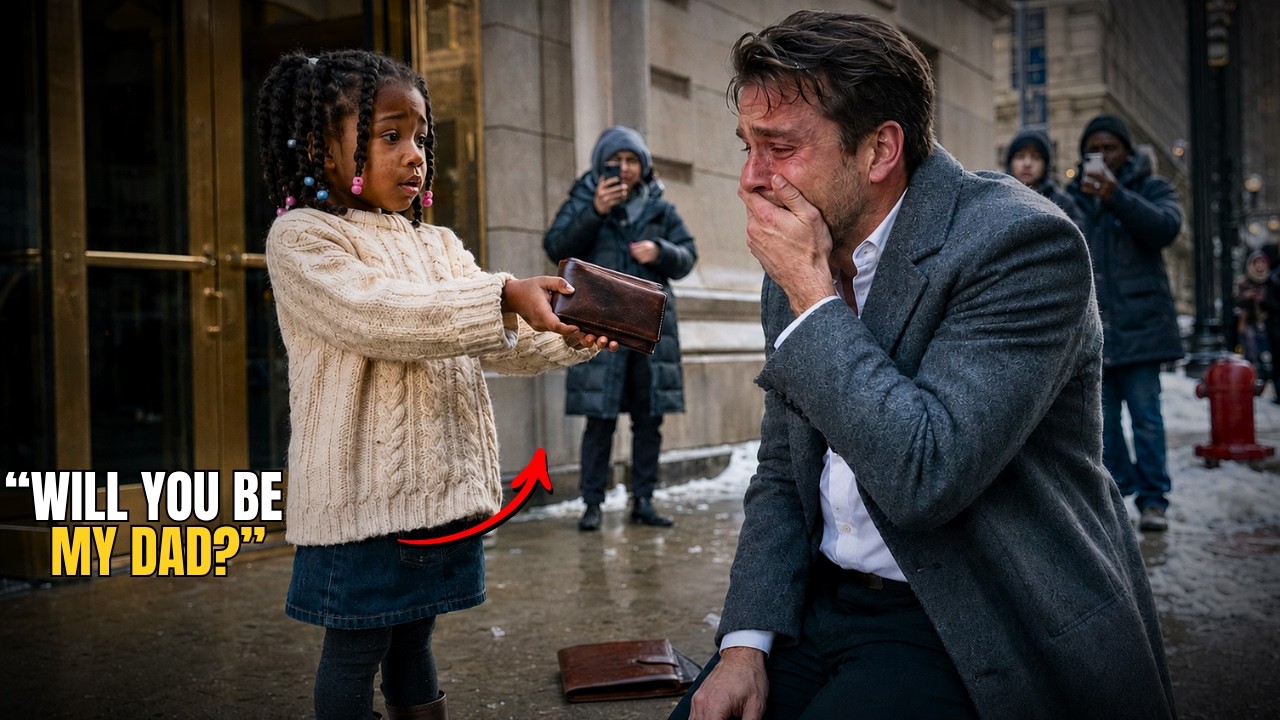
I said if it was the right person. He looks like the right person. ”
Renee closed her eyes for one full breath. When she opened them, she looked at Brian with something he couldn’t identify—not embarrassment, not exactly.
Closer to the look of a woman who had run out of soft places to put a hard thing. “Sir,” she said, “I’m sorry. She’s been carrying something around for two weeks. A thing the teacher asked them to think about.
She doesn’t know how to—”
“It’s all right,” Brian said gently. “She can ask me. ”
Renee looked down at her daughter and gave the smallest nod. Sophia took a small breath.
She squared her shoulders the way a child does when she has practiced what she is about to say. The pastel beads clicked softly. “My teacher said next Friday is career day. She said we have to bring somebody from our family who has a job.
So they can come to school and read us a book and talk about their work. ” She paused. “My mama works two jobs and she can’t get off either one. And my daddy can’t come.
”
Brian glanced at Renee. Renee was looking at the sidewalk. “My daddy died,” Sophia said. Her voice was steady, the way a child reports the weather.
“Six months ago. He fell at his work. He worked at the big building downtown. The new one.
”
Brian felt something in his chest go very still. “My teacher said only kids with a daddy at home get to bring one,” Sophia continued. “And I told her I didn’t have one anymore. But I thought maybe somebody else’s daddy could come.
Just one day. Just to read. ” She looked up at him with her serious, hopeful, six-year-old face. “Would you do it?
Would you come and read to my class? ”
For a long moment, Brian did not answer. The question sat between them in the cold air, simple as a coin set on a table. He had been asked for many things in his life—money, time, favors.
He had a folder under his arm with $11 million signed away in it, and not one of those dollars had asked him for anything this small or this heavy. Sophia waited. Renee did not look up. Brian opened his mouth to say “Of course.
” But something else came first. A pressure behind his ribs, sudden and uninvited, the way grief sometimes arrives when you have spent two years standing very still so it cannot find you. He had stood very still through Margaret’s funeral, through the foundation paperwork, through this morning’s signature. And then a child in a cream sweater had asked him to read a book to her class because her father had fallen at the new building downtown, and the stillness broke.
His knees buckled. He went down to the wet pavement on one knee, then the other, his free hand coming up to his mouth as if to physically hold something in. The leather folder slipped from under his arm and landed flat on the sidewalk beside him. A sound came out of him he hadn’t made in two years, a single broken inhalation.
His face crumpled in the way faces only crumple when a person has been carrying something so long they have forgotten the shape of putting it down. Someone whispered, “Oh my god. ” A phone came up. Brian saw, somewhere far away, Sophia’s small wet boots, her hands fallen still at her sides, her pastel beads.
Renee moved first. She stepped between Brian and the gathering eyes, half turning her body the way a mother turns toward a wounded animal—not to comfort it, but to give it a wall. She crouched and put a hand on Sophia’s shoulder, drawing her back. “Sophia, baby, come here.
It’s all right. You didn’t do anything. ”
“Did I make him sad? ” Sophia’s voice was very small.
“No, sweetheart. Sometimes grown-ups cry. It’s all right. ”
Brian heard them as if through water.
He pressed his hand harder against his mouth and tried to breathe. The cold from the pavement soaked through his trousers. He did not feel it. He felt, instead, the strange, clear weight of a thought he had not yet allowed himself to finish.
The new building downtown. There was only one. He had walked its lobby last week. He had cut its ribbon in November.
His name was etched into the stone above its entrance. He squeezed his eyes shut. Then he forced himself to look up, his face wet, and he looked at Sophia first because she needed to be looked at. “Sophia,” he said, his voice rough.
“I’m not crying because of you. I’m crying because what you asked me is a very kind thing, and because I lost somebody too. Sometimes when somebody asks you something kind, it makes the lost part come back for a second. ”
Sophia considered that.
Then she said, with the gravity of a small theologian, “I know about the lost part. ”
Brian’s face crumpled again. He caught it this time, but barely. “Yes.
I think you do. ”
Renee was watching him now. “Sir, are you all right? ”
Brian wiped his face with the back of his hand.
He did not stand yet. “What was your husband’s name? ”
Renee went still. “Daniel.
Daniel Hayes. ”
Brian closed his eyes. He let the name settle behind his ribs. Then he pressed both hands flat against his thighs and pushed himself up.
His knees were dark with melted slush. He picked up the leather folder and looked at Sophia. “Sophia. I would be honored to read to your class on Friday.
”
Sophia’s whole face changed—not a smile, but a slow softening. She looked up at her mother. Renee studied Brian for a long moment. “If you mean it, sir, then yes.
”
“I mean it. ”
“Friday is in four days. ”
“Friday, I will be there. ”
Brian got her number, didn’t ask for her last name.
He already knew it. He crouched again, held out his hand. Sophia shook it once, very seriously. “Thank you for my wallet, Sophia.
”
“You’re welcome, Mr. Brian. ”
He watched them walk to the corner. Sophia looked back once.
He lifted his hand. She lifted hers. Then they were gone. Brian stood on the sidewalk for a full minute.
Then he dialed his assistant, Rachel. “I need you to do three things. A family, Daniel Hayes. He died six months ago in a fall at the Hollis Tower construction site.
I want the accident report, OSHA filings, settlement records, everything on my desk by five. The site manager from that project—name, employment record, inspection paperwork. And a children’s book for Friday. I’m reading to a first-grade class.
Something honest. Not sad. Not a brave little girl one. Something honest.
”
Rachel paused. “Are you all right? ”
“No. ”
“What happened?
”
Brian looked at the place on the sidewalk where Sophia had stood. “A little girl returned my wallet. ”
Rachel didn’t press. By the time Brian reached his office, she had the preliminary file.
Daniel Hayes, thirty-one. Photo ID. Wide, serious eyes. The same eyes as Sophia.
The incident report was three pages. Daniel Hayes, subcontracted steel worker, fell forty-one feet from the nineteenth floor. Harness recovered unclipped. Classified as worker error.
No corporate liability. Settlement paid at minimum statutory level due to worker error classification. Multiple claim denials. The safety briefing sign-off was signed by site manager Kyle Reeves.
The signature on Daniel’s line didn’t match his signature on any other document. Brian kept reading. Twenty-six third-party safety inspections in the four months before the fall. Every single one passed without a single finding.
On a forty-story steel build. That was impossible. He checked the signatures. They were too consistent—the same angle, same length, same flourish.
Forged. An internal auditor named Priya Mehta had flagged repeated tie-off violations two weeks before the death. She recommended a formal safety stand-down. It was never conducted.
She resigned thirty-eight days later. “Relocated for family reasons. ”
Brian called Rachel. “I need Priya Mehta’s current contact number.
Personally. Not through HR. And schedule Carl Reeves in my office tomorrow at eight. Tell him it’s about the Lakeside Vista build.
Have legal, HR, and security in the building. Do not tell him any of them are there. ”
He looked at the photograph of Daniel Hayes one more time. The careful, not-quite-committed smile.
The eyes that were Sophia’s eyes. Carl Reeves arrived at 7:53. Thick-shouldered, easy posture, dark blazer. He smiled at Rachel.
Brian sat at the conference table, three folders in front of him. He opened the first one, turned it around to show the photograph. “Do you know who this is? ”
“That’s Hayes.
The accident on the Hollis Tower last June. ”
“Tell me what happened that day. ”
Carl spoke carefully—a man who had told the story many times. “Worker error.
He stepped out without clipping in. We did the safety briefing. He knew the protocol. Harness was right there on his back, just wasn’t clipped.
”
Brian nodded slowly. “The signature on his line of the briefing sheet does not match his signature on any other document. Six men on the crew—five don’t remember him saying anything in the briefing. Two remember you sent him to retrieve a tool.
One remembers you signed his name for him because he was running late. ”
Carl said nothing. Brian opened the third folder. “The twenty-six inspections.
Rachel checked the inspector’s calendar. He was in Indianapolis on six of those dates. On medical leave for back surgery on four. At his daughter’s wedding on one.
Someone signed for him. ” He looked up. “Eight percent under budget, Carl. That’s where the margin came from.
”
“Sir, it was one fall. We’ve built fifty buildings. Things happen. ”
“His daughter is six years old, Carl.
Her name is Sophia. She returned my wallet on a sidewalk yesterday and asked me to come read to her class on Friday because she doesn’t have a father to bring. ”
Carl closed his eyes. The door opened.
Legal, HR, security walked in. Carl signed both pages. Security walked him out. He left his tablet on the table.
After the door closed, Brian turned to Rachel. “Reopen the case. Appeal the accident classification. Notify OSHA of the falsified inspections.
And calculate the difference between what the Hayes family received and what they should have received under corporate liability. Double it. Put it in a private trust for the children’s education and the wife’s stability. No release.
No requirement of silence. I’m telling her myself. ”
Renee Hayes came to the office at three. She wore the same navy coat.
Her eyes were wary, but steady. Brian met her at the elevator and walked her to a small private conference room. There was coffee on the table, a box of tissues beside it—not prominent, just there. He told her everything.
The forged signatures. The ignored warning. The promotion after the accident. His own signature at the top of the cascade.
He told her her husband had not been negligent. He had been killed by a system Brian himself had built and had not bothered to look at closely enough. Renee sat very still. She breathed in once, slowly, holding herself together with hands she did not want anyone to see.
“You’re telling me my husband did everything right? ”
“Yes. ”
“And that man up there said he didn’t? ”
“Yes.
”
“And you signed the papers that let him say that? ”
Brian did not look away. “Yes. ”
Renee nodded slowly.
A single tear came loose. She did not wipe it. “Thank you for telling me to my face. ”
He told her about the trust, the corrected record, the private trust, no strings attached.
“Mrs. Hayes, this is not generosity. This is the bare beginning of what is owed. ”
She turned her face toward the window.
After a long while, she said, “You’re really coming Friday. ”
“Yes. ”
“You don’t have to. Not now.
Not with all of this. ”
“I’m coming Friday. ”
The smallest piece of her face softened. “She’s going to be the only kid in that class with a billionaire in a cardigan reading her a book.
”
“I will find a very ordinary cardigan. ”
Friday morning, Brian put on a soft oatmeal-colored cardigan that had once belonged to Margaret’s father. He drove himself to the school, carrying a single picture book—a story about a small girl who plants a seed and waits for it to grow, and is surprised by how much taller it is than she thought it would be. Miss Alvarez met him at the front office.
“Sophia has been talking about today all week. ”
Brian paused at the classroom door. Sophia sat cross-legged on a green rug in the front, her chunky two-strand twists bobbing as she whispered to a friend. The pastel beads caught the fluorescent light.
He stepped through the doorway. She saw him, went still, then got up slowly and walked across the classroom. She put her arms around his waist and pressed her face into the soft oatmeal cardigan. Miss Alvarez clapped her hands.
“Sophia, would you like to introduce him? ”
Sophia let go and turned to face the rug. She squared her shoulders. The pastel beads clicked.
“This is Mr. Brian. He is not my daddy, but my daddy can’t come because he is in heaven. And Mr.
Brian came instead because I asked him to, and he said yes. ”
The room was very quiet. “He brought a book,” Sophia added. Brian read the book sitting on a small wooden chair too low for him, knees bent awkwardly, the cardigan loose around his shoulders.
He held the pictures out so every child could see. He let Sophia sit closest, leaning lightly against his knee. When he came to the part where the small girl is surprised by how much her seed has grown, he had to pause and clear his throat. He glanced up and saw Renee standing in the doorway, crying without sound.
He nodded to her. She nodded back. He finished the book. The children clapped.
Sophia held up her hand. “Very seriously, Mr. Brian, what is your job? ”
Brian thought for a long moment.
“My job is making sure people are taken care of when they go to work. I used to think my job was building buildings. I was wrong. My real job is the people inside them.
”
Sophia nodded, satisfied with the answer. By Monday, the press release had been rewritten. The new children’s hospital wing would no longer carry Margaret’s name. The bronze plaque above the entrance would read: The Daniel Hayes Pediatric Wing.
Beneath that, smaller: Dedicated by Margaret Hollis, who would have wanted it this way. Carl Reeves was indicted seven weeks later. The Hollis Group’s bonus structure was rebuilt from the bottom up—safety findings rewarded, project margins removed from manager compensation. Brian signed every line himself, reading each one before he wrote his name.
Sophia Hayes started first grade in new shoes with dry toes. Her mother no longer worked two jobs. The trust held. Sophia kept the picture book on a small white shelf in her bedroom, next to a framed photograph of a man with a careful, not-quite-committed smile.
Beside both, for reasons she could not have explained, she kept a thick brown leather wallet she had once handed back to a stranger on a cold morning outside a bank.