” He inclined his head. “I am in your debt. A duke who acknowledges a debt to his household for the first time at thirty-four is a poor enough thing, but he is at least an honest one as of this morning. ”
He bowed to them—the bow of one man to a room full of others—and went out to ride to the Bell at Halverford Cross to meet Mr.
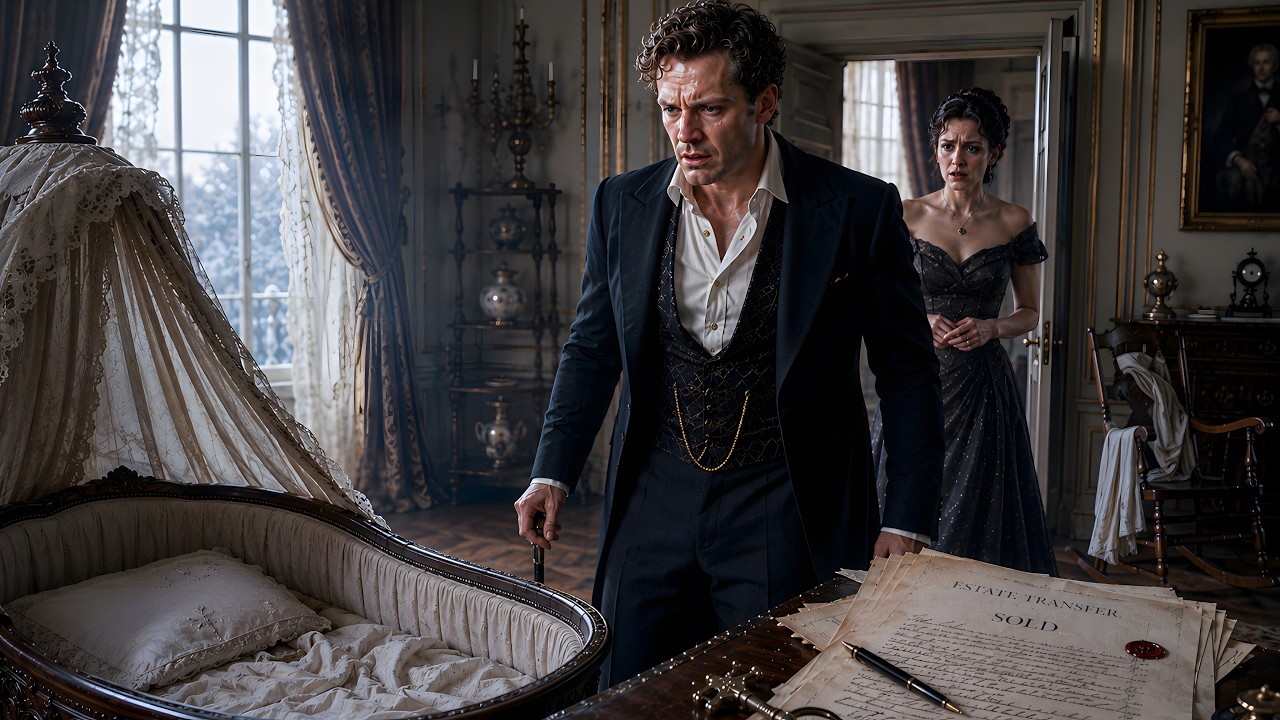
Howerin. The tap room was empty. The landlord came out wiping his hands. “He is in the back parlor, your grace, at his breakfast.
”
Edmund nodded. “Tell him the Duke of Halverford requests the favor of joining him. ”
The landlord went. He came back.
“He says your grace that the Duke is welcome but the bacon is his. ”
Edmund permitted himself a small movement at the corner of his mouth that was almost a smile. Mr. Howerin of Liverpool was a man of perhaps fifty, square-built, gray at the temples, in a coat cut by a London tailor not more than three months ago.
He did not rise. He gestured to the chair opposite. “You will want to ask me a great many questions. I will tell you at the start that I did not know your wife before last Tuesday week.
I bought the lands because they were for sale at a price that flattered me. That is the whole of what I know of you, and I would prefer to keep it so. ”
Edmund considered the man. “Tell me what you intend to do with my grandfather’s library.
”
Howerin put down his knife. “I have no use for it. I cannot read Latin. I could sell it, of course.
But I have stood in your library, and I have a notion that a man who has bought a great house should know what he has bought before he sells off the parts of it. So I will not sell the library this year. Perhaps not next year. I will leave it where it is for as long as it amuses me.
”
Edmund inclined his head. “It is better than I expected. ”
Howerin ate a piece of bacon. “Your grace, may I ask a thing in return?
”
“You may. ”
“The boy. Was he well treated? ”
Edmund did not answer at once.
“I am told he was. I do not know it of my own knowledge. I was not a father in any sense you would recognize. I was a man who had a son.
”
Howerin nodded. “Then I am sorry, your grace. For what it is worth from a stranger in a parlor. ”
Edmund stood.
“I will trespass on your property from time to time, if you will permit it—to walk the boundary, to stand once a quarter in the long gallery, to borrow perhaps the occasional book. ”
Howerin extended his hand. Edmund took it. “You will be welcome.
Bring your own horse. I have not yet bought yours. ”
He rode back under the limes. Somewhere between the third tree and the fourth, he understood that he had not been a duke for eleven years so much as he had been worn by a duke, like a coat worn by a man who has long ceased to notice the cut of it.
The coat had been taken off him in the night by his wife. He was, for the first time since he could not remember, walking in his own skin. He went down to the kitchen and asked Mrs. Tovi what she would have him do until dinner.
She told him the apples in the stillroom wanted turning. He turned them slowly and methodically for forty minutes. The stillroom woman, whose name he had been sorry not to know, told him her name was Mrs. Penhal, that her son had immigrated to Canada, and that she had three letters from him which she could not read because her eyes were going.
He read her the letters that night by the fire in the stillroom. The son in Canada was alive and married and the father of a child of two. Mrs. Penhal cried quietly into her apron.
Edmund’s own eyes were not quite dry, and he did not pretend they were. He went up late. He did not sleep. He sat by the window and thought about the boy in a way he had not permitted himself in eleven years: without strategy, without calculation.
He thought of the blue blanket, the rocking horse, the painted cup. He had never given the boy a cup. He had given him a christening, a name, a portrait once a year. Nothing else the boy could carry away in a nurse’s bag at midnight.
He understood that his wife had not stolen his son. She had taken the polite fiction that he had one. He made a decision: he would not chase her. He would not write.
He would become, slowly and without witnesses, a man whom in two years, when she sent the portrait of the boy at six, she would not be sorry to have once loved. The weeks went by. He learned the names of the eleven. He learned that the gardener’s daughter, Miss Jelico, wanted to learn Latin.
He taught her on Tuesday evenings in the library. By November she could read a page of Caesar with only minor swearing. He read to Mrs. Penhal every night.
He called the doctor for the lodgekeeper’s sick child and paid out of his own pocket. Mr. Howerin came down in the spring. He found Edmund in the long gallery dusting his grandfather’s portraits with a soft cloth.
“I have a proposal,” Howerin said. “I will keep the Welsh holdings and the Cumberland mines and the London properties. But the home farm, the library, the long gallery, and the right to call yourself master of them—I will sell back to you at the price I paid, over twenty years at four percent, on one condition. ”
Edmund waited.
“That when your son comes home, you bring him to my house in Liverpool, and you let my daughter, who is nine, give him tea. Because she has heard from her mother, who has heard from Mrs. Tovi, that there is a small boy somewhere whose father has begun late to be worth knowing. She would like my daughter to know him too.
”
Edmund felt the small clean hole behind his breastbone fill with something he had no name for. “I accept your terms. ”
The portrait came as promised, wrapped in brown paper, sent from an address in Yorkshire he did not pursue. The boy was six.
He had Clara’s eyes and Edmund’s mouth and his own particular grave expression. A letter folded behind it said only: *He is well. He asks about you sometimes. I tell him you are learning.
If you continue to learn, in another two years I will bring him myself to the Bell for an afternoon. Do not write back. *
Edmund propped the portrait on the mantel. That evening, after Mrs.
Penhal’s letters and Miss Jelico’s Latin and the supper of the twelve, he walked out into the home farm, which was once more his, and stood at the gate of the lower paddock where the grays were grazing. He said aloud to no one but Ren, who came to the gate when he called, that he hoped, if the boy was permitted to come, the boy would like horses. Ren breathed warmly into his palm.
It was as much answer as he had any right to expect, and he was content with it.