Harold weighed at least 180 pounds. Isaiah weighed 146. He hadn’t eaten in over 24 hours. It took twelve minutes.
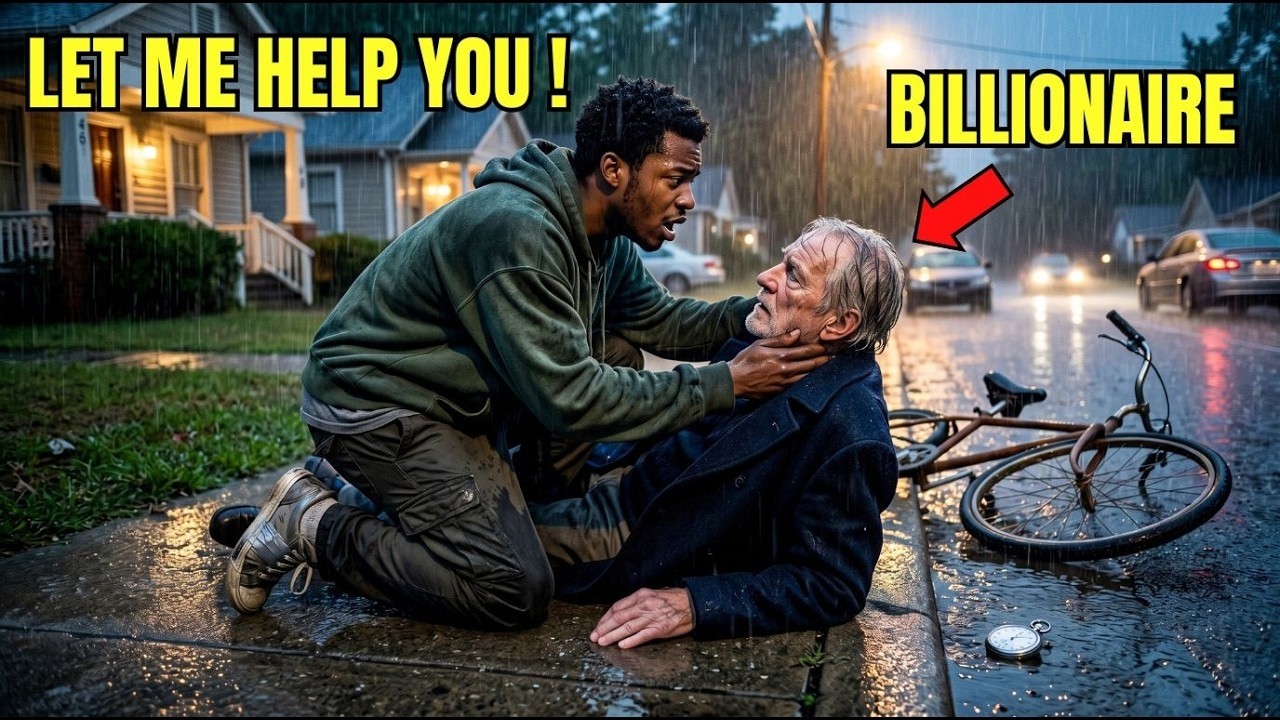
Pulling, adjusting, resting, pulling again. Isaiah talked the whole time. Low. Steady.
Never stopping. Almost there, sir. You’re doing good. Just a little more.
I got you. He propped Harold upright on a bus stop bench. He tore the garbage bag off his backpack and wrapped it around the old man’s body, the same way he tucked Nana’s blanket every single night. Harold’s hands folded over his chest.
Fingers interlaced. Thumbs pressed together. A prayer clasp. Automatic.
Like something his body did without asking permission. Isaiah stared at those hands. Something tugged at the back of his mind. He had seen that gesture before.
Somewhere. Sir, I need to go get help. Don’t close your eyes. Promise me.
Harold’s voice, barely there. Promise. Isaiah got on the Huffy and rode. No hoodie.
No jacket. Thin undershirt plastered to a body running on saltines and willpower. Cars blasted past close enough to rattle his handlebars. He reached the Quick Stop gas station in 22 minutes.
A ride that normally took 35. He crashed through the door. There’s an old man on Chestnut Lane. He collapsed.
Please, call 911. Trent Wilson behind the counter hesitated. One beat. Then picked up the phone.
Isaiah grabbed a bottle of water and a pack of hand warmers. He dug into his pocket. Everything he owned in the world. $3.
18. He spread it on the counter. Not enough. Trent shook his head.
Go. Just go. Isaiah rode back into the storm. His legs were almost gone.
The last mile he stood on the pedals because his body couldn’t hold the seat. He found Harold still conscious. Barely. He cracked the hand warmers, slid them inside the garbage bag.
Tilted small sips of water into the old man’s mouth. Then he sat down on the wet concrete, shoulder to shoulder with a man whose name he didn’t even know. The ambulance arrived. EMTs found a shivering, hollow-faced 20-year-old sitting beside a 78-year-old man, shoulders touching, neither one letting go.
Are you family? the lead EMT asked. Isaiah shook his head. No, ma’am.
I just found him. As they lifted Harold onto the stretcher, his hand shot out and found Isaiah’s forearm. His grip was surprisingly firm. His eyes locked onto Isaiah’s face.
Son, tell me your name. Isaiah, sir. Isaiah Robinson. Harold repeated it slowly, carefully, like he was pressing each syllable into stone.
That watch. You keep it for me. I’m going to come find you. Isaiah reached into his pocket and pulled out the silver pocket watch.
It’s yours, sir. Take it back. Harold shook his head. Hold onto it.
It means something. You’ll understand later. The ambulance doors closed. Isaiah stood alone on Chestnut Lane.
No hoodie. Bare arms. Holding a stranger’s pocket watch with zero dollars in his pocket. He walked the Huffy three miles home in the dark.
The bike chain had snapped during the return sprint. He arrived at the trailer at 8:40 p. m. Nana was in her wheelchair just inside the screen door.
She’d been sitting there for two hours. Isaiah forced a smile. Hey, Nana. Sorry I’m late.
Helped somebody on the road. She saw the bare arms. The muddy undershirt. The way he held the door frame for balance.
She didn’t push. That night, Isaiah set the pocket watch on the overturned milk crate he used as a nightstand. He turned it over. On the back, an engraved script worn soft by years of handling: For every life you reach, E.
B. He read it twice. Didn’t know what it meant. Three days later, a sleek black SUV with tinted windows was parked across from Beulah’s Diner.
When Isaiah looked at it, it pulled away slowly. A woman called Earl Davis at the Paper Depot, asking about the young man who ran the south delivery route. Earl warned Isaiah: Watch yourself, kid. Nana got a phone call.
A woman’s voice, calm and courteous. A representative of a private family office. Asking to confirm whether an Isaiah Robinson resided at this address. Nana hung up.
Don’t tell anyone where we live, Isaiah. You hear me? That night Isaiah sat on the porch step cleaning the watch. He flipped it open.
Behind the watch face, tucked into a tiny cover, a photograph. A woman with kind eyes, silver hair, a warm smile. Below the photo, engraved in script so small he had to angle his flashlight: Eleanor Bennett, 1948 to 2020. Bennett.
The next morning on his paper route, Isaiah stopped in front of the Bennett Community Health Clinic. He read the full sign for the first time. Bennett Community Health Clinic, founded by Harold and Eleanor Bennett, serving Barton County since 1989. He pulled the watch from his pocket.
Opened it. Eleanor’s photograph. The man he’d carried through the rain wasn’t just some stranger. He was the name on the building Isaiah had ridden past every morning of his life.
One week after the storm, a black Lincoln Town Car rolled up the gravel road to Isaiah’s trailer. Caroline Bennett Shaw stepped out. Mid-40s. Tailored charcoal coat.
She knocked. Nana opened the door from her wheelchair. Mrs. Robinson, my name is Caroline Bennett Shaw.
My father is Harold Bennett. One week ago your grandson saved his life. Nana didn’t respond. Her eyes filled.
Not because of the town car. Because of two words. Harold Bennett. She wheeled back from the door.
Come inside. And then Nana told a story she had never told Isaiah. Five years ago, when she was first diagnosed with lymphoma, she had no insurance. She went to the Bennett Community Health Clinic because someone said they helped people with nothing left.
She was placed on a waiting list. Eight to fourteen months. Her oncologist told her privately she had six months. Then, four days later, a phone call.
An anonymous donor had reviewed her file and approved a private grant covering the full cost of her chemotherapy. No co-pays. No repayment. No conditions.
The donor saw your file and said, this one, today. Dolores never learned who it was. But she remembered one thing from that day. She was sitting in the waiting area when a tall, elderly white man walked through the hallway.
He wasn’t a patient. He wasn’t wearing a lab coat. As he paused near the reception desk, she watched him fold his hands. Fingers interlaced.
Thumbs pressed together. Held against his chest. Like a man in quiet, permanent prayer. Nana’s voice broke.
That man saved my life, Caroline. He gave me five more years with my grandson. I never got to say thank you. Caroline reached across the table.
Mrs. Robinson, that was my father. Isaiah had been standing in the hallway. He stepped into the kitchen slowly, holding the pocket watch.
The connection hit him in waves. The clinic sign. The watch engraved by a dead wife. The prayer hands he couldn’t place.
The anonymous donor. The reason his grandmother was alive. The same man lying on a sidewalk while the whole town drove past. And Isaiah, knowing none of it, rode ten miles through a thunderstorm to bring him back.
He sat down at the table. He told me to keep it safe for him. Caroline looked at the watch. Her hand went to her mouth.
The next day, Harold was sitting up in bed when Isaiah and Nana arrived. His eyes sharp. A cane leaning against the nightstand. He looked like a man who had already made a decision.
There he is. The young man with the bike. Isaiah held out the watch. I brought it back, sir.
Harold took it. Ran his thumb over the engraving. Then he closed Isaiah’s fingers around it again. I told you to keep it.
Eleanor would have wanted you to have it. He asked Isaiah questions. Real questions. Isaiah told him the truth.
The dropout at 17. The three jobs. The leaking roof. The pills running out.
Harold listened completely. When Isaiah finished, Harold told him about the Bennett Future Builders Initiative. Full ride scholarship. GED completion.
College tuition. Housing. Textbooks. A laptop.
A monthly stipend. A guaranteed internship. Thirty-four young people have come through this program. Engineers.
Nurses. Teachers. But I’ve never met a candidate who earned it the way you did. Not with a test score.
With a thunderstorm, a rusted bicycle, and an empty stomach. He turned to Nana. Mrs. Robinson.
Caroline told me your story. I remember your file. I remember reading it and thinking, this woman has people who need her. He offered her full medical coverage.
Every treatment. Every medication. For as long as she needed it. Through his personal family foundation.
This isn’t charity. This is me finishing a conversation I should have had with you five years ago. Nana covered her face with both hands. Then Harold announced a five million dollar reinvestment commitment to Barton County.
Full renovation and expansion of the clinic. A community youth center. A micro-grant fund for families drowning in medical debt. Two shuttle vans connecting underserved neighborhoods to the clinic, the pharmacy, the school.
I’m not doing this because you saved my life, Harold said quietly. I’m doing this because you reminded me why I started. Within six months, Barton didn’t look like the same town. Isaiah enrolled in the GED prep program.
Completed it in four months. His tutor, the same teacher who called him her sharpest student, said: I’ve never seen someone learn like they’re breathing after being underwater. He applied to three universities. His essay ended with a line about his mother: I didn’t stop for a man in the rain because I’m special.
I stopped because my mother taught me that people aren’t disposable, even when the world treats you like you are. He got accepted to Georgia State University. Biomedical engineering. Full scholarship.
Nana’s treatment stabilized. She gained eleven pounds. She started volunteering at the clinic two mornings a week, greeting patients from her wheelchair at the front desk. The clinic reopened with double the capacity.
A new pediatric wing. The first mental health counselor in Barton County’s history. Harold, on his feet, leaning on his cane, cut the ribbon alongside Isaiah. The Barton County Gazette ran a front-page story.
The headline: The Man Who Stopped. One year later, on the anniversary of the storm, it was raining in Barton. A soft, steady fall. Isaiah, 21 now, rode his bike down Chestnut Lane.
He stopped at the exact spot where he’d found Harold. A small wooden bench sat beside the curb. A brass plaque bolted to the armrest. Four words: Because Somebody Stopped.
Isaiah sat on the bench. He pulled out the pocket watch. Opened it. Looked at Eleanor’s photograph.
Closed it gently. Slipped it back into his pocket. He rode to Harold’s house. A modest colonial.
Harold was on the porch with tea and a blanket across his knees. They sat together. Harold asked about school. Isaiah told him about his project: a modular low-cost wheelchair brake for rural clinics.
Harold’s eyes lit up. That’s how Eleanor and I started, you know. A tiny tube. She said if we can keep one heart open, we can keep a thousand.
They talked for an hour. No cameras. No reporters. Just a young man and an old man on a porch in the rain.
Isaiah had started something new. Every Saturday morning he rode through Barton. Not delivering papers. Just checking on people.
The widow on Maple Street. The veteran on Oak Avenue. He stopped, waved, asked if they needed anything. Sometimes he fixed a hinge.
Sometimes he just listened. Nana called it his rounds. Isaiah called it just riding. He pedaled through light rain, the pocket watch safe in his jacket.
Behind him, the freshly painted sign of the Bennett Community Health Clinic. New words at the bottom in clean blue lettering: Because Somebody Stopped. Expanded 2026. He rode past.
And this time, he didn’t look away. He smiled.