For the first time since the episode began, Lucas hesitated, suspended between panic and possibility. The lobby fell away. On a cold marble floor, one overwhelmed child found another who understood what the world felt like when it became too much. Lucas sat on the floor now, no longer rocking violently.
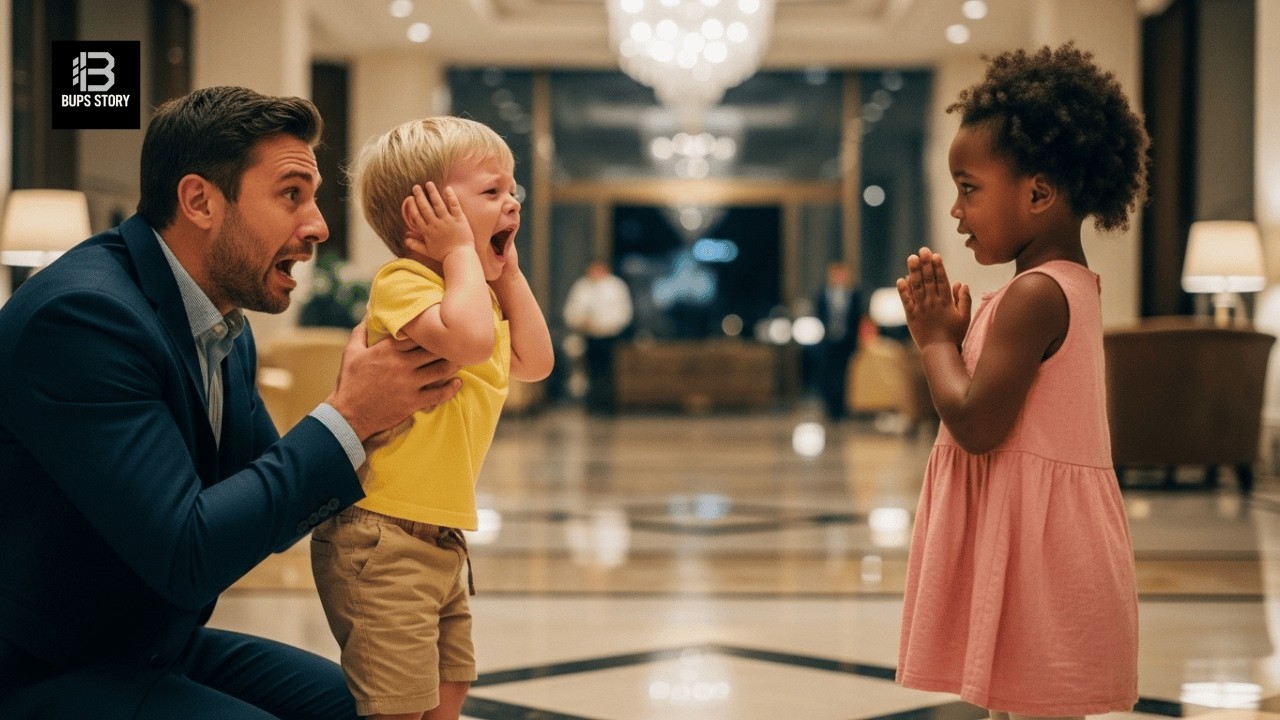
His knees were still pulled close, shoulders tense, but his screams had dissolved into uneven breaths. His eyes fixed on Annie’s hands as they tapped. Tap. Tap.
Tap. Tap. “It’s still loud,” he whispered. Annie nodded slowly.
“I know. You don’t have to stop it all at once. ” She tapped again. “You can listen to this instead.
Just this. ”
Lucas’s breathing hitched, then gradually began to follow the beat. Not perfectly. Not right away.
But enough. Richard felt his chest tighten. He had memorized charts, sat through endless consultations. No one had ever told him that sometimes what Lucas needed most was not instruction but permission.
Around them, the hotel staff shifted uneasily. The concierge took a half step forward, then stopped when the manager raised a hand. Annie glanced up briefly, then back to Lucas. “Are they still looking at me?
” he asked. “Some are,” she said honestly. “But you don’t have to look at them. ” She pointed to the floor between them.
“Look here. This spot. ”
Lucas followed her finger. The marble had a faint vein running through it, gray against white.
“It looks like a lightning bolt,” he said quietly. Annie smiled. “Yeah. I like that kind.
”
Another breath passed. Richard realized he had been holding his own. He let it out slowly. “Thank you,” he said softly.
Annie didn’t look at him. “Sometimes,” she said to Lucas, “when it gets too much, I pretend I’m smaller than the noise. ”
“How? ”
“I pick one thing.
One sound, one picture. And I stay there until the rest gets tired. ”
Lucas tapped his finger once against the floor, then again, mimicking her rhythm. “It’s not gone.
”
“It doesn’t have to be. Just quieter. ”
The manager cleared his throat. “Sir, we need to consider the comfort of our other guests.
”
Richard turned slowly. “My son is not a disruption. He’s a child having a medical episode. ” His tone ended the conversation.
The manager nodded stiffly and stepped back. Annie’s shoulders relaxed slightly. Lucas leaned back onto his hands, testing his balance. “Daddy,” he said, quieter now, “I don’t like when they look at me like that.
”
Richard lowered himself to one knee. “I know. I’m sorry. ”
Lucas frowned.
“Why? ”
“Because I should have helped sooner. ”
Annie looked up at him then. “Sometimes grown-ups don’t know how.
”
Richard met her eyes. “You do? ”
“Sometimes. ”
A woman nearby murmured, “Kids.
They surprise you. ”
Annie shifted and glanced toward the elevators, checking instinctively. Lucas followed her gaze. “Are you in trouble?
”
“No. I’m just waiting. ”
“For who? ”
“My mom.
She works here. ”
Lucas nodded. “My dad works everywhere. ”
Annie considered that.
“That sounds tiring. ”
Richard almost smiled. Annie tapped the floor one last time, then stopped. “You’re doing good.
Your body’s catching up. ”
Lucas took a deep breath, then another. The storm had not disappeared, but it had passed its worst point. Later, when Annie and her mother appeared, Richard introduced himself.
“Your daughter helped my son. She helped him more than anyone else. ”
Maria’s eyes flicked from Annie to Lucas, then back. Pride mixed with caution.
“We should go. My break’s almost over. ”
Annie turned to Lucas. “It was nice to meet you.
”
“It was nice to meet you too, Annie. ”
She smiled and walked away with her mother, disappearing into the back corridors. Richard knelt in front of his son. “She didn’t think I was bad,” Lucas said quietly.
“No. She didn’t. ”
And for the first time, Richard wondered how many times the world had failed that little girl, and how many times she had learned to carry grace anyway. That night, Lucas slept with the lights on.
The worn cleaning cloth Annie had given him clenched in his hand. Richard sat on the edge of the bed, listening to his breathing gradually slow. “Daddy? ” Lucas murmured.
“Yes? ”
“Annie’s name means grace. That’s a good name. ”
Richard smiled faintly.
“It is. ”
The next morning, Richard returned to the hotel alone. He asked for the cleaning supervisor. When Maria came forward, wary, he said, “I just want to talk.
No one’s in trouble. ”
They sat near a tall plant. Richard explained what he was beginning to understand. “My son has resources, advocates, a safety net.
When the world fails him, he’s protected. ” He paused. “What happens when a child like Annie grows up learning how to manage everyone else’s emotions before anyone ever manages hers? ”
Maria was quiet.
Then she said, “She learns to be careful. She learns when to speak and when not to. She learns how to calm people down so they don’t get angry. ” Her voice softened.
“She shouldn’t have to be that good at 6 years old. ”
“No,” Richard said. “She shouldn’t. ”
Maria studied him.
“Are you offering something? ”
“Eventually, maybe. But not today. Today, I’m listening.
”
That seemed to catch her off guard more than any check or promise would have. The next week, Richard called a press conference. He stood at the podium without notes. “I’m not here to talk about my company.
I’m here to talk about a child. A 6-year-old girl who helped my son during a moment of distress. She did so calmly, instinctively, without recognition. And afterward, she learned that helping might cost her safety.
”
He answered questions honestly. The news spread. The board asked him to step down. He didn’t argue.
“I’m stepping down effective immediately,” he said. When the media asked if he was reckless, he ignored them. That afternoon, he met Annie and Lucas in a small park between their neighborhoods. They sat on the grass and rolled a blue race car back and forth.
“It’s quieter here,” Annie said. “I like quiet,” Lucas replied. “So do I. ”
Maria watched from a bench with tears in her eyes.
Richard sat beside her. “Do you miss it? ” she asked. “The old life?
”
He thought about glass boardrooms and controlled language. “No. I miss who I thought I had to be to survive it. ”
Months passed.
Richard started a foundation in a borrowed community center. No cameras. No ribbon-cutting. Just folding chairs and a box of sensory toys.
People came. They talked about exhaustion and fear. They talked about children who already knew how to survive but shouldn’t have to learn alone. Annie still drew.
Her pictures changed. The bridge became wider. People stood on both sides. “What’s that?
” Richard asked one evening. “A place where people wait for each other. ”
On the one-year anniversary of the hotel incident, the foundation held its first open gathering. Neighbors came.
They sat together, ate together, listened. At the end of the day, as the sun dipped low, Richard stood with Maria watching the children play. “Do you think it was worth it? ” she asked.
Richard looked at Lucas laughing freely, not guarded. He looked at Annie, calm and unburdened. “Yes,” he said quietly. “Even if nothing else ever changed.
”
Maria smiled. “Things have changed. ”
That night, Richard tucked Lucas into bed. “Daddy,” Lucas said sleepily, “are we still walking slow?
”
Richard smiled. “Yes. Always. ”
Lucas nodded, satisfied, and drifted off.
Across the city, Maria tucked Annie in. “Mama, do I still have to help everyone? ”
Maria kissed her forehead. “No.
You get to choose now. ”
Annie smiled softly. “Okay. Then I’ll help when I want to.
”
She closed her eyes. The city hummed on, busy, imperfect, unresolved. But somewhere between a hotel lobby and a community center, between a child who screamed and a child who listened, a different rule had taken root. No one was too small to matter.
Kindness did not need permission. And sometimes the bravest thing an adult could do was step aside, slow down, and let a child show them how to be human again.