She should have said she couldn’t help. Nobody would have blamed her. But Stella had been raised by a woman who once gave her last loaf of bread to a neighbor in a snowstorm and said the Lord would figure out breakfast. She set her alarm for 4:45.
She drove to Southern Cycle Supply in Byron, rain easing to a drizzle. Earl, the owner, pulled the box off the shelf. $280. Stella opened her wallet.
Inside was a check she’d written from the shop’s operating fund. That money was supposed to go to Walgreens for her blood pressure medication. The prescription she’d been splitting in half for two months because she couldn’t afford full doses and Harold’s nursing home at the same time. She handed Earl the check.
Back at the shop by 7:30, Grant still asleep. Stella set the box on the workbench and went to work. She pulled the dead module, cleaned the connectors, seated the new one, torqued the bolts to spec from memory. Applied silicone sealant.
Let it set for ten minutes while she checked the rest of the bike. Tire pressure, chain tension, brake fluid. All fine. At 8:15 she turned the key and pressed the starter.
The V-twin caught. That deep Harley rumble filled the shop. The tools on the pegboard rattled softly. Stella smiled.
The sound woke Grant. He sat up, blinking, then walked to the bay in sock feet. The Road King was running, purring, ready. “You drove to Byron at five in the morning.
”
“Got your part. Installed it while you slept. ”
“How much do I owe you? ”
“Nothing.
”
He reached for his wallet. She raised her hand. “I didn’t fix your bike for money. I fixed it because you showed up at my door wet and hungry and three miles from nowhere.
That’s reason enough. ”
He held his coffee with both hands. “Why are you still doing this? Alone.
”
“Because this is where Harold is,” she said. “Not the nursing home. Here. In the walls, in the tools.
And because someone might knock on that door at midnight in a storm. If I’m not here, who opens it? ”
Grant finished his coffee. He pulled out his wallet and took out a fold of bills.
She didn’t look at the money. “Put your wallet away before you embarrass us both. ”
He slid the bills back. But from his jacket he pulled out a small white card.
“At least take this. ”
He set it on the workbench. Stella saw the name Holloway and something else underneath, but she didn’t read it. She slid it into the register drawer face down.
Grant left on his running motorcycle, raised a hand, rode south. Stella stood in the doorway until the sound faded. Then she cleaned up, folded Harold’s flannel shirt, hung it back on the hook. Three days passed.
Quiet. Barely surviving. On Monday a black SUV pulled into the lot, sat idling for three minutes, then pulled away. Tuesday, another one.
Wednesday, Stella was wiping down the register when her fingers brushed the business card. She almost flipped it over. She pushed the drawer shut. On Thursday, ten days before the bank deadline, she opened the register.
$7. As she closed it, the card slid forward. This time she picked it up. Grant W.
Holloway, Chairman, The Holloway Foundation. Below it: Supporting black-owned businesses across America since 2004. She stared at it. Then she opened the old laptop.
She typed in the name. The first result showed a website with a banner: $200 million committed to black-owned small businesses. She scrolled. Photos of ribbon cuttings, bakeries, barber shops, auto repair shops.
All saved by Holloway grants. Then she saw the logo. A stylized H with wings, like a motorcycle emblem. She’d seen that logo before.
On the SUVs. She clicked the about page. Grant Holloway in a suit behind a podium. The bio read: “Holloway spends three months each year traveling by motorcycle through rural communities visiting potential grant recipients in person, often without revealing his identity.
‘I want to see who people are when they think nobody important is watching. That’s when you see the truth. ’”
Stella read that three times. On the back of the card, in handwriting, was a phone number and two words: Thank you.
She didn’t call. But she took the card out of the drawer and set it on the shelf above the register, next to Harold’s blue mug. On Saturday morning, eight days before the bank deadline, Grant Holloway came back. She was in the bay changing oil when she heard it.
Engines. Not one. Not ten. A sound that built like rolling thunder from the south.
She walked to the bay door. Headlights, rows of them, cutting through the morning mist. Motorcycles, Harleys, Indians, custom builds, stretching back farther than she could see. Two hundred of them.
They turned into her lot, filled the gravel, lined up along 41. Kickstands dropped in sequence like applause. Grant dismounted from the Road King. “Good morning, Stella.
”
“You brought some friends. ”
“I brought some family. ” He gestured. “This is the Holloway Foundation’s annual ride.
Two hundred riders from eleven states. ”
A woman in a black blazer stepped forward. “Mr. Holloway told us about what happened that night.
We’ve done some research. We verify every candidate before making an offer. ”
“Though,” Grant said, “you weren’t a candidate. You were the reason I started this foundation.
Twenty years ago my father broke down on a highway in Alabama. A black mechanic named Willard Combs fixed his truck in the middle of the night and refused payment. My father never forgot that. When you opened your door that night, I thought, here it is again.
”
The woman opened a leather portfolio. “The foundation would like to offer you a community anchor grant. ” Three components: $150,000 in direct funding to clear the mortgage, pay off the loan, and renovate the shop. A vocational scholarship program in Harold’s name, training five young people per year.
Designation as a community training center with operational costs covered for three years. Stella stood in the doorway in her oil-stained coveralls. She didn’t move. She didn’t speak.
Grant said quietly, “You spent your medication money on my motorcycle. Gave me your dinner, your husband’s shirt. When I tried to pay you, you told me not to embarrass you. I’m not here to embarrass you.
I’m here because what you did—that’s the kind of person this foundation was built to find. ”
Stella’s chin trembled once. “Harold would have liked you. ”
“I think I would have liked Harold.
”
She picked up the pen and signed. The lot erupted. Cheers, horns, engines revving. Reggie Palmer stood at the edge wiping his eyes.
“That’s my mechanic,” he said. The renovation took six weeks. New electrical, new roof, new concrete. Two hydraulic lifts, a classroom space, digital diagnostic station.
But the pegboard stayed, every tool exactly where Harold had hung them. The sign stayed, sanded and sealed, letters still uneven. Stella visited Harold the Sunday after the renovation started. She brought his blue mug filled with fresh coffee.
“They’re fixing up the shop. Your sign stays. Your tools stay. Your mug goes right back where it was.
”
Harold looked at her and said her name. “Stell. ” One word, clear as morning. The scholarship launched in fall.
Five slots. One hundred fourteen applications. The first student was a seventeen-year-old named Darius whose grandfather rode a Harley. Stella handed him a wrench.
“Why motorcycles? ”
“I want to know what made the old man smile. ”
She taught the way she’d always done things. Saying little.
Letting the work speak. Six months later, on a Tuesday night in March, it rained again. Steady and gentle. Stella was closing up.
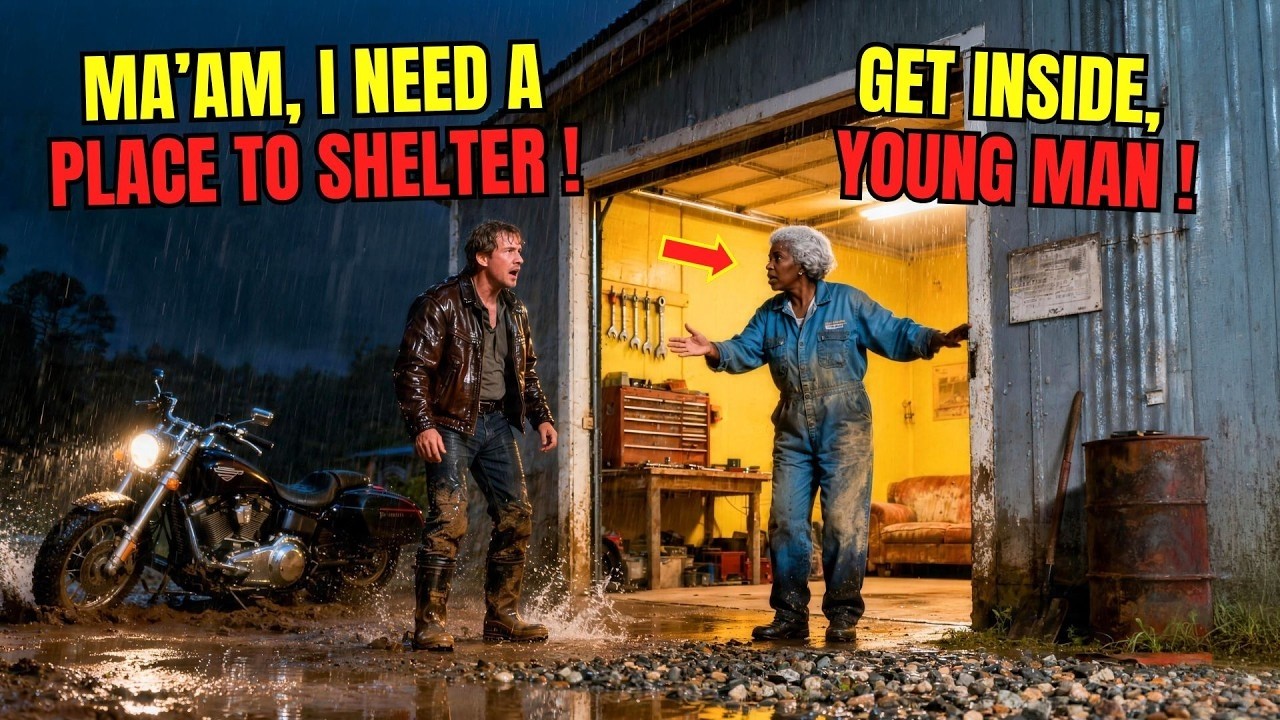
The students had gone home. Naomi had moved back from California and took over the books. At 9:47 someone knocked on the door. A young woman stood in the rain, soaked through, a beat-up Honda scooter with a flat rear tire.
“I’m sorry, ma’am. I don’t have money for a tow. ”
Stella looked at the girl, looked at the rain, looked at the scooter. She opened the door wide.
“Come inside. You’re soaking wet. ”
She gave her a towel, made her coffee, walked out into the rain, rolled the scooter into the bay, and fixed the flat in twelve minutes. Patched the tail light with electrical tape and a spare lens.
Didn’t charge a cent. “Why? ” the girl asked. Stella thought about it.
“Because someone knocked on my door once, and I opened it, and it turned out to be the best thing I ever did. Now it’s your turn. Someday someone’s going to knock on yours. You open it.
”
The girl rode away on her patched-up scooter. Stella stood in the doorway watching her go. Then she went back inside, washed the mug, set it on the shelf next to Harold’s blue one and the business card she kept face up. She turned off the lights except the one fluorescent over the workbench.
The one that hummed. She left it on in case someone else needed to find the light.