My sister Vanessa opened a credit card in my name without asking. When she got caught, she called me a sociopath on Instagram Live. I’m the youngest of three, and by far the quietest. My sister filled every room with opinions and chaos, and my parents learned early that it was easier to ignore the storm than stand in it.
So I got good at disappearing. I got my first job at fifteen, saved my allowance, kept my grades up, and stayed out of trouble. That was my role: the responsible one, the low-maintenance child. The one people could take advantage of.
Vanessa got pregnant at nineteen and married at twenty. The guy bailed before my nephew Leo turned two. I always tried to be a good uncle. I brought Lego sets, took him to the zoo, helped out when Vanessa needed an extra hand.
She loved to say Leo looked up to me. I believed it. A few years ago, I landed a big contract and started making real money. Not rich, but comfortable.
I never bragged. Vanessa found out anyway. She began joking that I was the rich one now. “Let Calvin pay.
He’s swimming in it. ” Always said with a laugh, but with too much weight behind the words. When Leo turned sixteen, everything changed. I’d given him one of my old iPhones a year earlier.
Unbeknownst to me, my Apple Pay was still linked. It started small. A few odd charges I assumed were subscriptions. Then a $640 charge at a store I didn’t recognize.
Then an $899 drone. I called the bank. Total: $31,700 gone. Most of it shipped to Vanessa’s address.
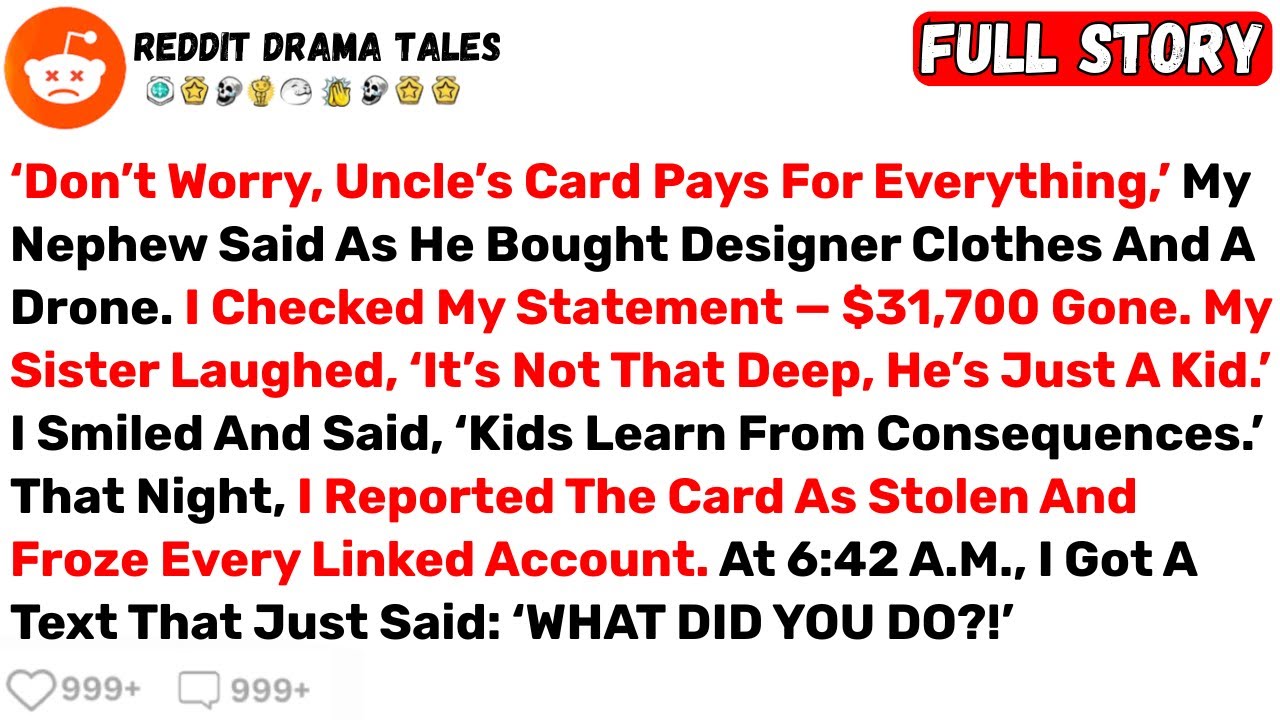
I didn’t want to believe it was Leo. Then I saw his Instagram post. A mirror selfie in Gucci and Nike. The caption: “Don’t worry, uncle’s card pays for everything.
”
I called Vanessa. She finally called back, chipper. When I told her thirty grand was missing, she sighed. “Oh, come on.
It’s not that deep, Cal. He’s just a kid. ”
“You think $30,000 is not that deep? ”
“I mean, he didn’t know any better.
And honestly, you make good money. I figured you wouldn’t even notice. ”
I hung up. That night, I froze every card I had.
Reported the card as stolen. Disputed every charge. At 6:42 a. m.
, my phone buzzed. One text, all caps: “What did you do? ”
I didn’t reply. Not that day.
Vanessa showed up at my building demanding to see me; I told the doorman I wasn’t home. My mom called, and when I explained, she said, “Maybe it’s not as serious as it looks. Leo’s just a teenager. You’ve always been a bit strict.
”
I asked her, “If I’d stolen $30,000 from Vanessa, what would you be saying right now? ” She didn’t answer. The subtle started. Vanessa posted passive-aggressive rants about how money changes people, how some family members would rather ruin a kid’s future than forgive a mistake.
My dad stayed silent, as always. But my aunt Laura called. She told me to keep an eye on my credit. She’d overheard Vanessa asking about credit limits, saying if I could live without a few thousand, I wouldn’t miss more.
I checked my credit report that night. Three new inquiries. One approved account I didn’t recognize. A credit card opened under my name, maxed out at $5,000.
This wasn’t Leo screwing around with a phone. This was calculated identity theft by my own sister. I filed a report, froze my credit, called the company. The next morning, I called my lawyer.
When Vanessa called, furious that her co-sign was getting flagged, I told her calmly what I knew. She tried to soften. “We’re family. Don’t let money turn us into strangers.
”
“You don’t get to play innocent anymore,” I said. She hissed, “You’ll be alone, Calvin. Just wait. ”
For weeks, I felt hollow.
I stayed off social media, ignored every text. I went to work like nothing was wrong, but inside I was running on fumes. I hadn’t spoken to anyone in three days. One night, at 2 a.
m. , I opened an old notebook I’d used to sketch business ideas. The first page asked, “What problem are you solving? ”
It wasn’t technical.
It was personal. I had no boundaries. I’d let love become tolerance. I wrote down: “Love without respect is just manipulation with nice packaging.
”
The next morning, I met with three financial advisers. One, a sharp woman named Laya, told me to treat my finances like my passwords. Compartmentalize. Diversify.
Never leave your back door open just because you share DNA. I set up a trust. Created an LLC. Encrypted everything.
Rebuilt my life like I was hardening a network against attack. Then Leo called. His voice was quiet, nervous. “I wanted to say sorry.
I didn’t mean to mess everything up. Mom said it was fine. ”
“You hurt me, Leo. Actions have consequences.
”
“Are you going to press charges? ”
“I’m not sure yet. ”
He said he missed when we used to hang out. That I was cool back then.
It stung. But I didn’t twist myself into knots trying to fix things anymore. I let the discomfort breathe. I started dreaming again.
I built a prototype for a financial security app for freelancers. Something that helps people set boundaries and prevent fraud. My apartment came alive again. I cooked real meals.
I hung art. I hosted a board game night. A friend asked what changed. I told him, “I stopped giving people discounts on my worth just because they share my blood.
”
Then the letter came. Handwritten. Return address was a P. O.
box. No name. I unfolded it. Vanessa’s curvy, dramatic loops.
One sentence: “You think this is over, Calvin? ”
I didn’t feel fear this time. I felt a click. I pulled out that notebook and wrote a new title at the top of the page: “Operation Consequence.
”
I went back through every bank statement from the last year. Turns out this went back further than I thought. Tiny charges—streaming services, Uber rides, Amazon packages delivered to her zip code. Over $8,000 in minor charges, hidden in the noise.
She’d been bleeding me dry in increments. I printed everything. Built a color-coded spreadsheet. It took three nights, and when I finished, I was holding documented truth.
I called my lawyer, Malcolm. He listened to the whole story. “You want to press charges? ”
“I want her to understand I’m not her punching bag.
”
He smirked. “We can do better than that. ”
We sent a certified letter addressed to Vanessa, copied to her employer and her landlord. It stated, in formal language, that I had documented evidence of financial misconduct and potential identity theft.
That I wasn’t currently pursuing criminal charges but had preserved all rights to do so. It didn’t threaten. It warned. Five days later, Vanessa called.
I let it go to voicemail. Her voice was trembling. “Cal, I got your letter. You can’t send stuff like that to my job.
They called me in. They asked if I’d stolen from a family member. ”
I saved the voicemail. I started reaching out quietly.
A friend told me Vanessa was spiraling, saying I was trying to destroy her life, but also admitting she’d opened that card in my name, saying it was my fault for not noticing. So I spoke. I drafted a message and posted it in the family group chat: “Vanessa used my financial information without permission and stole over $30,000 from me. I filed official reports and have documented evidence.
I’m not looking for drama. I’m just making it clear that I’m not the villain in this story. If you support what she did, please remove yourself from my life. ”
Then I logged out.
When I checked two days later, there were 197 unread messages. Most were stunned silence. A few cousins sent private messages of support. One aunt apologized for enabling Vanessa for years.
Vanessa never replied. But Leo sent a voice memo. “Hey, I read what you said. I believe you.
I’m sorry. ” Simple, unscripted. It meant more than he knew. With Malcolm’s help, I filed the final fraud claims.
I locked my credit with all three bureaus. I even updated my will. Vanessa was officially removed from any claim to my estate. Leo would get a small educational trust, but only if he stayed clean, after he turned twenty-five.
The rest went to an organization that helps victims of financial abuse. I slept better that night than I had in months. Then came the knock at the door. Vanessa, no warning, no rage.
She stood on my doorstep wearing sunglasses, holding a large envelope. She handed it to me without a word and walked away. Inside was a legal notice. Vanessa was suing me for emotional distress, reputational damage, and intentional interference with her employment.
I didn’t blink. I called Malcolm. “She actually filed it,” he said, amused. “Wow, she really is committed to the performance.
”
“I want to counter. ”
He paused. “You want to escalate? ”
“I want to finish it.
”
“Okay, let’s play chess. ”
We filed a formal response with a motion to dismiss, attaching every piece of documented evidence: the unauthorized charges, the fraud reports, the credit card statements, the screenshots of Leo’s Instagram post, and Vanessa’s own voicemail. Then we filed a counterclaim for damages. The figure was conservative: $75,000.
Vanessa doubled down. She posted Bible quotes about betrayal, pictures of Leo looking sad. But the comments turned skeptical. One cousin asked, “Didn’t you say a few months ago that Calvin wouldn’t notice if a few thousand disappeared?
” That post vanished quickly. At her deposition, Vanessa looked nothing like the confident woman who once told me I was too soft. She looked tired and pale, wearing a blazer that didn’t fit. When Malcolm dropped the first round of evidence—signed dispute reports, matching delivery addresses, screenshots of texts where she laughed about using my card—it was like watching air deflate from a balloon.
He played the voicemail. She didn’t tap her pen anymore. Malcolm invited me to make a statement. I said, “I tried to handle this quietly.
I didn’t want it to come to this. I was lied to, stolen from, and blamed when I protected myself. I didn’t go looking for revenge. I just wanted peace.
And now that we’re here, I want accountability. Nothing more, nothing less. ”
Vanessa didn’t look up. A week later, they offered a settlement.
She’d drop the suit and issue an apology in exchange for me dropping the counterclaim. I made a change. I dropped the financial counterclaim, but I wanted three things: a notarized confession acknowledging the fraud, mandatory documented financial counseling paid out of her own pocket, and a public statement posted to her social media and the family group chat. Her lawyer balked.
Malcolm said, “You want to fight this in open court? We’ll be happy to bring in witnesses. Maybe Leo’s teachers, maybe her landlord, maybe her employer. ”
The next day, they agreed.
Vanessa’s statement was short: “To my family and friends. I’ve made serious mistakes that hurt someone I care about. I misused Calvin’s financial information without permission and caused harm to both his finances and his trust in me. I take full responsibility for my actions.
Please don’t direct blame toward him. ” Signed, Vanessa. It was the closest she’d ever come to accountability in her life. The group chat blew up.
Some relatives privately apologized for not knowing the full story. The most surprising message came from my mom: “I owe you an apology. I didn’t believe you because I didn’t want to believe she could do something like that. I’m sorry for not protecting you, too.
”
I appreciated it. I didn’t reply immediately. Leo messaged me three weeks later: “I just finished my second counseling session with mom. She’s really different.
I don’t know if it’ll stick, but she’s trying. I miss you. Maybe we can hang out sometime. ”
I smiled.
Maybe we could. But not right away. Six months later, my app went live. It wasn’t flashy, but it worked.
Freelancers started signing up. I called it Iron Key. “Your life, your lock, your terms. ” One feature tracks shared accounts and alerts you if anything unusual happens, especially from people you think you can trust.
Vanessa’s name was never in the branding, but her shadow was everywhere in the code. I took that trip to the Pacific Northwest I’d always talked about. A week in a cabin with no calls and no noise. Just trees, wind, and peace.
The kind you earn by protecting your own peace. When I came back, I opened that same notebook. The first page still asked, “What problem are you solving? ”
Underneath, I wrote: “The problem of pretending love is real when there’s no respect to back it up.
”
Then I closed the book, took a deep breath, and smiled. Because for once, finally, my life belonged to me.