On a summer morning in 1910, a black man stood on the highest hill in Atlanta, Georgia. Behind him rose a mansion of multicolored brick, its grand columns gleaming white against the southern sky. From the rooftop terrace, he could see the spires of Atlanta University, the red clay roads winding through the city below, and somewhere in the distance the bustling streets where his empire had been built. His name was Alonzo Franklin Herndon.
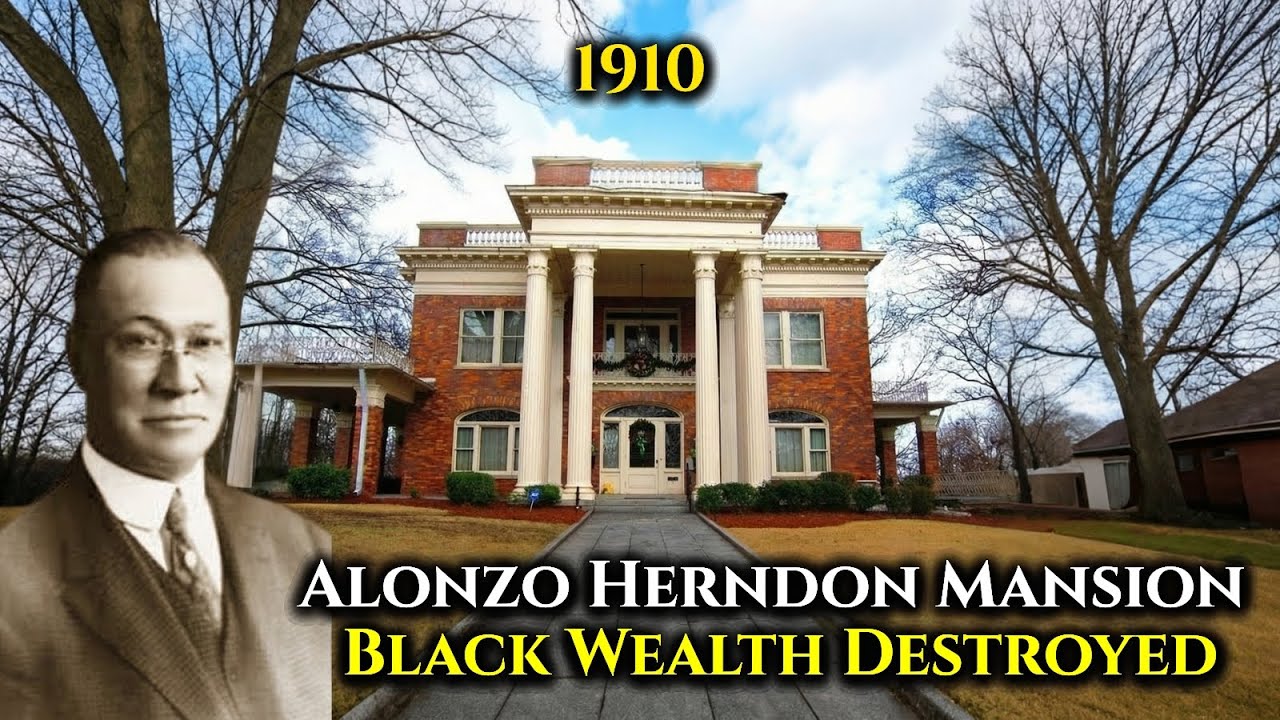
Just forty-five years earlier, he had been property, a slave child working the red Georgia soil, owned by the very man who was his father. Now he stood as Atlanta’s first black millionaire, founder of what would become the largest black-owned insurance company in America and master of one of the most magnificent homes the South had ever seen. But on that morning, the mansion felt empty. The woman who had designed every room, who had chosen every tile and imagined every detail, was gone.
Adrienne had died just weeks after they moved in. The home she had poured her soul into creating would never hear her laughter echo through its halls. To understand the mansion on Diamond Hill, you have to travel back to a plantation in rural Georgia, where a child named Alonzo was learning that he was worth less than the mules that pulled the plow. Alonzo was born on June 26, 1858, in Walton County, Georgia.
His mother was an enslaved woman named Sophony. His father was Frank Herndon, the white man who owned her, the same man who owned Alonzo. On southern plantations, this was common. White masters fathered children with enslaved women, then worked those children in the fields alongside the others.
Frank Herndon never acknowledged Alonzo as his son. To him, the boy was simply property, one of twenty-five souls he owned, valued only for the labor he could extract. Young Alonzo grew up knowing the peculiar cruelty of his existence. He could see his father’s face reflected in his own, could watch that man walk past him without a word of recognition.
He was lighter-skinned than many of the enslaved people around him, light enough that some said he could pass for white. But the law cared nothing for skin tone when your mother was enslaved. You followed the condition of the mother. And so Alonzo was property.
The work was brutal and unending. From before sunrise until after dark he labored in the fields. His small hands pulled cotton, planted seeds, and cleared brush. There was no childhood as others knew it.
But something burned inside young Alonzo that slavery could not extinguish. He watched how the overseer carried himself, how the merchants who visited the plantation conducted their business. He listened to conversations he was not supposed to hear and remembered every detail. Somewhere in his young mind, a plan was forming.
When the Civil War ended in 1865, the Emancipation Proclamation transformed Alonzo from property into person. He was seven years old. But freedom did not mean equality, and it certainly did not mean security. Frank Herndon wasted no time removing his former slaves from his land.
Alonzo, his mother, his younger brother Thomas, and his maternal grandparents were cast out with nothing. No money, no land, no education, no possessions except the clothes on their backs. The family had no choice but to become sharecroppers, working the land of others in exchange for a small portion of the harvest. It was slavery by another name.
The contracts were designed to keep black families perpetually in debt, perpetually dependent, perpetually poor. Year after year, the Herndons planted and harvested, and year after year, they barely survived. But young Alonzo refused to accept this as his destiny. While other children played, he worked.
He sold peanuts by the roadside. He made homemade molasses and axle grease to peddle to passersby. Every penny he earned went into a small fund he kept hidden, his escape savings. He knew with absolute certainty that he would not spend his life as a sharecropper.
Social Circle, Georgia, the town where they had settled, would not be his ending. It would only be his beginning. He managed to attend school for approximately one year, precious months during which he learned to read and write. It was all the formal education he would ever receive.
By the time he turned twenty, Alonzo had saved eleven dollars. It was a fortune for a young black man in postwar Georgia, and it represented his ticket out. One night in 1878, knowing his mother would never consent to his leaving, Alonzo placed his small trunk on his shoulder and slipped away into the darkness. He walked out of Social Circle on foot, heading southwest toward a future he could not yet imagine but refused to stop believing in.
The first town with telegraph wires nearly undid him. Alonzo had never seen such things, and the strange humming lines stretching overhead filled him with terror. He thought he was being tracked, that somehow those wires were announcing his escape to the world. His knees shook.
He nearly turned back. But he pressed on. He walked to Soya, Georgia, where he found work as a farmhand. It was there that he discovered the trade that would change his life.
A local barber took him on as an apprentice, teaching him to cut hair, shave faces, and make conversation with customers. Barbering in the postwar South was one of the few skilled trades open to black men, and it offered something farming never could: the chance to build relationships with powerful white men while earning decent money. Alonzo proved to be a natural. His hands were steady, his manner refined, and his mind was always working.
He listened to everything his customers said, absorbed their business wisdom, and studied how successful men carried themselves. After just a few months of apprenticeship, he moved to Jonesboro, Georgia, and opened his first barber shop. The shop was modest, but Alonzo ran it with the precision of a general commanding an army. Word spread quickly.
Before long, the young barber from Social Circle had developed a reputation as the best in the region. But Jonesboro was too small for his ambitions. In 1883, at the age of twenty-five, Alonzo arrived in Atlanta. The city was transforming itself.
Just eighteen years after General Sherman burned it to the ground, Atlanta was rising from the ashes with ferocious energy. New buildings climbed toward the sky. Railroads connected the city to markets across the nation. Alonzo entered into a partnership with a shop owner named William Dougherty Hutchins.
Within months, his reputation had eclipsed his partner’s. By 1886, he had bought out his partner. By 1890, he owned not one barber shop but three. One stood above the rest.
Located at 66 Peachtree Street in the heart of white Atlanta’s business district, it was called the Crystal Palace, and it was unlike anything the South had ever seen. Customers entered through massive sixteen-foot mahogany doors inlaid with beveled plate glass. Inside, crystal chandeliers hung from pressed-tin ceilings painted brilliant white. The floors were ceramic tile, polished until they gleamed.
Twenty-three custom barber chairs lined the walls, each one upholstered in dark green Spanish leather, outfitted with porcelain, brass, and nickel fittings. French beveled mirrors stretched along every wall, multiplying the light and creating an illusion of infinite space. It was the largest and most elegant barber shop in the South. Newspapers called it a marvel.
Visitors came from across the region just to see it, even if they didn’t need a haircut. But here was the painful irony that defined Alonzo Herndon’s life. He could not be a customer in his own establishment. The Crystal Palace served whites only.
That was the rule of Jim Crow Atlanta. Black barbers could cut white hair, could hold razors to white throats, could pamper white bodies, but they could not be pampered themselves. Alonzo and his all-black staff entered through the rear door, never the grand mahogany entrance they maintained with such care. Every day, Alonzo shaved the faces of judges who upheld segregation laws.
He trimmed the hair of politicians who wrote legislation designed to keep black people subordinate. He made pleasant conversation with businessmen who would never hire a black employee for anything but menial labor. And through it all, he smiled, listened, learned, and saved every dollar he could. His customers had no idea they were making small talk with a man who would soon own more property than most of them combined.
In 1893, Alonzo met Adrienne Elizabeth McNeil. She was unlike any woman he had ever known. Adrienne had been born in Augusta, Georgia in 1869, the daughter of an unwed domestic servant who had been enslaved. But where Alonzo’s childhood had been defined by field labor and survival, Adrienne’s had been shaped by ambition for the arts.
From her earliest years, she had dreamed of the stage, of performing Shakespeare and classical drama before great audiences. She had studied at Atlanta University’s Normal School, graduating in 1890 with distinction in oratory. Her passion was elocution, the art of expressive speech and dramatic performance. She was brilliant, cultured, and light-skinned enough to pass as white, a fact that would later play a complex role in her artistic career.
When Alonzo courted her, he made a promise that sealed their bond. He vowed to support her theatrical ambitions, to fund her studies, to help her achieve the stage career she so desperately wanted. For a woman with Adrienne’s dreams in the 1890s, such support was everything. They married on Halloween in 1893.
He was thirty-five. She was twenty-four. Adrienne immediately began elevating Alonzo’s world. She refined his speech, introduced him to literature and art, and expanded his understanding of culture beyond business.
In return, he provided the financial security that allowed her to pursue her studies. She traveled to Boston to study at the School of Expression. Later, she would attend the American Academy of Dramatic Arts in New York. But Adrienne’s theatrical dreams would be crushed by the very racism that defined their era.
When she made her debut performance at Steinert Hall in Boston in 1904, she did so under the stage name Anne Du Bignon, claiming French Creole heritage. She performed all twenty-two parts of Shakespeare’s Antony and Cleopatra. The reviews were positive. But when theater companies learned she was black, the offers stopped coming.
The American stage was closed to her because of her race. No matter how talented, how trained, how light her skin, she could not escape the barrier that kept black performers from mainstream success. If America would not let her perform on its stages, Adrienne decided she would build her own. In 1895, Adrienne was appointed to the faculty of Atlanta University as one of the first two African American faculty members.
She became the university’s first director of dramatics and teacher of elocution. She taught physical exercises, voice drills, and public speaking. She brought Shakespeare to Black Atlanta, directing the university’s first Shakespearean production, The Merchant of Venice, in 1905. Her productions became increasingly ambitious.
She brought professional stage sets and costumes to campus. She even convinced the William Gillette Theater Company of New York to perform Sherlock Holmes at the university. Adrienne was building something remarkable, a center for dramatic arts that gave Black Atlantans access to serious theater. If the white world would not accept her, she would create her own world and make it magnificent.
Meanwhile, she and Alonzo were raising a son. Norris Bumstead Herndon was born on July 15, 1897. The child would grow up witnessing history being made, traveling with his father to the founding of the Niagara Movement in 1905, where a young Norris watched W. E.
B. Du Bois and other Black leaders plant the seeds of what would become the NAACP. The Herndons were becoming one of Atlanta’s most prominent Black families. But the violence of Jim Crow was about to remind them that no amount of success could make them safe.
September 1906. For weeks, Atlanta’s white newspapers had been publishing inflammatory stories about alleged assaults on white women by Black men. Most were fabrications or gross exaggerations. But in the superheated atmosphere of Jim Crow politics, truth was irrelevant.
The stories whipped white Atlanta into a frenzy. On September 22, the violence exploded. White mobs poured into the streets, hunting any Black person they could find. They surged down Decatur Street, Pryor Street, Central Avenue, rampaging through the business district.
They pulled Black passengers from streetcars and beat them. They invaded Black businesses and destroyed everything inside. The Crystal Palace did not escape. The mob smashed through Alonzo’s beautiful windows, destroying the establishment he had built with such care.
Across the street, another Black-owned barber shop was attacked, and the barbers inside were killed. Alonzo had closed early and was home when the violence began. The Atlanta race massacre, as it would later be called, killed at least twenty-five Black citizens, though the true number was likely much higher. Hundreds more were injured.
Black Atlanta was traumatized, its economic progress set back by years. The message was clear: no matter how successful a Black person became, white violence could take everything away in an instant. But Alonzo refused to be defeated. He repaired the Crystal Palace.
He continued to serve his white customers with the same impeccable service, and he channeled his rage and grief into building something even more ambitious. In 1905, just before the massacre, Alonzo had made a fateful investment. The state of Georgia had increased capital requirements for insurance companies, putting many small Black-owned firms out of business. Two ministers approached Alonzo about purchasing a failing mutual aid association called the Atlanta Benevolent and Protective Association.
They believed a man of his business acumen could save it and turn it into something that served the Black community. Alonzo paid one hundred forty dollars for the company. He deposited five thousand dollars with the state as a guarantee fund, and he set about transforming a struggling organization into what would become the Atlanta Life Insurance Company. The concept of mutual aid had deep roots in Black America.
On plantations, enslaved people had formed secret societies to care for the sick and bury the dead with dignity. After emancipation, these traditions continued through churches and community organizations. But now, in the era of Jim Crow, Black families needed more than mutual aid. They needed real insurance, protection for their families, dignity in death.
White insurance companies either refused to serve Black customers or charged them exorbitant rates. Alonzo saw an opportunity to fill this void while building generational wealth for the Black community. He hired experienced executives, trained a professional sales force, and acquired smaller struggling companies across Georgia and neighboring states. By 1907, Atlanta Life had twenty-three offices across Georgia alone.
By the early 1920s, it had expanded into Florida, Kansas, Kentucky, Missouri, Tennessee, and Texas. The company’s motto was simple: We protect our own. And protect they did. Atlanta Life paid claims promptly and fairly, building trust in a community that had learned to expect betrayal from financial institutions.
By 1922, Atlanta Life had achieved legal reserve status, a position held by only four other Black insurance companies at the time. The small association Alonzo had purchased for one hundred forty dollars had grown into a company with assets exceeding four hundred thousand dollars. But even as his business empire expanded, Alonzo was planning something else. A monument.
A home for his family that would stand as permanent proof of what Black Americans could achieve. Diamond Hill was the highest natural elevation in the city of Atlanta. In the late 1800s, Atlanta University had purchased approximately sixty acres on this ridge with funding from the Freedmen’s Bureau. The idea was to create a model community for Black elites, a place where African American educators, professionals, and business leaders could build homes away from the indignities of daily life in Jim Crow Atlanta.
It was here, overlooking the city that had tried to destroy him, that Alonzo decided to build his family’s home. But this would not be just any house. This would be a statement. Around 1906, Adrienne began designing the mansion.
She had no formal architectural training, but she had something more valuable: vision. She knew exactly what she wanted. A Beaux-Arts classical home that blended French elegance with southern tradition. A residence that would rival any white mansion in the city while celebrating Black achievement at every turn.
She worked without formal blueprints, collaborating directly with a Black contractor named Will Campbell and a team of African American craftsmen. Every detail was discussed, debated, and refined. The brick would be a distinctive pumpkin color flecked with rose and purple iron deposits. The two-story entrance portico would feature paired Corinthian columns.
The windows would be etched glass with intricate patterns. And the roof would be flat, designed as a terrace where Adrienne could stage outdoor theatrical performances with the Atlanta skyline as her backdrop. Construction began in 1908. Except for the electrical and plumbing systems, all of the work was performed by Black laborers and contractors.
This was intentional. Adrienne and Alonzo wanted their home to be proof that Black hands could create beauty equal to anything white architects produced. The mansion took two years to build. Fifteen rooms spread across two stories.
Inside, different design traditions flowed together. Renaissance Revival in the reception hall and dining room, Rococo detailing in the music room, Arts and Crafts elements in the intimate spaces. But the most remarkable feature was the frieze. Running near the ceiling of the living room and library was a series of hand-painted murals depicting scenes from Alonzo’s life.
One panel showed him as a child tilling the red clay fields of Social Circle. Another depicted him as a young barber building his first shop. A third showed the Crystal Palace in all its glory. And the final panels celebrated his rise to business prominence and his family’s achievements.
It was autobiography rendered in paint, the story of a slave child who became a millionaire told in images that would greet every visitor who entered the home. Adrienne also included murals depicting theatrical scenes honoring the stage career she had been denied. Shakespeare lived on these walls even if he could not live in American theaters performed by Black actresses. The rooftop terrace was Adrienne’s special pride.
From there, visitors could see Atlanta University’s campus spread out below. She had designed the space specifically for outdoor performances, a stage where she could finally direct the plays she loved with her city as the audience. But Adrienne would never stand on that stage. In early 1910, the house was finally nearing completion.
Workers were putting the finishing touches on the interior. Furniture was being arranged. The family was preparing to move in. Adrienne had been fighting exhaustion for months.
At first, she attributed it to the stress of overseeing construction while continuing her teaching duties. But the fatigue grew worse. Her skin darkened in patches. She lost weight she could not afford to lose.
The diagnosis was Addison’s disease, a failure of the adrenal glands. In 1910, there was no treatment. The condition was invariably fatal. On April 6, 1910, just weeks after the Herndon family moved into their magnificent new home, Adrienne Elizabeth McNeil Herndon died.
She was forty years old. The mansion she had designed, the masterpiece she had poured her soul into creating, the stage from which she had dreamed of directing plays beneath the southern stars. She would never enjoy any of it. Alonzo was devastated.
The woman who had refined him, who had expanded his world, who had designed the physical embodiment of their shared dreams, was gone. Their son Norris, just twelve years old, had lost his mother. But Alonzo did not close the house. He did not sell it.
He did not retreat from public life. Instead, he continued to live in the mansion Adrienne had created, preserving it exactly as she had designed it. Every room remained a tribute to her vision. He would remarry in 1912 to Jesse Gillespie of Chicago, a woman he met through mutual friends.
Jesse was gracious, intelligent, and supportive. She became a valued partner in both his personal life and his business, but she understood that the Herndon home belonged spiritually to Adrienne, and she honored that legacy while adding her own touches to the decor. Throughout the 1910s and 1920s, the Herndon home became a gathering place for Black Atlanta’s elite. Business leaders, educators, artists, and activists passed through its mahogany doors.
Alonzo used his home and his wealth to support causes he believed in. He had attended the founding meeting of the National Negro Business League in 1900, organized by Booker T. Washington. He was among the twenty-nine men who gathered for the founding of the Niagara Movement in 1905.
He donated generously to Atlanta University, the institution where Adrienne had taught. He supported orphanages and nurseries that served Black children. He funded churches and community organizations. He believed that those who had been blessed with success had an obligation to lift others.
But he also understood that charity alone could not solve the problems facing Black America. Real change required economic power. It required Black people owning their own businesses, controlling their own resources, building their own wealth. The Herndon home stood as proof that such success was possible.
On July 21, 1927, Alonzo Franklin Herndon died in his Atlanta mansion. He was sixty-nine years old. The boy who had been property, who had walked out of Social Circle with eleven dollars and a dream, died as one of the wealthiest Black men in America. His real estate holdings alone were assessed at nearly three hundred thousand dollars.
His funeral paused traffic on the streets of Atlanta. Black and white citizens alike acknowledged the loss of a man who had embodied the possibility of the American dream, even when that dream was denied to those who looked like him. Norris Bumstead Herndon was thirty years old when his father died. He had been preparing for this moment his entire life.
Norris had grown up in privilege unlike anything his father had known. He had traveled internationally, attended the finest schools, and graduated from Harvard Business School in 1921 with a master’s degree in business administration. He was one of only two African Americans in his graduating class. But Norris had also grown up understanding the responsibilities that came with his family’s position.
He had witnessed history at the Niagara Movement founding. When his father died, Norris assumed the presidency of Atlanta Life Insurance Company. He was joined by his stepmother, Jesse, who became vice president. The Great Depression devastated many insurance companies, but Atlanta Life survived.
The company that had been built to serve Black families when no one else would proved remarkably resilient. Its conservative financial practices, established by Alonzo, protected it from the speculative excesses that destroyed other firms. Under Norris’s leadership, Atlanta Life continued to expand. By the time of his retirement in 1973, the company’s assets had grown from approximately one million dollars at his father’s death to eighty-four million dollars.
But Norris’s greatest contribution may have been his quiet, persistent support of the civil rights movement. Throughout the 1950s and 1960s, Atlanta Life provided something the movement desperately needed: financial backing and institutional support. When other companies were afraid to associate with activists, Atlanta Life stepped forward. The company issued a life insurance policy to a young minister named Martin Luther King Jr.
when others refused to cover him. This was not merely a business transaction. It was a statement of solidarity. Norris funded civil rights organizations with the same quiet determination his father had shown in building the business.
He gave generously to the NAACP, the organization that had grown from the Niagara Movement his father had helped found. He supported the Southern Christian Leadership Conference, Martin Luther King’s organization. He contributed to the Montgomery Improvement Association, the group that coordinated the bus boycott. He funded the United Negro College Fund, Morris Brown College, Atlanta University, and the National Urban League.
Unlike many philanthropists, Norris preferred anonymity. He rarely spoke publicly. He avoided society pages and national conventions. He let his money speak for him, providing the financial foundation that allowed others to do the visible work of activism.
The Herndon home became a sanctuary during these turbulent years. Civil rights leaders knew they could meet there in safety. The mansion that Adrienne had designed and Alonzo had built became a gathering place for those planning the transformation of America. In 1947, following the death of his stepmother Jesse, Norris established the Alonzo F.
and Norris B. Herndon Foundation to preserve and extend his family’s philanthropic work. In 1973, as Norris prepared to retire from active leadership of Atlanta Life, he transformed his family home into a museum. The Herndon Home opened to the public, allowing visitors to see the mansion that had been built by former slaves, designed by a professor of drama, and maintained by three generations of one of America’s most remarkable Black families.
Norris Bumstead Herndon died at home on June 7, 1977. He was seventy-nine years old. He was buried in South View Cemetery in Atlanta, joining his father and the other members of the family who had built an empire from nothing. His will directed his estate to the foundation he had established, ensuring that the work would continue indefinitely.
In 2000, the Herndon Home was designated a national historic landmark. The house that Adrienne had designed and African American craftsmen had built had become officially recognized as a treasure of national importance. The broader Herndon legacy in Atlanta faced threats. The Herndon Building on Auburn Avenue, a massive commercial complex that Alonzo had built in 1924, had fallen into disrepair over the decades.
Once a thriving center of Black business life with sixty offices, storefronts, a hotel, and even its own gas station, it had become vacant and deteriorating. On March 14, 2008, a tornado tore through downtown Atlanta. The storm damaged historic Oakland Cemetery and swept directly through the Sweet Auburn district, the heart of Black Atlanta’s historic business community. The Herndon Building, already fragile, was devastated.
Weeks later, it was demolished. The tornado passed close to the Herndon Home itself, but the mansion survived. Once again, the house on Diamond Hill stood while destruction swirled around it. Today, the Herndon Home Museum still stands on Diamond Hill, still overlooking Atlanta, though the view has changed dramatically.
Where Adrienne once imagined seeing Atlanta University from her rooftop stage, the Mercedes-Benz Stadium now dominates part of the sightline. Visitors enter through the same portico that Adrienne designed. They walk through the reception hall with its mahogany paneling. They see the murals depicting Alonzo’s journey from slavery to success.
They stand in the dining room where history was discussed and futures were planned. The foundation that Norris established continues to support education, mentoring, and entrepreneurship. The Atlanta Life Insurance Company, though changed by the decades, still operates, still serving communities that were once systematically excluded from financial services. But perhaps the most important legacy is invisible.
It lives in the thousands of Black families who were able to bury their loved ones with dignity because Atlanta Life honored its policies. It lives in the civil rights workers who were funded by Herndon money. It lives in the students who attended schools the Herndons supported, in the entrepreneurs who were inspired by their example, in everyone who learned that a slave child could become a millionaire if he never stopped believing in himself. Stand on the steps of the Herndon Home today and look out over Atlanta.
Try to imagine what Alonzo saw when he first stood here in 1910. A Black man born as property, master of one of the finest homes in the South. A man whose father had owned him, now owning more property than most white men would ever possess. A man who had entered freedom with nothing, now surrounded by everything.
The mansion was never just a house. It was an argument. It was proof. It was defiance made manifest in brick and marble.
Every Corinthian column was a rebuttal to those who claimed Black people could not appreciate beauty. Every etched glass window was an answer to those who said former slaves could not achieve greatness. But the house was also tragedy. Adrienne died before she could enjoy it.
Alonzo lived there for seventeen years as a widower, surrounded by his first wife’s vision. Norris, who never married and never had children, lived there alone for decades, the last of his line, a man whose wealth could not buy him the family that had given the house its original warmth. The Herndon Home teaches us that success and suffering often walk together. That the same determination that builds empires can exact terrible personal costs.
That monuments to achievement can also be monuments to loss. Perhaps that is what makes the house so powerful. It does not pretend that Alonzo Herndon’s story was simple or easy. It shows the murals of his triumph alongside the empty spaces where loved ones should have stood.
It celebrates what was achieved while acknowledging what was lost. As the afternoon light falls across Diamond Hill and the shadows lengthen in the grand parlor, the Herndon Home waits. Waits for the next visitor who will walk through its doors and learn the story of a slave who became a king. Waits to remind another generation that dreams, even impossible ones, sometimes come true.
Waits to stand as witness to what Black Americans could accomplish when given even the smallest chance. The walls still hold their secrets. The murals still tell their stories. And somewhere, perhaps, the ghost of Adrienne finally stands on her rooftop stage performing Shakespeare for an audience of stars.
This is the Herndon Home, built by dreams, preserved by love, standing still.