Between 1957 and 1961, forty-seven people vanished on the rural roads of Western Kentucky. No bodies were ever found. No witnesses survived. Just abandoned wagons, frightened horses wandering alone along Route 62, and a silence that swallowed everything the way black earth swallows rain.
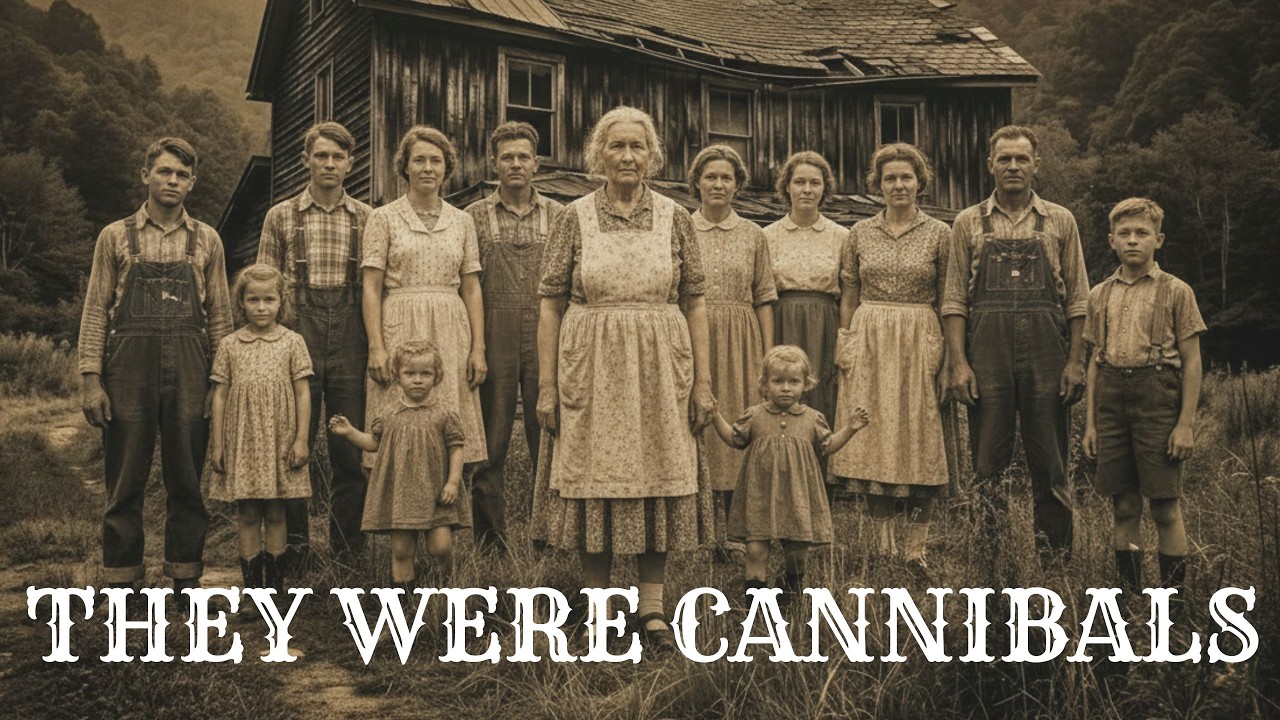
But what was happening in the depths of Harlan Hollow was worse than anything a civilized mind could imagine. There is a kind of silence that isn’t the absence of sound. It’s the presence of something you can’t name. Anyone who knew the back country of Grayson County in the 1950s knew that silence.
Certain red dirt roads were avoided without anyone explaining why. Certain valleys locked between the Appalachian hills seemed to swallow sunlight before it ever reached the bottom. Certain families had lived for generations in those hollows without anyone asking questions. And asking questions in that place, in that time, was the kind of thing that could make you disappear.
In March of 1962, Sheriff Dale Akerson crossed with twelve armed men through the rusted gate of a property that barely appeared on county maps. What he found inside that dark wooden barn at the bottom of the valley the Harlan family had called home for sixty years was enough to bring hardened men to their knees in the mud, retching. Enough to shut an entire town in grief and nausea for weeks. Enough that Reverend Howard Tibbetts, a Baptist minister with thirty years of service, requested an immediate transfer and never again led a service without his hands shaking.
To understand the Harlans, you first need to understand the hollow. What that place did to the people born inside it. The horror Sheriff Akerson found that March morning didn’t begin with blood. It began with silence, with isolation, with generations of people who learned that the world ended at the edges of the valley.
And that everything that came into that valley belonged to them. The hollow had no official name on any map printed by the state of Kentucky. It appeared, when it appeared at all, as a thin unmarked crease between two ridgelines in the southeastern corner of Grayson County. Locals called it simply the Harlan place.
Or sometimes, when they were being less polite, they called it the dark holler. But mostly they didn’t call it anything at all. Mostly, they just didn’t talk about it. That was the first rule of living near the Harlan Hollow.
The second rule was simpler still: You didn’t go there. To reach the property from Caneyville, the nearest town, you had to follow Route 62 west for eleven miles, then turn onto a dirt road the county hadn’t maintained since 1941. From there, another forty minutes on horseback through second-growth timber and creek crossings that flooded every spring. The kind of road that didn’t invite travelers.
The kind of road that suggested, in its own quiet way, that whatever waited at the end of it preferred to be left alone. The Harlan family had lived at the end of that road for as long as anyone could remember. Longer, actually. Old-timers in town said their own grandfathers had spoken of the Harlans as already being there.
Already settled, already isolated, already strange back when the county itself was barely organized. Three generations, maybe four, of the same family occupying the same hollow, intermarrying, pulling inward, cutting the threads that connected them to the outside world one by one until there were no threads left at all. What remained was fourteen people living as though the twentieth century had never arrived. Edna May Harlan was the center of everything.
She was seventy-four years old in 1957, small and bent at the shoulders, her white hair pulled back with a strip of cloth torn from an old flower sack. She moved slowly around the property with the authority of someone who had never once been questioned. Her eyes were pale gray, almost colorless in certain light, and they had the particular quality of eyes that have stopped being surprised by anything. She wore the same black dress every day, the same wool shawl, regardless of season, and it smelled of wood smoke and something else, something sweet and metallic underneath that caught in the back of the throat and stayed there.
Walt Pruitt, who ran the general store on Main Street and would later spend the rest of his life trying to forget he had ever done business with the Harlans, said this in a 1963 interview: “She wasn’t what you’d call frightening to look at. She looked like somebody’s grandmother. Talked quiet, moved slow. But there was something in how she looked at you.
Like she was measuring something. Like she was always counting. ”
Counting. That word would take on a meaning no one was prepared for.
Clem Harlan was Edna May’s oldest son. Forty-one years old, tall and lean, his hands enormous and crosshatched with scars that no visitor could account for. Too numerous, too varied to have come from ordinary farm work. He spoke rarely.
When he did, his voice came out rough and low, like something dragged across gravel. He had his mother’s eyes. That same pale measuring quality. That same absence of surprise.
Loretta Harlan was thirty-seven, Clem’s half-sister. She ran the domestic operations of the hollow with the systematic efficiency of someone trained to waste nothing. She kept records, meticulous and precise, in a leather-bound notebook she carried everywhere. That notebook would later become the single most damning piece of evidence in one of the most disturbing criminal trials the state of Kentucky had ever seen.
Boyd Harlan was forty-four, a cousin who had married into the closer family circle in ways the county clerk’s office would have found deeply irregular. He was enormous, built like something quarried rather than born. He said almost nothing, ever. His wife Nola was his opposite in every way, small, nervous, quick-moving, repeating phrases under her breath like prayers.
Whatever Edna May said, Nola echoed within minutes. “We do what we must. We do what we must. ” It was only later that the repetition made a terrible kind of sense.
Darlene Harlan was twenty-four, and she was the face the hollow showed to the outside world. Pretty in a plain way, with dark hair and an easy smile. She was the one who came to Caneyville, who chatted with Walt Pruitt at the counter, who knew exactly how much friendliness was required to keep people from asking questions and never offered a single degree more than that. Her brother Roy was twenty, quieter, stronger, preferring the work that required silence and strong hands.
And then there were the children. Six of them, ranging in age from six to sixteen. Virgil, the oldest. Wanda Lou.
Curtis. Della. The twins Galen and Glenn. And June, just six.
Anyone who saw the Harlan children in Caneyville noticed something they struggled to put into words. It wasn’t the clothes, worn and mended past the point of dignity. It wasn’t the thinness. It was something in the eyes.
A quality of stillness that didn’t belong in children. The Harlan children moved in groups, always, and when they stood near the butcher’s counter at Pruitt’s store, they had a way of looking at the meat on display that several townspeople later described in almost identical terms. “Like they were comparing,” said Mabel Sizemore. “Like they already knew something about that meat that the rest of us didn’t.
”
The Hollow itself shaped everything about the family. The valley ran roughly north to south, hemmed in on both sides by ridgelines dense with oak and hickory. A creek ran through the center. The buildings were scattered without logic across the valley floor.
And then there was one other structure, set apart from the others, further back toward the north end where the ridgeline cut off the afternoon light earliest. A large wooden barn, newer than the others, the boards more recently cut, always locked. On certain mornings when the wind came from the north, something drifted down the valley from that barn, a smell, sweet and heavy and wrong, the kind of smell that triggers something ancient and animal in the back of the brain and says simply, “Leave. ” Most people did.
The few who stayed long enough to ask received the same answer from Edna May. “Smokehouse,” she would say, and then look at you with those eyes, and something in the quality of that look made further questions feel unwise. In 1955, the family lived in grinding generational poverty. The children were visibly underfed.
They bought the minimum at Pruitt’s store, salt, kerosene, occasionally a bolt of the cheapest cloth, and paid in coins that Walt Pruitt later admitted made him uncomfortable without knowing why. “The coins were always warm,” he said. “Always, even in winter. Like they’d been held a long time.
”
In the summer of 1957, something changed. It happened gradually, the way a season changes. The Harlan children began to look healthier. Their faces filled out.
Their eyes, if anything, grew stranger. Not hollower, as you might expect from hunger, but fuller, satisfied in a way that was difficult to look at directly. Edna May appeared in Caneyville for the first time in three years that August. She bought fabric.
She bought a new blade for the handsaw. She paid in paper money, crumpled, as though it had spent a long time folded in a pocket. When Reverend Tibbetts encountered her outside the store and asked how the family was getting on, Edna May looked at him for a long moment before answering. “We found a way,” she said.
“The Lord always provides a way for those willing to do what’s necessary. ”
The reverend smiled and went about his day. He would spend the rest of his life wishing he had asked what, exactly, they had found a way to do. Darlene Harlan first walked into Walt Pruitt’s general store with a serious offer on a Thursday morning in September of 1957.
She came in just after eight, when the store was still quiet. Set a wrapped parcel on the counter without preamble. Inside was meat, salted, carefully cut, the pieces uniform in size and thickness in a way that suggested real practice. “We’ve been taking more game than we can use,” Darlene said.
Her voice was easy. Everything about her in that moment was calibrated to be easy. “Thought you might want to take some off our hands. Good price.
”
Walt had been running that store for twenty-two years. He knew game meat. He knew venison, dark and lean, with a particular iron smell. He knew wild boar, coarser and fattier.
This meat was none of those things. It was pale, paler than venison, paler than pork, with a fine grain and a softness that seemed almost wrong. The smell was faint, sweet in a way that sat at the back of the throat. “What game?
” he asked. Darlene’s smile didn’t waver. “Mixed,” she said. “Whatever’s running.
You know how it is up in the hills. ”
Something in Walt, something old and animal, said that this meat had not come from anything that ran in those hills. He bought it anyway. He would ask himself why for the rest of his life.
“I didn’t want to know,” he told investigators in 1963. His voice flat with a shame that had long since finished surprising him. “That’s the truth of it. Something in me knew that asking would lead somewhere I didn’t want to go.
So I didn’t ask, and then I sold it, and then other people ate it, and I have to live with that. ”
The customers liked the meat. That was the part that made everything worse in retrospect. If it had been poor quality, the whole operation might have collapsed within weeks.
But it was exceptional. Tender in a way that surprised people. Flavorful without being gamey. It held salt well and kept longer than most cured meats.
“Best thing I’ve tasted since before the war,” said one regular customer, a farmer named Gerald Odum, who would later require psychiatric treatment after learning what he had been eating. By October, Darlene was coming every Thursday. By November, she was bringing Roy with her, the two of them loading heavier parcels onto the counter with the mechanical rhythm of people engaged in serious production. The quantities increased steadily, deliberately, as though someone was carefully managing the rate of increase to stay below the threshold of notice.
Someone was. Loretta Harlan’s notebook, recovered from the property in March of 1962 and entered into evidence at the trial in Bowling Green that October, revealed a supply operation managed with a precision that stunned the investigators who studied it. Every delivery was recorded. Every price negotiated.
Every pound accounted for. It was, in the dry language of commerce, an efficient small business. The language around what the business actually produced would not become clear until investigators read further into the notebook, until they reached the entries that made the lead investigator set it down on the evidence table and walk out of the room for eleven minutes before he could return to it. The family’s transformation continued through 1958.
The children arrived in Caneyville looking healthier each month. Virgil filled out across the shoulders. Wanda Lou’s face lost its hollow look. And something else changed in them, something harder to name.
They had always been quiet children. But the quality of their quiet changed. It became less the silence of deprivation and more the quiet of satisfaction, of sufficiency. Reverend Tibbetts wrote in his journal on November 14th, 1957: “The Harlan family continues to prosper in ways I find difficult to account for.
There is something moving underneath the surface of this town that I cannot see clearly. I pray that I am being uncharitable. ”
His prayers would feel thinner still before the year was out. In January of 1958, a traveling salesman named Earl Dupree left Caneyville heading west on Route 62 and never arrived where he was going.
He was fifty-three, a heavy-set man with a good-natured laugh. Three weeks later, his truck was found pulled off onto the grass shoulder, engine cold, keys still in the ignition. His sample cases were in the back, intact. His thermos sat on the passenger seat, half full of coffee that had frozen and thawed again.
Earl Dupree was simply gone. The truck had been found less than two miles from the turnoff that led to the Harlan property. Sheriff Dale Akerson noted this in his report, and then noted that there were three other farms accessible from that same stretch of road, and that Earl might have met any number of fates that had nothing to do with anyone named Harlan. The hills took people sometimes.
Everyone knew that. He filed the report and moved on. He would file six more reports like it before the pattern became impossible to ignore. Between 1958 and 1961, fear arrived in Grayson County the way fog arrives in a valley.
Gradually. Incrementally. So slowly that you can’t point to the moment it began. You only notice it when it’s already everywhere.
Akerson kept notes on scraps of paper stuffed into his breast pocket and transferred each week to a Manila folder in the bottom drawer of his desk. By the spring of 1959, that folder was getting thick. Earl Dupree, January 1958. Thomas and Cecil Wynn, March 1958, two brothers from Muhlenberg County.
Their horses found six weeks later, thin and frightened, wandering the creek bottom along the eastern edge of the Harlan property. Ruth Ella Combs, June 1958, a widow from Elizabethtown. Her mule was found in August, tethered to a fence post on a property adjoining the Harlan land, terrified. In each case, Akerson drove out to the Harlan property and asked his questions.
In each case, he was met by Clem or Edna May with the same patient, impenetrable courtesy. Nobody had come through. Nobody had been seen. The worst came in September of 1958.
A family. James and Loretta Cutter, sharecroppers from Mississippi moving north with their three children, Bobby, age seven, Patricia, age five, and an infant daughter named Mary, not yet eight months old. They passed through Caneyville on September 4th. Reverend Tibbetts gave them what he had in his pocket and wrote “God keep them” in his journal.
God did not keep them. Two weeks later, their wagon was found abandoned on the shoulder of the road three miles past the Harlan turnoff. Everything was gone. On the floorboards, half covered by a burlap sack, were stains the county coroner identified without hesitation.
Blood. A significant quantity of blood. But without bodies, there was no crime. Five people, Akerson wrote in his folder that night.
His handwriting was less neat than usual. One of them eight months old, and I can’t do a goddamn thing. The disappearances continued through 1959 and 1960. Two drifters.
A young man named Harley Dixon. An older woman whose name investigators never established. And in November of 1960, two county surveyors, Gerald Park and Louis Abernathy, known men with families and colleagues. Their supervisor filed a report within hours.
Akerson drove out to the Harlan property. Clem met him at the gate. Nobody came through, Clem said. Akerson asked if he minded them looking around.
Clem asked if they had a warrant. They didn’t. Akerson drove back to Caneyville and spread the contents of his Manila folder across his desk. Then he got out a map and began to mark it.
Every disappearance, every last known location, every abandoned wagon, every horse found wandering without a rider. The red circles made a pattern. A rough circle, approximately twelve miles across, centered with a precision that felt almost deliberate on a single point in the southeastern corner of the county. The Harlan property.
He called the county judge and asked for an appointment first thing in the morning. He had his warrant within forty-eight hours. But there was one more thing that needed to happen first. One more witness.
One more pair of eyes that had seen what was inside that barn and survived the seeing. Barely. Her name was Carol Ann Sizemore. She was nineteen years old.
And on a stormy night in February of 1962, she got lost on the wrong road and saw something that no living person should ever have to see. The storm came in from the northwest without warning. The clouds came over the northern ridge like a wall, and before Carol Ann had covered half the distance between the Prather farm and her own home, the rain was falling in sheets, driven sideways by wind that stung like thrown gravel. She had lived her entire life in Grayson County.
She knew these hills like her own hands. But the rain erased the world, reduced it to a radius of ten feet. The trail simply ceased to exist. She walked.
She kept moving because stopping felt like surrender. She told herself the lights she could see through the curtain of rain, faint and far ahead, were the lights of the Hensley farm, familiar and safe. She was wrong. The lights belonged to the Harlan property.
She crossed through a gap in a wire fence she didn’t recognize, came around a stand of cedar trees, and saw the main house. She knocked. The sound was swallowed by the rain and thunder. Nothing.
She stepped back and looked around. There was light coming from the large structure set apart from the rest, leaking through gaps between boards. Warm, orange lamplight. Someone was in there.
She walked toward it. She was perhaps thirty feet from the barn wall when the smell reached her. She stopped. Sweet and heavy, like something that had been cooking a long time.
But underneath that, something metal. Something that got into your throat and stayed there. Something in the oldest part of her brain told her to leave. Told her clearly to turn around and walk back into the rain and keep walking.
She didn’t leave. The door was ajar. A gap of perhaps four inches. Light spilling out in a thin orange line across the mud.
She moved to the door and looked through the gap. What she saw in the next thirty seconds rearranged something fundamental in her understanding of the world, something that would never be rearranged back. The inside of the barn was larger than the outside suggested. Then the hooks.
Iron hooks hanging from the ceiling beams on lengths of chain, dozens of them. Some empty, swaying in a draft she couldn’t feel. Some occupied. Her mind processed what hung from those hooks in stages.
First as shapes. Then as shapes with specific characteristics. Then with a lurch she felt physically, a dropping in her chest and stomach simultaneously. An arm, intact from shoulder to fingertips, a simple gold band catching the lamplight on the ring finger.
A leg, cut at the hip with precision. A torso suspended by a hook through the shoulder cavity. Other things, at various stages of what she would later understand was processing, was production, was the systematic conversion of raw material into a marketable product. The long tables, dark with absorbed stain.
The tools arranged along one side with the orderly care of a craftsman. Knives in graduated sizes. Saws. A hand ax.
The barrels along the far wall. On a shelf near the door, so close she could have reached through the gap and touched it, a leather notebook, open to a page of careful handwriting. Columns of figures. Dates and weights and dollar amounts.
She read three lines before her mind stopped accepting information. She did not scream. She would be asked about this many times. Her answer was always the same: “There was nothing in me that could make a sound.
”
She stepped back from the door. She turned. And then everything that had stopped in her came back at once, and she ran. She fell twice in the mud and got up without registering it.
She ran until the lights of the Harlan property were gone behind her and the dark closed back in. She found the right road eventually, by accident. When morning came, she was still sitting on the edge of her bed in her wet clothes, holding in the front of her mind with terrible clarity what she had seen. She went to find Reverend Tibbetts before the town was properly awake.
She told it without drama, in the flat careful voice of someone who has used up all available emotion. When she finished, the Reverend sat for a long time without speaking. He was thinking about Walt Pruitt’s unfinished sentence in the churchyard three years earlier. You ever think about where that meat comes from?
That afternoon she sat in Ackerson’s office and told it again. When she finished, the sheriff opened his bottom drawer and took out the Manila folder and set it on the desk between them. “How sure are you,” he said carefully, “about what you saw? ” Carol Ann looked at him.
“Sheriff,” she said, “I wish I wasn’t sure at all. ”
He had the warrant by the following morning. Twelve men rode out of Caneyville at 4:30 in the morning. Their horses’ breath steamed in the cold air.
Nobody spoke. The Hollow looked peaceful in the early morning light. The mist lay soft and white in the bottom of it. The creek caught the light like a thin silver thread.
Peaceful. Ordinary. Except the barn. Even from the ridge, even at that distance, the barn sat differently in the landscape.
Set apart. Pulled back toward the curve of the ridge. And the smell, drifting up from the valley floor on the thin morning air. Even from the ridge.
Several of the men shifted in their saddles. Edna May Harlan opened the front door before they reached it. She was already dressed. Already wearing the black dress, the wool shawl.
As though she had seen them coming from a long way off. She stood in the doorway and looked at Ackerson with those pale gray eyes. “Figured you’d come eventually,” she said. “Took longer than I expected.
”
The family assembled in the main room with the unhurried compliance of people who have accepted something. Four deputies stayed with them. Eight men followed Ackerson out into the valley. They searched the main house.
Ordinary. Spare. Nothing that didn’t belong. The smaller outbuildings.
Nothing. They walked north. The barn door was locked with a padlock that had seen considerable use. Deputy Webb carried the bolt cutters.
The padlock took three seconds to remove. The door swung open. What came out of that barn was not precisely a smell. It was a physical presence, something with weight and texture that hit the men standing in the doorway like a wave.
Several stepped back involuntarily. Dr. Raymond Flat, who had delivered babies and sat with dying men and smelled every variety of human biological reality over two decades of practice, put one hand against the barn’s exterior wall and stood there for a full thirty seconds with his eyes closed before he was able to go in. Ackerson went in first.
The hooks. Iron hooks filling the upper half of the barn’s interior the way stalactites fill a cave. Some empty, turning slowly in the draft. Some occupied.
What occupied them did not need to be described in full to be understood. The tables. The tools. The barrels.
Ackerson walked the length of the barn. He counted the hooks. He counted what was on them. Dr.
Flat examined the nearest table with his medical bag open. Deputy Webb found the notebook on the shelf near the door and brought it to Ackerson without speaking. Loretta’s handwriting was precise and consistent. The entries ran from the fall of 1957 to the most recent, dated just three weeks before.
Each entry followed the same format. A date. A physical description. An estimated weight.
A breakdown of what had been sold, what had been retained, what had been disposed of. The entry for September 1958 read: “Family, man approx 34, woman approx 31, boy approx seven, girl approx five, infant female approx eight months. Total yield significant. Quality good.
Infant yield minimal but nothing wasted. Revenue this week highest to date. ”
Ackerson closed the notebook. “Bag that,” he said quietly.
In the far corner of the barn, behind the last row of barrels, partially concealed by a canvas, was a door set into the rear wall. Low, heavy, fitted with two locks. Beyond it, a short passage of perhaps eight feet. And at the end of the passage, a space with a packed earth floor.
In the floor, covered by boards, a circular opening approximately four feet in diameter. A well. Or what had been designed to look like a well. The smell that rose from the opening was total.
It sent two men to their knees. Ackerson looked down into it for a long time. Then he stepped back and said, in a voice very quiet and very flat, “We’re going to need more men, and we’re going to need a lot of bags. ”
What the well contained had accumulated over four years.
The remains of what Loretta’s notebook recorded with such careful precision. The parts that had no market value. The waste. Forty-seven entries in the notebook.
Forty-seven sets of remains in the well. Dr. Flat descended on a rope. He was down there for forty minutes.
When they pulled him back up, his face was the color of old ash. “Children,” he said finally. “There are children down there. ”
The arrest was made without resistance.
The family came out when called and accepted the handcuffs with the compliance of people who have already done their accounting and found it balanced. Edna May was last. She stood in front of Ackerson and looked up at him with those pale measuring eyes. “The children,” she said, “they didn’t understand what they were part of.
You remember that. ” Ackerson looked at her for a long moment. “Ma’am,” he said, “I’m not sure that makes it better. ” She agreed.
She held out her wrists for the handcuffs. She did not shake. The trial began on October 8th, 1962, in the Warren County Courthouse in Bowling Green. The venue had been changed from Grayson County on the grounds that an impartial jury could not be assembled in a place where half the population had, in one way or another, consumed what the Harlan family had produced.
The courthouse steps were crowded every morning. Edna May walked into that courtroom every day the same way she had walked out of her house on the morning of her arrest, slowly, with the authority of someone who has never once been questioned. The prosecuting attorney, Gerald Mossbarger, read from Loretta’s notebook aloud, deliberately, methodically, entry by entry, his voice flat and steady. When he asked Carol Ann Sizemore how certain she was about what she had seen, she looked at him for a moment before answering.
“Mr. Mossbarger, there are things I’ve tried to forget in my life. I know what it feels like to try to forget something. I haven’t forgotten one second of what I saw in that barn.
I have tried. It is not possible. That’s how certain I am. ”
The defense argued isolation, generational conditioning, a value system so distorted by decades of inbreeding that the Harlans couldn’t be held to the same moral standard.
Mossbarger’s response was decisive. “You don’t hide a ledger unless you understand that what the ledger records needs to be hidden. You don’t lock a barn unless you understand that what’s inside needs to be kept from view. The Harlans knew.
They chose. And choice, deliberate, sustained, profitable choice, is exactly what this court exists to judge. ”
When the judge asked Edna May if she wished to make a statement, she stood and looked at the room, at the jury, at the judge, with those pale measuring eyes, and said, “I kept my family alive. I kept them fed and healthy and together.
Everything I did, I did for them. You can call it what you want to call it. I know what it was. ”
The judge called it murder.
Forty-seven counts of first-degree murder with special circumstances. He sentenced Edna May, Clem, and Loretta to life imprisonment without the possibility of parole. Boyd received the same sentence in the same silence with which he had received everything else. Nola was remanded to the Eastern State Hospital for indefinite psychiatric commitment, still murmuring her phrases.
Darlene received thirty years. Roy received twenty-five. The six children were not tried. They were remanded to the Department of Child Welfare and distributed among state institutions and religious organizations.
They were not placed together. Virgil, the oldest, escaped in January of 1964 and was never recaptured. Wanda Lou disappeared at twenty-one. Curtis’s whereabouts after his release are not part of any public record.
Della was adopted at fourteen under a new name, married, had children, and died of cancer in 1991. In her final days, delirious with medication, she said, clearly and without apparent emotion, “Grandma Edna was just doing what she thought was right. ” The twins were separated immediately. Galen lived alone and died in 1987 in a rented room in Owensboro; the landlady said no one had ever visited him in six years.
Glenn declined into total mutism and died at twenty-two. June was placed with a convent school and adopted at thirteen by a patient childless couple. She became an elementary school teacher, perceptive and attentive to quiet children. She has never spoken publicly about her history.
Some things are carried in silence because silence is the only container strong enough to hold them. Edna May died in prison in 1971 at the age of eighty-eight. Her last words, according to the chaplain, were: “I did right by my family. Whatever else I did, I did right by them.
” Clem died in 1974. Loretta died in 1981, insisting her record-keeping had been exemplary. Boyd died in 1969, still silent. Darlene died of tuberculosis in 1988.
Roy was paroled in 1983 and died six months later. The Harlan property was burned by order of the Grayson County Court on April 1st, 1962. The fire burned for three days. When it finally died, nothing remained above ground.
The land was never purchased, never farmed, never built on. Hunters who worked those hills afterward reported that their dogs would not enter the hollow. They would stop at the tree line, hackles raised, looking at the empty ground, and refuse to go further. Animals know things in the old way, the pre-language way.
Perhaps that is the final lesson of the Harlan Hollow. That the line between what human beings are capable of and what they actually do is not a wall. It is a choice, made daily, made collectively, in the small ordinary moments when something feels wrong and we decide whether to say so. The people of Caneyville didn’t say so for four years.
And forty-seven people paid the price of that silence. In the cemetery outside Caneyville, there are forty-seven markers. Twenty-three have names. Twenty-four say only: Unknown.
Harlan Hollow, 1957–1961. Every year on the 18th of March, a small service is held at those markers. The attendance has declined over the decades. But the markers remain, and the names on them remain, and the twenty-four that have no names remain unnamed in the particular way of losses that cannot be fully accounted for.
There is a kind of silence that isn’t the absence of sound. The hollow is silent now. The creek still runs through the center of it. The ridgelines still rise on both sides.
From the ridge above, in the early morning light, it looks like any other valley in Grayson County. Peaceful. Ordinary. But the dogs won’t go in.
And some of the hunters who have stood at that tree line have said they understood the dogs. Standing there, looking down into that quiet empty ground, they felt something they couldn’t name but recognized. Something that said, clearly and without ambiguity, there are things in this world that should not be. Things that, once done, leave a mark on the place where they were done that no fire, no time, no silence fully removes.
Know where the hollows are. And know what can grow in them when no one is watching.