In the fall of 1907, the parish of St. Martin, Louisiana, woke to a mystery that would outlast everyone who tried to solve it. Six men entered the Atchafalaya Basin on the night of October 18th and never came out. Their boats were found at sunrise, drifting among the cypress knees in a back channel known as Bayou Tortu.
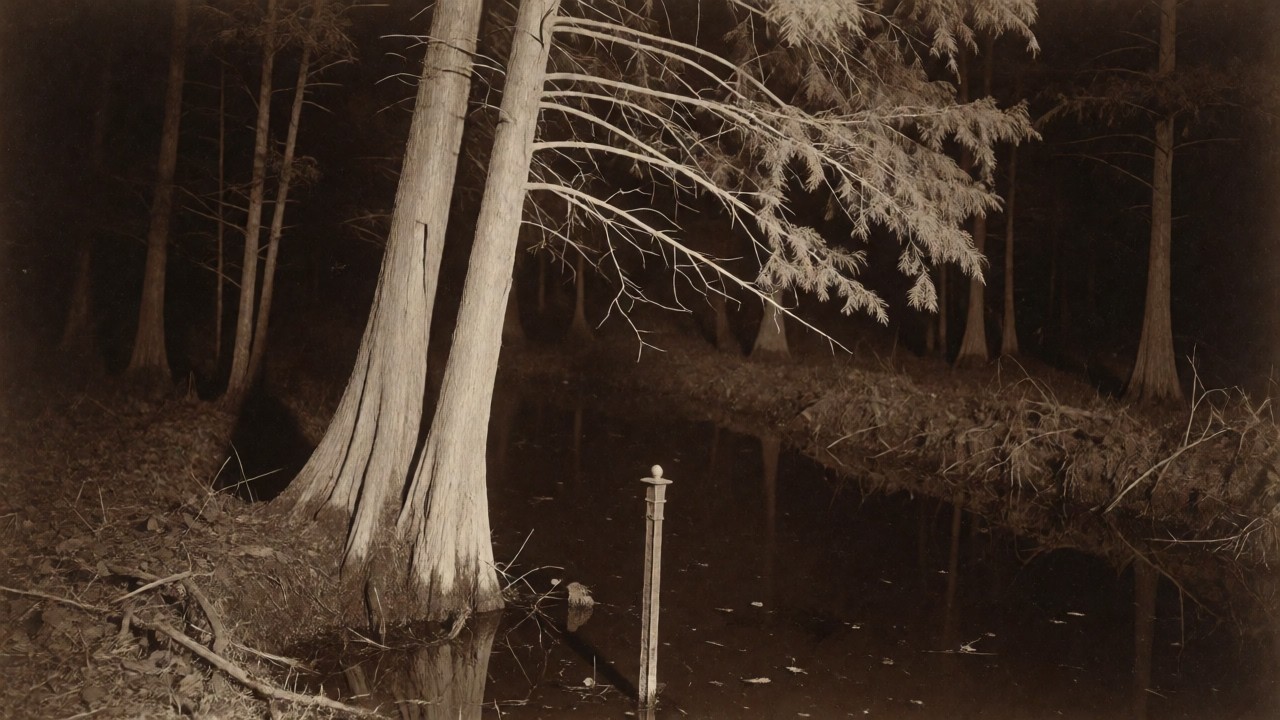
On board, deputies found five rifles, three boxes of ammunition, two wool coats folded neatly across the benches, a leather satchel with dried meat and biscuits, and a kerosene lantern still burning. The flame had lasted through the night. The men were never seen again. Broussard sat along the Bayou Teche, twelve miles north of Lafayette.
In 1907 it was a town of sawmills, sugar plantations, and river trade, where most families depended on the timber industry to survive. The largest operation belonged to Silas Mercer, a man of forty-seven who had arrived from Mississippi two decades earlier with little more than a mule and a handshake. By the turn of the century he controlled the Mercer Lumber and Transport Company, which included the sawmill on the western bank of the Teche, a fleet of flatboats that moved timber south toward Morgan City, the only general store within ten miles, and contracts with the railway that shipped cypress and pine as far north as Baton Rouge. He employed more than two hundred men and held the mortgages on a significant portion of the houses those men lived in.
Mercer was not merely an employer. He was the architecture of survival for the entire region. His offices occupied a two-story wooden building beside the mill, where the scream of the saw blades served as a constant reminder of the operation’s scale. The clerks worked on the ground floor processing invoices, logging shipments, and managing the payroll for every man who handled an axe or steered a flatboat.
Among them was Ruth Bell, a woman of thirty-two who had come to Broussard four years earlier after answering an advertisement in a Baton Rouge newspaper. She was quiet, precise, and widely regarded as the most competent bookkeeper the company had ever employed. She lived alone in a rented room above the schoolhouse on Bridge Street, kept no company, and spent her evenings reading or writing letters to her younger sister in Tennessee. The townspeople described her as polite but distant, the sort of person who attended church regularly but never lingered afterward for conversation.
She had one living relative in Louisiana, her brother Daniel, two years older, who had followed her to Broussard and found work at the mill as a lumber inspector. Daniel Bell died on the morning of August 28th, 1907, when a platform at the mill’s eastern loading dock collapsed beneath him. He fell fourteen feet into the Teche and struck his head on a submerged log. The body was recovered within the hour.
Mercer expressed his condolences personally and arranged for a burial plot at the Methodist cemetery outside town. He paid for the coffin. He attended the service. Three days later, according to company records, a notation was added to Daniel Bell’s employment file stating that he had voluntarily left his position on August 25th due to personal reasons.
The date of departure was recorded as three days before his death. Ruth noticed the discrepancy when she returned to work after the funeral. She requested a copy of her brother’s file from the personnel clerk, a man named Harlan Graves, who told her the file had already been sealed and sent to storage. When she pressed further, Graves informed her that sealed files could only be accessed with written authorization from Mr.
Mercer himself. She requested the authorization. It was denied. The reason given was that sealed records were company property and could not be released to former employees or their families.
Ruth pointed out that Daniel had not been a former employee at the time of his death. Graves replied that according to the file, he had been. That moment, reconstructed decades later from fragments of correspondence and a single journal entry found among Ruth Bell’s personal papers, appears to have been the beginning of everything that followed. Over the next several weeks, Ruth began a quiet, methodical audit of the company’s books.
She did not announce her intentions. She worked during regular business hours, performing her assigned duties with the same precision she had always shown. Then she remained after the office closed, supposedly to organize invoices or reconcile shipping manifests. In reality, she was comparing the daily pay logs against the quarterly summaries, cross-referencing the names of workers with the company’s insurance records, and tracing the flow of payments through accounts she had never been authorized to examine.
What she found was not a single error or a simple case of embezzlement. She uncovered a system. The Mercer Lumber and Transport Company had been operating for at least four years with a parallel set of financial records. One set, the official books, was presented to the parish tax assessor and the railway auditors.
The other set, maintained separately and stored in a locked cabinet in Silas Mercer’s private office, documented the company’s actual transactions. Between the two lay a pattern of systematic fraud that was both elaborate and deeply embedded. Workers who had never been hired appeared on the payroll and collected wages that were deposited into accounts controlled by Mercer. Deductions for tools and equipment were charged to employees who had purchased their own supplies.
Indemnity payments intended for the families of men killed or injured on the job were recorded as dispersed but never reached their intended recipients. At least seven workers who had died in mill accidents between 1903 and 1907 had been reclassified in the books as having abandoned their employment. Their families received nothing. The company’s insurance records showed no claims filed under their names.
Ruth calculated that the scheme had diverted somewhere in excess of forty thousand dollars over four years, a sum that in 1907 represented more than most mill workers would earn in several lifetimes. The money flowed through a network of accounts connected not only to Mercer but to at least two parish officials, a railway inspector, and a notary public in Lafayette who authenticated documents that should never have existed. The discovery that caused her the most distress, however, was not financial. While reviewing the accident records for the preceding five years, she noticed a recurring name.
Nolan Price. Price was Mercer’s personal foreman, a man who oversaw the loading crews and reported directly to Mercer without any intermediary. According to the records Ruth examined, Price had been present at the loading dock on the morning of every significant accident the mill had experienced. He was there when a crane cable snapped and killed two men in 1904.
He was there when a stack of green cypress shifted and crushed a deckhand in 1905. He was there when a boiler exploded in the planing shed and killed a maintenance worker in 1906. And he was there on August 28th, 1907, supervising the crew that included Daniel Bell. Ruth did not share her findings with anyone in Broussard.
She began making duplicate copies of every document she could access using carbon paper and a small hand press she kept in her rented room. At night, after the office had closed, she copied invoices, payroll sheets, accident reports, and internal correspondence. She placed the duplicates in metal biscuit tins and, on her days off, buried them at marked locations along the bayou. Beneath a fallen oak near the old ferry crossing.
Inside a hollow cypress stump at the bend of Bayou Tortu. Behind a survey marker that had been driven into the mud by the Army Corps of Engineers in 1892. She created a map with coded notations showing each burial site and its contents and kept it folded inside the lining of her coat. The map was the only evidence she carried.
The originals remained in the ground. It is unclear how long Ruth intended to continue this practice before taking action. The surviving records suggest she had been duplicating documents for approximately six weeks when, in early October of 1907, she received an unexpected visitor at her rented room. He came after dark, knocking softly and refusing to identify himself until she opened the door.
His name was Amos Reed. He had been employed at the mill for three years, working as an assistant to Harlan Graves in the personnel office. He was one of the few people in the company who had access to employee files, and he had helped process the paperwork that reclassified Daniel Bell as a voluntary departure. Amos Reed was visibly afraid.
He told Ruth that he had been summoned to Mercer’s office two days earlier and informed that several workers were planning to confess to the parish sheriff about the company’s fraudulent practices. Mercer told Reed that the confession would implicate him specifically, that his name appeared on dozens of altered forms, and that he would be the one sent to prison if the scheme was exposed. Mercer offered him protection and a sum of money if he would identify which employees were involved. Reed asked for time to consider.
Later that same day, Reed encountered one of the other men named by Mercer. The man, a shift supervisor named Clyde Dunham, told Reed that Mercer had given him the same story in reverse. Reed and two others were planning to confess and blame Dunham. Dunham had been promised protection in exchange for identifying the conspirators.
Within twenty-four hours, Reed had spoken with three additional men whose names had appeared on Mercer’s list, and each had received an identical warning. The six men, all of whom had participated in various stages of the document falsification, were being turned against one another. Reed came to Ruth because he knew she had been asking questions about her brother’s accident. He had seen her staying late at the office and suspected she was conducting an investigation of her own.
He did not know about the copies she had made or the tins she had buried. He only knew that she was the one person in Broussard who had a reason to distrust Silas Mercer as much as he now did. Ruth listened to Reed’s account and made a decision. She told him that she possessed documents that could expose the entire operation and that she intended to deliver them to a federal agent she had contacted through an intermediary in New Orleans.
The agent, whose name she did not reveal, had agreed to meet her at an abandoned survey station on the eastern edge of the Atchafalaya Basin on the night of October 18th. The station had been built by the Corps of Engineers during a flood control project and had been unused for more than a decade. It was accessible only by water. Reed agreed to help.
He would leave the mill at dusk on the 18th and meet Ruth at the survey station. Together they would deliver the evidence to the federal agent and leave the parish before Mercer realized what had happened. The plan was compromised before it began. Mercer learned of Ruth’s activities through an informant whose identity was never established.
He did not discover the location of the buried documents, but he understood that Ruth had been copying records and intended to deliver them to authorities. On the afternoon of October 18th, he summoned six men to his office and gave them instructions that would set them all on a collision course in the dark waters of the Atchafalaya. Those six men were Amos Reed, Clyde Dunham, Harlan Graves, a flatboat operator named Leonard Straoud, a timber inspector named Vernon Cole, and a man known primarily by his surname, Blanchard, who had worked as an enforcer for Mercer for at least five years, intimidating workers who complained about wages or questioned the company’s practices. Each man received a different version of the mission.
Three were told that Ruth Bell had stolen company funds and needed to be apprehended alive so she could be turned over to the sheriff. Two were told that their primary objective was to recover a leather satchel containing financial documents and that once the satchel was secured, the other members of the party could be abandoned in the swamp. Amos Reed, whose meeting with Mercer took place last, was told that the other five men had been conspiring with Ruth and that his survival depended on staying close to them and reporting everything they said. The only element consistent across all six accounts was that the men were ordered to pursue her into the bayou that night.
Mercer told them she would be heading toward the old survey station, that she would be carrying a satchel containing evidence of crimes committed by company employees, and that the situation needed to be resolved before morning. Shortly after ten o’clock on the night of October 18th, 1907, Ruth Bell left her rented room above the schoolhouse carrying a leather satchel and a kerosene lantern. She walked east along Bridge Street toward the edge of town, where the road dissolved into a dirt path that led to the bayou. Several residents saw her pass.
A woman named Deline Tran, who lived in a cottage near the parish road, told deputies later that week that Ruth had been walking quickly but did not appear panicked. She did not look back. She did not acknowledge Tran’s greeting. She simply continued toward the water.
Less than thirty minutes later, six men exited the sawmill on the western side of town and walked down to the company dock, where two wooden flatboats were moored. The boats were fourteen feet long, each equipped with oars, a small gasoline outboard motor, and storage compartments beneath the benches. The men divided into pairs for each boat. Graves and Blanchard in the first, with Dunham at the motor.
Straoud and Cole in the second, with Reed at the motor. Reed later stated that he had never been assigned to operate a motorized boat before and had been given no instruction beyond a brief demonstration at the dock. They pushed off from the mill at approximately 10:45 and headed east into the main channel of the Atchafalaya, following a route that would intersect with the path Ruth had taken on foot. The night was overcast.
There was no moon. The Atchafalaya Basin in 1907 was not the managed floodway it would become after the great flood of 1927. It was a vast labyrinthine wetland covering nearly a million acres, threaded with bayous, sloughs, and channels that shifted with every heavy rain. The water moved slowly beneath canopies of cypress and tupelo, and the air was thick with the smell of mud and decaying vegetation.
Navigation at night was treacherous even for experienced boatmen. Channels that appeared wide enough to pass through often narrowed suddenly around blind turns, and submerged logs lay just beneath the surface, capable of tearing through a wooden hull without warning. Ruth reached the water’s edge at a small cove known as Pelier’s Landing, where she had hidden a pirogue, a narrow flat-bottomed canoe, among the reeds two days earlier. She lit her lantern, placed the satchel in the bow, and began paddling east, following a series of landmarks she had memorized.
The leaning cypress with the split trunk. The iron survey post driven into the mud at the junction of two channels. The abandoned duck blind built on stilts. The survey station lay approximately four miles from the landing, a distance that would take her nearly two hours to cover in the dark.
She heard the motors of the flatboats shortly before midnight. The sound carried across the water in a way that made it difficult to determine direction. At first she thought the boats were behind her, approaching from the west, but then the noise seemed to shift, echoing off the trees, and she could not be certain whether it came from ahead or from one of the side channels. She extinguished her lantern and continued paddling in silence.
The six men, meanwhile, had already begun to experience difficulties. According to the testimony later transcribed in Ruth’s declaration, the two boats became separated within the first hour. Reed and his companions Straoud and Cole navigated a narrow channel that dead-ended in a grove of flooded cypress, forcing them to turn around and backtrack for nearly thirty minutes. The other boat, carrying Graves, Blanchard, and Dunham, continued along the main route but struck a submerged obstruction that damaged the propeller of the outboard motor.
Dunham managed to keep it running, but the vibration worsened as they proceeded, and they were forced to slow to a crawl. It was during this delay that the first argument occurred. Graves, who had spent the previous two days speaking with Reed and the others about Mercer’s manipulations, confronted Blanchard directly. He asked Blanchard what instructions Mercer had given him.
Blanchard, who had been told by Mercer that the other men were planning to confess and blame him for the document falsification, responded by accusing Graves of the same thing. Dunham, listening from the stern, realized that the warnings Mercer had given him were identical to the ones the other men had received. Within minutes, all three men in the first boat understood that Mercer had set them against one another. The second boat reached a similar conclusion during the same hour.
Reed, who had been instructed to observe the others and report back to Mercer, chose instead to tell Straoud and Cole exactly what had been said to him in the office that afternoon. Cole responded by admitting that Mercer had told him Straoud was carrying evidence that would implicate Cole in the payroll fraud. Straoud, incredulous, revealed that Mercer had warned him about Cole. The symmetry of the deceptions left no room for doubt.
All six men had been given the same story, tailored to each individual, designed to ensure that they would distrust and ultimately destroy one another. By one in the morning, the pursuit of Ruth Bell had effectively ended. The men in both boats had agreed through a series of shouted exchanges across the dark water that they had been sent into the bayou not to capture anyone but to be eliminated themselves. If they returned empty-handed, Mercer would blame them for the escape.
If they turned on one another, Mercer’s problem would solve itself. If they simply vanished, the official story would be that Ruth Bell had somehow overpowered or evaded six armed men, a narrative that would allow Mercer to portray her as dangerous and the men as victims. The question of what to do next was interrupted by a practical discovery. When the two boats finally regrouped in a wide channel approximately a mile and a half from the survey station, Straoud checked the storage compartments and found that the spare fuel canisters for both outboard motors were empty.
He then examined the oars and discovered that three of the four had been partially sawn through. The cuts were hidden beneath the leather grips where they would not be noticed in the dark. The damage was not immediately catastrophic. The oars were still intact enough to be used, but they would not withstand any significant strain.
Someone had prepared the boats for a one-way journey. Reed recognized the implications immediately. The boats had been moored at the company dock, accessible only to mill employees. The fuel canisters had been stored in a locked shed behind Mercer’s office.
The saw cuts on the oars were clean and deliberate. Someone with access to the mill and knowledge of the expedition had ensured that the six men would have difficulty returning from the bayou, regardless of whether they succeeded in capturing Ruth. At approximately two in the morning, the six men made a collective decision to abandon both the pursuit and the boats. They would proceed toward a railway embankment that ran along the eastern boundary of the basin, where Reed had mentioned a federal agent was rumored to be waiting.
None of the men knew the agent’s name or whether he would actually be there, but the railway line offered the nearest route to solid ground and the possibility of escape. What happened during the next hour remains the subject of the investigation conducted forty-one years later by Margaret DeLacroix. The account that follows is drawn from three sources. The declaration signed by Ruth Bell on October 21st, 1907, which DeLacroix discovered in an uncataloged box of documents in 1948.
A deposition given by a railway night watchman named Francis LeMoyne, who reported hearing voices and what he described as a mechanical sound on the water in the hours before dawn. And a maintenance log from the Mercer Lumber and Transport Company, which DeLacroix located in the parish archives, and which showed that a third boat, a twenty-foot skiff equipped with a high-powered engine, had been checked out on the night of October 18th by Nolan Price, and returned the following morning with significant damage to its hull. Ruth Bell, from her position on the elevated survey platform, heard the third boat approaching at approximately three in the morning. She had reached the station around one, after navigating the last mile by feeling her way along a line of cypress trunks she knew would lead her to the structure.
The station was a wooden platform built on pilings roughly twelve feet above the water, with a small covered shelter that had once housed survey equipment. It had been abandoned since the late 1890s and was slowly being reclaimed by the swamp. Vines had grown through the floorboards, and the roof sagged where a branch had fallen across it years earlier, but the platform was solid enough to support her weight, and the shelter provided concealment from anyone approaching by water. She had been waiting for Amos Reed to arrive when she heard the voices of the six men drifting across the channel.
She could not make out their exact words, but the tone was unmistakable. They were arguing among themselves, and the argument was escalating. She remained motionless on the platform, watching the dim glow of their lanterns move between the trees. The third motor arrived from the south.
Ruth recognized the sound because it was deeper than the engines on the flatboats, a heavy rhythmic chug that indicated a larger vessel. She also recognized the voice that called out from the skiff as it approached the six men. Nolan Price, the foreman who had been present at the loading dock on the morning of her brother’s death. Price did not announce himself as an enemy.
He called out to the group as if he were a rescuer, someone sent by Mercer to assist them after learning that the boats had been sabotaged. He told the men that Mercer had discovered the tampering and had dispatched him to bring them back safely. He asked where Ruth was. The men did not answer immediately.
What happened next is known only from Ruth’s testimony and from the fragments of conversation she was able to hear from the platform. One of the men challenged Price’s story. He asked how Mercer had known about the sabotage if Price had not reported it. Price answered that a worker at the dock had noticed the damaged oars and informed the office.
The same man asked why Price would come alone at night into the basin if the purpose was to rescue six men who were already lost. Price did not answer the second question. Reed, at some point during this exchange, recognized the skiff that Price was operating. It was the same vessel that had been used to transport documents from the mill to the railway depot for disposal.
Documents that Reed himself had helped load onto the skiff on at least three occasions. He knew the boat’s compartment layout and was aware that it had enough space beneath the deck to carry cargo that was never listed on any manifest. He said nothing about this to Price. Instead, he asked whether the federal agent at the railway line was real or whether that had been another of Mercer’s fabrications.
Price told him there was no federal agent and never had been. The statement, intended to discourage the men from continuing toward the embankment, had the opposite effect. It confirmed to the six men that Price knew the details of their plan and had come to prevent them from reaching the railway. The confrontation that followed was not violent in the way violence is typically recorded.
No shots were fired. No blows were struck. According to Ruth’s account, the men argued for perhaps twenty minutes, their voices rising and falling as Price attempted to convince them to return with him, and each of the six men refused in turn. At some point, Price’s demeanor changed.
He stopped arguing and became silent. Then, without explanation, he started the engine of the skiff and pulled away from the group, heading not toward Broussard but deeper into the basin, in the direction of an old logging channel that had been abandoned after the timber in that section was exhausted. The six men watched him go. They now understood with a clarity that left no room for negotiation that returning to Broussard was no longer an option.
Whatever fate Mercer had intended for them in the bayou had not changed simply because Price had failed to carry it out. If they went back, there would be other nights, other expeditions, other accidents. They decided to continue toward the railway embankment. It was, by Reed’s estimate, approximately three miles from their current position, a difficult journey on foot but manageable if they stayed together and moved carefully.
The swamp in that direction was shallow enough to wade through in most places, and Straoud, who had trapped in the basin as a younger man, knew the location of several old logging trails that would speed their progress. Ruth did not reveal herself. She remained on the platform, listening to the men’s voices recede into the darkness until the last glimmer of their lanterns had vanished among the trees. She did not know whether they would reach the railway.
She did not know whether Price would return. She did not know whether any of them, including herself, would survive until morning. She stayed on the platform until dawn. When the first gray light began to filter through the canopy, she descended the ladder and found her pirogue still tied to the piling where she had left it.
She paddled east, away from Broussard, away from the six men, away from the survey station and the satchel and the map of buried evidence that was no longer hidden. She traveled for two days, sleeping in abandoned trappers’ shacks and drinking water from the bayou, until she reached the town of Pierre Part in Assumption Parish. She arrived on the morning of October 21st, 1907, wearing clothes that were still damp with swamp water and carrying nothing but the lantern she had refused to let go of. The events she had witnessed would not be made public for more than forty years.
In Broussard, the alarm was raised shortly after sunrise on October 19th, when a fisherman named Etienne Boudreaux discovered the two flatboats drifting in Bayou Tortu near the old Pelier’s Landing. Boudreaux, who had been setting trot lines for catfish since before first light, noticed the boats because one of them had a lantern still burning on its bench, a detail so unusual that he paddled closer to investigate. He found the boats empty, their contents undisturbed, their mooring lines trailing in the water as if they had been cut or simply allowed to come loose. The rifles were still there.
The ammunition was still there, the coats, the food, the extra oars, all present. The only things missing were the men. Boudreaux towed the boats back to the public landing and sent his son to fetch the sheriff. By mid-morning, a search party had been organized, consisting of deputies, mill workers, and volunteers from the town.
They spent the day combing the channels and banks near where the boats had been found, calling the men’s names, firing signal shots into the air, and examining the mud for footprints or drag marks. They found nothing. No bodies, no tracks leading out of the water, no signs of struggle, no blood. The swamp had simply closed around the six men and erased them.
Silas Mercer arrived at the landing in the early afternoon, accompanied by two of his senior supervisors. He expressed shock at the news and offered to fund the search efforts personally. He told the sheriff that the missing men had been employees of the mill who had gone into the basin the previous night to apprehend a former clerk named Ruth Bell, who had stolen company funds and was attempting to flee the parish. He described the pursuit as a well-intentioned but unauthorized effort by loyal workers to recover the stolen money.
He did not explain why six men had required five rifles, three boxes of ammunition, and two boats to recover cash from a single female clerk. He was not asked. The sheriff, whose office depended on Mercer’s political support for its operating budget, accepted the explanation without further inquiry. Ruth Bell was declared a fugitive and a suspect in the disappearance of the six men.
A warrant was issued for her arrest. The search for the missing employees continued for three weeks, gradually scaling back as hope of finding them alive diminished. The last organized search party returned to Broussard on November 9th, 1907, having covered more than forty square miles of the basin without discovering a single trace of the six men. Within a month, the case had been filed away as an unsolved disappearance.
The boats were returned to the mill. The rifles and ammunition were claimed by the sheriff’s office as abandoned property. The kerosene lantern that had been found still burning was given to Boudreaux as a reward for reporting the discovery. He kept it on his porch for the rest of his life and told the story to anyone who asked.
Mercer offered a reward of five hundred dollars for information leading to the capture of Ruth Bell. The notice was printed in newspapers across southern Louisiana, accompanied by a description that emphasized her height, her dark hair, and the leather satchel she was reported to be carrying. No one ever claimed the reward. The case became known locally as the night of the empty boats.
Mothers warned their children not to wander near the bayou after dark. Old men fishing alone sometimes reported hearing voices in the channels where no voices should have been. A few residents claimed to have seen lanterns moving through the trees late at night, bobbing slowly between the cypress trunks as if carried by someone who was not in any hurry to reach solid ground. The years passed, and the story faded.
Silas Mercer sold his timber holdings in 1912, citing declining profits and the exhaustion of the local supply. He relocated to Houston, Texas, where he established a new lumber operation and lived comfortably for another two decades. He died in his sleep in 1934 at the age of seventy-four, surrounded by family and widely mourned as a pioneer of the Louisiana timber industry. His obituary made no mention of the six men who had vanished in the Atchafalaya on his instructions.
It did not mention Ruth Bell. It did not mention the night of the empty boats. Ruth Bell herself disappeared from public record after 1907. She had never returned to Broussard, never contacted the authorities to clear her name, and never spoken publicly about the events of that October night.
The woman who had risked her life to expose a massive fraud simply ceased to exist in any official capacity. What no one in Broussard knew was that Ruth Bell had not disappeared at all. She had simply become someone else. Margaret DeLacroix was fifty-three years old when she opened the box that changed everything.
The year was 1948, and she had been employed as an archivist for the Louisiana State Archives for eleven years, working out of a cramped office on the third floor of the old courthouse annex in Baton Rouge. Her job consisted primarily of cataloging judicial records from the nineteenth and early twentieth centuries, a task most of her colleagues considered tedious and which she found endlessly absorbing. The box in question had been delivered to the archives in 1946, part of a larger collection donated by the family of Judge Auguste Perrault, who had served as a justice of the peace in St. Martin Parish from 1892 until his death in 1912.
The family had found the boxes in the attic of Perrault’s summerhouse near Henderson and had turned them over to the state without examining their contents. Due to the volume of material and the archives’ perpetual shortage of staff, the Perrault collection had sat unprocessed for two years. Margaret began sorting through the collection on a Tuesday morning in early March. The first several boxes contained what she expected, docket books, correspondence, and case files from minor civil disputes.
The seventh box was different. Inside, wrapped in oilcloth and tied with twine, she found a bundle of documents that were clearly not judicial records. There were payroll sheets from the Mercer Lumber and Transport Company, each stamped with the company’s seal and signed by the personnel clerk. There were maps of timber cutting areas hand-drawn on onionskin paper with notations indicating the locations of boundary markers and survey posts.
There were internal memoranda on company letterhead, some bearing Silas Mercer’s signature. And there was a document that made her stop and read it twice before she fully understood what she was holding. It was a sworn statement dated October 21st, 1907, bearing the signature of Ruth Bell and witnessed by a notary public in Assumption Parish. The statement ran to seventeen pages, handwritten in a small precise script that suggested both urgency and care.
It detailed the fraud Ruth had uncovered at Mercer’s mill, the systematic falsification of employment records, the theft of indemnity payments intended for the families of dead workers, the network of officials who had been paid to look the other way, and the events of the night of October 18th, when six armed men had pursued her into the Atchafalaya Basin and never emerged. The statement was attached to another document, a letter from the same notary dated November 4th, 1907, addressed to Judge Perrault and requesting his assistance in forwarding the enclosed materials to federal authorities in New Orleans. The letter explained that the bearer, a woman who had provided identification under the name Ruth Bell, had arrived at the notary’s office in Pierre Part on October 21st, exhausted and frightened, and had spent three days dictating her account before signing it in the presence of two witnesses. The notary had agreed to hold the original documents that Ruth had brought with her and had arranged for their delivery to Perrault, who was known to have connections with the United States Attorney’s Office.
Perrault, it appeared, had received the package but had not forwarded it. No record remained to explain his decision. He might have been prevented by illness. He was seventy-one years old in 1907 and would die five years later.
He might have been dissuaded by the political connections of the men implicated in Ruth’s evidence. He might simply have placed the documents in a box and forgotten about them. Whatever the reason, the evidence that Ruth Bell had risked her life to preserve had sat unexamined for forty-one years. Margaret spent the next several days reading every document in the bundle.
She cross-referenced the names in the payroll sheets against parish death records and discovered that at least eleven men whose deaths had been recorded between 1903 and 1907 appeared in Mercer’s books as voluntary departures rather than workplace fatalities. She compared the maps in the Perrault box with property records and found that the timber cutting areas marked on them corresponded to parcels that Mercer had sold to the railway company at inflated prices using fraudulent appraisals authenticated by the notary in Lafayette. She traced the payments listed in Ruth’s duplicate ledgers and confirmed that sums deducted from workers’ wages for tools and equipment had been deposited into accounts that did not appear in the company’s official tax filings. She also found, tucked into a fold of one of the payroll sheets, a small photograph.
It showed a group of men standing in front of the sawmill, their faces shadowed by the brims of their hats. On the back, written in pencil, were six names. Amos Reed, Clyde Dunham, Harlan Graves, Leonard Straoud, Vernon Cole, Edward Blanchard. Margaret recognized three of the names from the copy of the disappearance report that had been filed with the sheriff’s office in 1907.
The other three had been mentioned only once in a brief newspaper article from October 20th and had not appeared in any subsequent account of the case. The most significant discovery came from the payroll sheets themselves. By reconstructing the company’s employment records for the period between August and October of 1907, Margaret was able to document the specific roles that each of the six missing men had played in the falsification scheme. Clyde Dunham, a shift supervisor, had been responsible for reporting which workers were present during accidents and which had been absent.
His reports had been used to reclassify Daniel Bell and at least four other deceased employees as voluntary departures. Harlan Graves, the personnel clerk, had altered the official employment files to match Dunham’s reports, backdating separation notices and forging signatures. Leonard Straoud, the flatboat operator, had transported documents between the mill and a burning site on the bayou, where evidence of the fraud was destroyed in weekly bonfires. Vernon Cole, the timber inspector, had filed false reports overstating the amount of lumber cut from Mercer’s leased parcels, allowing the company to claim reimbursement from the railway for timber that had never been harvested.
Edward Blanchard, the enforcer whose surname was the only name most workers knew him by, had been the one who visited the families of dead workers and informed them that the company was not responsible for the accidents, that their husbands or sons or brothers had quit before the incidents occurred, and that pursuing the matter would result in eviction from company-owned housing. Amos Reed, the youngest of the six at twenty-four, had been assigned to Graves as an assistant. His role had been to file the altered documents and maintain the appearance that the personnel records were accurate. He had done this for eighteen months before Daniel Bell’s death caused him to question what he was participating in.
Margaret’s reconstruction of the scheme was meticulous. She assembled a timeline showing how Mercer had recruited each of the six men into the operation separately, offering them small additional payments for extra duties and gradually increasing their involvement until each had committed acts that would have exposed them to criminal prosecution. By that point, none of them could turn on Mercer without incriminating themselves. The system was designed to be self-policing.
Any man who attempted to confess would implicate the others, and any man who attempted to leave would be silenced by the threat of exposure. The six men who had entered the bayou on October 18th, 1907, were not Mercer’s enemies. They were his instruments, and until the moment when they compared the instructions he had given each of them and realized they had been manipulated into a trap, they had believed that they were acting on his behalf. Margaret’s discoveries extended beyond the six men.
While searching through the parish tax records for the years following the disappearance, she located the maintenance log for the Mercer Lumber and Transport Company. The log, a leather-bound ledger kept by the company’s equipment manager, recorded the daily use of all company vessels, including the three boats involved in the events of October 18th. On the page dated that night, three entries appeared. Two for the flatboats that had been taken by the six men, and one for a twenty-foot skiff checked out at 11:45 in the evening by Nolan Price.
The return time was listed as 5:20 in the morning. The purpose column read basin recovery. The equipment condition column noted significant damage to the port side of the hull requiring repair. Margaret also found records of payments made to Price in the weeks following the disappearance.
The amounts were substantial. Two hundred dollars on October 22nd, another one hundred fifty on November 1st, and a final payment of one hundred dollars on November 15th. The payments were described in the ledger as severance compensation, although Price continued to be listed on the company’s employment rolls until December of that year. On December 5th, 1907, a notation was added to Price’s personnel file, transferred to Texas operations.
There was no record of his arrival at any company facility in Texas. There was no record of his existence after December 5th. The implication was clear and chilling. Price had returned from the basin on the morning of October 19th with damage to his boat that indicated a significant impact.
He had collected substantial payments from the company in the weeks immediately following the disappearance, and then he had vanished from the historical record. Margaret did not find any evidence that directly proved what had happened to the six men after Ruth Bell lost sight of them. The declaration signed by Ruth in 1907 ended with the following passage. I remained on the survey platform until first light.
During that time I heard no further voices or sounds of motorized boats. I cannot state with certainty what occurred after the departure of Nolan Price or whether the six men reached their intended destination. At dawn I descended from the platform and proceeded east by pirogue, arriving in Assumption Parish two days later. I did not see the men again, and I cannot account for their whereabouts.
This gap in the testimony, the hours between approximately 3:30 in the morning, when Ruth heard Price’s skiff retreating into the basin, and dawn, when she descended from the platform, remained the central void in the historical record. The six men had been alive and moving toward the railway embankment when Ruth last observed them. They had not been heard from again. Their bodies had never been found.
The search parties that had scoured the basin in the weeks following the disappearance had found no clothing, no weapons, no remains, and no indication of what had become of them. Margaret DeLacroix, in her capacity as an archivist, did not attempt to solve the mystery. Her role was to document what the historical record contained and to identify what it did not. She prepared a detailed report summarizing her findings and submitted it to her superiors in April of 1948.
The report recommended that the documents be cataloged as part of the Perrault collection and made available to researchers. It also noted that the evidence of fraud uncovered by Ruth Bell appeared to be substantial and that the disappearance of the six men remained unexplained. The report was accepted and filed. No investigation was opened.
No charges were considered. The men implicated in the fraud were either dead or had moved beyond the reach of Louisiana’s jurisdiction. Silas Mercer had died fourteen years earlier. Nolan Price could not be located.
The officials who had accepted payments from Mercer were all deceased. The case, such as it was, was closed by the simple passage of time. But Margaret did not consider the matter finished. She continued to search for additional records during her evenings and weekends.
It was during one of these searches in the summer of 1951 that she found the final piece. The document was a single page torn from a ledger book that had been misfiled among the bankruptcy records of a failed feed store in St. Martinville. The page bore the letterhead of the Mercer Lumber and Transport Company and was dated for the month of October 1907.
It was a page from what appeared to be a private accounting book, separate from the official ledgers that had been submitted to the tax authorities. The entries were written in Silas Mercer’s handwriting, a distinctive script that Margaret had learned to recognize from the signed correspondence in the Perrault collection. The page contained a list of six names. Amos Reed, Clyde Dunham, Harlan Graves, Leonard Straoud, Vernon Cole, and Edward Blanchard.
Each name was written in a column beneath the heading closed accounts. Beside each name was a date, October 18th, 1907. And at the bottom of the column, in the same handwriting but pressed more heavily into the paper, as if the writer had borne down with unusual force, was a single notation, resolved before sunrise. The phrase was ambiguous in the way that all of Mercer’s most damaging statements were ambiguous.
It did not say that the men were dead. It did not say that Mercer had ordered their deaths. It did not say what had been resolved or how. It simply stated, with the finality of a bookkeeper closing a ledger, that on the morning of October 19th, six accounts had been settled.
Margaret sat in the reading room of the archives for a long time after she found the page, looking at the six names and the date and the three words that contained more meaning than any document she had ever cataloged. The page did not solve the mystery of the night of the empty boats. It confirmed something worse. That Silas Mercer had known, before the sun came up on the morning of October 19th, that none of those men would return.
He had known this before the boats were found. He had known this before the search parties were organized. He had known this before the families of the missing men began to gather at the sheriff’s office, asking questions that would never be answered. The page also raised a question that the declaration signed by Ruth Bell could not address.
How had Mercer known? Price had returned to the mill at 5:20 in the morning. According to the maintenance log, the page placed in the ledger was dated the 18th, suggesting that Mercer had already determined the outcome before Price’s return. Had there been a prearranged signal?
Had Price been instructed to report by some other means? Had Mercer simply assumed that the trap he had set would succeed and recorded the result before it was confirmed? The document offered no answers. It offered only the knowledge that Mercer had considered the matter settled within hours of the pursuit’s beginning.
Margaret included the torn ledger page in a supplement to her original report, filed in December of 1951. The supplement noted the discovery and its implications but made no new recommendations. The case had been closed for more than four decades. The evidence she had assembled was historical, not prosecutorial.
The men were dead. The women who had lost husbands and brothers and sons in the mill accidents had grown old and died themselves. The town of Broussard had moved on, its collective memory of the events fading with each passing year. There was, however, one question that Margaret had never been able to answer despite years of searching.
The question concerned the woman at the center of the case. Ruth Bell had signed her declaration in 1907 and then disappeared. She had not returned to Broussard. She had not contacted her sister in Tennessee.
She had not attempted to claim the property she had left behind in her rented room above the schoolhouse. The warrant issued by the sheriff of St. Martin Parish had never been served, but neither had it been withdrawn. As far as the official record was concerned, Ruth Bell remained a fugitive, suspected of involvement in the disappearance of six men.
Margaret had searched for her in census records, marriage certificates, death certificates, and property records across Louisiana, Texas, Mississippi, and Tennessee. She had found no trace. It was not until the spring of 1953 that Margaret received a letter that provided an answer. The letter was postmarked from a small town in eastern Oregon and was written on plain stationery, unsigned, with no return address.
The handwriting was the same as the handwriting on the seventeen-page declaration that Margaret had read five years earlier. The letter was brief. It stated that the writer had learned of Margaret’s investigation through a newspaper article published in the Baton Rouge Advocate, which had reported on the archivist’s discovery of the Perrault documents. The writer did not identify herself by name.
She did not provide details of her current circumstances. She wrote only to express gratitude that the evidence she had preserved had finally been found and to offer a single piece of information that she believed Margaret would want to know. After leaving Louisiana in 1907, the writer had adopted her mother’s maiden name, Henderson, and had relocated to Fort Worth, Texas, where she had found work as a bookkeeper for a cotton brokerage. She had remained in that position for twelve years, never speaking of her past, never contacting anyone from Broussard.
In 1920, she had married a widower named Thomas Ashby, a cattle buyer who traveled extensively through the western states. They had moved to Oregon in 1924 and had lived there quietly for the remainder of their lives. Thomas Ashby had died in 1947. The writer had continued to live in their house at the edge of town, tending a small garden and keeping her own books, until her death in December of 1952.
The letter had been written, according to its last paragraph, by the writer’s stepdaughter, Ellen Ashby, who had found it among her mother’s papers after the funeral. Ellen explained that her stepmother had left instructions for the letter to be mailed to Margaret DeLacroix if news of the Perrault discovery ever became public. The stepmother had followed the reports of Margaret’s investigation from Oregon, reading newspaper articles forwarded to her by a former colleague in Baton Rouge. She had wanted Margaret to know that she had lived, that she had found some measure of peace, and that she had never regretted what she had done.
On the night of October 18th, 1907, Ellen Ashby also included a detail that her stepmother had never shared with anyone. During the two days that Ruth had spent walking through the swamp after leaving the survey platform, she had carried not just the lantern but also a small leather pouch containing a lock of her brother Daniel’s hair, which she had cut from his body before the funeral. She had kept that pouch with her for forty-five years. It was buried with her in the cemetery outside the town of Pendleton, Oregon, beneath a headstone that bore the name Ruth Henderson Ashby and the dates 1875 to 1952.
The letter contained no mention of Silas Mercer, of Nolan Price, or of the six men who had vanished in the bayou. It contained no speculation about their fate. It simply confirmed that Ruth Bell had survived and that the evidence she had risked her life to protect had finally served its purpose, even if the justice it was meant to enable had come too late to matter. Margaret filed the letter with the rest of the Perrault documents and closed her investigation.
She was sixty years old by then and approaching retirement. She had spent five years of her life reconstructing a story that no one else had wanted to examine, and she had come as close to the truth as the historical record would allow. The gaps that remained, the fate of the six men, the exact nature of Price’s actions on the night of the disappearance, the reason Judge Perrault had chosen not to forward the evidence in 1907, would remain gaps. Some mysteries, she reflected in the final note she added to the file, are not meant to be solved.
They are meant to be remembered. The night of the empty boats became a case study in the limitations of documentary evidence. Margaret DeLacroix’s report, which was eventually published in a small academic journal devoted to Louisiana history, attracted little attention outside a handful of scholars and archivists. The families of the six missing men had scattered across the South, and none of them pursued the matter.
The name Silas Mercer remained associated with the early timber industry in the region, his role in the events of 1907 either forgotten or deliberately ignored. The official records of St. Martin Parish continued to list Ruth Bell as a fugitive, the warrant for her arrest never having been formally rescinded. But among the people who lived along the bayous and in the small towns that bordered the Atchafalaya Basin, the story persisted in a different form.
It was told less as a case of fraud and more as a ghost story. A tale of six men who had entered the swamp and never returned, of lanterns seen moving through the cypress at night, of voices heard in channels where no living person should have been. The details shifted with each retelling. Ruth Bell was sometimes portrayed as a witch, sometimes as a victim, sometimes as a clever woman who had outwitted her pursuers and left them to wander the basin until the swamp claimed them.
The fraud that had motivated the events was rarely mentioned. The names of the men were forgotten. Only the image of the boats remained. Two flatboats drifting in the shallow water of Bayou Tortu, their benches empty, their cargo undisturbed, and one kerosene lantern still burning as the sun came up over the Atchafalaya.
The physical landscape that contained the events of that October night has been erased as thoroughly as the names of the six men were erased from the company’s employment records. The survey platform was demolished during the construction of the Atchafalaya floodway in the 1930s. The sawmill burned down in 1921. The bayou itself has been altered by a century of flood control projects, levee construction, and silt accumulation.
The channels that Ruth Bell followed are no longer navigable in many places. The hollow cypress stumps where she buried her duplicate ledgers have rotted or been washed away. And yet, if you drive far enough into the Atchafalaya Basin on a moonless night, past the last boat launches and the last fishing camps, past the signs that warn against entering the swamp after dark, you might still see it. A light moving between the trees, bobbing slowly above the dark water, not hurrying, not stopping, not acknowledging any call.
The locals who live along the basin’s edge still speak of it sometimes in low voices when the mist rises off the water and the cypress branches hang motionless in the humid air. They say it is the lantern that was found still burning on the boat, the one that Etienne Boudreaux kept on his porch for the rest of his life. They say that Boudreaux tried to extinguish it once in the weeks after the disappearance and could not. They say that after his death, the lantern disappeared from his porch and was seen again in the basin, drifting through the channels that lead toward the old survey station, as if it were still waiting for the men who had left it behind.
What is known is this. On the night of October 18th, 1907, six men entered the Atchafalaya Basin pursuing a woman who had done nothing more than tell the truth. They were sent by a man who had built an empire on lies. They were given orders that contradicted one another, equipment that had been sabotaged, and a destination that none of them would reach.
They were accounted for before they were lost. And when the sun rose on the morning of October 19th, their boats were found drifting in Bayou Tortu, their lanterns still burning, their coats still folded, their rifles still unfired in their cases. The men who had occupied those boats were gone. They have never been found.
The woman they were sent to capture lived for another forty-five years. She married. She moved to a place where no one knew her name, and she kept a lock of her brother’s hair in a leather pouch until the day she died. She never spoke publicly of what she saw in the bayou.
She never returned to Louisiana. She left behind a declaration that explained everything she knew and a silence that contained everything she did not. The man who sent her pursuers into the swamp died in his bed, surrounded by his family, mourned by his community, his crimes unpunished, and his reputation intact. The page from his private ledger, bearing the names of six men and the notation resolved before sunrise, remains in a file in the state archives in Baton Rouge, waiting for a researcher who may never come.
And the Atchafalaya Basin, as it has done for centuries, continues to move. The water flows south toward the Gulf. The cypress trees drop their needles into the channels. The mist rises at dusk and obscures the boundary between the world that can be mapped and the world that cannot.
And somewhere in the deepest part of the swamp, where the channels narrow and the light never quite reaches the water, there may still be a sound that does not belong there. The low murmur of voices, six men arguing in the darkness, their words indistinguishable, their lanterns flickering, their boats long since gone. They are still trying to find their way home.
They always will be.