In 1902, in a dust-covered town in Kansas that few people remember by name, a twenty-three-year-old woman stood alone in the middle of winter with a sick baby, a homestead that barely held together, and exactly four dollars and seventy cents standing between her and the end of everything. Her husband had been dead for seven months. Her neighbors had turned their backs. And while her daughter struggled to breathe that night, not a single door opened.
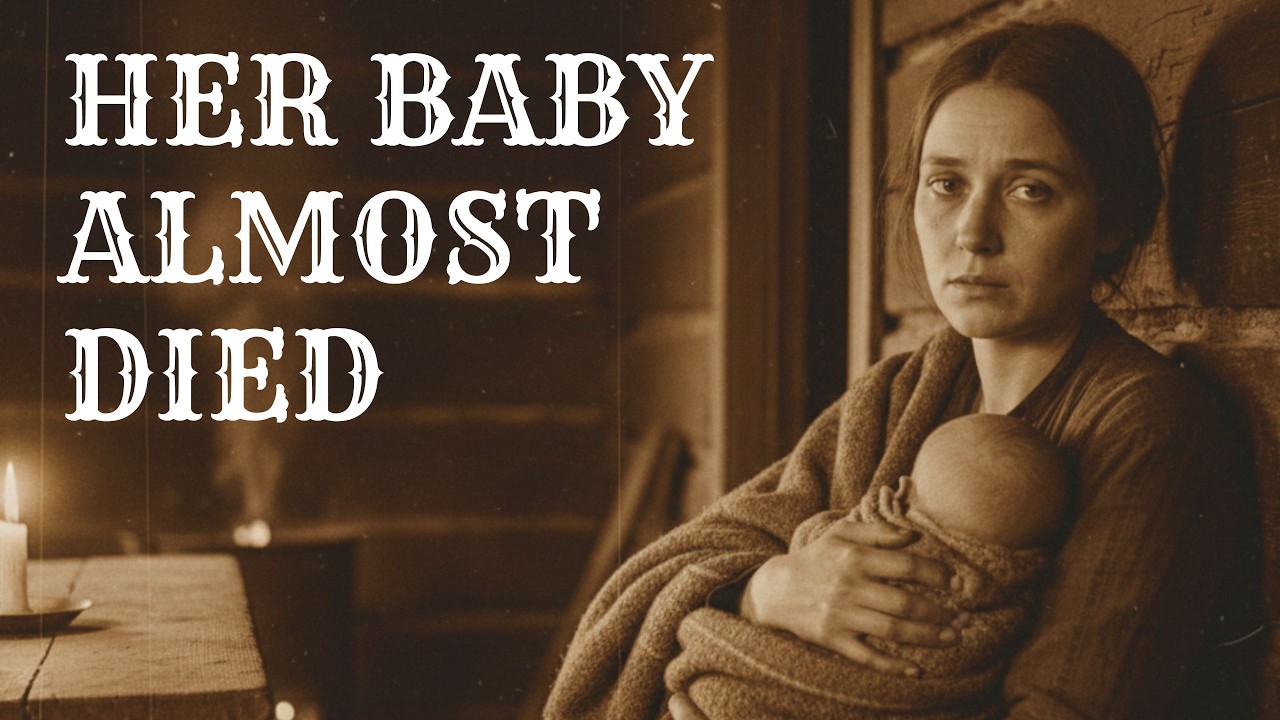
Not a single candle was lit for her. Nobody came. Or so she believed. Until she heard heavy footsteps in the dark mud of the street.
Anna Pierce had not chosen Kansas out of courage. She had chosen it out of desperation. She was born in Ohio, the third daughter of a Methodist minister who believed that silence was a virtue and suffering was God’s instruction. Her childhood home smelled of candle wax and old paper, and the walls were thin enough that she could hear her father pray alone in the dark, his voice low and trembling, asking for patience he never quite received.
She learned early that warmth was something you earned, not something you were simply given. She married Thomas Pierce in the spring of 1899. He was twenty-six, lean and serious, with calloused hands and the kind of quiet determination that made people believe he would amount to something. He had heard about the land opportunities opening in Kansas, tracts being offered under the Homestead Act to anyone willing to work them for five years.
A hundred and sixty acres. A future built from nothing but labor and will. Thomas believed in it the way some men believed in scripture. Anna believed in Thomas.
They arrived in Gravel Bend in late April of 1900, stepping off a Missouri Pacific train onto a platform that was little more than weathered planks over dry earth. The wind hit her before anything else, not a gentle breeze but something flat and relentless, carrying fine red dust that settled on her lips and teeth before she had taken three steps. The sky was enormous here, larger than anything Ohio had prepared her for. The land stretched in every direction without apology, without softness, without end.
Gravel Bend was not much of a town. A main street of perhaps eight buildings, including a general store run by a heavy-set man named Aldous Webb, a farrier, a small post office, a white chapel that leaned slightly to the east, and a saloon at the far end that never seemed entirely closed regardless of the hour. The people who lived there had the look of those who had already survived something and were simply waiting to see what came next. Thomas filed the land claim that first week.
The filing fee was fourteen dollars, nearly everything they had brought with them. He shook the land officer’s hand with the gravity of a man signing a covenant. Anna stood beside him and said nothing, but she pressed her fingers together inside her coat pocket and felt the cold seep through the fabric and into her knuckles. The land they were granted sat two miles east of town at the end of a rutted track that turned to mud in the rain and cracked clay in the heat.
The previous claimant had abandoned it after one winter, leaving behind a half-built sod house with a collapsed corner and a well that needed redigging. Thomas looked at it the way a man looks at something broken that he is already planning to fix. Anna looked at it and felt something she could not name settle quietly into her chest. They spent that first summer breaking sod.
The prairie grass had roots that went down eighteen inches into the earth, thick and tangled as rope, and cutting through it required a steel-breaking plow pulled by their single mule, a gray animal named Porter who bore the labor without complaint, but also without enthusiasm. Thomas walked behind the plow from first light until his hands bled, and Anna worked beside him, pulling stones, stacking them for walls, hauling water from the shallow creek a quarter mile away in two tin buckets that grew heavier with every trip. By mid-June they had planted a small field of winter wheat and a kitchen garden of beans, turnips, and onions. By late July the garden was producing enough to eat, though barely.
Thomas began expanding the sod house, adding a second room and patching the collapsed corner with fresh-cut blocks. At night they sat outside in the cooling air and listened to the silence of the plains, which was never truly silent, but filled instead with wind and insects and the occasional distant cry of something Anna could not identify. She was happy then, or something close to it. Something that felt like the beginning of happiness, fragile and unfinished, the way a building looks before its roof goes on.
She did not know yet what was coming. Thomas Pierce died on a Thursday in November of 1901. There was no dramatic warning, no long goodbye. He had been coughing since early October, the kind of dry, persistent cough that men on the plains dismissed as dust and cold air and overwork.
Anna had asked him twice to ride into town and see Doc Harlan. Thomas had said he would. He never did. Men like Thomas did not stop moving until the moving stopped them.
He collapsed near the well on a gray Thursday morning, the bucket still in his hand. By the time Anna reached him, his lips were the color of ash, and his breathing was a shallow, broken thing that frightened her more than any silence ever had. She rode Porter into Gravel Bend at a full gallop, something she had never done before, the cold air tearing at her face and her hair loose behind her. Doc Harlan came, but it was already too late for medicine to matter.
Thomas Pierce was buried two days later in the small cemetery behind the leaning white chapel. The ground was hard, and the grave took longer to dig than anyone expected. Anna stood at the edge of it with her hands folded and her face still, the way her father had taught her to stand in the presence of God’s instruction. Seven people attended.
Three of them she barely knew. She was twenty-two years old. She was four months pregnant. And she was alone on a hundred and sixty acres of Kansas prairie with one mule, one milk cow, eleven dollars in a tin box under the floorboards, and a winter that had only just begun.
The months that followed were the longest of her life. She survived them the way animals survive things, not with grace, not with understanding, but with a kind of blind forward motion that does not stop to ask why. She chopped wood until her shoulders ached so deeply she could not lift her arms above her head at night. She kept the stove burning.
She fed Porter and the cow. She ate what she had and stretched it as far as it would go, measuring flour by the tablespoon and rationing the salt pork she had smoked in October down to thin slices that flavored the broth more than they filled the belly. The baby came in late February during a sleet storm that coated the windows in gray ice and turned the world outside into something barely visible. There was no doctor.
There was no midwife. Anna had asked Mrs. Caldwell, the farrier’s wife, weeks earlier if she would come when the time arrived. Mrs.
Caldwell had agreed with a warmth that felt genuine in October and apparently cooled considerably by February. When Anna sent word through a passing rider that the labor had begun, no one came. She delivered the baby alone on the floor of the sod house beside the stove in the thin light of a single oil lamp. A girl, small and furious and alive, with a voice that cut through the sound of the sleet like something that had decided, before it even drew its first full breath, that it intended to stay.
Anna named her Clara. She lay on that floor for a long time afterward, the baby on her chest, listening to the storm. She was not crying. She had moved past crying somewhere around midnight.
She was simply breathing, feeling the small weight of her daughter against her ribs, and understanding in a way that went deeper than thought that everything from this point forward would be harder than anything that had come before. She was right. Spring came slowly to Gravel Bend that year, reluctant and incomplete, with frosts returning well into April and the creek running too high and fast from snowmelt to be useful for irrigation. Anna planted what she could, later than she should have, with Clara strapped to her back in a length of wool cloth.
The wheat she had managed to harvest the previous autumn had brought her thirty cents a bushel at Aldous Webb’s store, enough to replenish some supplies, but not enough to feel safe. She owed Webb four dollars on credit he had extended in January with a smile that had not reached his eyes. The people of Gravel Bend were not cruel. That was the hardest part to carry.
They were simply indifferent in the particular way of people who have their own difficulties and have quietly decided that another person’s suffering, however visible, is not their responsibility. Neighbors nodded when they passed her on the road. Women at the chapel offered brief condolences that had grown briefer with each passing month. No one brought food.
No one offered to help with the harvest. No one asked how she was managing with an infant and a homestead and no man to work the heavy ground. Choices had costs, even when they were the right ones. And silence, Anna was learning, had a cost too.
It accumulated slowly, the way debt accumulates, invisible until the moment it becomes impossible to ignore. By late September of 1902, Clara was seven months old, and the homestead was still standing, though barely. The roof of the sod house had developed a soft spot over the main room that leaked brown water when it rained. The well needed new timber lining.
Porter had thrown a shoe, and Anna could not afford the farrier. She had two dollars and forty cents left in the tin box under the floorboards, a dwindling supply of cornmeal, and a baby who had begun coughing three days ago with a sound that lived in Anna’s chest like a splinter she could not reach. She told herself it was nothing. The dust.
The change of season. The dry air. She told herself that every morning for four days. On the fifth morning, Clara’s breathing had changed.
Slower. Heavier. A wet sound beneath each exhale that had not been there before. Anna pressed her lips to her daughter’s forehead and felt a heat that made her close her eyes.
It was not nothing. It had never been nothing. And Anna Pierce, who had survived a husband’s death and a winter alone and a birth with no one present and seven months of silence from the people around her, felt something she had not allowed herself to feel in a very long time. She felt afraid.
She did not make the decision all at once. It came to her in pieces, the way most desperate decisions do, assembling themselves quietly in the back of the mind while the front is still insisting that everything will be fine. She tried the cornmeal poultice first, pressing a warm cloth against Clara’s chest the way she had seen her mother do once for a neighbor’s child in Ohio. The baby’s breathing did not change.
She tried elevating her on a folded blanket, angling her small body so the fluid might settle differently. It did not help. She sat beside the stove through the night with Clara in her arms, feeding small pieces of wood into the fire to keep the temperature steady, watching her daughter’s chest rise and fall with that wet, labored sound that grew heavier as the hours passed. By dawn, she knew.
She wrapped Clara in the warmest blanket she owned, a thick wool piece she had brought from Ohio that still smelled faintly of cedar from the chest it had been stored in. She put on her coat. She pulled Porter from the shelter with hands that were not entirely steady, tied the blanket across her chest so that Clara was pressed against her body and both her arms were free, and mounted bareback in the gray morning light. The two miles into Gravel Bend had never felt longer.
The road was hard and rutted from the recent cold. Her boots found every uneven stone. Clara made small sounds against her collarbone, weak and irregular, and Anna counted them the way a person counts the seconds between lightning and thunder, measuring distance, measuring time, measuring how much was left. She reached the first house on the edge of town before seven in the morning.
The Hendersons. She had spoken to Martha Henderson perhaps a dozen times at the chapel. She knocked. The door opened a cautious few inches, and Martha looked out with the expression of someone who had already decided, before seeing who it was, that whatever was being asked of her was going to be inconvenient.
Anna showed her Clara, explained the breathing, asked if she could sit with the baby while she found Doc Harlan. Martha Henderson said she was sorry. She said she had her own children to think about. She said illness spread.
She closed the door. Anna stood on that porch for three seconds. Then she turned and kept walking. She tried two more doors before she reached the main street.
The result was the same, not cruelty, never outright cruelty, just the particular architecture of self-preservation that ordinary people construct around themselves when the world asks too much of them. A shake of the head, a hand on the door, the soft final sound of a latch catching. Gravel Bend’s main street was beginning to stir when she reached it. The general store was not yet open, but Aldous Webb was visible through the window, moving between shelves.
A man she did not know was loading a wagon outside the farrier. Smoke was rising from the chimney of the saloon, which meant someone was already inside despite the early hour. And then she saw Doc Harlan’s shingle at the far end of the street, the painted letters faded but still legible, swinging slightly in the morning wind. She was halfway there when she heard it.
The slow, heavy sound of a horse being walked down the center of the street behind her. She did not turn immediately, but something in the quality of the silence that formed around that sound made her stop. When she turned, she saw him. He was tall in the saddle in the way that some men are tall everywhere, as though height was simply their natural condition and the horse beneath them was incidental.
He wore a dark coat, trail-worn and serious, and a hat pulled low against the wind. His face was angular and still, the kind of face that gave nothing away and seemed to have made a deliberate decision about that long ago. A rifle sat in the scabbard at his left knee, two revolvers holstered at his hips, worn with the ease of things that had been there a long time. She had heard the name Cole Danner twice since arriving in Gravel Bend.
Once from Thomas, who had mentioned him in passing as a man to be given distance. Once from Aldous Webb, who had said with the careful neutrality of a man who feared being overheard that Danner had ridden into town three weeks ago, that nobody knew exactly why, and that in Webb’s experience, men like that were never passing through for pleasant reasons. The street had gone quiet in the particular way it went quiet when Cole Danner moved through it. Doors that had been open were less open.
Conversations that had been happening were less happening. People found reasons to be slightly elsewhere. Anna Pierce did not move. She stood in the middle of that street with her daughter against her chest and looked up at the man on the horse and felt something she could not afford to feel, which was the sharp, irrational certainty that this was the last door available to her, that if this one closed, there were no more.
She took three steps toward him. Her voice, when it came, was steadier than she expected, not because she was not afraid, but because fear, at a certain depth, stops trembling and becomes something harder and quieter and more dangerous than trembling. She said his name. She did not know how she knew it in that moment.
It simply came. “Mr. Danner, please, my daughter is dying. ”
The horse stopped.
Cole Danner looked down at her with those still, unreadable eyes, and the wind moved between them, and the street waited. The crowd that had quietly gathered along the edges of the storefronts watched with the particular attention of people who expected to witness a rejection. Some had already composed their expressions for it, the practiced sympathy of those who knew how this kind of story ended. A few whispered between themselves.
The widow. Danner. Nothing good would come of this. The silence stretched.
Clara made a small, faint sound, barely a breath. Cole Danner looked at the baby for one long moment, then back at Anna, and said two words in a low, flat voice that carried no warmth and no explanation. “Get inside. ”
Then he turned his horse and rode toward the other end of the street.
The crowd reacted the way crowds always react when their expectations are confirmed. Heads shook. Voices rose just enough to be heard without being accountable. Someone said the word heartless.
Someone else said they had known. They had always known that a man like that had nothing to offer a decent woman. Anna stood perfectly still. The cold pressed down on her from the gray sky above, and Clara’s breathing rattled softly against her neck, and she felt the last of something drain out of her, quietly and completely, the way water drains from a cracked vessel, not with drama, just with finality.
She turned toward the nearest doorway because he had said get inside, and she had no other instruction to follow, and because her legs had stopped being reliable and she needed a wall nearby. She did not see where Cole Danner went. Nobody did. But what happened in the next twenty minutes in the back room of that saloon at the far end of Gravel Bend’s main street was something that nobody in that town would fully understand until much later.
The old doctor was there, sitting in the corner with a glass that was not his first of the morning, his coat hanging loose, his bag somewhere under the table. Doc Harlan had been a capable physician once, in another place and another decade, before the plains had worn something essential out of him. He was not a bad man. He was simply a man who had stopped believing that his presence made much difference.
Cole Danner walked through the saloon door without knocking. He crossed the room in four steps, picked up the doctor’s bag from under the table, and set it on the surface in front of him with a sound that was not loud but was very final. He did not raise his voice. Men who have lived the kind of life Cole Danner had lived rarely need to raise their voices.
The weight of what they carry does the work for them. He said, “There’s a woman on the main street with a sick baby. You’re going to get up, put your coat on, and go see her. Right now.
”
Doc Harlan looked at him for a moment. Then he looked at the glass in his hand. Then he set the glass down, reached for his coat, and stood up. He did not ask questions.
Some doors, it turns out, do not need to be knocked on more than once. They simply need the right hand. Doc Harlan arrived at the doorway where Anna was sitting on a wooden bench outside the dry goods store, her back against the wall and Clara pressed to her chest, still counting breaths. She did not hear him approach.
She only looked up when his shadow fell across her and she saw the bag in his hand and the coat he had not quite managed to button straight in his hurry. He did not explain himself. He simply knelt beside her, opened the bag, and began to work. Anna watched his hands.
They were older hands, slightly unsteady at the edges, but they moved with the memory of competence, finding instruments and remedies with the practiced efficiency of a man who had done this thousands of times before the plains had gotten into him. He listened to Clara’s chest with a small wooden stethoscope, his eyes closed, his expression shifting from the blankness of a man still partly somewhere else into something more focused and present. He said it was croup. Severe, but catchable.
He said another day without treatment and it would have become something worse. He said she had been right to come when she did. He did not say who had sent him. Anna did not ask.
Not yet. She was too focused on Clara, on watching the doctor’s hands, on the sound of her daughter’s breathing, which even in those first minutes of treatment seemed to carry slightly less of that wet, dragging weight that had kept Anna awake through the night. She held Clara’s small hand while Doc Harlan worked and felt the baby’s fingers curl weakly around her thumb and closed her eyes for just a moment. The relief that moved through her was not the clean, bright kind.
It was the exhausted kind. The kind that comes after something has been held too tightly for too long and is finally allowed to loosen. It moved through her like warm water through cold hands, slow and aching and necessary. By midmorning, Clara’s breathing had steadied.
Not fully, not completely, but enough. Doc Harlan left a small paper of powders to be dissolved in warm water and administered twice daily, and a tin of camphor salve to be rubbed on the baby’s chest each night. He told Anna to keep her warm and away from the cold air for at least two weeks. He told her to come find him if the fever returned.
He charged her nothing. That, more than anything, told her something had happened that she did not yet fully understand. She walked back through Gravel Bend’s main street with Clara sleeping against her shoulder, the baby’s breath soft and regular against her neck, and she looked for him. She did not know exactly what she was looking for.
The dark coat, the tall horse, some evidence that he was still there, that the thing she half believed had happened had actually happened. The street was ordinary. The horse was gone. Cole Danner was gone.
She asked Aldous Webb, who was sweeping his front step with the careful attention of a man who had seen everything and preferred to discuss none of it, whether he had seen where Danner had gone. Webb swept two more strokes before answering. He said Danner had ridden out heading north, maybe an hour ago. He said it without looking up.
Anna stood there on the wooden sidewalk with her daughter asleep on her shoulder and the October wind moving through the gap between the buildings and felt something she could not immediately name. It was not quite gratitude, though gratitude was part of it. It was not quite confusion, though that was there too. It was something closer to the feeling of a door that had been opened in a wall she had believed was solid, letting in light from a room she had not known existed.
She walked home. She did not tell anyone what she suspected, partly because she was not certain, partly because certainty in Gravel Bend had a way of becoming currency that other people spent on your behalf. The days that followed were quieter. Clara improved steadily, the way young things improve when the crisis passes and the body remembers what it was built to do.
The cough loosened and then thinned and then disappeared over the course of ten days, leaving behind a baby who seemed, if anything, slightly more determined than before, as though the illness had tested something in her and she had passed. Anna worked. She always worked. There was no alternative, and she had long since stopped thinking of it as a choice.
She repaired the leaking section of the roof with mud and dry grass packed tight into the soft spot, a temporary solution that she knew would not survive the spring but would hold through winter if she was fortunate. She restacked the wood pile, moving the driest pieces to the inside where they would be needed first. She mended the fence along the eastern edge of the property where Porter had pushed through twice looking for better grazing. She thought about Cole Danner more than she intended to.
Not with longing, not with the particular warmth that she would later recognize the feeling becoming, simply with the persistent, quiet curiosity of a woman trying to understand something that did not fit the shape of the world as she had been taught to see it. A man with that reputation, that history, those eyes that gave nothing away. And yet. And yet he had walked into that saloon.
He had picked up that bag. He had said those words to a man who needed to hear them. She did not know why. She was not sure he knew why either.
Twelve days after that morning on the main street, she was drawing water from the well in the thin afternoon light when she heard hooves on the rutted track that led to her property. She turned slowly, the bucket still in her hand, and shielded her eyes against the low autumn sun. He was at the edge of the property, stopped at the fence line, sitting his horse with that same stillness she remembered. He did not call out.
He simply waited, the way a man waits who is not entirely sure he should have come, but has come anyway. Anna set the bucket down. She walked to the fence. They stood on opposite sides of it for a moment, the wind moving between them, the late light falling across the dry grass in long golden strips.
Neither of them spoke. Clara was inside, asleep. The world was very quiet. Then Cole Danner said, in that low, flat voice that she was beginning to understand was simply how he spoke and not an indication of coldness, “The baby.
She recovered. ”
Anna looked at him for a long moment. “She did,” she said. “Thanks to you.
”
He said nothing to that. He looked at the fence post between them as though it had said something worth considering. Then he looked back at her, and something moved briefly across his face, there and gone before she could name it. “Good,” he said.
He held her gaze for one more second. Then he turned the horse and rode back down the track toward the main road without another word. Anna watched him go until the dust settled back onto the grass and the sound of the hooves faded into the wide Kansas silence. She stood there for a long time after.
Something had shifted. She could not have said what, exactly, only that the wall she had felt closing in around her life since Thomas died had developed, in the space of that brief conversation, another crack. And that light, even in small amounts, has a way of changing everything it touches. She did not know yet what was coming, but for the first time in a very long time, she did not dread finding out.
He came back eleven days later. She was splitting wood behind the sod house when she heard the horse on the track. This time, there was something across the back of his saddle, a bundle wrapped in canvas, tied with rope. He dismounted without being invited.
He opened the fence gate with the careful movement of a man who respects other people’s property, closed it behind him, and carried the bundle to the wood pile without a word. He set it down and unwrapped it. Inside was a splitting maul, heavier and better balanced than the hatchet Anna had been using, and two steel wedges for the larger rounds that had been defeating her all autumn. He looked at the hatchet leaning against the chopping block.
Then he looked at her. He did not say anything. He did not need to. Anna said, “You didn’t have to do that.
”
Cole picked up the maul, positioned a large round of elm that had been sitting unsplit for three weeks, and brought the maul down once with the clean economy of someone who had done this ten thousand times. The elm split perfectly, the two halves falling away from each other in the cold air. He set another round on the block. “I know,” he said.
She watched him work for a moment. Then she went back to stacking what had already been split, because standing still felt wrong and there was always work to be done anyway. They worked in silence for the better part of an hour, the sound of the maul steady and rhythmic in the cold afternoon air, Clara asleep inside. It was not comfortable silence, exactly, but it was not uncomfortable either.
It was the silence of two people who had both spent enough time alone to know that silence was not always absence. Sometimes it was simply the most honest thing available. When the wood pile was done, he stacked the wedges neatly against the wall of the sod house where she could reach them. She offered him coffee.
He hesitated long enough that she thought he would refuse. Then he said yes. They sat on opposite ends of the small bench on the porch, the coffee tin warm between their hands, and the conversation came slowly, the way water comes from a pump that has not been used in a while. At first it was practical.
The condition of the roof. Whether the well would hold through winter. The price of cornmeal at Webb’s store, which had gone up two cents a pound since September and showed no sign of coming back down. Then it became something else.
She asked him where he had come from. Not Gravel Bend. Before. He was quiet for long enough that she thought he had decided not to answer.
Then he said New Mexico. Before that, Texas. Before that, a place in Missouri he did not name. He said it the way people describe a journey they are not proud of.
Not with shame exactly, but with the careful neutrality of someone editing as they go. She did not press. She understood editing. She had been doing it herself since Thomas died, cutting away the parts of her story that were too heavy to carry in public.
He left before the light was fully gone, riding back down the track with the same quiet purposefulness with which he did everything. Anna stood on the porch and watched him go and then went inside to feed Clara and bank the stove for the night. She did not tell herself it meant anything. But she thought about the weight of the maul in her hands the next morning when she used it, and about the way he had said I know, and about the particular quality of his silence, which was not the silence of indifference but of someone who had learned through long and costly experience to be very careful with words.
He came again two weeks after that. This time he brought nothing but himself, arriving in the mid-afternoon and finding her attempting to re-mud the section of fence where the posts had heaved in the first hard freeze. He tied his horse to the gate and helped without asking permission, working the mud into the gaps with his hands while she held the posts steady. They finished in forty minutes what would have taken her two hours alone.
The coffee ritual repeated itself. The bench, the tin cups, the slow conversation. This time she learned that he had a brother somewhere in Colorado he had not spoken to in four years. That he had taught himself to read from a single Bible and a mail-order almanac during a winter he had spent alone in a line shack outside Amarillo.
That he did not sleep well and never had. That the plains at night suited him for that reason, that there was something in the wide darkness and the wind that made the sleeplessness feel less like a deficiency and more like simply being awake in a world that was worth staying awake in. She told him about Ohio. About her father’s house and the smell of candle wax and the walls that were too thin.
About Thomas, carefully, the way you speak about someone you loved and lost and are still in the process of understanding how to carry. About the night Clara was born, the sleet on the windows, the oil lamp, the silence of a house with no one else in it. He listened the way very few people listen. Without preparation, without waiting for his turn, simply receiving what she said and holding it without comment, which was, she was discovering, its own kind of response.
By mid-December he was coming every week. Sometimes twice. The town noticed. Of course it noticed.
Gravel Bend was the kind of place where a horse tied to a widow’s fence gate for two hours on a Wednesday afternoon was the kind of detail that traveled from the general store to the chapel to the farrier and back again before the horse had been untied. Anna heard the whispers secondhand through the careful silences of women at the post office and the slightly too long pauses in Webb’s store when she came to buy supplies. She did not change anything. She had spent too long adjusting herself to the comfort of people who had closed their doors on her in October to begin doing it again now.
Cole, for his part, seemed genuinely indifferent to the town’s opinion in the way that only people who have lived entirely outside society’s approval for a long time can be. He did not avoid the main street when he rode in. He did not time his visits to Anna’s homestead for hours when fewer people would see. He simply came when he came and left when he left and met whatever looks were directed at him with the same flat, unreadable expression he met everything with.
But there were moments in the middle of those slow afternoons on the porch when the expression changed. When something underneath the stillness became briefly visible, the way the bottom of a creek becomes visible when the wind stops moving the surface. Not softness exactly. Something more durable than softness.
Something that had survived a great deal and was still, despite everything, present. Anna noticed. She was a careful observer of the things people tried not to show. Her father’s house had trained her well in that.
She noticed, and she said nothing, and she filed it away in the part of herself that was slowly, cautiously, and with full awareness of the cost involved, beginning to hope again. The hardest part wasn’t the work. It never had been. The hardest part was allowing yourself to want something again after the wanting had already cost you everything once before.
But the heart, Anna Pierce was learning, does not ask permission. It simply continues. The way the prairie continues. The way winter continues into spring whether you are ready for it or not.
And somewhere in the long cold weeks of that December, without either of them naming it or acknowledging it directly, something between them had become something neither of them knew exactly how to handle. Something that felt, cautiously and terrifyingly, like the beginning of the rest of their lives. It was a Tuesday evening in late January when he told her. The temperature had dropped sharply after sundown, the kind of cold that arrives without wind and settles over everything like a held breath, turning the world outside the windows into a still, frozen thing.
Anna had kept the stove burning high, and Clara was asleep in her small cot in the corner, bundled to the chin, her breathing soft and even. The oil lamp on the table threw a warm circle of light that did not reach the edges of the room. Cole had come that afternoon to repair the soft spot in the roof that Anna’s mud patch had not survived the freeze. He had worked up there for three hours in the cold, his breath visible in the air above him, replacing the compromised sod blocks with fresh ones he had cut from the field edge and packed tight with clay.
When he came down, his hands were stiff and his coat was dark with moisture, and Anna had told him without discussion that he would stay for supper. A statement rather than an invitation, delivered in the tone of a woman who had stopped asking unnecessary questions. He had stayed. They ate in the comfortable near silence that had become their way, the small sounds of the meal and the fire filling the space between them naturally, without effort.
Clara had woken briefly, regarded Cole from across the room with the serious, evaluating expression she had recently developed toward everything, and then apparently decided he was acceptable and gone back to sleep. It was after supper, when the plates had been cleared and the coffee was on and the lamp had burned down slightly so that the room felt smaller and warmer and closer than it did in full light, that he spoke. He did not begin with an explanation. He began with a name.
“There was a man named Luis in New Mexico. 1898. ”
Anna set her coffee down. She did not say anything.
She simply waited, the way she had learned to wait with him, giving the silence room to become whatever it needed to become. He looked at his hands on the table for a moment. Then he looked at her. He told her about Luis.
About the circumstances that had brought two men to the same dusty crossroads outside of Las Cruces on a September afternoon four years ago. About the life he had been living before that, the kind of life that accumulates its own logic over time, one decision leading to the next with a momentum that feels like necessity until you are standing in front of it and cannot recognize the road that brought you there. He had hired his gun out. That was the plain truth of it, and he said it plainly, without decoration or excuse.
He had done work for men who paid well and asked few questions, and he had told himself the stories that men in that position tell themselves about justice and necessity and the difference between killing and murder, and he had believed those stories the way you believe things when the alternative is too costly to examine. Luis had not been a good man. That was also true and also beside the point. The man who hired Cole to find him had not been a good man either.
The world at that crossroads outside Las Cruces had contained no good men, only men with varying degrees of blood on their hands and varying abilities to sleep at night. Cole had been faster. He said it without drama. A fact delivered as a fact, the way a man describes weather.
But then he said, and this was the part that cost him something visible, that Luis had not been alone at that crossroads. That there had been a boy with him. Twelve years old, maybe thirteen. A nephew or a younger brother.
Nobody had been entirely clear. That the boy had not been hurt, that Cole had made certain of that, had put himself physically between the boy and the men he was working for when it became clear what they intended. That he had gotten the boy onto a horse and pointed him toward the nearest town and told him to ride and not look back. But that the boy’s face had stayed with him.
In the way that certain things stay. Not as guilt exactly, though guilt was part of it. More as a kind of permanent awareness of who he was and what he had been willing to do and the distance between those things and the life he might have chosen if he had chosen differently at seventeen or twenty or twenty-four. He had left New Mexico three weeks after Las Cruces.
He had drifted north through Colorado and into Kansas without a particular destination, carrying the accumulated weight of a life he was trying to put down without knowing quite how. Gravel Bend had simply been where the horse stopped. He had not intended to stay. He was not certain even now that staying was the right thing, but he had stayed.
And the staying had gradually stopped feeling like a mistake. And then it had gradually started feeling like something else entirely. Something he did not have a word for yet. He stopped talking.
The fire settled in the stove. Outside, the frozen Kansas night pressed against the walls of the sod house in silence. Clara breathed softly in her corner. Anna looked at him for a long moment.
At the hands on the table. At the face that was not unreadable to her anymore. Not after these months, not after learning the particular vocabulary of his silences and the specific weight of the things he chose not to say. She said, “Why are you telling me this?
”
He met her eyes. “Because you should know who you’re letting onto your property. ”
She was quiet for a moment. Then she said, “I know who I’m letting onto my property.
”
Something in his expression shifted. That thing she had seen before, underneath the stillness. The thing more durable than softness. It was closer to the surface now than she had ever seen it.
She reached across the table and put her hand over his. Not with romance. Not with the self-conscious weight of a gesture being made. Simply with the directness of a woman who had stopped having the patience for indirection somewhere around the second winter alone.
He looked at her hand on his. He did not pull away. The lamp burned low between them, and the fire spoke quietly in the stove, and outside the January night held everything in its cold and absolute stillness. And neither of them said anything for a long time.
Because some things do not need to be said to be understood. Choices had costs. Even when they were the right ones. Both of them knew that.
Both of them had paid enough to understand it deeply in the specific way that only loss teaches. But there are also moments when the cost and the choice arrive together, inseparable. And you look at them both clearly and reach out your hand anyway. This was one of those moments.
And both of them, in their own way, knew it. The stranger arrived on a Wednesday morning in the first week of February. Anna did not see him come into town. She heard about him the way she heard about most things in Gravel Bend, through the particular silence that Aldous Webb deployed when he was deciding how much to say, standing behind his counter with his hands flat on the wood and his eyes doing the work his mouth was avoiding.
She had come in for cornmeal and salt. Webb had measured them out with his usual deliberate slowness and then, as she was gathering her parcels, had said without looking up that there was a man asking questions. That he had come in on the afternoon stage from Dodge City the previous day. That he was staying at the saloon and had been there since sundown the night before, drinking moderately and talking to anyone who would talk to him.
That the questions he was asking were about a man named Danner. Anna had stood very still at the counter. Webb had looked up then, briefly. And whatever he saw in her face had made him add, in a quieter voice, that the man did not look like law.
That he looked like something else. That in Webb’s experience, which was considerable, men who came asking quiet questions about men like Cole Danner were rarely bringing good news. She thanked him. She gathered her parcels.
She walked out into the February cold with a steadiness she did not entirely feel. His name, she learned later that same day, was Virgil Tate. He was perhaps fifty, lean and weathered in the way of men who had spent their lives outdoors without particular enjoyment of it. He had a quiet manner and a patient way of waiting that reminded her uncomfortably of a man who was accustomed to waiting for things and had learned through experience that waiting usually worked.
He wore no visible weapons, which meant nothing and which she suspected he knew meant nothing. He had found her before she found Cole. She was halfway down the main street heading for the north road when she heard her name spoken pleasantly and without urgency, and turned to find him standing outside the saloon with his hat in his hands and an expression of such practiced reasonableness that it made her trust him less immediately than she would have trusted open hostility. He said he understood she was acquainted with Cole Danner.
He said he was an old associate of Danner’s, that they had unfinished business of a professional nature, that he meant no trouble to anyone in the town and certainly not to her. And that if she happened to know where Danner was staying, he would be grateful for the information and would trouble her no further. Anna looked at him for a long moment. She said she was not in the habit of sharing information about her friends with strangers.
Virgil Tate smiled. It was a patient smile, the kind that has time on its side. He said he understood completely. He said he would be in town for a few days in any case, no hurry.
And that if she changed her mind, or if Danner himself wanted to have a conversation, he would be easy enough to find. He put his hat back on and went back inside. Anna rode hard to Cole’s camp. He had been staying three miles north of town on a section of unclaimed land along the creek, in a canvas shelter he had built against a cottonwood stand in October and winterized with cut sod and pine boughs.
It was not much. But it was dry. And it was his. And he had seemed, in the months she had known him, to be a man who required very little in the way of shelter and a great deal in the way of space.
She found him at the fire working on a piece of tack and told him everything without preamble, because there was no time for preamble and because she had learned that he preferred plain speech to preparation. He listened without interruption. His hands stopped moving on the leather, but he did not put it down. When she finished, he was quiet for a long moment, looking at the fire.
Then he said, “Tate. ”
Not a question. She said, “You know him. ”
He said, “Yes.
”
He said Virgil Tate had been working for a man named Carver out of Santa Fe for the better part of a decade. That Carver was the man who had hired Cole in New Mexico in 1898. That after Las Cruces, Cole had left without collecting the remainder of what he was owed, which had apparently been interpreted not as a man walking away from a life he no longer wanted, but as a debt unpaid and a slight unaddressed. That Carver was a man who did not tolerate either.
Anna felt the cold more sharply than she had a moment before. She said, “What does he want? ”
Cole set the tack down. He looked at her across the fire with those eyes that she knew now, that she had learned to read across these months the way you learn to read weather on the plains, the specific language of approaching fronts and shifting pressures.
He said, “Money, most likely. Or a message delivered. Carver doesn’t send Tate to kill people. He sends him to remind people that Carver exists and that debts have a way of compounding.
”
He paused. “Or,” he said more quietly, “he’s here to tell me something has changed and the original arrangement has been revised. ”
Anna said, “What does that mean? ”
He looked at the fire again.
“It means Carver may have decided that the money isn’t enough anymore. ”
The silence between them was a different quality than their usual silences. It had weight and direction, like weather. She said, “Then you need to talk to him.
”
Cole looked at her. She said, “Not run. Not disappear in the night the way you’ve done before. Talk to him.
Here. On ground you know, with people around. ”
She paused. “You’re not the same man you were in New Mexico.
But you’ll never stop being that man to anyone else until you stand still long enough to show them otherwise. ”
It was the most she had said at once in all the months they had known each other. She felt the weight of it in the air between them after she finished. Cole was quiet for a long time.
The fire cracked and settled. The cottonwoods above them moved in the February wind, their bare branches making a dry, papery sound against the gray sky. He said, “You’re not afraid of what happens if this goes wrong. ”
It was not quite a question.
She said, “I’ve already lost everything once. I know what that feels like. ” She held his gaze. “This doesn’t feel like that.
”
He looked at her with an expression she had never seen on him before. Not the durable, survived thing she knew. Something more open than that. Something that had not yet been named and was not sure it was safe to be seen.
He picked up the tack again, worked it slowly between his hands, and then he said quietly, “All right. ”
Two words. The same number he had spoken to her on the main street that October morning, but carrying this time an entirely different weight. She rode back to town in the thin February light with her heart steady and her jaw set and the particular resolve of a woman who had decided that the life she was building was worth the cost of defending it, whatever that cost turned out to be.
She did not know yet how the next morning would go. None of us ever do. But she knew who she was, and she knew now who he was trying to become. And sometimes, on the plains as in life, knowing those two things is enough to take the next step forward, even when the ground ahead is uncertain and the wind is cold and the outcome is not guaranteed.
Sometimes it has to be. The meeting happened the following morning. Cole rode into Gravel Bend at eight o’clock, earlier than most people were expecting anything from a day that had begun gray and cold and unremarkable. He tied his horse in front of the saloon with the same unhurried deliberateness with which he did everything, and he went inside.
Anna was at the dry goods store across the street, not buying anything, standing near the window with Clara on her hip and her eyes on the saloon door. Webb said nothing. He found something to organize on the shelf behind him and left her to her watching. She did not know what was being said inside.
She could not hear it. The street between her and the saloon door was forty feet of frozen mud and February silence, and whatever was happening in that room was happening without her and beyond her influence, and she had made her peace with that on the ride home the previous evening, understanding that there are moments in a life when you have said what you can say and done what you can do, and the rest belongs to someone else. But she watched the door. Virgil Tate had been inside since seven.
She had seen him enter from her position at the edge of the street, had noted the absence of anything overtly threatening in his manner, had reminded herself that this was precisely what made him worth being careful about. The door opened at 8:40. Cole came out first. His coat was straight and his hat was level, and he was moving with the even, unhurried stride of a man who had not been required to be anything other than what he was.
He stopped on the step and looked across the street directly at her, and even at forty feet, she could read what was in his face. It was over. Tate came out behind him. He stood on the step for a moment, put his hat on, looked once in Anna’s direction with the expression of a man reassessing a situation he had arrived at with certain assumptions, and then walked toward the stage office without looking back.
He left on the noon stage. Anna watched the coach pull out of Gravel Bend with its four horses blowing steam in the cold air and felt something release in her chest that she had been holding since Wednesday morning without fully realizing the holding of it. She found out what had been said later that day, sitting on the bench on her porch in the thin winter sunlight with Clara between them pulling at the fringe of Anna’s wool shawl with the focused determination of a child who has identified a project. Cole told her that Tate had come with a number.
Carver wanted three hundred dollars, the amount Cole had left uncollected in New Mexico plus interest calculated at a rate that reflected Carver’s opinion of himself. The three hundred dollars was more than Cole had. He had told Tate this plainly. Anna said, “And?
”
He had offered eighty dollars, every cent he had saved since arriving in Kansas, kept in a roll inside his saddlebag and never spoken of. He had set it on the table between them without ceremony and told Tate it was what he had, that it was offered in good faith, and that the remainder would be paid over time at a rate they could agree on. He had also told Tate something else. That he was done moving.
That he was in Gravel Bend, Kansas, that people here knew his name and his face, and that if Carver decided eighty dollars and a payment arrangement were not sufficient and sent someone else, Cole would ride to Santa Fe himself and have the conversation directly with the man. And that Carver, who was a businessman before anything else, might want to consider carefully whether the full amount was worth that particular complication, given what Cole knew about the Las Cruces job and the people who had ordered it. That last part had changed the quality of the silence in the room. Tate had looked at the money for a long moment.
Then he had picked it up, folded it into his coat pocket, and said he would relay everything to Carver. His voice had carried, for the first time that morning, a slight uncertainty that had not been there before. He had left on the noon stage without further conversation. It was not a clean resolution.
Cole did not pretend it was. Carver might send word. He might send someone else. The debt was reduced, but not erased, and men like Carver had long memories and longer patience.
But the ground had shifted. And sometimes a shift in the ground is the best outcome available, and a man who has lived long enough learns to recognize it as the victory it is. Anna was quiet for a moment, watching Clara work at the fringe. Then she said, “Do you think he’ll come back?
”
Cole said he did not know. That Carver was unpredictable in some ways and entirely predictable in others. That the honest answer was that this might be finished and it might not be, and that either way, he had meant what he said and would do what he had said he would do if it came to it. He paused.
Then he said, in the careful, deliberate way of a man choosing words that he has been turning over for some time, “I’ve been thinking about the roof. ”
Anna looked at him. He said the sod roof was a temporary solution to a permanent problem, and that what the house needed was proper timber framing and shingles, which would require lumber from the mill in Dodge City and two weeks of work in the spring. He said he had been considering whether it would make more sense to do it as an addition to the existing structure or as a full replacement of the roofline.
He was looking at Clara when he said it, not at Anna. His voice was even and practical, the voice he used for fence posts and well linings and the price of cornmeal. Anna understood what he was not saying. She had become fluent over these months in the language of what Cole Danner did not say.
She said, “That sounds like a project that would take most of the spring. ”
He said it would. That it was not a small undertaking. That a person would need to plan for it carefully, account for the cost of materials, think about the logistics of having lumber hauled from Dodge.
That it was the kind of project that made more sense if you intended to be in a place for a long time. He looked at her then. She looked back at him. Clara pulled the fringe loose from the shawl with a small sound of triumph and held it up for inspection.
Anna said, “I intend to be here for a long time. ”
The wind moved across the dry grass of the homestead, and the late winter sun lay flat and pale across the frozen ground, and somewhere to the north a hawk turned slow circles in the enormous Kansas sky. Cole reached over and took the fringe gently from Clara’s hand and gave it back to Anna. His fingers brushed hers in the exchange.
He did not pull away quickly. He said, “Then I’ll start on the lumber order in March. ”
It was not a proposal in any form that Gravel Bend would have recognized. There were no words that the chapel would have approved of, no formal asking, no answer delivered in the language that society expected.
It was simply two people who had both survived the unsurvivable, looking at each other across the cold, bright air of a February afternoon, and understanding, without requiring it to be said, that they had decided. The town had opinions about the timeline. Of course it did. Six months was too soon, some said, for a widow who had buried her husband less than a year and a half ago.
Others said that a woman alone on a homestead with an infant had no business keeping company with a man of Cole’s history regardless of the timeline. The reverend had requested a private conversation with Anna in March, during which he had expressed his concerns with the careful indirection of a man who understood that she was not asking for his approval but felt obligated to offer it anyway. She had thanked him for his time and left. She had discussed none of it with Cole.
He had not asked. They had both, independently and without coordination, arrived at the same understanding, which was that the people of Gravel Bend had forfeited a certain amount of their right to weigh in on Anna Pierce’s choices on the morning they had closed their doors while her daughter was dying. This was not bitterness. It was simply accounting.
They were married in April on a Thursday in the leaning white chapel, with Doc Harlan and Aldous Webb as witnesses and Clara sitting up on Anna’s hip in a white dress Anna had sewn from a length of cotton she had been saving since Ohio without knowing what for. The ceremony was short. The reverend was efficient. The congregation, such as it was, was the same town that had closed its doors in October and turned its eyes away on a cold morning when a young woman ran through the street with a dying baby in her arms.
They watched now with the complicated expressions of people who know they owe a debt they will never be asked to pay directly. Cole stood at the front of that chapel in a clean shirt and his best coat and said the words that were required of him in the even voice that Anna had long since stopped hearing as cold and had come to understand as simply the sound of a man who meant what he said and said only what he meant. When it was done, he looked at her with that thing she had first seen in January, the open thing beneath the stillness, and this time he did not guard it. She had spent two years learning that the world could be cruel in its silences, in its closed doors and turned faces and careful indifference.
She had learned it in Ohio, and in the winter after Thomas died, and in every morning she had risen alone to face a day that offered no guarantee. But she had also learned, and this was the harder and more necessary lesson, that cruelty is not the whole of it. That sometimes, in the least expected places, in the most unlikely people, there is something else. Something that does not announce itself or ask for recognition.
Something that simply acts in the dark and the cold and the mud of an ordinary street, because acting is the only honest response to a world that is suffering. Cole Danner never became a celebrated man. Gravel Bend never erected anything in his name. The story of what he had done on that October morning, walking into the saloon and standing over a drunk doctor with two words and the weight of who he was, spread through town the way true stories spread, slowly and without drama, arriving in people’s understanding months after the fact and settling there quietly.
He built the roof that spring. Timber-framed, properly shingled, solid enough to outlast both of them. He filed a homestead claim of his own on the adjacent section in June, combining it with Anna’s through a legal arrangement that Gravel Bend’s single lawyer drew up on a Tuesday afternoon for a fee of two dollars. The guns went away in July.
It happened on a Sunday afternoon when Clara, newly walking and entirely without fear, crossed the room with her focused unsteady gait and reached up toward the holster hanging on the wall peg beside the door with the simple curiosity of a child who does not yet know what things are for. Cole was across the room in two steps. He lifted her away gently, redirected her attention toward the wooden spoon she had been carrying earlier, and then stood for a moment looking at the holster on the wall. Anna watched from the doorway.
She did not say anything. He took the holster down. He carried it to the bedroom, wrapped both revolvers in a length of oilcloth, placed them in the box he kept under the bed, and slid it back into the darkness. He came back to the main room and picked Clara up and held her against his shoulder with the careful, slightly self-conscious tenderness of a man still learning that he was allowed to do this.
He did not make a speech about it. He did not mark the moment with words. But Anna had seen his face in the second before he turned away from the wall, and she understood that something had been set down that would not be picked up again. Not because the world had become safe, but because the thing he was protecting now was worth more than anything the guns had ever given him.
Clara learned to walk that summer, crossing the distance between the porch and the fence gate with the focused, slightly alarmed expression of someone discovering that the ground is less reliable than previously understood. Cole watched her from the porch with his coffee and did not laugh, though something in his face did something that amounted to the same thing. Some stories do not survive. They are carried off by the wind and the seasons and the simple passage of time that covers everything on the plains eventually, the good and the bad alike, without distinction or mercy.
But some stories hold. Not because they are extraordinary. Not because the people in them are larger than life or free from the costs that ordinary living extracts from everyone. But because they are true.
Because they happened in the particular way that real things happen, slowly and imperfectly and at great expense. And because the people in them chose, against the weight of everything they had already lost, to keep choosing. Have you ever walked away from the life you were supposed to live and built something entirely different from the pieces that remained? Have you ever been seen clearly by someone who had no reason to look, and found that being seen was the thing you had needed all along?
Some of the most important histories are the ones that were never written down. And this one almost wasn’t.