In the autumn of 1863, as the Civil War tore across Virginia, the plantation called Thornfield Manor stood isolated in the dense woodlands of Rapahhan County, some fifteen miles northeast of the town of Washington. The estate, owned by Colonel Jeremiah Blackwood, had operated for nearly forty years as one of the region’s most profitable tobacco farms, employing more than sixty enslaved workers across its eight hundred acres. What set Thornfield apart from neighboring plantations was not its size or productivity, but the peculiar silence that seemed to hang over its grounds, broken only by distant work bells and the occasional creak of wagon wheels along the dirt paths between the tobacco fields and the imposing three-story brick manor house. Among the enslaved people at Thornfield lived a young woman named Sarah Elizabeth Carter.
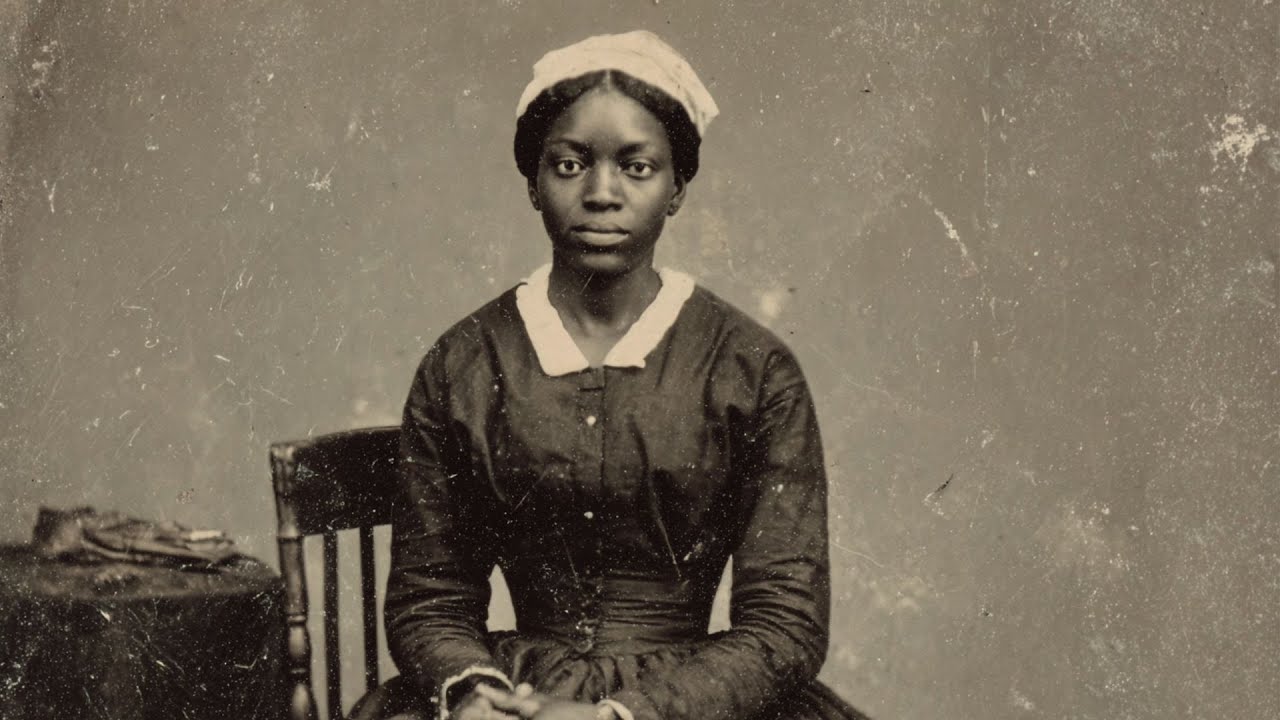
She had arrived at the plantation in 1858 at the age of eighteen, purchased from a failing farm in neighboring Fauquier County for eight hundred dollars, a price that contemporary records suggest was considerably below market value for a healthy young woman of her age. The circumstances of her arrival would later become the subject of widespread speculation among local historians. Unlike most enslaved individuals, who were assigned to fieldwork or domestic duties upon arrival, Sarah was immediately designated for what plantation records euphemistically termed special household service, a classification that appeared nowhere else in Thornfield’s meticulously kept ledgers. Colonel Blackwood, a widower who had lost his wife to consumption in 1856, maintained strict control over every aspect of plantation operations.
Standing nearly six feet tall, with graying hair and piercing blue eyes, he was known throughout the county for his exacting standards and volatile temper. Neighboring plantation owners often spoke of his unusual management style, which involved personal oversight of even the most mundane activities. His only child, a son named Marcus, had left for Confederate military service in 1861 and had not returned since his enlistment. That absence left the colonel increasingly isolated inside the manor house, where he spent long hours in his study reviewing accounts and corresponding with tobacco merchants in Richmond.
Sarah’s duties, as later pieced together from fragmentary records and oral testimony, centered on the maintenance of the colonel’s private quarters on the second floor. She cleaned his study, prepared his meals, and attended to various personal needs that were never specifically detailed in any surviving documentation. What made her situation particularly striking was her complete isolation from the rest of the enslaved community. Unlike other house servants, who lived in quarters adjacent to the main residence, Sarah occupied a small room in the manor’s east wing, accessible only through the colonel’s private study.
This arrangement, highly unusual for the time, effectively severed her from contact with others on the plantation, except during brief supervised visits to the kitchen. The overseer’s daily reports, discovered in 1894 during renovation work on the old manor house, contain frequent references to Sarah’s restricted movements. These documents, written in the careful script of Thomas Whitmore, Thornfield’s head overseer, indicate that Sarah was prohibited from participating in the communal activities that typically provided enslaved people with opportunities for social interaction and emotional support. Beginning in late 1859, roughly eighteen months after her arrival, Whitmore began documenting Sarah’s whereabouts at hourly intervals throughout each day.
Entries such as SC study duties 10:00 a. m. or SC kitchen supervised 2:00 p. m.
suggested a level of monitoring that far exceeded standard plantation security. The isolation imposed on Sarah became even more pronounced during the winter of 1860 to 1861, when heavy snows made travel between plantations nearly impossible. During that period, Sarah’s contact with the outside world was limited to occasional glimpses through the manor house windows and brief exchanges with the cook, an elderly woman named Patience, who had worked at Thornfield for more than twenty years. Patience would later provide crucial testimony about Sarah’s condition during this time.
In a statement recorded by a traveling minister in 1868, she described Sarah as having become increasingly withdrawn and fearful, often startling at sudden sounds and carrying what she termed a haunted look in her eyes. Patience noted that Sarah frequently appeared tired and struggled to concentrate on simple tasks. The winter of 1861 brought additional changes. Colonel Blackwood, whose behavior had grown increasingly erratic following his son’s departure for military service, began implementing what he called enhanced discipline protocols throughout the plantation.
These new measures, detailed in his personal correspondence with a cousin in Richmond, included extended work hours, reduced meal rations, and the elimination of traditional rest periods on Sundays. For Sarah, the enhanced protocols meant even greater restriction of movement and longer hours confined to the manor house. Whitmore’s reports from this period indicate that she was rarely seen outside the building for weeks at a time, leading to speculation among the other enslaved workers about her welfare. The spring of 1862 marked the beginning of what plantation records would later refer to as the difficult period.
Sarah’s health declined significantly during these months. Patience noted in her later testimony that the young woman had lost considerable weight and often appeared to be in physical discomfort. More troubling were the changes in her behavior, which had become increasingly unpredictable. Sarah would sometimes freeze in the middle of tasks, staring blankly ahead for several minutes before resuming her work without explanation.
On other occasions, she would flinch violently at the sound of footsteps or voices, even when the source was clearly a familiar member of the household staff. The colonel’s mood swings grew more volatile as well. Neighboring plantation owner William Henderson would later recall visiting Thornfield in the summer of 1862 and finding Blackwood in what he described as an agitated and suspicious state. The colonel accused Henderson of attempting to spy on plantation operations and demanded that he leave the property immediately.
In his personal diary, Henderson noted that Blackwood appeared to have aged considerably since their last meeting, describing him as haggard and wild-eyed, with the bearing of a man who trusted no one and saw enemies in every shadow. The autumn of 1862 brought news that further destabilized conditions at Thornfield. Word arrived that Marcus Blackwood had been killed at the Battle of Antietam, leaving his father without an heir and increasingly bitter about the war’s impact on his family. The colonel’s response was to withdraw even further from social contact, refusing visits from neighbors and clergy who came to offer condolences.
For Sarah, the colonel’s grief manifested in increased demands for her presence and attention. Whitmore’s reports from this period indicate that she was now required to remain in the manor house around the clock, with no scheduled breaks or opportunities to venture outside. The overseer noted with apparent concern that Sarah was becoming increasingly thin and pale, with a nervous disposition that seemed to worsen by the day. The winter of 1862 to 1863 proved especially harsh, with temperatures dropping well below normal and heavy snows blocking roads throughout the county for weeks at a time.
Isolation at Thornfield became complete, with no visitors, deliveries, or communication with the outside world for nearly two months. It was during this isolation that the first disturbing sounds began to emanate from the manor house. According to testimony later provided by several field workers, strange noises could be heard coming from the building during the late evening hours. These sounds, described as crying or moaning by some witnesses and like furniture being moved around by others, became a source of growing concern among the enslaved community.
Patience would later recount that she became increasingly worried about Sarah’s welfare during this period. On the rare occasions when she encountered Sarah in the kitchen, she noticed that the young woman appeared to be in constant fear, jumping at the slightest unexpected sound and speaking only in whispers. More disturbing were the marks Patience observed on Sarah’s arms and neck, which she described as dark bruises that seemed to never fully heal. The arrival of spring in 1863 brought little relief.
Colonel Blackwood’s behavior had become increasingly unpredictable, with violent outbursts directed at field workers and household staff becoming more frequent. Whitmore documented several incidents in which the colonel had threatened workers with physical punishment for minor infractions or imagined transgressions. It was against this backdrop of mounting tension and fear that the events of the night of April 23, 1863, would unfold. The day began unremarkably, with Sarah performing her usual duties while field workers tended to the spring planting of tobacco seedlings.
Whitmore’s daily report, one of the last he would file from Thornfield, noted that all activities proceeded according to normal schedules until approximately midafternoon, when what he described as an unusual commotion arose from the direction of the manor house. Several field workers later testified to hearing raised voices and what sounded like furniture being thrown about in the upper floors of the building. These sounds continued for approximately thirty minutes before an eerie silence settled over the plantation. When questioned about the disturbances, Whitmore reportedly told the workers to return to their tasks and avoid approaching the manor house without explicit permission.
As evening approached, the usual routine underwent a subtle but significant change. The dinner bell, typically rung at precisely six o’clock, remained silent. Field workers, waiting for the signal to end their day’s labor, found themselves uncertain about whether to continue working or return to their quarters. Patience, whose responsibilities included preparing the colonel’s evening meal, grew increasingly concerned as darkness fell without any summons to the manor house.
In her later testimony, she described feeling an overwhelming sense of dread as she approached the kitchen entrance, noting that the usual lamplight was absent from the colonel’s study window on the second floor. Upon entering the kitchen, Patience discovered that Sarah was nowhere to be found. This absence was particularly troubling because Sarah’s duties typically required her to remain in the manor house at all times, especially during the evening hours. A search of the ground floor revealed no sign of either Sarah or Colonel Blackwood.
The building appeared completely deserted, with an unsettling quiet that seemed to permeate every room. Patience would later describe the atmosphere as heavy and oppressive, as if the very air had become difficult to breathe. The discovery of the colonel’s study on the second floor provided the first concrete evidence that something terrible had occurred. The room, typically maintained in perfect order according to the colonel’s exacting standards, showed signs of a violent struggle.
Furniture had been overturned, papers were scattered across the floor, and what appeared to be blood stains marked the walls near the window overlooking the plantation grounds. Most disturbing was the condition of Sarah’s small room adjacent to the study. The space, barely large enough to contain a narrow bed and small table, bore evidence of significant disturbance. The bed had been stripped of its linens, the table overturned, and personal belongings that Sarah had accumulated during her years at Thornfield were scattered and broken throughout the confined space.
Whitmore, summoned by Patience’s alarm, arrived to find a scene that defied easy explanation. In his final report filed with county authorities three days later, he described discovering clear evidence of violence and struggle, but noted the complete absence of both the colonel and Sarah. No bodies were found despite an extensive search of the building and immediate grounds. The investigation that followed proved to be one of the most perplexing cases in the county’s history.
Local authorities, already overwhelmed by wartime responsibilities, found themselves confronting a mystery with no logical solution. Interviews with plantation workers revealed a consistent pattern of testimony. Multiple witnesses confirmed hearing sounds of conflict from the manor house on the afternoon and evening of April 23, but none reported seeing anyone leave the building or approach it from outside. This testimony suggested that whatever had occurred had been an entirely internal affair.
The condition of the plantation following the disappearances provided additional puzzling details. Livestock remained properly tended, field tools were found in their usual storage locations, and the plantation’s financial records appeared intact and up to date through the day of the incident. This orderly state of affairs seemed inconsistent with a scenario involving outside attackers or spontaneous abandonment. Perhaps most intriguingly, searchers discovered a partially written letter in the colonel’s study, apparently begun on the morning of April 23 but never completed.
The letter, addressed to his cousin in Richmond, contained routine discussion of plantation business and tobacco prices but ended abruptly mid-sentence with the words She has finally. The remainder of the page was blank. The fate of the other enslaved individuals at Thornfield became an immediate concern for county authorities. Without clear ownership or legal oversight, the plantation’s operations effectively ceased, forcing workers to seek shelter and employment elsewhere.
Many carried with them memories and suspicions that would influence local folklore for generations. Patience, whose advanced age made her relocation particularly difficult, remained on the property for several additional weeks before accepting shelter with a neighboring family. During this period, she reported hearing disturbing sounds from the manor house at night, describing them as footsteps and voices that seemed to come from rooms that should have been empty. These reports of unexplained phenomena persisted for months following the disappearances.
Travelers frequently reported seeing lights in the manor house windows late at night, despite the building’s confirmed abandonment. The mystery deepened in June 1863, when county officials conducting a formal inventory of the plantation discovered Sarah’s personal diary hidden beneath a loose floorboard in her room. The diary, containing entries spanning from her arrival in 1858 through early April 1863, provided the first detailed insight into the true nature of her experiences. The entries, written in Sarah’s careful handwriting, revealed a pattern of abuse and control that far exceeded what investigators had initially suspected.
Beginning shortly after her arrival, Sarah documented increasingly severe restrictions on her freedom of movement, escalating demands for her availability and attention, and what she described as punishments for perceived failures in her duties or attitude. More disturbing were the diary’s references to the colonel’s growing obsession with controlling every aspect of Sarah’s existence. Entries from 1860 and 1861 described his insistence on selecting her clothing, monitoring her consumption of food and water, and requiring detailed accounts of how she spent every moment of her time. Sarah wrote of feeling like a bird in a cage that grows smaller each day.
The diary’s later entries painted an increasingly desperate picture. By late 1862, she was documenting symptoms of severe exhaustion, persistent fear, and what she described as a feeling that I am disappearing piece by piece. These entries suggested that Sarah had begun to plan some form of resistance or escape, though the specific details were not clearly articulated. The final entry, dated April 20, 1863, three days before the disappearances, contained a chilling statement of intent.
Sarah wrote, I cannot endure another day of this existence. The colonel believes he owns not just my body, but my very soul. Tonight I will show him that some things cannot be possessed. The diary contained no further entries.
The discovery prompted a more intensive investigation of the manor house and surrounding grounds. A room-by-room examination revealed disturbing details about the conditions in which Sarah had been forced to live. Her small room showed evidence of modifications suggesting it had been designed more as a prison cell than living quarters. The single window had been fitted with heavy iron bars.
The door could be locked from the outside, and scratches on the walls indicated repeated attempts to mark the passage of time. Even more troubling was the discovery of a hidden chamber beneath the manor’s main staircase, accessed through a concealed panel in the wall. Inside were locks of hair, pieces of clothing, and detailed written observations about Sarah’s daily activities and emotional states. The chamber also contained what appeared to be plans for some form of permanent confinement.
Investigators discovered shackles, chains, and construction materials that seemed intended for the creation of a more secure prison-like environment. These findings suggested that the colonel had been planning to escalate his control over Sarah to even more extreme levels. The implications sent shock waves through the local community. Neighbors who had considered Blackwood a respectable, if somewhat eccentric, member of the local elite found themselves questioning their previous assumptions about his character and the true nature of life at Thornfield Manor.
The investigation took another unexpected turn in August 1863, when workmen clearing debris from a collapsed section of the manor’s basement uncovered what appeared to be the remnants of a makeshift grave. The grave contained the skeletal remains of an individual whose identity could not be immediately determined. The positioning of the bones and the crude nature of the burial suggested a hasty interment, possibly conducted under circumstances that required secrecy. More troubling was evidence that the burial had occurred relatively recently, possibly within the year preceding the discovery.
Medical examination revealed signs of trauma consistent with violence. Several bones showed evidence of breaks or fractures that appeared to have occurred around the time of death. The physician’s report concluded that the individual had likely died as a result of severe bodily harm inflicted by person or persons unknown. Further excavation revealed additional troubling evidence.
Hidden beneath layers of earth and debris, investigators discovered personal items that appeared to have belonged to Sarah, including jewelry and clothing fragments that matched descriptions provided by Patience and other witnesses. The investigation also uncovered evidence of previous burial sites in the basement area, indicating that the recently discovered grave was not an isolated incident. Thornfield Manor appeared to have been the site of multiple deaths and secret burials over an extended period. These revelations prompted authorities to expand their investigation.
A review of plantation records and correspondence dating back several years revealed a pattern of unexplained disappearances and personnel changes that had gone largely unnoticed. Enslaved individuals who had been reported as sold to distant plantations or relocated for agricultural needs could not be traced to their supposed destinations. Letters dating from 1861 and 1862 contained cryptic references to disciplinary matters and the need for absolute authority in household management. Some correspondents expressed concern about reports of harsh conditions at Thornfield, but these warnings appeared to have been dismissed or ignored.
As autumn gave way to winter, the case began to attract attention beyond the county. Newspaper accounts of the Thornfield mystery appeared in Richmond and other Virginia cities, drawing curious visitors and amateur investigators to the abandoned plantation. The notoriety brought forward additional witnesses who had previously remained silent. A traveling merchant reported observing unusual restrictions on the movement of household staff during his visits.
A former overseer who had worked briefly at Thornfield in 1860 described an atmosphere of fear and secrecy that had prompted his early departure. Most significantly, a minister who had occasionally conducted religious services for the enslaved community came forward with disturbing observations. Reverend Isaiah Crawford testified that he had noticed signs of physical abuse and psychological distress during his encounters with Sarah, but had been prevented from speaking with her privately by the colonel’s constant supervision. He described observing a progressive decline in her health and spirits over the course of several visits between 1860 and 1862.
Most troubling was his account of their final encounter in early 1863, when Sarah had appeared to be barely clinging to sanity and hope. During one visit, she had apparently tried to pass him a written message but had been intercepted by the colonel before the exchange could be completed. Crawford expressed deep regret about his failure to intervene more forcefully, acknowledging that the social and legal constraints of the time had limited his ability to challenge a property owner’s treatment of enslaved individuals. As 1864 began, the formal investigation was quietly suspended due to the demands of wartime administration.
The case file was archived in the county courthouse with a notation that it remained unresolved pending the availability of additional resources. The abandonment of the official investigation did not end local interest. Thornfield Manor, now standing empty and increasingly deteriorated, became a source of fascination and fear. Tales of unexplained phenomena continued to circulate, with some visitors reporting the sound of a woman weeping or footsteps in empty rooms.
The property gradually fell into ruin as the war continued to disrupt normal economic and social life. By 1865, Thornfield had become a haunting reminder of the violence and suffering that had occurred within its boundaries. In the years following the war, various attempts were made to settle the legal questions surrounding ownership of the abandoned plantation. Colonel Blackwood’s extended family members emerged to claim the property, but disputes over inheritance and the unclear circumstances of his disappearance prevented any resolution.
The land remained in legal limbo, effectively preventing any new development or habitation. The passage of time gradually reduced public interest, though local residents continued to share stories and speculation about the events of April 1863. These oral traditions kept alive the memory of Sarah’s suffering and the colonel’s mysterious fate. In 1894, more than thirty years after the disappearances, renovation work on the old courthouse led to the rediscovery of the archived case files.
A young clerk named Robert Mills, tasked with organizing old records, became fascinated by the Thornfield documents and began conducting his own investigation into the long-cold case. Mills’s research led him to interview surviving witnesses and community members. He located Patience’s niece, who had preserved oral accounts of her aunt’s experiences and observations. The renewed interest prompted Mills to visit the ruins of Thornfield Manor, which by then had deteriorated into a skeleton of its former grandeur.
Much of the structure had collapsed or been reclaimed by vegetation, but the basement area remained partially accessible. It was during this exploration that Mills made a final disturbing discovery. Hidden in a crevice in the basement wall, he found a small metal box containing what appeared to be Sarah’s final written words. The message, scratched onto a piece of metal with a sharp object, read: If anyone finds this, know that I chose my own ending rather than let him destroy what remained of my soul.
I pray that God forgives what I had to do. The message was unsigned but appeared to be written in the same hand as the diary entries. This discovery provided the first clear indication of what might have transpired on the night of April 23, 1863. Sarah’s message suggested that she had indeed planned and executed some form of resistance against Colonel Blackwood, possibly resulting in his death and her own demise.
The violent evidence found in the manor house and the hidden burial sites began to form a coherent, if tragic, narrative. Mills documented his findings in a detailed report submitted to county authorities in 1895. His conclusions, based on the accumulated evidence and testimony, suggested that Sarah had reached a breaking point in her ability to endure the colonel’s abuse and had taken desperate action to end her torment. The specific details remained uncertain, but the general outline of a final violent confrontation seemed clear.
The report also addressed the question of the multiple burial sites. Mills theorized that Sarah had not been the colonel’s only victim, and that her action on April 23 had been motivated not only by her own suffering but also by knowledge of previous deaths that had occurred at Thornfield. This interpretation cast her final act as one of both desperation and justice. The publication of Mills’s findings in a local historical journal in 1896 marked the last formal attempt to understand the events at Thornfield Manor for nearly a century.
While questions about specific details remained unanswered, the broader narrative of abuse, resistance, and violent resolution had been established. The ruins of Thornfield continued to deteriorate through the early decades of the twentieth century, gradually disappearing beneath undergrowth and the natural reclamation of the land. By 1920, little remained visible except portions of the stone foundation and scattered debris. Local residents, however, continued to avoid the area, particularly during evening hours, when unexplained sounds and phenomena were still occasionally reported.
The memory of Sarah’s suffering and the violent events of April 1863 remained alive in community consciousness even as the physical evidence of the plantation faded from view. In 1962, exactly one hundred years after Sarah’s final diary entry, county officials citing space constraints and the sensitive nature of certain historical materials transferred the Thornfield case files to a restricted collection that would remain closed to public access for an additional fifty years. This decision effectively ended scholarly interest in the case for several decades. The story of Sarah Elizabeth Carter began to fade from academic discourse, surviving primarily in local oral traditions.
The restriction of the archives coincided with the final disappearance of Thornfield Manor’s physical remains. A severe storm in 1961 had toppled the last standing sections of the foundation, and subsequent winters had scattered even these remnants beneath layers of fallen leaves and new growth. By 1965, no trace of the plantation buildings remained visible to casual observers. Local development pressures in the 1970s brought renewed attention to the former Thornfield property.
A proposed residential subdivision required environmental and archaeological surveys of the land, leading to the first systematic examination of the site since Mills’s investigation. The survey team, unaware of the property’s dark history, initially treated the project as routine documentation. The archaeological work quickly revealed anomalies that defied easy explanation. Ground-penetrating radar detected unusual subsurface features in the area where the manor house had once stood, including what appeared to be filled chambers that extended deeper than typical construction would have warranted.
More disturbing were the repeated discoveries of human remains scattered throughout the survey area. The project was quietly suspended when the number of discovered burial sites exceeded anything that could be explained by normal plantation cemetery practices. The proposed development was canceled, and the land was designated as historically significant, effectively preventing future commercial use. The land was quietly purchased by the state of Virginia and designated as protected forest, ensuring that its secrets would remain undisturbed.
In 1998, the fifty-year restriction on the Thornfield archives expired. Dr. Margaret Whitfield, a historian specializing in antebellum Virginia social history, became the first scholar to conduct comprehensive research into the newly accessible materials. Her findings, published in a limited academic journal in 2001, provided the most complete analysis of the case to date.
Her examination of Sarah’s diary revealed evidence of systematic psychological manipulation that exceeded even the abuse documented in the original investigation. The patterns of control and isolation described in Sarah’s writings, Whitfield argued, represented one of the most extreme examples of individual victimization within the slavery system found in historical records. Most significantly, Whitfield’s analysis suggested that Sarah’s final act had been carefully planned over an extended period rather than being an impulsive response to immediate crisis. The diary entries from early 1863 revealed subtle references to preparation and planning that previous investigators had overlooked.
Sarah had apparently spent weeks or months developing a strategy for confronting Colonel Blackwood, suggesting a level of determination and courage that transcended desperate reaction. This perspective transformed her from a tragic victim who had reached a breaking point into a strategic actor who had chosen to resist her oppression despite understanding the likely consequences. Whitfield’s work also addressed the question of the multiple burial sites. Her analysis of plantation records and correspondence suggested that Thornfield had served as a destination for enslaved individuals who had been deemed problematic by owners on other properties.
This interpretation explained both the unusually high mortality rate at the plantation and Sarah’s apparent knowledge of previous deaths that had motivated her final action. The publication of Whitfield’s research sparked brief academic interest, but broader public attention remained limited. The story of Sarah Elizabeth Carter, while compelling to specialists, seemed too distant and too dark to capture contemporary imagination. The case remained an obscure footnote in the larger narrative of American slavery.
This scholarly neglect began to change in 2015, when genealogical research conducted by a descendant of Patience revealed new documentation related to the case. Family records preserved for over 150 years contained letters and testimony that had never been included in official investigations. One letter, written by Patience to her sister in 1864, conveyed the daily reality of Sarah’s existence with an immediacy that formal investigation reports had lacked. Patience’s description of Sarah’s progressive deterioration, her attempts to maintain hope despite overwhelming circumstances, and her gradual recognition that resistance might be her only option provided crucial emotional context to the factual record.
Most remarkably, the family archive contained what appeared to be a copy of a letter that Sarah had managed to smuggle to Patience shortly before the events of April 23. This letter, previously unknown to investigators, revealed Sarah’s specific plans and her reasoning for the action she intended to take. In the letter, Sarah wrote: I have lived as less than human for so long that I have forgotten what freedom feels like, but I remember what dignity means, and I will not surrender the last piece of myself to his cruelty. Whatever happens, I will choose my own path, even if that path leads to darkness.
Future generations must know that some of us refuse to be broken completely. The discovery of this letter fundamentally changed scholarly understanding of the Thornfield case. Sarah emerged not as a victim driven to desperate action, but as a conscious resistor who had made a deliberate choice to sacrifice her life rather than accept complete dehumanization. Her action represented not surrender to despair but an assertion of human agency in circumstances designed to eliminate all possibility of self-determination.
Contemporary historians now recognize the Thornfield Manor case as one of the most well-documented examples of individual resistance within the slavery system. The land where Thornfield Manor once stood remains protected forest today, visited occasionally by historians, genealogists, and others drawn to understand this dark chapter of American history. The Virginia Department of Historical Resources has placed a small, discrete marker near the site. The marker reads simply: In memory of Sarah Elizabeth Carter and all those who suffered at this site.
Their stories remind us that human dignity survives even the darkest chapters of our history. No details of the specific events are provided, leaving visitors to discover the fuller story through their own research and reflection. The mystery of exactly what transpired during the final hours at Thornfield Manor died with its participants on that April night in 1863. But Sarah’s letters, her diary, and the testimony of witnesses ensure that her choice to resist, despite its ultimate cost, continues to speak across the centuries about courage, human dignity, and the power of individual agency even under the most oppressive circumstances.
In choosing resistance over submission, Sarah Elizabeth Carter claimed a victory that transcends the tragic circumstances of her death and continues to inspire recognition of the fundamental humanity that no system of oppression can ultimately erase.