Five women, one cabin in the Montana mountains, and a government that believed it had the right to tear them away from it. There were no husbands, no children, only sisters who had promised their dying father they would never abandon the land he had claimed with his own hands. In 1910, when Glacier National Park was established, thousands of families sold their properties and left. But the Garrett sisters refused every offer, every threat, every court order.
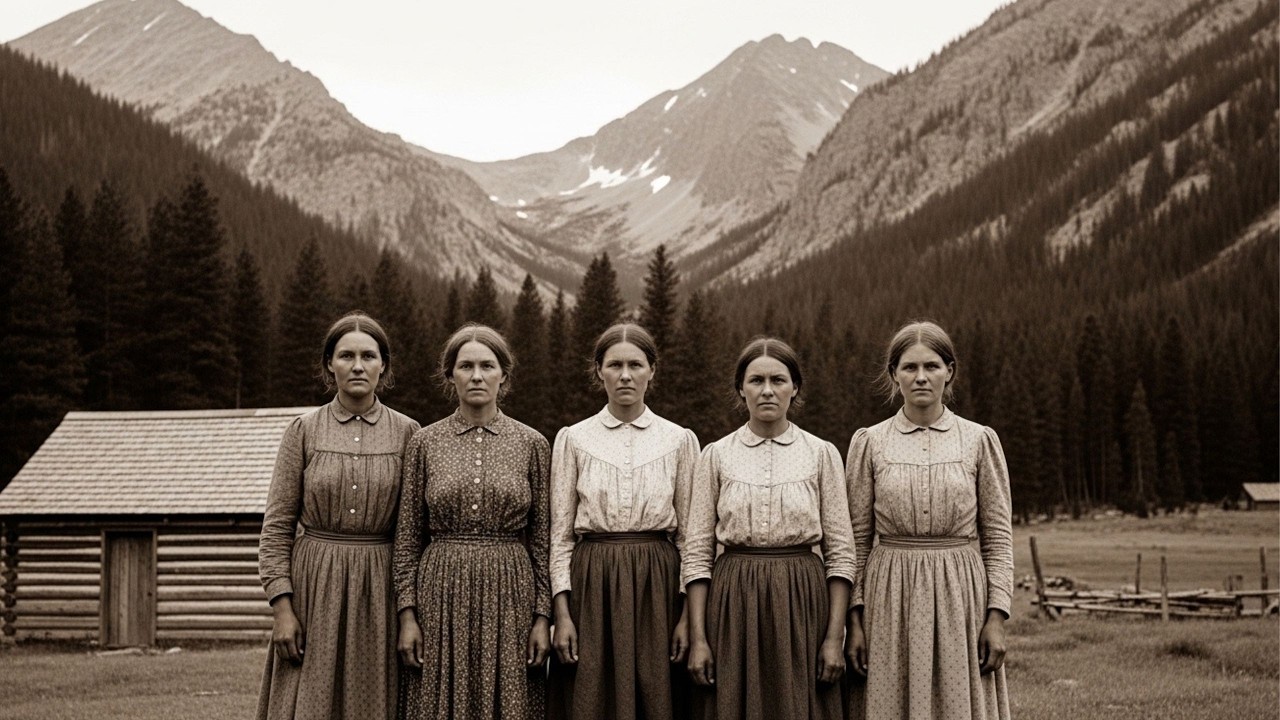
The world was changing, and the mountains were being taken in the name of progress. And they were alone, surrounded by a winter that showed no mercy, and by men who could not understand why five women would choose solitude and brutal work over the safety of a civilized life. What happened over the next fifty years was not just a legal battle. It was a silent war against the very idea that land could belong to someone who dared to love it too much to sell it.
The story begins long before the sisters ever stood against the government. It begins with a man who had seen enough of war to know that peace was something you had to build with your own two hands. John Garrett, everyone called him Jack, arrived in Montana territory in the spring of 1880. He was thirty-six years old.
He had fought in a war that left scars deeper than the ones visible on his body. He had worked in factories in Pennsylvania where the air was thick with coal dust and the days bled into one another without distinction. He had married a woman named Eleanor Hartley in a small church outside Pittsburgh, and together they had made a decision that would alter the course of their bloodline forever. They would go west.
Not for gold, not for adventure, but for something quieter, something that couldn’t be bought or sold or taken by men in suits who spoke in legal terms. They wanted land, and they wanted to be left alone. The journey west was long. The train carried them through landscapes that shifted from green valleys to endless plains to mountains that rose like the broken teeth of something ancient and indifferent.
Eleanor sat by the window with her hand pressed against the glass, watching the world blur past. She was thirty-one. Her hands were already calloused from years of work, but there was a stillness in her that Jack had always admired. She didn’t speak much, but when she did, her words carried weight.
They arrived in Montana in late May, when the snow had finally retreated from the lower elevations and the wildflowers were beginning to push through the soil. The air was thin and cold and smelled of pine and water from the mountains. Jack filed his claim at the land office in Kalispell, two hundred acres near the edge of what would one day be called Glacier National Park. The filing fee was fourteen dollars.
The land was free as long as he could prove he had improved it within five years. The clerk handed him the papers without ceremony. Jack folded them carefully and put them in his coat pocket. The land itself was wild.
Dense forest, rocky slopes, a creek that ran clear and cold through the valley. Grizzly bears moved through the timber like shadows. Elk grazed in the meadows at dawn. The silence was so complete it felt like a presence.
Jack stood at the edge of the claim and looked out at the mountains that rose in the distance, their peaks still white with snow. Eleanor stood beside him. Neither of them spoke. There was nothing that needed to be said.
They built the cabin that summer. Jack felled yellow pine and Douglas fir with an axe and a crosscut saw. Eleanor stripped bark and hauled logs with a mule they had purchased in town for forty-five dollars. The work was slow and unforgiving.
The altitude made breathing harder. The mosquitoes were relentless. But by the time the first snow fell in October, they had four walls, a roof, and a stone fireplace that drew smoke up and out into the cold Montana sky. The cabin was small.
One room. A dirt floor that Eleanor would later cover with planks Jack cut by hand. A window facing east so they could see the sunrise. A door that latched from the inside.
It wasn’t much, but it was theirs. Eleanor gave birth to their first daughter, Elizabeth, in the summer of 1882. The midwife came from a homestead twelve miles away and stayed for three days. The labor was long.
Eleanor didn’t cry out. When the baby finally came, Jack held her in his arms and felt something shift inside him that he couldn’t name. She was small and red-faced and perfect. They called her Beth.
Two years later came Margaret, then Catherine in 1886, then Rose in 1889, and finally Clara in 1892. Five daughters. No sons. Some of the neighbors made comments.
Some of the men in town joked that Jack must be cursed. But Jack didn’t care. He loved his daughters with a fierceness that surprised even him. He taught them to work, to hunt, to read the weather and the land, to respect the forest and the animals that lived in it.
He taught them that no man had the right to take from them what they had earned. Eleanor raised them with the same quiet strength she had always carried. She taught them to sew and cook and preserve food for the winter. She taught them to read using a Bible and a handful of books they had brought from Pennsylvania.
She taught them that survival was not just about physical endurance. It was about knowing when to bend and when to stand firm. The years passed. The cabin grew.
Jack added a second room, then a loft where the girls slept in a row like birds on a wire. He built a barn for the livestock. Chickens, a milk cow, hogs that roamed the forest and fattened on pine nuts and roots. He cleared land for crops.
Potatoes, turnips, carrots, cabbage, corn that struggled in the short growing season but produced enough to feed them through the winter. The work was endless. Breaking ground, hauling water, splitting firewood, mending fences, slaughtering hogs in the fall, smoking meat in the shed Jack had built behind the cabin, rendering fat into lard, salting and drying and storing everything they could before the snow came and buried the world in white. The winters were brutal.
Temperatures dropped to twenty below zero. Snow piled against the cabin walls until the windows were half buried. The wind howled through the trees like something alive and hungry. Some winters they didn’t see another soul for months.
The isolation was total, but the Garrett family endured. They had each other. They had the land, and they had the knowledge that they were building something that would last. By the early 1900s, the girls were no longer children.
Beth was in her twenties, strong and capable. She could shoot a rifle as well as any man and often brought home deer and elk that fed the family through the lean months. Maggie had a gift for healing. She learned which plants could bring down a fever and which could stop infection.
Kate was the strongest of them all. She could haul water and split wood and work the plow behind the mule without complaint. Rose had a quieter nature. She kept journals and wrote poetry and saw beauty in things the others overlooked.
Clara, the youngest, was quick to laugh and quick to cry and loved the animals with a tenderness that made her the heart of the family. Eleanor grew older. Her hair turned gray. Her hands grew more gnarled, but she never stopped working.
She never stopped teaching, and she never stopped reminding her daughters that the land was not just dirt and trees. It was legacy. It was freedom. It was the only thing in this world that couldn’t be taken unless you let it.
In the winter of 1905, Eleanor fell ill. It started as a cough, then a fever, then a weakness that spread through her body like water soaking into wood. Maggie tried everything she knew. Teas made from willow bark and elderflower, poultices, rest.
But the illness didn’t care. By February, Eleanor could barely rise from bed. Jack sat beside her every night. The girls took turns reading to her.
On a cold morning in early March, Eleanor Garrett died in the cabin she had helped build twenty-five years earlier. She was fifty-six years old. They buried her on a hill overlooking the valley. Jack carved her name into a wooden cross.
The girls stood in the snow and wept. Jack didn’t cry. He just stood there with his hat in his hands, staring at the mountains in the distance. After Eleanor’s death, something changed in Jack.
He grew quieter. He worked even harder, as if trying to outrun grief. But the years were catching up to him. His back ached.
His hands shook. By 1908, he could no longer do the work he once did. The girls took over more and more of the responsibilities. They ran the homestead.
They made the decisions. And Jack watched them with a mixture of pride and sorrow. In the fall of 1909, Jack Garrett collapsed while chopping wood. Beth found him lying in the dirt, his axe beside him.
They carried him into the cabin and laid him on the bed. Maggie knew there was nothing to be done. His heart was failing. He lingered for three days.
On the third night, he called his daughters to his bedside. His voice was weak, but clear. “This land,” he said, “don’t let them take it. Don’t let anyone tell you it’s not yours.
You hear me? ”
They promised. All five of them, standing in a circle around the bed where their father lay dying. Jack Garrett died just before dawn.
He was sixty-five years old. They buried him beside Eleanor on the hill, and the five Garrett sisters were left alone in the cabin their parents had built, surrounded by mountains that cared nothing for human grief, in a world that was about to change in ways they could not yet imagine. The winter after their father’s death was the hardest they had known. Not because of the cold or the snow or the work.
Those things had always been there. But because for the first time in their lives, the Garrett sisters truly understood what it meant to be alone. Beth was twenty-seven. Maggie was twenty-five.
Kate was twenty-three. Rose was twenty. Clara was seventeen. In any other place, at any other time, they would have been married by now.
They would have had children. They would have left their father’s land and started lives of their own. But the Garrett sisters had made a different choice. They had promised their father they would keep the land, and they meant to keep that promise.
The work continued as it always had. Feeding the animals, hauling water from the creek, splitting firewood, mending the roof where the winter wind had torn away shingles. The days were short, and the nights were long, and the silence in the cabin felt heavier now that their parents were gone. But they endured.
They had been raised for this. In the spring of 1910, a man arrived on horseback. He wore a suit that looked out of place in the mountains and carried papers in a leather satchel. He introduced himself as a representative of the federal government.
He was polite, almost apologetic. He explained that there was a movement to create a national park in the area. A place where the land would be preserved for future generations, protected from logging and mining and development. Beth stood in the doorway of the cabin and listened.
The man kept talking. He said that families in the area were being offered fair prices for their land. He said it was an opportunity. A chance to move somewhere with schools and churches and neighbors.
A chance for a better life. “We’re not interested,” Beth said. The man blinked. He looked past her at the cabin, at the chickens scratching in the dirt, at the mountains rising in the distance.
“Miss Garrett,” he said carefully, “I don’t think you understand. This park is going to happen, with or without your cooperation. ”
“Then it’ll happen without. ”
And she closed the door.
The man rode away, but he wasn’t the last. By the summer of 1910, Glacier National Park had been officially established by an act of Congress. The government began purchasing land from homesteaders and ranchers throughout the region. Some families sold willingly.
They took the money and moved to towns like Kalispell or Whitefish or Columbia Falls. They bought houses with electricity and running water. They sent their children to real schools. They left the mountains behind without looking back.
But others resisted. They had spent decades carving lives out of the wilderness. They had buried family members in the soil. They had fought bears and wolves and winters that killed livestock and sometimes people.
They were not interested in being relocated for the sake of progress. The Garrett sisters were among those who refused. More men came. Government surveyors, land agents, lawyers.
They offered money. They offered assistance in relocating. They explained that the park would benefit everyone, that it would protect the land from exploitation, that it was the right thing to do. Beth met with them each time.
She was polite, but firm. She told them the land was not for sale. She told them her father had claimed it legally under the Homestead Act. She told them they had no right to take it.
The men grew frustrated. They stopped being polite. They began to imply that the sisters were being unreasonable, selfish, that five unmarried women had no business living alone in the wilderness, that it wasn’t natural, that it wasn’t safe. “Safe for who?
” Kate asked one afternoon when a particularly arrogant surveyor suggested they were putting themselves in danger. The man didn’t have an answer. The neighbors began to talk. Some were sympathetic.
Others thought the sisters were foolish. A few of the women from nearby homesteads visited and tried to convince them to sell. They spoke in hushed tones about propriety and reputation, about what people were saying, about how it looked for five women to be living alone without men to protect them. Maggie listened patiently and then said, “We’ve been protecting ourselves just fine.
”
The visits stopped after that. By 1912, most of the families in the area had sold their land and left. The Garretts’ nearest neighbor was now eight miles away. The forest grew quieter.
The trails they had once used to visit other homesteads became overgrown. The sense of isolation deepened. But the sisters adapted. They always had.
They continued to work the land. They planted their garden each spring. Potatoes, carrots, turnips, cabbage, peas, beans. They kept chickens for eggs and hogs for meat.
They hunted deer and elk when they needed to. They fished the creek that ran through their property. They gathered wild berries in the summer and preserved them for winter. They rendered lard and smoked meat and stored root vegetables in the cellar Jack had dug beneath the cabin.
The rhythm of their lives was dictated by the seasons. Spring meant planting and calving and shearing the sheep they kept for wool. Summer meant tending the garden and putting up hay and gathering firewood for the winter ahead. Fall meant harvest and slaughter and preparation.
Winter meant survival. They spun wool into yarn and knitted socks and sweaters and blankets. They sewed their own clothes. They made soap from lye and animal fat.
They churned butter and baked bread and cooked meals over the wood stove that kept the cabin warm. They read by candlelight and lantern light. They sang songs their mother had taught them. They told stories about their parents and about the early days when the land was still wild and full of promise.
The work was hard, but it was theirs. In the fall of 1914, a lawyer arrived with a new offer. The government was willing to pay three hundred dollars for the two hundred acres. It was more than they had offered before.
The lawyer sat at the table in the cabin and spread the papers out in front of Beth. He explained that the offer was generous, that it was more than the land was worth, that they should take it while they still could. Beth didn’t touch the papers. “This land is worth more than money,” she said quietly.
The lawyer sighed. He folded the papers and put them back in his case. “Miss Garrett,” he said, “you need to understand something. The government has the authority to take this land whether you agree or not.
It’s called eminent domain. They’re trying to be fair, but if you keep refusing, they’ll just take it anyway, and you’ll get nothing. ”
“Then they’ll have to take it,” Beth said, “because we’re not selling. ”
The lawyer left, and the sisters knew the fight was only beginning.
By 1916, the pressure was mounting. Letters arrived from government offices in Washington, legal notices, warnings. The language grew more formal and more threatening. The sisters hired a lawyer of their own using money they had saved from selling wool and preserving extra food to sell in town.
The lawyer was an older man named Thomas Whitcomb, who had homesteaded in Montana himself decades earlier. He understood what the land meant. He filed motions and appeals and did everything he could to slow the process down. But the law was not on their side.
The government had the power to take land for public use. The courts had upheld that power again and again. All the legal maneuvering in the world couldn’t change that fundamental fact. Still, the sisters fought.
They refused to sign papers. They refused to meet with agents. They refused to discuss terms. They simply said no over and over.
No. The townspeople in Kalispell began to see them as curiosities. The five Garrett sisters who wouldn’t leave their cabin. Some admired their stubbornness.
Others thought they were mad. A few of the men made jokes about women who didn’t know their place. But the sisters didn’t care what people thought. They had never cared.
In the winter of 1918, the Spanish flu swept through Montana. Towns were quarantined. Schools and churches closed. People died by the hundreds.
The Garrett sisters stayed in their cabin and didn’t see another soul for four months. When spring came, they emerged to find that the world had changed again. More families had left. More land had been sold.
The park was expanding, and still the sisters remained. In the summer of 1920, a woman named Alice Brennan visited the cabin. She was a reporter for a newspaper in Great Falls. She had heard about the Garrett sisters and wanted to write a story.
Beth was suspicious at first, but Alice was kind and respectful. She sat at the table and drank tea and asked questions without judgment. “Why won’t you sell? ” Alice asked.
Beth was quiet for a long moment. Then she said, “Because this land is all we have, and it’s all we are. If we leave, we’re just five women with no place in the world. Here we’re home.
”
The article was published a few weeks later. It was sympathetic. It portrayed the sisters as women of principle who were standing up to an overreaching government. Some people read it and felt moved.
Others read it and felt annoyed. But it didn’t change anything. The legal battle continued. By the end of the 1920s, the sisters had been fighting for nearly two decades.
They were older now. Beth’s hair was streaked with gray. Maggie’s hands were stiff from arthritis. Kate’s back ached from years of heavy labor.
Rose’s eyes had grown weaker. Clara, the youngest, was nearly forty. But they had not given up. And they would not give up.
The land was in their blood. It was in their bones. It was the only thing their father had left them, and they would defend it until they had nothing left to give. In the spring of 1925, the government made its position clear.
A federal agent named Harrison Cole arrived at the cabin with a court order. He was a tall man with gray temples and eyes that had seen too many battles to care about one more. He didn’t dismount from his horse. He simply held out the papers and waited for Beth to take them.
She read them standing in the doorway. The legal language was dense and deliberate, but the message was simple. The United States government was exercising its right of eminent domain. The Garrett property was being seized for inclusion in Glacier National Park.
The sisters had sixty days to vacate. They would be compensated four hundred fifty dollars for the land and all improvements. Beth folded the papers and handed them back. “We’re not leaving,” she said.
Cole didn’t look surprised. “Miss Garrett,” he said evenly, “this isn’t a negotiation. This is a court order. If you’re not gone in sixty days, federal marshals will remove you by force.
”
“Then they’ll have to do that,” Beth said, and she went back inside and closed the door. Cole sat on his horse for a moment, staring at the cabin. Then he turned and rode away. Inside, the sisters gathered around the table.
The court order lay in the center like something poisonous. No one spoke at first. The weight of what was happening pressed down on them like the snow that buried the cabin each winter. Finally, Maggie said, “We knew this was coming.
”
“Knowing and living it are different things,” Rose said quietly. Kate stood and walked to the window. She looked out at the mountains. “They think we’ll just pack up and go.
They think we’re afraid. ”
“Maybe we should be,” Clara said. Her voice was small. She was the youngest.
She had never known another life. The thought of leaving terrified her in ways she couldn’t articulate. Beth reached across the table and took Clara’s hand. “We made a promise,” she said.
“To Pa, to Ma, to ourselves. We don’t break promises. ”
And so they didn’t leave. The sixty days came and went.
No marshals arrived. Instead, more letters came, more legal threats, more agents riding up to the cabin with new offers and new warnings. The sisters met each one with the same response. No.
Their lawyer, Thomas Whitcomb, filed an appeal. He argued that the seizure was unconstitutional, that the Homestead Act guaranteed the sisters’ right to the land, that the government had no legitimate public purpose for taking a small family homestead when thousands of acres of wilderness surrounded it. The appeal was denied. He filed another.
It was denied. He filed a third. The courts were not interested in hearing the case. The law was clear.
The government had the power, and the Garrett sisters had none. But legal power and physical removal were two different things, and the government seemed reluctant to send armed men to drag five women out of their home. The optics were bad. The press had already written sympathetic stories.
There were people in Montana and beyond who saw the sisters as symbols of something larger. Resistance to federal overreach. The dignity of the individual against the machinery of bureaucracy. The right to live as one chose.
So the government waited, and the sisters waited, and the stalemate continued. The isolation grew deeper. The few neighbors who remained kept their distance. Some because they didn’t want to be associated with people who were defying the government.
Others because they simply didn’t know what to say. The Garrett sisters had become outlaws of a kind. Not criminals, but outsiders. People who had chosen a path that put them at odds with the world.
The winters grew harder, not because the cold was worse, but because the supplies were running low. The sisters had always been self-sufficient, but there were things they couldn’t grow or make. Salt, sugar, coffee, nails, fabric, ammunition. They had always traded wool and preserved food in town for the things they needed.
But now, when they went to town, people stared. Shopkeepers were reluctant to deal with them. Some refused outright. The message was clear.
Comply or be excluded. Kate took to hunting more often. She brought down deer and elk and sold the meat to families who didn’t care about politics. They needed the money.
Every dollar mattered now. Maggie grew herbs and made remedies that she sold quietly to women who came to the cabin under cover of darkness. Rose wrote poetry and sold small handwritten books to travelers passing through the area. Clara raised chickens and sold eggs.
They cobbled together a living from the edges of a world that wanted nothing to do with them. In the fall of 1928, a man named Reverend Paul Hutchins came to the cabin. He was the minister of a church in Columbia Falls. He had heard about the sisters and felt it was his Christian duty to intervene.
He arrived on a Sunday afternoon, wearing his church clothes and carrying a Bible. Beth met him at the door. “Miss Garrett,” he said with a practiced smile, “I’ve come to speak with you about your situation. ”
“We don’t have a situation,” Beth said.
The reverend’s smile didn’t waver. “With all respect, you do. You’re living in defiance of the law. You’re putting yourselves in danger.
And you’re setting a poor example for other women in the community. ”
“What example is that? ” Kate asked from behind Beth. “Independence,” the reverend said, and this time the smile faded.
“A woman’s place is under the protection of a husband or a father or the church. You have none of those things. You’re living outside the order that God established. It’s not right.
And it’s not safe. ”
Maggie stepped forward. She was smaller than her sisters, but her voice carried weight. “Reverend,” she said, “with respect, we’ve been living this way for nearly twenty years.
We’ve survived just fine. We don’t need protection. We need to be left alone. ”
The reverend opened his Bible.
He began to read from a passage about submission and obedience. Kate walked away before he finished. Rose followed. Clara looked torn, but stayed.
When the reverend finished reading, Beth said, “We appreciate your concern, but we’re not leaving, and we’re not changing. If that troubles you, you’re welcome to pray for us, but don’t come back here telling us we’re wrong for choosing our own lives. ”
The reverend closed his Bible. He looked at the sisters with something that might have been pity, or might have been contempt.
“You’ll regret this,” he said. “When winter comes and you’re alone and cold and hungry, you’ll regret it. ”
“Maybe,” Beth said, “but it’ll be our regret, not yours. ”
The reverend left, and the sisters went back to their work.
That winter was brutal. The snow came early and stayed late. The temperatures dropped to thirty below zero. The wind screamed through the trees and rattled the cabin walls.
They burned through firewood faster than they could replace it. The chickens died. Two of the hogs froze. The garden was buried under six feet of snow.
They rationed food. They wore every piece of clothing they owned. They huddled together at night for warmth, and they endured. In February, Clara fell ill.
She developed a fever that spiked and wouldn’t break. Maggie tried everything. Willow bark tea, cold compresses, prayer. But the fever raged.
For three days, Clara lay in bed shaking and delirious. The sisters took turns sitting with her. They didn’t speak about what would happen if she died, but they all thought of it. On the fourth day, the fever broke.
Clara woke weak and pale, but alive. Maggie cried for the first time in years. When spring finally came, the sisters emerged from the cabin like survivors of a shipwreck. They were thinner, exhausted, but they were still there.
And the land was still theirs. At least in the only way that mattered. In the summer of 1929, the stock market crashed. The country plunged into economic chaos.
Banks failed, businesses collapsed, people lost everything. The Great Depression spread across the nation like a sickness. But the Garrett sisters barely noticed. They had never had money.
They had never relied on banks or markets or the goodwill of strangers. They had the land. And the land didn’t care about Wall Street. Ironically, the depression worked in their favor.
The government had bigger problems than five stubborn women in Montana. The push to remove them slowed. The legal threats continued, but no one came with marshals or eviction notices. The sisters were left alone.
Not because the government had given up, but because it had more urgent battles to fight. They used the reprieve to strengthen their position. They repaired the cabin. They rebuilt their livestock.
They expanded the garden. They put up more food than they had in years. They prepared for the day when the fight would resume, because they knew it would. By the mid-1930s, the country was still reeling from the depression.
Dust storms ravaged the plains. Families abandoned farms and headed west looking for work. The world was broken in ways it hadn’t been since the war. But the Garrett sisters remained in their cabin in the mountains, untouched by the chaos that consumed the rest of the nation.
They had become legends in their own right. People told stories about them. The five women who refused to leave, who lived like pioneers in a world that had moved on without them. Some admired them.
Some pitied them. Some thought they were insane. But no one could deny that they had survived when so many others had not. In the spring of 1937, a new government agent arrived.
His name was David Marsh. He was younger than the others, less formal. He didn’t come with threats or court orders. He came with questions.
He sat at the table and drank coffee and asked the sisters why they stayed. Beth answered simply, “Because it’s ours. ”
Marsh nodded. He looked around the cabin, at the worn furniture, the handmade quilts, the jars of preserved food lining the shelves, the rifle hanging over the door.
“You know you can’t win,” he said. “Eventually the government will take this land. That’s just reality. ”
“Maybe,” Beth said, “but until they do, we’re staying.
”
Marsh finished his coffee. He stood and put his hat on. “I respect what you’re doing,” he said. “I don’t agree with it, but I respect it.
”
It was the closest thing to sympathy they had received from anyone representing the government in twenty-seven years. After he left, the sisters sat in silence. The fight was far from over, but they had proven something important. They had proven they could endure.
And that was enough, for now. The turning point came in the winter of 1939, not with violence or drama, but with exhaustion on both sides. The Garrett sisters had been fighting for nearly thirty years. They were no longer young.
Beth was fifty-seven. Maggie was fifty-five. Kate was fifty-three. Rose was fifty.
Clara was forty-seven. Their bodies carried the evidence of decades of hard labor. Bent fingers, scarred hands, backs that ached in the morning, eyes that struggled to see fine details in dim light. They were still strong, still capable, but they were also aging in a place where aging meant vulnerability.
The government, for its part, had grown weary of the fight as well. The depression was easing, but the scars remained. Europe was sliding toward war again. There were larger concerns than five women in Montana who refused to acknowledge defeat.
And there was the matter of public perception. Every few years, a journalist would write another story about the Garrett sisters, and every time the government came across as bullying and petty. It was not a good look. So a compromise was proposed.
David Marsh returned in February. The snow was deep, and the trail to the cabin was difficult. He came alone this time. No lawyers, no surveyors, just a man on horseback carrying a single envelope.
Beth met him at the door. She had expected him, or someone like him. The pattern had become familiar over the years. Marsh didn’t waste time.
“I have an offer,” he said, “and I think you should hear it before you say no. ”
They sat at the table, the same table where Jack Garrett had eaten meals with his family forty years earlier. Marsh opened the envelope and pulled out a document. He slid it across to Beth.
“The government is taking the land,” he said quietly. “That’s not changing. But they’re willing to grant you a lifetime lease. You can stay here for as long as you live.
All five of you. The cabin, the immediate land around it. You won’t own it anymore. But you can live here undisturbed.
”
Beth read the document carefully. The terms were clear. The property would transfer to the National Park Service. The sisters would become tenants.
They could remain in the cabin until the last of them died. But there were restrictions. No commercial use of the land. No large-scale farming.
No hunting beyond what was necessary for personal subsistence. The park would own everything. And when the last sister died, the cabin would become park property. “You’re asking us to surrender,” Kate said.
“I’m asking you to survive,” Marsh said. He looked at each of them in turn. “You’re not going to win this fight. You know that.
The courts have ruled against you. The law is clear. But this way, you get to stay. You get to live out your lives here.
Isn’t that what matters? ”
Maggie spoke up. “And if we refuse? ”
Marsh’s expression didn’t change.
“Then the marshals will come, and they’ll remove you. And you’ll have nothing. No land. No cabin.
No choice. ”
The sisters looked at one another. A lifetime of communication passed between them in silence. They had fought for so long, sacrificed so much.
The thought of surrender tasted like ash. But the alternative was worse. To be dragged from their home, to lose everything in one brutal moment, to end their fight not with dignity, but with humiliation. Beth was the first to speak.
“We need time to discuss it. ”
Marsh nodded. “You have one week. After that, the offer expires.
”
He left the document on the table and rode away. For three days, the sisters debated. They argued. They wept.
They sat in silence. Beth wanted to keep fighting. Kate agreed. But Maggie and Rose were tired.
And Clara, the youngest, was afraid of what would happen if they lost everything. “We promised Pa we wouldn’t let them take the land,” Beth said on the third night. “And we haven’t,” Maggie said softly. “We’ve held it for thirty years.
We fought longer than anyone else. But we’re not young anymore. If we lose this fight, we lose everything. At least this way, we stay.
”
“As tenants,” Kate said bitterly. “As survivors,” Rose said. In the end, they agreed. Not because they wanted to, but because survival required compromise.
And they had always been survivors. When Marsh returned a week later, Beth handed him the signed document. He took it without ceremony. “You made the right choice,” he said.
Beth didn’t respond. There was nothing to say. The land transferred to the National Park Service in the spring of 1940. The Garrett sisters remained in the cabin, but everything had changed.
They were no longer landowners. They were tenants on property that belonged to the federal government. The irony was not lost on them. They had spent their entire lives building something that could not be taken, and in the end, it had been taken anyway.
Not by force, but by law. By time. By the slow grinding machinery of progress that devoured everything in its path. The restrictions were immediate.
They could no longer hunt freely. Park rangers patrolled the area and enforced the rules. The sisters were allowed to kill deer or elk only if they could prove it was necessary for food. And even then, they needed permission.
The garden was allowed, but it had to remain small. No large crops. No commercial farming. The livestock was permitted, but only a limited number.
The hogs that had once roamed free were confined to pens. The sisters adapted. They always had. They planted a smaller garden.
Potatoes, carrots, onions, enough to feed themselves, but nothing more. They kept a few chickens for eggs, a milk cow, two hogs. They hunted sparingly and only when necessary. They gathered wild plants and berries as they always had.
They made do with less, and they endured. The years passed slowly. The war came and went. Young men left Montana for Europe and the Pacific.
Some came back. Some didn’t. The world changed again, but the Garrett sisters remained in their cabin, living a life that belonged to a different century. In 1946, a journalist named Margaret Hale from the Saturday Evening Post arrived at the cabin.
She had heard about the sisters from a park ranger who thought their story was worth telling. Margaret was a woman in her thirties with sharp eyes and a gentle manner. She asked permission to stay for a week and write about their lives. The sisters were cautious at first.
They had been burned by journalists before. Some had portrayed them as heroes, others as fools. But Margaret was different. She didn’t come with an agenda.
She came with curiosity and respect. She stayed for ten days. She helped with chores. She milked the cow and gathered eggs and hauled water from the creek.
She sat with the sisters in the evenings and listened to their stories. And when she left, she promised to tell the truth. The article was published in September. It was titled “The Last Homesteaders.
” It told the story of five sisters who had refused to leave the land their father had claimed, who had fought the government for three decades, who now lived as relics of a vanished world surrounded by a national park that had consumed everything they once owned. The article was sympathetic. It was also honest. It didn’t romanticize their lives.
It showed the hardship, the isolation, the cost of their choice. But it also showed their dignity, their strength, the quiet defiance that had sustained them for so long. The response was immediate and overwhelming. Letters arrived by the hundreds, from all over the country, from people who admired the sisters, who were inspired by them, who wanted to meet them.
Within weeks, visitors began showing up at the cabin. Hikers, tourists, families. They came from nearby towns and distant states. They knocked on the door and asked if they could see the famous Garrett sisters.
At first, the sisters were suspicious. They had spent their lives avoiding attention. But Clara, always the most social, convinced her sisters to welcome the visitors. “We need the money,” she said simply.
And she was right. They began inviting people inside. They served coffee and cornbread. They told stories about their parents and the early days.
They showed visitors the quilts they had made and the tools their father had used. And they sold what they could. Hand-knitted socks, jars of preserves, small wooden carvings that Kate made during the long winters, poems that Rose had written and copied by hand. The visitors paid, sometimes generously, and the money helped.
It bought the things they could no longer produce themselves. Salt, sugar, coffee, fabric, medicine. The sisters became a tourist attraction. Not in a garish way, but in a quiet, almost sacred way.
People came to see what was left of the old world, to touch something real and unpolished and true. The Garrett sisters represented something that was disappearing from America. Self-reliance, simplicity, the courage to live according to one’s own values regardless of cost. The years continued to pass.
The sisters grew older. Their hair turned white. Their movements slowed. But they remained in the cabin.
And people continued to come. In the fall of 1955, Kate died. She had been chopping wood when her heart gave out. She collapsed in the yard and never woke up.
They buried her beside their parents on the hill. There were four sisters now. In the winter of 1958, Beth followed. She died in her sleep on a cold January night.
She was seventy-six years old. She had fought longer and harder than anyone, and she had never stopped believing that the land was theirs, no matter what the papers said. Three sisters remained. In the spring of 1961, Maggie passed.
She had been ill for months. A slow decline that even her knowledge of healing couldn’t stop. She died surrounded by her sisters, holding their hands. She was seventy-seven.
Rose and Clara were alone now. The cabin felt enormous and empty. But they stayed. They had nowhere else to go.
And they had promised. In the fall of 1963, Rose died. She had always been the quietest, the most introspective. She left behind journals filled with poetry and observations about the land and the life they had lived.
Clara read them after her sister was gone and wept. Clara was the last. She was seventy-one years old. She lived alone in the cabin for three more years.
Park rangers checked on her regularly. Visitors still came, though less frequently. The world had changed again. The 1960s brought upheaval and revolution and a rejection of old values.
The Garrett sisters were becoming footnotes, curiosities from a time that most people wanted to forget. Clara didn’t mind. She had never wanted fame. She tended her small garden.
She fed her chickens. She read her sisters’ journals. She remembered. On a quiet morning in October 1966, Clara Garrett died in the cabin where she had been born seventy-four years earlier.
She died peacefully, alone, but not lonely, surrounded by the mountains she had always loved. They buried her beside her sisters, and the cabin stood empty for the first time in eighty-six years. The cabin still stands today. Not as it was when Jack Garrett built it in 1880.
Not as it was when Eleanor raised five daughters within its walls. Not even as it was when the sisters fought to keep it. But it stands. A monument to something that cannot be easily named.
Stubbornness, perhaps, or dignity, or the simple human refusal to surrender what matters, even when the world insists it doesn’t matter at all. The National Park Service maintains it now. They have repaired the roof and reinforced the walls. They have replaced rotted logs and reset the stone foundation.
They have turned it into an exhibit, a place where tourists can stop and take photographs and read plaques that explain who the Garrett sisters were and why their story matters. The plaques are accurate, but they are also incomplete. They tell you that five women lived here, that they resisted the government, that they stayed until they died. But they don’t tell you what it cost.
They don’t tell you about the winters when the food ran low and the cold seeped through the walls like something alive. They don’t tell you about the loneliness, the doubt, the nights when even the strongest of them wondered if they had made the right choice. They don’t tell you that courage is not the absence of fear. It is the decision to continue in spite of it.
The graves are still there on the hill overlooking the valley. Seven wooden crosses marking seven lives. John and Eleanor, Beth, Kate, Maggie, Rose, Clara. The wood is weathered now.
The names carved into them have faded. But they remain, and people still visit. They stand in the grass and look out at the mountains and try to imagine what it was like to live the way the Garretts lived. To choose hardship over compromise.
To value freedom more than comfort. Most visitors don’t stay long. They take their pictures. They read the plaques.
They walk through the cabin and marvel at how small it is, how primitive, how difficult life must have been. And then they get back in their cars and drive to hotels with electricity and running water and climate control. They return to a world the Garrett sisters would barely recognize. But some visitors linger.
They sit on the porch where the sisters once sat. They look out at the same mountains, and they feel something. A connection to a time when choices were starker, when the consequences of those choices were immediate and undeniable, when people built their lives with their own hands and defended them with everything they had. The story of the Garrett sisters has been told many times since Clara’s death.
Historians have written about them. Documentarians have filmed the cabin. Journalists have analyzed their decision to resist. Some portray them as heroes.
Others as tragic figures clinging to a past that was already gone. A few dismiss them entirely as eccentric women who wasted their lives fighting a battle they could never win. But the sisters would not have cared about any of that. They never fought for recognition.
They fought for the right to live as they chose, and in that at least, they succeeded. The land they loved is protected now. Glacier National Park preserves millions of acres of wilderness. Grizzly bears still roam the forests.
Elk still graze in the meadows. The mountains still rise against the sky, indifferent and eternal. The park draws visitors from around the world. People come to see beauty that has been saved from exploitation, to experience nature in a form that is increasingly rare.
The irony would not have been lost on the sisters. The government that took their land claimed to do so in the name of preservation. And in a sense, they were right. The land is preserved.
But so is the memory of what was taken. And from whom. And at what cost. There are still people in Montana who remember the Garrett sisters.
Not personally, they are all gone now. But the stories remain. Passed down from grandparents to grandchildren, told around campfires and dinner tables. The five women who wouldn’t leave.
Who lived on their own terms until the very end. Some of the stories are true. Some have been embellished over time. But the core remains the same.
The Garretts were people who believed that land was more than property. That it was identity. Legacy. Freedom.
And they were willing to pay any price to hold on to it. In the years since the last sister died, the world has changed in ways they could never have imagined. Technology has advanced beyond recognition. Society has transformed.
The values that governed their lives, self-reliance, simplicity, connection to the land, have been replaced by others. Speed, convenience, constant connectivity. But there are still people who feel the pull of what the Garretts represented. Who understand on some level that something was lost when the old ways disappeared.
That the price of progress was higher than anyone admitted. That the land remembers even when people forget. The cabin stands as a reminder, not of what was, but of what mattered. To seven people who lived and died in the shadow of mountains that cared nothing for human ambition, who built a life that was hard and honest and entirely their own, who refused to be moved even when the world insisted they had no right to stay.
Their story is not a happy one, not in the conventional sense. They did not triumph. They did not change the law or stop the government or save their land. In the end, they lost everything they had fought for.
The property was taken. Their way of life was extinguished. The world moved on without them. But they did not lose everything.
They kept their dignity, their autonomy, their right to choose. And they proved that even a losing fight can be worth fighting if the stakes are high enough and the cause is true enough. Sometimes the bravest thing is not winning. It is refusing to surrender what matters, even when surrender would be easier, even when the outcome is already decided, even when no one is watching and no one will remember.
The Garrett sisters understood this. They lived it. And in doing so, they left behind something more valuable than land or money or recognition. They left behind a question that each person must answer for themselves.
What are you willing to fight for? What are you willing to lose? And when the world tells you to give up, to move on, to accept what cannot be changed, what will you do? The cabin stands on a hillside in Montana.
The wind moves through the trees the way it always has. The creek runs cold and clear. The mountains rise against the sky, unchanged by time or human struggle. And somewhere in the silence, the spirit of five women who refused to leave lingers still.
Not as ghosts, but as memory. As proof that some things matter more than comfort or safety or the approval of others. That a life lived on one’s own terms, no matter how difficult, is worth more than a life lived in compromise. The Garrett sisters are gone, but their story remains.
And it will remain as long as there are people who understand that freedom is not given. It is chosen. And it is defended.
One day at a time, one choice at a time, until there are no days left.