
My grandfather lived through the Great Depression, and he never paid full price for heat in his entire life. Last winter, my heating bill hit $340 for one month. This winter, it was 37 bucks. Same house, same thermostat setting.
He didn’t have fancy smart home gadgets or expensive renovations. He had a deep understanding of where heat goes to die, and he knew how to plug every gap with stuff he could buy at the dollar store. These aren’t modern solutions. They’re 25 hacks under $5 each, grounded in simple physics and Depression-era survival skills.
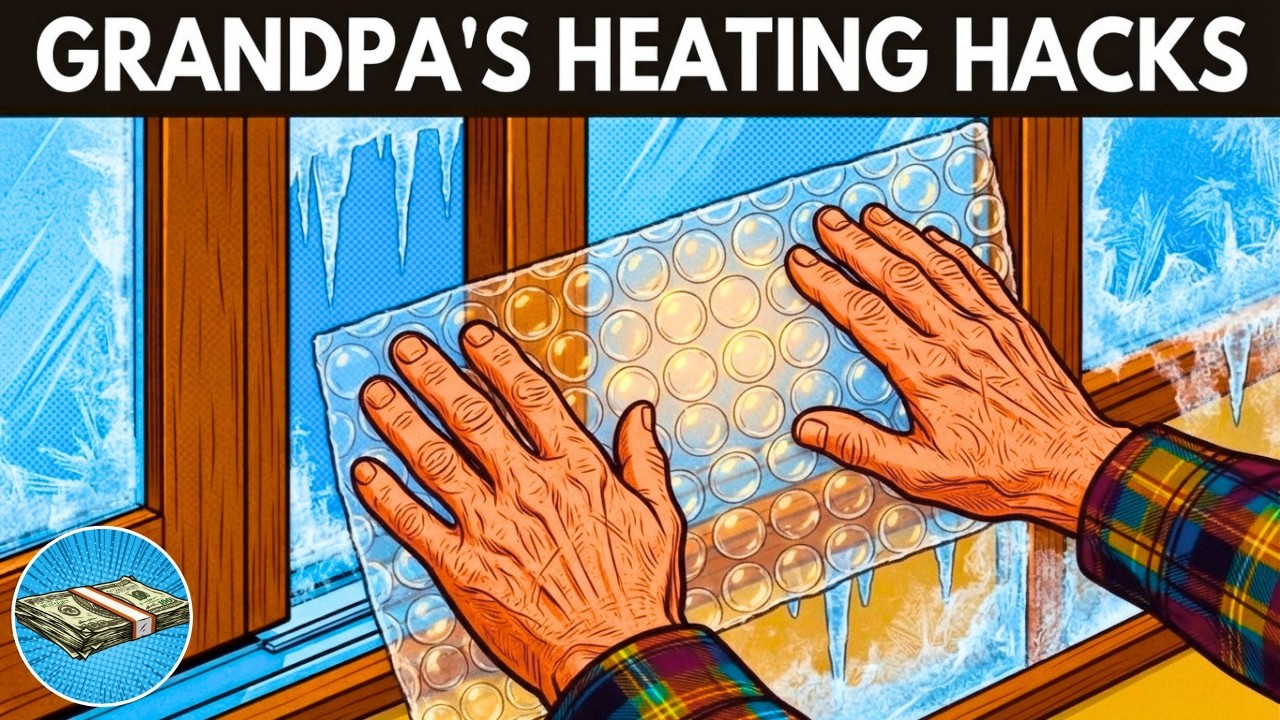
The first line of defense is stopping drafts. A pool noodle cut to match a door’s width and stuffed inside an old sock creates an airtight seal against cold air sneaking under the door. It costs about $2 and saves $8 to $12 a month. For windows, large bubble wrap sprayed with water and pressed against the glass creates thousands of tiny air pockets that act as insulation while still letting light through.
This technique can improve single-pane window insulation by up to 50%, costing $3 and saving $15 to $20 a month. Even tinier cracks matter. Running a hand slowly around every window and door frame reveals micro cracks that create convection currents, pulling warm air out and cold air in. A thin bead of clear caulk in each gap costs $5 and saves $12 to $18 a month.
Radiators and heating sources need their own protection. If radiators sit against exterior walls, they’re heating the outside of the house. Cutting cardboard slightly smaller than the radiator, covering it with aluminum foil shiny side out, and sliding it behind reflects radiant heat back into the room. Radiant heat travels in straight lines, and reflective surfaces bounce it back.
This costs $4 and saves $6 to $10 per radiator each month. A similar trick works on a larger scale: a cardboard box opened up, lined with aluminum foil, and positioned behind a space heater can increase its effective heating output by 30 to 50%. The cardboard provides structure, and the foil bounces heat waves back toward the living space. Mirrors also redirect heat waves just like light.
Placing them on walls opposite heating vents or space heaters can double the effective heat output from existing sources. At thrift stores, these cost about $5 and save $10 to $20 a month. Thick curtains with thermal backing, found at thrift stores for about $5 per window, reduce heat loss by up to 25%. The white or silver backing reflects heat back into the room while the thick fabric adds insulation.
Hanging them close to the window and extending them below the sill maximizes the effect, saving $8 to $15 per window each month. Walls themselves steal heat through thermal bridging. Carpet stores often give away remnants or samples, and hanging these on the coldest exterior walls like tapestries traps air in the fibers, creating a barrier between the warm room and the cold wall. This costs anywhere from nothing to $3 and saves $5 to $12 per room.
For basement or unfinished walls, taping newspaper directly onto cold walls with overlapping edges works surprisingly well. Newspaper contains thousands of tiny air pockets in its fiber structure, making it an excellent insulator. Multiple layers trap additional air between sheets. It costs nothing if you already have newspapers and saves $8 to $20 a month depending on wall area.
Cold floors drain body heat through conduction, making a room feel chilly even when the air is warm. Layering multiple rugs or carpet remnants on the coldest floors, especially over concrete or hardwood, traps air between layers and insulates feet from the cold surface below. This costs $3 to $5 for remnants and saves $5 to $12 per room each month. Windows are the biggest heat thieves, and several methods address them.
Clear plastic film applied to the inside of single-pane windows creates a pocket of trapped air that acts like double glazing. A hairdryer shrinks the film tight until it becomes nearly invisible. Still air is one of nature’s best insulators, and the film prevents convection currents from forming against the cold glass. A $5 insulation kit saves $12 to $25 a month depending on window size and number.
Black plastic bottles filled with water and placed in sunny windows absorb solar energy all day and radiate heat into the room at night. Even winter sunlight contains enough energy to heat water significantly, and water holds heat for hours after the sun goes down. Using recycled bottles makes it free, or $3 for black paint, saving $8 to $15 a month depending on south-facing windows. The bed is another target.
Instead of heating the entire bedroom all night, hot water bottles placed under blankets before bedtime create a warm microclimate that lasts for hours. One gallon of hot water contains enough thermal energy to keep a person warm for six to eight hours. This costs $4 for a good bottle and saves $20 to $30 a month by allowing the thermostat to be turned down at night. The body itself can compensate for lower indoor temperatures.
Wearing thermal underwear as a base layer, insulating middle layers like fleece or wool, and topping with a wind-resistant outer layer even indoors traps body heat in multiple dead air spaces. This allows the thermostat to be lowered by 5 to 8 degrees, saving $20 to $40 a month. Thick socks and slippers stationed in every room keep extremities warm, allowing most people to lower the thermostat by 3 to 5 degrees without feeling cold. Every degree lower saves about 8% on heating costs, and multiple pairs cost about $10.
Furniture placement matters too. Moving furniture away from heating vents and radiators allows warm air to circulate freely, while positioning chairs and sofas to receive direct sunlight through south-facing windows maximizes free solar heating. Blocked vents waste energy by forcing heated air to work around obstacles. This free rearrangement saves $5 to $15 a month.
Ceiling fans run clockwise at low speed in winter push warm air that rises to the ceiling back down into the living space, preventing stratification where hot air accumulates uselessly near the ceiling. This free adjustment saves $5 to $15 a month. Closing heating vents in rooms that aren’t regularly used forces more heated air into occupied spaces. However, no more than 20% of total vents should be closed to avoid creating pressure problems for the heating system.
This costs nothing and saves $8 to $20 a month. After using the oven, leaving the door open captures residual heat for the kitchen and adjacent areas instead of letting it go to waste. Saving hot cooking water for washing dishes also captures heat already paid for. This is free and saves $3 to $8 a month.
A fireplace that isn’t used is essentially an open hole to the outside. Even closed dampers often leak significantly due to warping or debris. A chimney balloon inflates to completely seal the opening while remaining easy to remove if the fireplace is ever used again. This costs $5 and saves $15 to $30 a month, making it one of the biggest sources of heat loss in homes with fireplaces.
Electrical outlets on exterior walls are basically holes straight through the insulation. Cold air flows through them, noticeable by holding a hand close. Foam gaskets installed behind outlet covers seal these openings. After turning off power, unscrewing the cover plate, installing the gasket, and replacing the cover, dozens of hidden air leaks throughout the house are eliminated.
A pack of gaskets costs $4 and saves $10 to $20 a month. Exposed hot water pipes lose heat as water travels from the water heater to faucets and radiators. Foam pipe insulation that slits open and snaps around the pipes keeps water hotter during transport and reduces how hard the water heater works. In heating systems, it also prevents heat loss as hot water circulates through unheated spaces like basements or crawl spaces.
This costs $4 for six feet and saves $6 to $15 a month. Worn weatherstripping on doors and windows should be replaced with fresh adhesive-backed stripping. Even tiny gaps create continuous air infiltration paths, and new seals stop drafts that cost $15 to $30 a month. Enough stripping for several doors and windows costs $5.
The final trick, the one my grandfather used during the Depression, was strategic hot water placement. Large pots, mason jars, even milk jugs filled with hot water store massive amounts of thermal energy and release it slowly over hours. Positioned near seating areas or under desks, the radiant heat warms directly. Refreshing the water morning and evening provides continuous warmth.
Using containers already owned makes it free, and by allowing the thermostat to be significantly lowered while staying comfortable, it saves $20 to $50 a month. My grandfather survived the Depression by understanding that staying warm didn’t require a massive heating bill. These aren’t just money-saving tricks.
They’re financial survival skills that work just as well today as they did 90 years ago.
