The man who spent five thousand dollars on cameras and a monitored alarm system stood in his own living room, watching his grandfather glance around for about thirty seconds. The old man’s verdict was quiet and final: none of this would stop anyone who actually wanted in. And the worst part was that he was right. The $5,000 system was designed to record a break-in, not prevent one.
The grandfather’s entire philosophy, on the other hand, rested on a simpler idea that professional security consultants charge hundreds of dollars to explain: criminals are looking for easy targets, and the job of a homeowner is to make sure they are not one. That philosophy was built from layers of inexpensive, practical measures, each one tested by generations of people who could not afford monthly monitoring fees but could not afford to be victimized either. The first layer began at the edge of the property. Loose gravel on walkways, driveways, and along the sides of the house was not decorative.
It was acoustics. Every footstep on gravel produces a crunch that carries far at night when the world is still. Anyone approaching the house would announce themselves, buying the people inside a few extra seconds to wake, to become aware, and to respond. The next layer addressed the points of entry themselves.
On every exterior door, a handful of jingle bells strung on twine and hung from the inside handle created a sharp, immediate alarm that carried even from two rooms away while the family slept. The back door, statistically the most common entry point for intruders because it is out of sight from the street, got the most attention. Instead of a standard single-cylinder deadbolt, which a burglar could defeat by breaking a nearby pane of glass and reaching through to turn the thumb turn in about three seconds, the grandfather installed a double-cylinder deadbolt requiring a key on both sides. The key hung on a small hook slightly out of arm’s reach from any glass, close enough for the family to grab in an emergency but beyond the reach zone of an arm snaking through a broken pane.
The door frames themselves were reinforced. Most residential strike plates are held in by tiny screws that bite only into the soft wooden trim, which is why an average door can be kicked in with one or two solid kicks. The grandfather replaced his strike plates with heavy-duty versions and drove three-inch screws through the trim into the solid wall stud behind it, a fix costing around eight dollars that made the door withstand many times more force. On sliding glass doors, he cut a wooden dowel, often a piece of an old broom handle, and fitted it snugly into the bottom track.
Even if someone completely defeated the lock, the door physically could not slide open. The windows did not escape his attention either. Under every ground-floor window, he planted thorny bushes, roses, hawthorn, barberry, holly, anything with serious thorns. The thinking was straightforward: anyone who wanted to crouch under a window to observe the house or pry it open had to first get through a barrier of sharp, painful, noisy vegetation.
It looked neighborly. Nobody looks at a rose bush and thinks security system, but once established, it functioned as one, requiring no batteries and never failing because the power went out. On the double-hung windows themselves, he drilled a downward-angled hole through the inside sash and partially into the outer sash, then dropped a metal pin or sturdy nail into the hole. Even if the latch was defeated, the pin physically prevented the sashes from being forced apart.
A second hole drilled slightly higher allowed the window to be pinned open an inch or two for ventilation while still blocking full entry. Lighting played a central role. Basic mechanical timers plugged into outlets turned a living room lamp on around seven in the evening and off around eleven, simulating the pattern of someone being home and then going to bed. The grandfather understood that a house that looks occupied is a house that gets skipped.
He used multiple timers in different rooms on slightly different schedules to simulate actual human movement rather than one light clicking on and off rigidly. Outside, inexpensive motion sensor floodlights were placed at the back of the house and along side gates, the dark corners where streetlights did not reach. A light that suddenly blazes on eliminates the cover of darkness, alerts neighbors and passersby, and signals to the person on the property that their presence is known. He also used psychological deterrents that cost almost nothing.
Stickers and yard signs from alarm companies create doubt in a potential intruder’s mind, and the grandfather recognized that the sign did a large portion of the work regardless of whether the system behind it actually existed. A pair of large, worn-looking work boots left outside the back door suggested that a big man lived there, a powerful deterrent for a woman living alone or an elderly person. An old or broken camera, or even a carved wooden block painted black, mounted at the corner of the house at a logical angle covering the driveway or front door, created the same uncertainty. If a potential intruder believes they are being watched, they move on to the next house.
Inside the house, the grandfather kept a simple bag near his bed containing a flashlight with fresh batteries, a whistle, a charged phone, a list of emergency numbers written on paper, and a basic first aid kit. He called it response readiness. If something happened in the night, everything needed was in one place, charged and ready, no fumbling in the dark with a pounding heart. On the bedroom door itself, he used a barricade bar, a simple metal bar that braces against the door handle in the floor, making the door almost impossible to kick in.
He called it the last lock and never slept without it engaged, because it bought time, time to call for help, time to get to a window. He did not neglect the approach either. The side gate into the backyard was secured with a solid keyed padlock through a hasp bolted to a wooden post or brick pillar, cutting off access to the back door, the sliding glass door, and the ground-floor windows away from street visibility. Any intruder was forced to attempt the front of the house, in view of the street, neighbors, and streetlights.
Hedges and trees were kept trimmed so that nothing grew tall enough to hide behind near the house and no branches overhung the roof within climbing distance. The property offered no natural concealment. Perhaps the most undervalued measure was neighborly awareness. The grandfather was on a first-name basis with every person within four houses in either direction and across the street.
He knew their cars, their schedules, when they left for work, and they knew the same about him. Anything unusual, a strange car parked out front too long, an unfamiliar person walking slowly down the street, was noticed and mentioned. No app could replace that genuine relationship. Other tricks were behavioral.
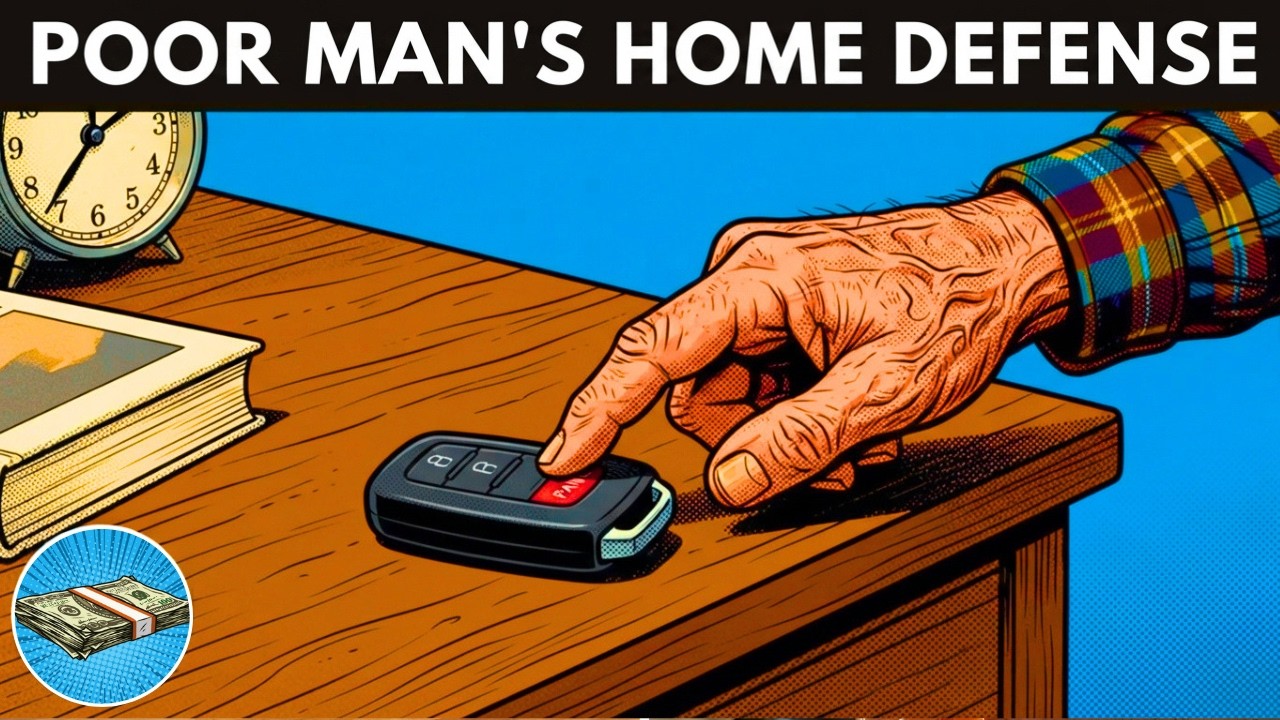
He varied his daily routine, leaving at different times, taking different routes, varying when he took out the trash and when lights went on or off. Houses get cased before they get burglarized, and breaking up the pattern, even slightly, made that planning much harder. He kept a car key fob on the nightstand and pressed the panic button at any suspicious sound, setting off a car alarm that made an enormous noise, lit up the exterior of the home, and woke the neighbors, one of the fastest ways to draw attention to a specific location at night. Each of these measures was inexpensive on its own.
The gravel, the bells, the dowel, the thorny bushes, the timers, the signage, the boots, the pins, the padlocks, the curtains drawn after dark to keep the inside of the home from becoming a display case, the small bolted safe for documents and irreplaceable items, the standalone magnetic contact sensors on doors and windows costing about two dollars each that made a loud noise when a door opened without needing a monitoring subscription, all of them were cheap or free. None required a contract. The grandfather never relied on a single barrier. He thought in layers.
The perimeter: gravel, thorny bushes, padlocked gates. The exterior: motion lights, reinforced strike plates, window pins, double-sided deadbolts. The interior: door alarms, jingle bells, the bedroom barricade bar. The power was not that any one of these things was impenetrable.
The power was that each layer added time, noise, and effort. A burglar is counting on being fast and quiet. Every additional second in the space increases the risk of being caught. Every additional noise event increases the chance of being seen.
Stack the layers, and the math works entirely against them. The master principle was simple: make the house look lived-in, watched, and not worth the trouble. Criminals are rational actors making cost-benefit calculations. They want easy targets, empty houses, dark approaches, quiet entries, no witnesses, no obstacles, no noise, no dogs, no unpredictability.
Everything the grandfather did was in service of making his home the opposite of all of that. None of it required serious money. None of it required a contract or a monthly fee.
Together, it formed a coherent approach to home defense that had protected families for generations without a single piece of technology more sophisticated than a light timer.